
Variable annuities with living benefits were designed to address this directly. They combine market participation — giving your money a chance to grow — with contractual income guarantees that don't disappear if markets turn. In theory, it's the best of both worlds.
In practice, the mechanics are more layered. Rider types, benefit bases, fee structures, and withdrawal rules interact in ways that catch many owners off guard. This guide breaks it all down in plain language so you can evaluate whether these products belong in your retirement plan.
This is especially relevant if you're a federal employee or pre-retiree weighing your income options alongside existing pension or TSP income.
TL;DR: Key Takeaways
- Variable annuities grow tax-deferred through investment subaccounts; living benefit riders add contractual income or principal guarantees
- Four main rider types exist: GMWB, GLWB, GMIB, and GMAB — each works differently and fits different income timelines
- Total annual costs can exceed 3%, including M&E charges, fund expenses, and rider fees
- The benefit base used to calculate your guarantee is not your actual account value — you cannot withdraw it as a lump sum
- Suitability depends on your risk tolerance, retirement timeline, and whether a pension or Social Security already covers your baseline income
What Is a Variable Annuity with Living Benefits?
A variable annuity is a contract between you and an insurance company. You invest a sum — either as a lump sum or through ongoing premiums — and the account value grows (or declines) based on the performance of underlying investment subaccounts, which function similarly to mutual funds. Unlike a fixed annuity, there's no guaranteed interest rate. Your balance moves with the market.
FINRA notes that variable annuities' complexity makes them a leading source of investor complaints — which says less about the products themselves and more about how poorly they're often explained before purchase.
That's where living benefit riders come in. These are optional add-ons you attach to the base annuity contract, providing a contractual floor of protection while you're alive. Depending on the rider, that protection can guarantee:
- A minimum level of income regardless of market performance
- Recovery of your original principal over time
- A minimum account value accumulation after a set period
These differ from death benefit riders, which pay out to your beneficiaries.
Adding a living benefit rider costs extra. That charge layers on top of the base annuity's existing fees — mortality and expense charges, plus fund management costs. In practical terms, you're trading a portion of upside return potential for a contractual guarantee that protects you if the market turns against you.
The Four Types of Living Benefit Riders Explained
While product names vary by insurer, living benefit riders fall into four categories. Matching the right type to your actual income needs matters far more than simply checking a box.
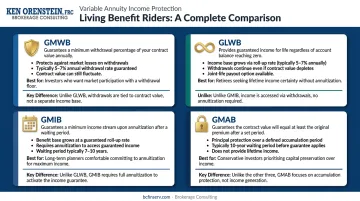
Guaranteed Minimum Withdrawal Benefit (GMWB)
A GMWB guarantees you can withdraw a fixed percentage of your original investment each year until 100% of your principal is recovered, even if the underlying investments have declined to zero.
This is principal recovery over a defined period, not lifetime income. For instance, a $50,000 investment with a 7% GMWB rate generates $3,500 per year for at least 14 years, regardless of market performance. Once you've recovered your full premium, the guarantee ends.
GMWBs suit investors who want downside protection over a set window. They're not designed for those seeking income for life.
Guaranteed Lifetime Withdrawal Benefit (GLWB)
A GLWB extends the concept to your entire lifetime. You withdraw a set percentage of your benefit base each year, and those payments continue as long as you live, even if the account value falls to zero.
Withdrawal percentages typically increase with age. SEC-filed examples show rates such as:
- 4.00% at ages 59½–64
- 5.00%–6.00% at ages 65–70
- 6.00%–7.00% at age 70+
Exact rates vary significantly by contract (these are product-specific, not universal). Joint coverage options exist for couples who need payments to continue after the first spouse dies.
Guaranteed Minimum Income Benefit (GMIB)
With a GMIB, your benefit base grows at a guaranteed minimum rate over a required holding period of 7–10 years. After that window, you can annuitize at the protected amount regardless of market performance, exchanging your account for a guaranteed lifetime income stream.
Two features set the GMIB apart from other living benefit riders:
- Full annuitization is required — you trade your account value for an income stream, and the exchange is irreversible
- Age setback provisions can reduce your annual payments by calculating payouts as if you're several years younger than you actually are
MetLife's GMIB Max V filing, for example, discloses a 10-year age setback in its annuity table calculation — worth scrutinizing before committing to annuitization.
Guaranteed Minimum Accumulation Benefit (GMAB)
The GMAB takes a different approach: it guarantees your contract value will be restored to at least 100% of premiums paid after a defined holding period (typically 10 years), regardless of market performance.
Unlike the other riders, no annuitization is required. You can take a lump sum, roll it into another product, or leave it invested. That flexibility is the GMAB's strength.
The tradeoff: a GMAB provides principal protection only. It doesn't generate guaranteed lifetime income or guard against longevity risk. Retirees who need ongoing income should consider pairing a GMAB with a GLWB or GMIB rider for more complete coverage.
Understanding What a Living Benefit Actually Guarantees
The fine print on living benefits trips up more variable annuity owners than almost any other contract detail. Understanding two specific figures — and how they interact — is the place to start.
Two Values, Two Purposes
Every variable annuity with a living benefit has two separate figures that serve entirely different functions:
- Contract value — the actual market value of your investments, available as a lump sum
- Benefit base — a separate calculated figure used only to determine the size of your guaranteed payouts
The benefit base is not money you can access. Per Insurance Compact standards, it cannot be withdrawn as a lump sum and is not payable as a death benefit. It's an insurance calculation — a number that exists solely to determine what your rider will pay.
If your benefit base is $300,000 and your contract value is $180,000, you do not have $300,000. You have $180,000 in real, accessible assets and a guarantee calculated on $300,000.
The Withdrawal Trap
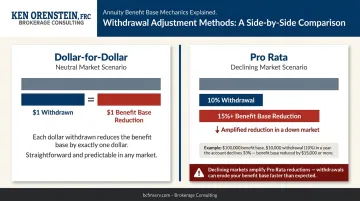
Taking money out of a variable annuity — especially early or in excess of the allowed amount — can permanently reduce your benefit base. Two adjustment methods are commonly used:
- Dollar-for-dollar: Each dollar withdrawn reduces the benefit base by one dollar
- Pro rata: Each withdrawal reduces the benefit base by the same percentage it represents of the contract value
Pro rata adjustments are particularly damaging in declining markets. If your contract value has dropped significantly and you withdraw even a modest amount, the proportional impact on the benefit base is often larger than the withdrawal itself.
Step-Up Provisions
On certain contract anniversary dates, if your account value has grown above your benefit base, the benefit base "steps up" — locking in those gains permanently. This increases your future guaranteed income.
Step-ups are what make living benefits genuinely valuable in strong markets. They let you capture upside and preserve it even if markets later reverse.
A Counterintuitive Point on Investment Strategy
Because living benefits provide a guaranteed floor, they can actually support more aggressive investing inside the subaccounts. If investments perform well, you capture gains. If they fall, the guarantee kicks in.
That creates an underappreciated mismatch: investing conservatively inside a variable annuity while paying for a living benefit rider means paying for downside protection that a conservative portfolio may already provide on its own. The rider's value is most defensible when the subaccounts are actually exposed to meaningful market risk.
The Real Cost of Living Benefit Riders
Variable annuities with living benefits carry layered fees that compound over time. Knowing the full cost picture before committing is essential — fees here can quietly erode the very protection you're paying for.
Fee Breakdown
| Fee Component | Typical Range |
|---|---|
| Mortality & Expense (M&E) charge | ~1.25% annually |
| Administrative fee | ~$25–$50/year or ~0.15% |
| Subaccount fund expenses | 0.23%–4.15% (varies by fund) |
| Living benefit rider fee | 0.94%–1.30% on average (varies by rider type) |

According to SOA/LIMRA data, 2015 GLWB issues averaged 237 basis points for M&E plus rider fees alone — before adding fund management costs. Total all-in costs regularly exceed 3% per year.
On a $250,000 account, a 1% rider fee alone equals $2,500 annually, charged regardless of investment performance.
When the Costs Are Worth It
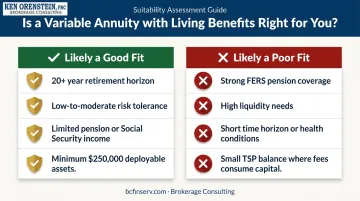
Living benefit costs may make sense when:
- You have a 20+ year retirement horizon and genuine longevity risk
- You have low risk tolerance but want market participation with a safety net
- You have limited guaranteed income from other sources — no pension, minimal Social Security
They're harder to justify when:
- You already receive robust pension income (many FERS retirees fall here)
- You have a short time horizon or health conditions that limit expected longevity
- You need full liquidity — surrender charges restrict access for years
- A simpler fixed or fixed indexed annuity would deliver comparable protection at lower cost
A Note on Advisor Compensation
High-fee products often carry high advisor commissions — which means the cost picture and the compensation picture are connected. Before purchasing, ask any advisor recommending a variable annuity what they earn on the sale and whether lower-cost alternatives were considered.
Ken Orenstein at Brokerage Consulting addresses this directly: insurance products pay commission, and that's disclosed at the outset, so clients understand the compensation model before making any decision.
Is a Variable Annuity with Living Benefits Right for You?
Factors That Support Suitability
- Low-to-moderate risk tolerance with a desire for market participation
- Retirement horizon of 20+ years (SSA data shows a 65-year-old woman has an average 20.12 additional years of life expectancy)
- Limited guaranteed income from other sources — no pension, or only partial Social Security
- Discipline to follow withdrawal rules and avoid excess distributions that damage the benefit base
- Minimum deployable assets of approximately $250,000
Scenarios Where It's Likely a Poor Fit
- Federal retirees with full FERS pensions — the pension plus Social Security may already cover baseline income needs, making the living benefit redundant and the fees unnecessary
- FERS participants with TSP balances — the 2024 TSP Annual Report shows average FERS balances of $194,131, with a median of $61,817; for those in the lower range, the cost structure of a variable annuity may consume too much of limited capital
- Individuals needing liquidity — surrender charges typically start at 7% and phase out over years, locking up funds
- Those with serious health conditions — longevity-based guarantees provide less value with a shortened time horizon
For federal employees specifically, Ken Orenstein's approach evaluates FERS pension, Social Security, and TSP income as a combined picture before any annuity recommendation enters the conversation. A variable annuity enters the picture only after those foundational income sources are accounted for.
Variable annuities with living benefits involve real complexity: fee interactions, withdrawal rules, tax implications, and surrender periods all affect outcomes. Ken Orenstein at Brokerage Consulting offers no-cost consultations for individuals, pre-retirees, and federal employees who want a clear-eyed look at whether one fits their retirement picture.
Frequently Asked Questions
What is a living benefit on a variable annuity?
A living benefit is an optional rider added to a variable annuity that guarantees a level of income, principal recovery, or accumulation protection while the annuity owner is alive. It differs from a death benefit rider, which pays beneficiaries after the owner dies.
What is a variable annuity rider fee?
A rider fee is an annual charge deducted from the annuity's contract value in exchange for the living benefit guarantee, typically ranging from 0.5% to 1.5% of the account value per year. This is in addition to base charges such as M&E fees and fund expenses.
Can variable annuities have riders?
Yes. Variable annuities commonly offer optional riders, including living benefit and death benefit riders, that can be added to the base contract for an additional annual cost.
Are living benefit riders on variable annuities worth the cost?
It depends. They tend to make sense for those with long retirement horizons, low risk tolerance, and limited guaranteed income from other sources. They're harder to justify for those with strong pension income, short time horizons, or high liquidity needs.
What is the difference between a GLWB and a GMIB?
A GLWB allows lifetime withdrawals directly from the annuity without requiring full annuitization. A GMIB typically requires the owner to irrevocably convert the contract into a lifetime income stream after a mandatory holding period, surrendering access to the lump sum in exchange for guaranteed income.