
A 65-year-old man and a 65-year-old woman buying identical contracts from the same carrier will receive different monthly checks. Someone who defers payments for a decade will receive significantly more than someone who starts immediately. This guide breaks down the actual ranges, the variables that move the needle, and real scenarios to help you figure out whether $300,000 in an annuity fits your retirement income plan.
Key Takeaways
- A $300,000 immediate lifetime annuity typically pays $1,300–$2,000/month for a 65-year-old, with amounts varying by age, gender, and payout structure
- Older buyers receive higher monthly payments because the insurer calculates over a shorter expected payout period
- Deferring 10 years before collecting often doubles or triples the monthly payout compared to starting immediately
- Payout structure (single life, joint life, period certain) directly trades monthly income against beneficiary protection
- Most retirees use $300,000 as a guaranteed income floor, paired with Social Security and investment savings
How Much Does a $300,000 Annuity Pay Per Month?
There is no single answer. The range for a 65-year-old purchasing a $300,000 immediate lifetime annuity runs roughly $1,300 to $2,000 per month, depending on gender and payout structure. Deferred annuities — where you wait years before income begins — can push that figure considerably higher.
Immediate Fixed Annuity
With an immediate fixed annuity (also called a SPIA — Single Premium Immediate Annuity), you hand over $300,000 and payments begin within roughly 30 days. Based on current market quotes from annuity.org, approximate monthly payouts for a $300,000 immediate lifetime annuity look like this:
| Age | Male (Single Life) | Female (Single Life) |
|---|---|---|
| 60 | ~$1,500/month | ~$1,400/month |
| 65 | ~$1,700/month | ~$1,580/month |
| 70 | ~$2,000/month | ~$1,850/month |
| 75 | ~$2,400/month | ~$2,200/month |
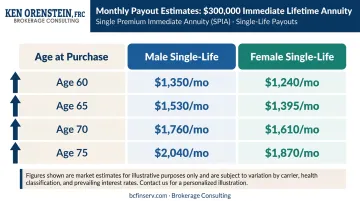
Note: These figures are estimates based on published market data. Actual quotes vary by carrier and current interest rates.
Men receive slightly higher payments because actuarial tables show shorter average life expectancy — the insurer expects to pay over fewer years. The key trade-off with immediate annuities: once you purchase, the lump sum is gone. You cannot access the principal.
Deferred Annuity
Deferring payouts lets interest compound during the accumulation phase. A 55-year-old who puts $300,000 into a deferred annuity and waits 10 years before taking income at 65 will receive more per month than someone who buys immediately at 65. That deferred payout often lands in the $2,500–$3,500/month range, depending on the guaranteed roll-up rate built into the income rider.
Three main structures to know:
- Fixed deferred — guaranteed interest rate during accumulation; most predictable payout
- Variable or fixed indexed deferred — returns tied to market or index performance; payout predictability decreases as market exposure increases
- Deferred income annuity (DIA) — no accumulation value; locks in a future income date, often producing higher payouts than SPIAs for the same premium
Variable and Index Annuities
Unlike the guaranteed structures above, variable and indexed annuities introduce market exposure — which changes the income math considerably.
- Variable annuities — monthly income tied to sub-account investment performance; payouts can rise or fall with the market
- Fixed indexed annuities (FIAs) — returns linked to an index like the S&P 500, with downside protection but participation caps that limit the upside
- Income riders on both types — a guaranteed lifetime withdrawal benefit (GLWB) rider can establish a minimum income floor even if account value drops
Without an income rider, projecting a specific monthly payout from either product before purchase isn't reliable. With one, you trade some growth potential for a defined income guarantee.
Key Factors That Affect Your Monthly Payout
Two people investing the same $300,000 can receive very different monthly checks. These are the variables that determine where you land in the range.
Age at Purchase
Insurers base payments on life expectancy. A 70-year-old receives more per month than a 60-year-old for the same $300,000 — the insurer calculates over a shorter expected payment period. The table above shows this progression clearly: from roughly $1,500/month at age 60 to $2,400/month at age 75 for a male single-life contract.
Payout Structure Selected
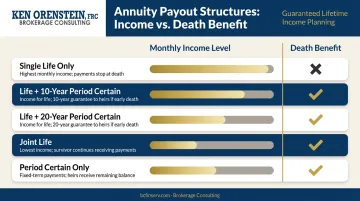
Your payout option may matter as much as your age:
| Payout Type | Monthly Amount | What Happens at Death |
|---|---|---|
| Single life only | Highest | Payments stop; no benefit to heirs |
| Life + 10-year period certain | Slightly lower | Payments continue to beneficiary for remainder of term |
| Life + 20-year period certain | Moderate reduction | Same as above, longer guarantee |
| Joint life | Lowest | Payments continue to surviving spouse |
| Period certain only | Varies | Fixed term (e.g., 20 years); payments stop when term ends |
Interest Rates at Time of Purchase
Prevailing interest rates at purchase directly affect your monthly check. Higher rate environments produce higher payouts for the same premium, and those rates lock in at signing.
If rates drop after you buy, your contract is unaffected; if rates rise, you don't benefit from the increase. Timing matters — an independent advisor can help you evaluate whether current rates justify locking in now.
Gender and Life Expectancy
Women statistically live longer, so insurers pay them less per month for the same premium. A 65-year-old woman purchasing a $300,000 single-life immediate annuity receives roughly $100–$150 less per month than a male counterpart of the same age. At age 70, that gap is similar in dollar terms but smaller as a percentage of the total payout.
Riders and Customizations
Riders customize the contract but reduce the base monthly payout because the insurer takes on additional risk. Common riders and their trade-offs:
- Cost-of-living adjustment (COLA): annual increases of 1–3% offset inflation, but your starting payment will be lower than without it
- Return of premium: your beneficiaries receive at least the original $300,000 if you die early — this guarantee meaningfully reduces monthly income
- Guaranteed Lifetime Withdrawal Benefit (GLWB): common on FIAs and variable annuities; income floor holds even if the account value drops to zero
Rider math gets complex quickly. Evaluating one means comparing the roll-up rate during accumulation, the payout multiplier at activation age, and the annual rider fee (typically 0.5–1.5% of the income base) against the guaranteed income value — numbers that vary significantly by contract and carrier. Ken Orenstein at Brokerage Consulting walks clients through this comparison before any contract is signed.
$300,000 Annuity Payout Scenarios
The same $300,000 plays out very differently based on individual circumstances.
Scenario 1: Immediate Payout at 65 (Single Retiree)
A 65-year-old male purchases a $300,000 immediate single-life annuity. Approximate monthly payment: $1,700/month, guaranteed for life with no death benefit. Payments stop at death — nothing passes to heirs — making this the highest-income option for a single retiree with no dependents.
Scenario 2: Deferred Payout — Buying at 55, Starting at 65
A 55-year-old purchases a $300,000 deferred fixed annuity with a 6% annual roll-up income rider. After 10 years of compounding, the income base grows to approximately $537,000. At age 65, assuming a 5% payout rate on the income base, monthly income comes to roughly $2,685/month — compared to $1,700/month in Scenario 1. That's nearly 60% more income for the same $300,000 investment, simply by deferring one decade.
Scenario 3: Joint Life Annuity for a Couple
A couple, both age 65, purchases a $300,000 joint lifetime annuity with 100% survivor benefit. Approximate monthly payout: $1,400–$1,500/month — lower than the single-life option because the insurer must account for two lifetimes. Payments continue at the same level for whichever spouse survives. The $200–$300/month reduction versus single-life is the cost of guaranteeing that survivor protection.
Is $300,000 Enough to Live On in Retirement?
Directly: for most retirees, no — not as a standalone income source. According to the Bureau of Labor Statistics' Consumer Expenditure Survey, Americans aged 65–74 spend roughly $4,800–$5,500 per month on average across housing, healthcare, food, and transportation. A $300,000 annuity paying $1,700/month covers roughly one-third of that.
That said, very few retirees fund retirement from a single source. The more useful framework is income stacking:
- Layer 1 — Social Security: Average benefit is approximately $1,900/month as of 2025
- Layer 2 — Pension (if applicable): FERS retirees with 30 years of service typically receive 30% or more of their high-3 salary
- Layer 3 — Annuity income: Guaranteed lifetime floor that covers essential expenses regardless of market conditions
- Layer 4 — Portfolio withdrawals: TSP, IRA, or brokerage assets for discretionary spending and emergencies
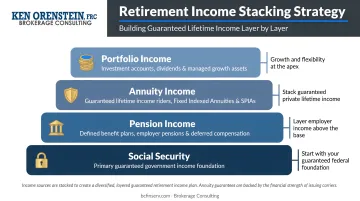
A $300,000 annuity in Layer 3 doesn't need to cover everything — it needs to cover the gap between guaranteed income sources and essential monthly expenses.
For federal employees specifically, a FERS pension and Social Security already fill Layers 1 and 2, which often means a $300,000 annuity only needs to close a modest remaining gap. Ken Orenstein at Brokerage Consulting works with federal employees to map exactly this kind of income architecture — how much guaranteed income is already in place, whether an annuity is needed, and what structure fits.
His book The Informed Fed covers TSP income strategy and retirement income planning for the federal workforce. A no-cost consultation is available by calling (888) 315-3608 or visiting bcfinserv.com.
What Most People Get Wrong About $300,000 Annuity Payouts
Most people focus on the monthly payout number — and miss three factors that determine what they actually receive and keep.
The "life only" trap. A life-only payout often shows the highest monthly figure, but payments stop entirely at death — nothing passes to a spouse or heirs. Always weigh the payout structure against what happens at death, not just what arrives monthly.
The quote isn't the contract. Online calculators give estimates based on your inputs and current market rates. The actual contract from a specific carrier may differ, and rates can shift between the time you request a quote and the day you sign — sometimes by a noticeable margin.
Tax treatment can reshape your real take-home. Annuity taxation isn't simple:
- Non-qualified annuities (funded with after-tax dollars): Only the gain portion of each payment is taxable. The return of principal is tax-free — calculated using the IRS exclusion ratio per IRS Publication 575
- Qualified annuities (funded via IRA rollover or pre-tax dollars): Every dollar of every payment is taxable as ordinary income
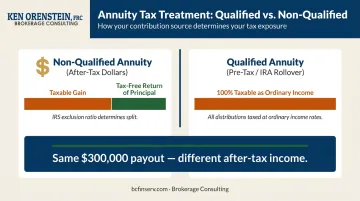
A $300,000 qualified annuity and a $300,000 non-qualified annuity may show identical monthly payouts — but produce very different after-tax income. That gap is worth calculating before you sign.
Frequently Asked Questions
How much does an annuity pay per month for different principal amounts?
Payouts scale roughly proportionally. For a 65-year-old purchasing a single-life immediate annuity: $100,000 yields approximately $550–$600/month; $300,000 yields approximately $1,600–$1,800/month; $1,000,000 yields approximately $5,400–$6,000/month. Exact amounts vary by carrier, gender, and current interest rates.
What annuity can I get with $300,000?
$300,000 can fund any major annuity type: fixed, variable, indexed, immediate, or deferred. The best fit depends on when you need income, your risk tolerance, and whether growth potential or guaranteed predictability matters more. An independent advisor can compare options across multiple carriers at once.
Can I live off the interest of $300,000?
Savings accounts and CDs at today's rates (roughly 4–5%) yield about $12,000–$15,000 per year on $300,000, or $1,000–$1,250/month before taxes. An annuity blends interest with principal return to deliver more monthly income, though most retirees treat $300,000 as one of several income sources rather than the sole one.
Should a 70-year-old buy an annuity?
Yes. Age 70 is actually an advantageous time to buy because higher age produces higher monthly payouts. Whether it makes sense depends on health status, other income sources, and whether guaranteed lifetime income is a priority.
What type of annuity pays the most from a $300,000 investment?
A deferred fixed annuity held for 10–20 years before payouts begin typically generates the highest monthly income. Among immediate options, a single-life-only payout with no period certain or death benefit delivers the highest monthly check for the same $300,000 investment.
How does buying a joint annuity affect the monthly payout from $300,000?
Adding a spouse reduces the monthly payment: often by $200–$400 compared to a single-life option, because the insurer must account for two lifetimes. The trade-off is income security for the surviving spouse, which is worth the reduction for couples who both depend on that check.