
Recent rate conditions have shifted payout estimates upward compared to the low-rate environment of 2020-2021, meaning retirees buying today may lock in meaningfully better income than those who purchased just a few years ago.
This article breaks down realistic monthly payout ranges for a $750,000 annuity, the variables that drive those figures up or down, real-world scenarios across common buyer profiles, and how to evaluate whether this structure fits your broader retirement plan.
Key Takeaways
- A $750,000 immediate annuity pays an estimated $4,294–$7,844/month for single-life structures across ages 60–80, based on 2025 quote data
- Across all payout structures, the monthly range runs from roughly $3,345 to $8,625/month
- Older buyers and men receive higher monthly payments due to shorter projected life expectancy
- Deferring income start — buying now but receiving payments later — can increase monthly payments considerably
- Joint-life and period-certain structures lower monthly income; single-life lifetime payouts maximize it
- Tax treatment, inflation erosion, and liquidity loss are the most overlooked trade-offs
How Much Does a $750,000 Annuity Pay Per Month?
There is no single answer. Monthly payouts from a $750,000 annuity vary based on annuity type, the buyer's age and gender, the interest rate environment at time of purchase, and the payout structure chosen.
Immediate Fixed Annuity Payouts
A fixed immediate annuity converts $750,000 into a guaranteed, level monthly payment starting within 30 days of purchase. It's the most predictable structure and the easiest to compare across providers.
The table below shows estimated monthly payouts for a $750,000 single-life immediate annuity by age and gender, based on 2025 estimates from CBS News citing Annuity.org/Cannex data. These are estimates — actual quotes vary by insurer, state, and market conditions.
| Age | Male (Single-Life) | Female (Single-Life) |
|---|---|---|
| 60 | $4,430/month | $4,294/month |
| 65 | $4,857/month | $4,655/month |
| 70 | $5,483/month | $5,183/month |
| 75 | $6,404/month | $5,952/month |
| 80 | $7,844/month | $7,196/month |

Source: CBS News / Annuity.org / Cannex, June 2025. Estimates only.
Deferred Annuity Payouts
Deferring income — buying today but electing to start payments years later — allows the premium to compound, producing significantly higher monthly checks when income begins.
The contrast is substantial. According to RetireGuide's December 2024 analysis, a 60-year-old woman purchasing a deferred annuity with income starting at age 70 could receive approximately $12,343/month for life — versus roughly $5,015/month if she waited until age 70 to purchase. Timing of purchase, in other words, matters as much as which product type you select.
Variable and Indexed Annuity Payouts
Variable annuities tie payouts to underlying investment performance — equity markets have historically averaged 7%–10% annually over long periods, though that's not a guarantee. Indexed annuities link growth to an index like the S&P 500 with downside protection, meaning principal is generally preserved even when markets fall. Monthly income from both structures is harder to predict upfront.
One common income structure across these products is the Guaranteed Lifetime Withdrawal Benefit (GLWB). Key parameters to understand:
- Withdrawal rate: Typically 5.00% annually for single life at ages 65–69, per Fidelity's published GLWB parameters
- Monthly estimate: On a $750,000 benefit base, that works out to approximately $3,125/month before contract fees
- Tradeoff: Generally lower than a comparable SPIA, but the contract retains market participation potential
Joint Life vs. Single Life Payouts
A joint-life annuity covers two people and continues payments until the second spouse dies — a meaningful protection, but one that lowers the monthly check.
Using the same 2025 CBS data, a 65-year-old male purchasing a single-life annuity receives an estimated $4,857/month. The same $750,000 structured as a joint-life annuity for a 65-year-old couple drops to approximately $4,212/month — roughly $645 less per month in exchange for continued income after the first spouse dies.
Key Factors That Affect Your Monthly $750,000 Annuity Payout
Insurers calculate payouts using a combination of actuarial, financial, and contractual variables. Each factor below can move your monthly check by hundreds of dollars — sometimes more.
Age and Life Expectancy
Older buyers receive higher monthly payments because insurers project fewer years of payouts. The CBS data makes this concrete: a 75-year-old male receives an estimated $6,404/month versus $4,857/month for a 65-year-old — a difference of over $1,500/month for the same $750,000 premium.
Interest Rates at Purchase
Prevailing interest rates directly influence payout levels. When rates are higher, insurers can invest premiums at better yields and pass more income to annuitants.
CANNEX's historical pricing data shows that a 65-year-old male SPIA payout rate averaged 6.65% in July 2022 (a rate shock environment) versus a low of 5.53% in August 2020. Locking in during a favorable rate environment can improve lifetime income by a measurable margin.
Payout Structure and Period
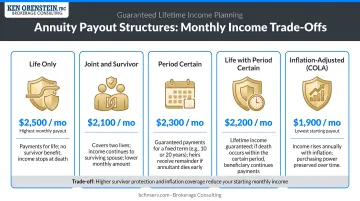
Common payout structures include:
- Single-life lifetime — highest monthly payment, no residual to heirs
- Life with 10-year period certain — payments continue to beneficiaries if you die within 10 years
- Life with 20-year period certain — same concept, longer guarantee window, lower payment
- Joint-life — covers both spouses, lower monthly amount
- Period-certain only — payments for a fixed number of years regardless of survival
Adding a joint-life or period-certain feature typically reduces the starting monthly check by 5–15%, depending on the guarantee length.
Gender
Women statistically live longer than men. According to the SSA 2021 period life table, a 65-year-old woman has a remaining life expectancy of 19.35 years versus 16.67 years for a 65-year-old man — a 2.68-year gap. Insurers price this difference into monthly payments, which is why same-age women receive lower monthly checks.
Riders and Customizations
Optional add-ons reduce the base monthly payout in exchange for added protection:
- COLA rider (3% annual increase): A 65-year-old male might receive $550/month on a $100,000 annuity without this rider, versus $450/month with it — an 18.2% lower starting payment, according to ImmediateAnnuities.com
- Inflation-adjusted SPIA: Starting income runs lower, then steps up annually — useful if your expenses are expected to grow in retirement
- Enhanced death benefit: Guarantees heirs receive any unspent premium, which lowers the monthly payment in exchange for that legacy protection
- Annuity laddering (a structural strategy, not a rider): Splitting the $750,000 across immediate and deferred annuities — one tranche pays income now, the other grows and activates later
$750,000 Annuity Payout Scenarios
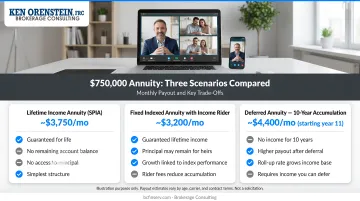
Real-world examples make the numbers concrete. All figures below are sourced from current market estimates and clearly labeled as such.
Scenario 1: Immediate Income at 65 — Single Life Male
A 65-year-old man purchases a $750,000 immediate fixed annuity with a single-life lifetime payout. Based on 2025 CBS/Cannex estimates, he receives approximately $4,857/month — roughly $58,284/year — for life.
This structure maximizes monthly income. The trade-off: no residual benefit to heirs. If he dies at 72, the insurer retains the remaining funds unless a period-certain or refund feature was added.
Scenario 2: Deferred Annuity for Higher Future Income
A 60-year-old purchases a $750,000 annuity today with income starting at age 70. Based on RetireGuide's 2024 illustration, this produces approximately $12,343/month at age 70 — more than double the roughly $5,015/month available to someone who waits and buys at 70 with the same premium.
The difference comes from compounding during the deferral period and a shorter projected payout horizon beginning at 70. This strategy suits pre-retirees who have other income bridging the gap and want to maximize future guaranteed income.
Scenario 3: Joint-Life Annuity for a Couple
A couple, both age 65, purchase a $750,000 joint-life immediate annuity. Based on 2025 CBS data, the estimated monthly payout is approximately $4,212/month, compared to $4,857/month for a single-life policy on the male spouse.
The $645/month reduction buys income continuation for whichever spouse survives. For couples without a pension, this structure functions like one: guaranteed income neither spouse can outlive.
How the Three Scenarios Compare
| Scenario | Buyer Profile | Est. Monthly Payout | Key Trade-off |
|---|---|---|---|
| Immediate, Single Life | Male, age 65 | ~$4,857/mo | No heir benefit; income stops at death |
| Deferred Income | Age 60, income at 70 | ~$12,343/mo | Must bridge 10 years without this income |
| Joint Life | Couple, both age 65 | ~$4,212/mo | Lower monthly payout; both spouses covered |
Is a $750,000 Annuity Worth It?
The honest answer: it depends on what problem you're trying to solve.
Annuities work best for retirees who:
- Have no pension and need predictable income to cover fixed expenses
- Are concerned about outliving savings (longevity risk)
- Want to reduce sequence-of-returns risk on their investment portfolio
- Are converting a lump sum — TSP rollover, pension buyout, or inheritance — into income
Key trade-offs to weigh honestly:
- Liquidity: Once purchased, most annuity contracts offer limited or no access to the principal. A $750,000 commitment is largely irrevocable.
- Taxes: If funded with pre-tax dollars (IRA or 401(k) rollover), every dollar of monthly income is taxable as ordinary income. At a 22% marginal rate, a $4,500/month payment nets roughly $3,510/month after federal tax — meaningfully less than the gross figure.
- Inflation: A fixed $4,500/month today loses purchasing power over a 20-year retirement. At 3% annual inflation, that same payment has the spending power of approximately $2,491/month in today's dollars by year 20, per Blueprint Income's published inflation projections.
A $750,000 annuity is rarely a standalone retirement solution. It works best as one layer in a multi-income strategy — alongside Social Security, investment accounts, and potentially a pension.
Ken Orenstein at Brokerage Consulting structures annuities as Layer 3 in a retirement income architecture: beneath Social Security and pension income, but above discretionary portfolio assets. The goal is ensuring essential expenses are fully covered before any growth assets are touched. Evaluating fit, tax structure, and annuity laddering strategy with an advisor before committing is the step most retirees skip — and the one that most often determines whether the annuity becomes an asset or a constraint.
What Most People Miss About $750,000 Annuity Payouts
The Tax Impact on Net Income
The gross monthly figure gets most of the attention. Net income after taxes is what actually matters.
If the $750,000 comes from a traditional IRA or 401(k) rollover, every dollar of annuity income is taxable as ordinary income under IRS Topic 410. At a 22% marginal rate, a $4,857/month payment produces roughly $1,068 in federal taxes, netting approximately $3,789/month. At 24%, the tax bite is larger.
Nonqualified funding (after-tax dollars) is treated differently: only the earnings portion is taxable, with the cost-basis portion returned tax-free. The structuring decision — qualified versus nonqualified — can shift net monthly income by hundreds of dollars.
Inflation Erodes Fixed Payments Over Time
A fixed monthly payment sounds stable. Over a 20-year retirement, it isn't.
At 3% annual inflation, $4,500/month today has the purchasing power of roughly $2,491/month in 20 years. That's a 44% reduction in real terms. Options to address this:
- Add a COLA rider (3% annual increase starts lower but compounds upward)
- Keep inflation-sensitive assets — equities, real estate — in the discretionary portfolio
- Use annuity laddering to activate additional income tranches in later years
Quote Variation Across Insurers Is Larger Than Most People Expect
CANNEX's historical pricing data shows best-to-worst provider spreads that most buyers never anticipate:
| Market Condition | Quote Spread (Best vs. Worst Carrier) |
|---|---|
| Normal periods | ~10% |
| July 2022 spike | 33.7% |
| DIAs, 20-year deferral | ~50% |
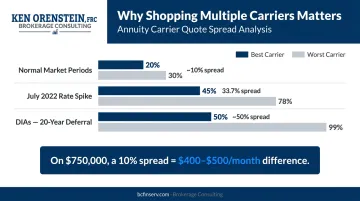
On a $750,000 premium, even a 10% spread equals $400–$500 per month in income. That gap compounds over a lifetime. Comparing multiple carriers before purchasing is how you capture the higher end of that range.
Frequently Asked Questions
How much income will a $750,000 annuity generate per month?
Based on 2025 estimates, a $750,000 immediate annuity pays roughly $4,294–$7,844/month for single-life structures across ages 60–80. Across all structures including period-certain and joint-life, the broader range runs approximately $3,345–$8,625/month. Age, gender, annuity type, and payout structure all determine where you land.
Does age affect how much a $750,000 annuity pays monthly?
Age is one of the most significant factors. A 75-year-old receives roughly $6,404/month while a 65-year-old receives approximately $4,857/month for the same $750,000 single-life structure — because the insurer expects fewer years of payments. Younger buyers receive less monthly but often benefit more from deferral strategies.
What is the difference between a fixed and variable $750,000 annuity payout?
A fixed annuity guarantees the same payment every month regardless of market conditions. A variable annuity's payments fluctuate based on underlying investment performance — potentially higher over time, but less certain. Fixed is more predictable; variable offers market participation with corresponding risk.
Are monthly payments from a $750,000 annuity taxable?
If funded with pre-tax dollars — traditional IRA or 401(k) rollover — all payments are taxed as ordinary income. If funded with after-tax money, only the earnings portion is taxable; the principal returns tax-free. A financial advisor can help structure the funding source to minimize your tax exposure.
Is a $750,000 annuity a good retirement strategy?
For retirees concerned about outliving their savings, a $750,000 annuity can provide guaranteed, predictable income. It works best alongside a broader plan that covers liquidity needs, inflation, and Social Security coordination — not as a standalone solution.
Can you lose money with a $750,000 annuity?
Fixed and fixed-indexed annuities protect principal from market losses. Variable annuities carry more risk — poor subaccount performance can reduce contract value. For lifetime payout structures, dying early means the insurer retains remaining funds unless you added a period-certain or return-of-premium rider at purchase.