
That's not a reason to panic. It's a reason to think clearly.
This guide breaks down both options honestly: what you actually get, what you give up, and the specific factors that should drive your decision. There's no universal right answer here—only the right answer for your health, income, family, and risk tolerance.
Key Takeaways
- A lump sum gives you full control over a large pool of capital but shifts all investment and longevity risk onto you.
- Pension annuities deliver guaranteed income for life with no investment management required, but offer little flexibility once started.
- Your health, existing income sources, risk tolerance, and life expectancy determine which option wins for you.
- In today's higher interest rate environment, lump sum values are meaningfully lower than they were in 2021—making annuities comparatively more attractive.
- A hybrid approach—rolling part of your payout into an IRA while converting the rest to guaranteed income—balances flexibility with financial security.
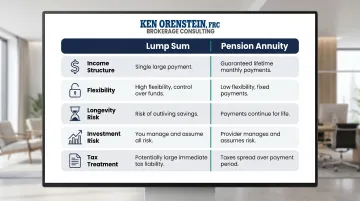
Lump Sum vs. Annuity: Quick Comparison
Here's how the two options stack up across the factors that matter most in retirement planning:
| Factor | Lump Sum | Pension Annuity |
|---|---|---|
| Income structure | One-time payment; you invest and manage it | Fixed monthly payments for life (or set term) |
| Flexibility | Full access to capital; can leave to heirs | Principal locked in; minimal access after start |
| Longevity risk | You bear it entirely | Transferred to insurer or pension fund |
| Investment risk | Entirely yours | None—payments are fixed |
| Tax treatment | Direct receipt triggers immediate income tax; rollover defers taxes | Taxed as ordinary income each year, spread over time |
What Is a Lump Sum Pension Payout?
A lump sum is a single distribution of your entire accumulated pension benefit. It can be paid directly to you or rolled into a traditional IRA or qualified retirement plan. One factor that dramatically affects how much you actually receive: interest rates.
How Interest Rates Affect What You Receive
The IRS sets segment rates under IRC Section 417(e)(3)(D) that pension plans use to calculate lump sum present values. Higher rates produce lower lump sums — and the difference can be substantial.
Milliman calculated that a hypothetical lump sum for a 51-year-old with a $1,000/month benefit dropped from $116,800 in November 2021 to $66,300 in November 2022 — a 43% decline in just 12 months, driven by IRS first-segment rates climbing from 1.02% to 5.09%. As of March 2026, those segment rates stand at 4.24% / 5.35% / 6.25%, meaning today's lump sum offers are significantly lower than they were three years ago.
Core Benefits
- Complete control over how the money is invested
- Ability to leave remaining assets to any heirs
- Option to deploy funds toward large expenses or debt payoff
- Flexibility to pursue a Roth conversion strategy over time
Primary Risks
- Risk of outliving your money if investments underperform or withdrawals run too high
- No built-in inflation protection unless you deliberately construct it
- Significant tax hit if not rolled over properly — specifically, if taken as cash rather than rolled into a qualified account
What Is a Pension Annuity?
A pension annuity is a contractual income stream—either from your employer's pension plan or purchased from an insurance company—that pays a set amount each month for life or a defined period.
Common Annuity Structures
Different structures affect your monthly payment significantly:
- Single-life: Highest monthly payment; stops at your death
- Joint-and-survivor (50% or 100%): Lower monthly payment; continues for a surviving spouse at the elected percentage
- Term-certain: Guarantees payments for a set period (10 or 20 years) regardless of when you die; beneficiaries receive remaining payments if you die early
Core Advantages
- Longevity protection—payments continue no matter how long you live
- No investment decisions or portfolio management required
- Predictable monthly income that covers fixed expenses like housing and healthcare
Trade-Offs Worth Understanding
- Access to your principal is extremely limited once you annuitize
- Early death can mean collecting far less than the lump sum equivalent—a real risk for heirs
- Without a cost-of-living adjustment (COLA), inflation chips away at your purchasing power across a 20+ year retirement
That trade-off picture looks different for everyone—which is why comparing it directly against a lump sum matters.
Key Factors to Consider When Choosing
This isn't a pure math problem. The right answer requires layering personal health, finances, family situation, and risk preferences together.
Health and Life Expectancy
The longer you live, the more valuable a lifetime annuity becomes. CDC data puts life expectancy at age 65 at 19.7 years for the total population—20.8 years for women, 18.4 years for men.
The critical concept here is the break-even age: the point at which cumulative annuity payments surpass the lump sum plus what it could have earned invested.
Example: Suppose you're offered a $300,000 lump sum or $1,500/month ($18,000/year) annuity at age 65.
- At an 18-year life expectancy, total annuity payments = $324,000. The lump sum only needs to earn roughly 0.6% annually to match that.
- If you live to 90, the required return rises to about 3.2% to keep pace.
- If you live to 95, it rises to roughly 4.1%.

Shorter expected lifespan? The lump sum may deliver more total value. Excellent health and family longevity? The annuity becomes harder to beat.
Risk Tolerance and Investment Experience
Taking a lump sum requires real discipline: invest prudently, manage withdrawals, and avoid depleting principal during market downturns. Retirees uncomfortable with volatility—or without a qualified advisor guiding them—face significant risk with this path. Experienced investors working with an advisor may generate returns that match or exceed the annuity's implied rate, but that outcome is far from guaranteed.
Existing Income Sources
Map your guaranteed income before deciding anything. The average Social Security retirement benefit is $2,071/month as of January 2026 (SSA). If Social Security already covers your essential expenses, an annuity may duplicate coverage you already have—making a lump sum for growth or discretionary use more logical. When guaranteed income is thin, an annuity becomes a critical baseline, not optional.
Survivor and Family Considerations
Married? The choice gets more complex. A joint-and-survivor annuity protects your spouse at the cost of a lower monthly payment. A single-life annuity maximizes income but leaves your spouse unprotected after your death.
One strategy to evaluate: compare the joint annuity payment reduction against the cost of purchasing equivalent term or permanent life insurance. In some cases, taking the higher single-life payment and buying life insurance to protect your spouse produces better total value. Ken Orenstein at Brokerage Consulting can run this side-by-side analysis using products from multiple carriers.
Situational Recommendations
| Choose the Annuity If... | Choose the Lump Sum If... |
|---|---|
| You're in good health with longer life expectancy | You have a serious health condition or shorter outlook |
| You lack significant other guaranteed income | Social Security and other income already cover essentials |
| You prioritize simplicity and predictability | You want estate planning flexibility and heirs in mind |
| You're risk-averse or prefer not to manage investments | You're a disciplined investor or work with a trusted advisor |
A hybrid approach often makes sense: roll part of the benefit into a traditional IRA for growth and flexibility, and use part to purchase a private immediate annuity (SPIA) for guaranteed income. This structure gives you both a safety floor and investable capital.
Federal employees note: FERS and CSRS do not offer a traditional lump sum pension election. Your defined-benefit annuity is essentially mandatory unless you forfeit it entirely by requesting a refund of contributions. The lump sum vs. annuity decision for federal employees primarily applies to TSP distributions. Ken Orenstein—a Federal Retirement Consultant and author of The Informed Fed—specializes in helping federal workers navigate the precise terms of FERS, CSRS, and TSP decisions that generic advisors often misread.
Tax Implications and Rollover Rules You Need to Know
Taking the Lump Sum Directly
If your pension distributes the lump sum directly to you (rather than via a trustee-to-trustee transfer), the full taxable amount gets added to your income in that year. A mandatory 20% federal withholding applies immediately. This doesn't mean your tax bill is exactly 20%—it gets reconciled when you file—but a large distribution can push you into a significantly higher bracket for that year.
There's a cascade risk most people miss: a large lump sum can:
- Push Social Security benefits into the 85% taxable range (above $34,000 single / $44,000 married filing jointly in combined income)
- Trigger Medicare IRMAA surcharges on Parts B and D with a two-year lookback
- Generate a substantial one-time tax bill that erodes the lump sum's apparent value
The Direct Rollover Advantage
A trustee-to-trustee rollover—where the pension plan transfers funds directly to a traditional IRA—avoids the 20% mandatory withholding and defers all taxes. Rolling into a Roth IRA is also allowed, but the taxable portion must be included in gross income for the conversion year. That can be a smart long-term strategy but requires careful tax planning.
Annuity Taxation
Pension annuity payments funded entirely with pre-tax contributions are fully taxable as ordinary income each year. If you made after-tax contributions, a portion of each payment may be excludable under the exclusion ratio.
Spread across decades, this annual tax treatment creates a lower single-year burden than a lump sum hit. It still adds to total income, though, which can affect Medicare premiums and Social Security taxability.
RMD Rules You Can't Ignore
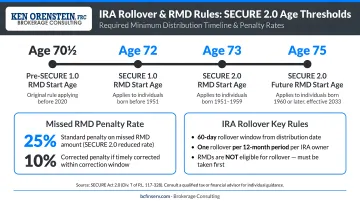
A lump sum rolled into a traditional IRA doesn't eliminate Required Minimum Distributions—it just restructures them. Under SECURE 2.0, RMDs begin at age 73, rising to 75 for those born in 1960 or later. Missing an RMD triggers a 25% excise tax (reducible to 10% if corrected within two years).
Pension annuity payments generally satisfy RMD requirements automatically. Roth IRAs have no lifetime RMDs, meaning inherited balances can continue growing tax-free — a meaningful advantage when comparing rollover paths. Qualified Longevity Annuity Contracts (QLACs) inside an IRA can further reduce RMD obligations while providing late-retirement income. Ken Orenstein at Brokerage Consulting works through these options with clients during retirement income planning consultations.
Conclusion
This decision comes down to your health, income needs, family circumstances, risk tolerance, and tax situation—and for most people, it's permanent.
The readers who make this choice well are the ones who model the scenarios before committing: break-even analysis, survivor impact, tax cascade risk, and how the decision fits into their full retirement income architecture.
Because this decision compounds over decades, it deserves more than a gut call. Ken Orenstein and the team at Brokerage Consulting offer no-cost initial consultations—by phone, virtually, or in person in Flemington, NJ—to help you stress-test the numbers against your specific situation.
Federal employees, in particular, benefit from working with someone who understands FERS, CSRS, and TSP distribution rules at a detailed level, not just in general terms.
To get started, visit bcfinserv.com/request-a-quote or call (888) 315-3608.
Frequently Asked Questions
Should I take my pension as a lump sum or an annuity?
The right choice depends on your health, life expectancy, existing income, and risk tolerance. Most people benefit from comparing their break-even age and current guaranteed income sources before deciding — a no-cost consultation can help clarify which option fits your situation.
What is the 6% rule for lump sum pension?
The 6% rule is a practitioner guideline: divide your annual pension payment by the lump sum offer. If the result is 6% or higher — for example, $18,000/year on a $300,000 offer — the annuity is generally considered more competitive, especially for retirees with longer life expectancies.
Can I roll over my 401(k) or IRA into an annuity, and is that taxable?
Yes. A direct trustee-to-trustee rollover moves qualified funds (401(k), IRA) into an annuity without immediate tax consequences. Taxes apply only when you begin receiving income payments — spread across the payment period rather than taken all at once.
Are retirement account rollovers taxable, and will they generate a 1099-R?
A direct rollover is not taxed immediately, but you will receive a Form 1099-R (Code G for non-Roth direct rollovers). If you took the distribution personally first, mandatory 20% withholding applies and the full amount must be redeposited within 60 days to avoid taxes and penalties.
What mistakes should I avoid when rolling over into an IRA or annuity?
The most common pitfalls include:
- Missing the 60-day rollover deadline
- Skipping the direct trustee-to-trustee transfer (triggering withholding)
- Rolling pre-tax funds into a Roth without accounting for the immediate tax bill
- Not reviewing the financial strength ratings of an annuity carrier before committing