
Here's what most beneficiaries don't know going in: inherited non-qualified annuities are not fully taxable. Because the original owner funded the contract with after-tax dollars, only the accumulated earnings — not the original principal — are subject to ordinary income tax. That single distinction changes every decision you need to make.
This article covers how the taxes actually work, a clear comparison of your distribution options and their consequences, how a 1035 exchange can defer taxes into the future, and practical steps to build a tax-efficient strategy before you touch the money.
Key Takeaways
- Only the earnings (growth) in an inherited non-qualified annuity are taxable — the original principal comes back to you tax-free
- You have four main distribution options: lump-sum, five-year rule, annuitization, and nonqualified stretch — each with different tax timing
- The nonqualified stretch spreads taxes over your life expectancy — but must be elected within one year of the original owner's death
- A 1035 exchange lets you transfer the inherited contract into a better-suited annuity without triggering taxes at transfer
- Given the one-year deadline and the permanence of some elections, acting quickly and consulting a qualified advisor is essential
What Makes an Inherited Non-Qualified Annuity Different
A non-qualified annuity is a contract between an individual and an insurance company, funded with after-tax dollars and held outside any retirement account like an IRA or 401(k). When you inherit one, you step into the role of contract owner — receiving not just a payout, but the actual policy with all its terms, riders, and features.
The Cost Basis Distinction
Because the original owner already paid income tax on their contributions, that cost basis — the total premiums paid — comes back to you tax-free. Only the growth inside the contract is taxable as ordinary income upon distribution.
Compare this to a qualified (IRA-held) annuity, where the entire distribution is taxable because the owner contributed pre-tax dollars. For non-qualified beneficiaries, that difference can reduce the taxable portion of an inheritance by a significant margin — sometimes by half or more, depending on how long the contract was held.
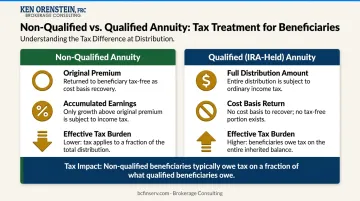
Here's how the two contract types compare at distribution:
- Non-qualified annuity: Only accumulated earnings are taxable; the original premium basis is returned tax-free
- Qualified (IRA-held) annuity: The full distribution amount is taxable as ordinary income
- Tax impact: Non-qualified beneficiaries typically owe income tax on a fraction of what qualified beneficiaries owe
Why This Isn't an Inherited IRA
Inherited non-qualified annuities are governed by IRC Section 72(s) — not by the SECURE Act rules that apply to qualified plans. Most non-spouse IRA beneficiaries are now required to fully deplete inherited accounts within 10 years. That rule does not apply to non-qualified annuities. The governing rule here — Section 72(s) — allows life-expectancy-based stretch distributions, giving beneficiaries more time to spread out taxable income and manage their annual tax exposure.
How Inherited Non-Qualified Annuity Taxes Actually Work
The LIFO Rule: Gains Come Out First
For any withdrawals taken before the contract is annuitized, the IRS applies a Last In, First Out (LIFO) rule under IRC Section 72(e). Every dollar you withdraw comes from accumulated earnings first — and is fully taxable as ordinary income — until all gains have been distributed. Only after the earnings are exhausted does the tax-free principal start flowing back.
This front-loads your tax burden. A beneficiary who takes systematic withdrawals will pay taxes on every dollar until the entire gain is recovered, no matter the withdrawal amount.
The Exclusion Ratio: A Better Approach
When the contract is annuitized — converted into a stream of regular payments — a different, more favorable rule applies. Each payment is treated as partly a return of principal (tax-free) and partly a return of earnings (taxable). The formula:
Exclusion Ratio = Cost Basis ÷ Total Expected Payments
This spreads tax liability evenly across every payment, rather than front-loading it. For beneficiaries with significant accumulated gains, annuitization is generally more tax-efficient than LIFO-based systematic withdrawals.
The Bracket Impact of a Large Distribution
The distribution method you choose doesn't just determine how evenly taxes are spread — it can determine which bracket you land in entirely.
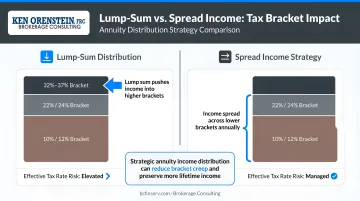
Annuity earnings are taxed as ordinary income, not at the lower capital gains rate. A large or poorly timed distribution can push you into a significantly higher bracket. Consider this example:
| Scenario | Taxable Income | Federal Bracket (2024, Married Filing Jointly) |
|---|---|---|
| Base income only | $80,000 | 22% |
| Base income + $150,000 lump-sum gain | $230,000 | 32% (on income above $201,050) |
That 10-percentage-point bracket jump is entirely avoidable with a structured distribution plan. Spreading withdrawals across multiple tax years — or annuitizing — keeps more of the gain in lower brackets.
The 10% Penalty Exemption
If you're under age 59½, you may be worried about the 10% early withdrawal penalty that normally applies to annuity distributions. IRC Section 72(q)(2)(B) specifically exempts distributions made on or after the death of the contract holder from this penalty. Your age as the beneficiary is not the controlling factor — the death of the original owner triggers the exemption.
Your Distribution Options and Their Tax Consequences
Each option carries different tax timing, flexibility, and long-term consequences. Before choosing, know three things: the contract's cost basis, its current value, and your own tax bracket.
Lump-Sum Distribution
The entire contract value is paid at once. The full accumulated gain becomes taxable ordinary income in the year received — no spreading, no deferral.
- Tax impact: Highest immediate burden; greatest risk of bracket creep
- When it makes sense: Urgent capital need, or when the gain in the contract is minimal
- When to avoid: Almost always, if any other option is available
Five-Year Rule
Non-spouse beneficiaries who don't elect the nonqualified stretch must distribute the full contract value within five years of the original owner's death. There are no required annual minimums — you can time distributions as you choose within that window. But LIFO still applies, meaning gains come out first and are fully taxable until exhausted.
- Tax impact: Moderates the burden versus a lump sum, but compresses taxable income into a short window
- Flexibility: High within the five-year period
- Key risk: Missing the stretch election window forces you here by default
Annuitization
Converting the contract into a regular income stream (either for a fixed period or for your lifetime) activates the exclusion ratio. A portion of each payment is tax-free; only the earnings portion is taxable. This is one of the more tax-efficient payout methods available.
Critical caveat: Annuitization is irrevocable. Once elected, you cannot access the full contract value as a lump sum, even if your financial circumstances change dramatically. A financial advisor can model the income projections against your alternatives before you commit to this path.
Nonqualified Stretch (Life Expectancy Method)
Under IRC Section 72(s)(2), distributions are taken annually based on your remaining life expectancy. Each year, divide the contract's account value by your remaining life expectancy factor; that factor decreases by one each subsequent year. Key advantages of this method:
- Keeps annual taxable income lower than lump-sum or five-year approaches
- May preserve a more favorable tax bracket year over year
- Allows continued tax-deferred growth on undistributed gains
The deadline most beneficiaries miss: Distributions must begin no later than one year after the original owner's death. The IRS enforces this strictly. In PLR 201532026, the IRS required a non-spouse beneficiary to distribute under the five-year rule after payments didn't start within one year.
Miss this window and you lose the stretch permanently.
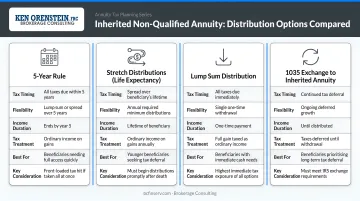
This time-sensitive decision is one of the most important reasons to contact a financial advisor immediately after inheriting, not weeks later.
Using a 1035 Exchange to Defer Taxes
What a 1035 Exchange Does
Under IRC Section 1035(a)(3), a beneficiary can transfer an inherited non-qualified annuity directly into a new non-qualified annuity contract on a tax-free basis. The accumulated gains don't become taxable at transfer — they carry over into the new contract and are only taxed upon future distributions.
The IRS confirmed this treatment in PLR 201330016 (July 26, 2013), holding that a direct transfer of inherited contract values into a new annuity qualified as a Section 1035 exchange. PLRs apply only to the requesting taxpayer and are not binding precedent, but the ruling offers practical guidance on how the IRS views this structure.
When a 1035 Exchange Makes Sense
Consider an exchange when the inherited contract's current terms don't align with your goals:
- High annual fees eroding growth (common with older variable annuities)
- Below-market credited rates on fixed contracts
- Poor investment options or outdated crediting methods
- Unfavorable payout provisions or missing income riders
A 1035 exchange lets you move into a contract with better features — lower expenses, improved income riders or guaranteed lifetime withdrawal benefits, or different investment options — without triggering an immediate tax bill. The original cost basis and tax-deferred status carry over into the new contract.
Key Rules and Common Mistakes
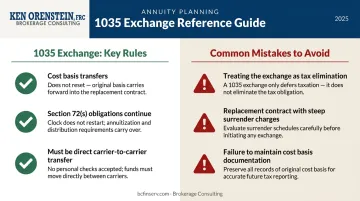
Three rules that catch beneficiaries off guard:
- Cost basis transfers to the new contract — it does not reset to current value
- The Section 72(s) distribution obligations (five-year or stretch) continue — the clock does not restart
- The exchange must be annuity-to-annuity; taking a check and endorsing it to a new carrier does not qualify and creates an immediate taxable event (Rev. Rul. 2007-24)
Mistakes to avoid:
- Treating a 1035 exchange as tax elimination — it defers taxes, it does not eliminate them
- Moving into a replacement contract with steep surrender charges that limit flexibility
- Failing to maintain proper cost basis documentation through the transfer
If you've inherited a contract with high fees or poor payout terms, a 1035 exchange may be worth analyzing before accepting the current structure. Ken Orenstein at Brokerage Consulting works through these comparisons directly — reviewing fees, payout provisions, and replacement contract options relative to the beneficiary's income timeline and tax situation.
Spousal vs. Non-Spouse Beneficiaries: Key Tax Differences
The rules differ significantly depending on your relationship to the original owner.
Surviving spouses have a unique advantage: under IRC Section 72(s)(3), a surviving spouse is treated as the new holder of the contract. This means they can:
- Continue the annuity as their own with no immediate distribution required
- Name their own beneficiaries going forward
- Begin or continue income payments on their own timeline
This is typically the most favorable option for spouses from both a tax and flexibility standpoint.
Non-spouse beneficiaries — adult children, siblings, other named individuals — cannot continue the contract as their own. They must choose among the available distribution options (lump-sum, five-year, annuitization, or nonqualified stretch) and are subject to the one-year stretch election deadline.
Younger non-spouse beneficiaries with longer life expectancies tend to benefit most from the stretch option, since it maximizes deferral across more years.
When multiple non-spouse beneficiaries are named, planning becomes more layered. Each can generally elect their own distribution method, but the execution requires careful administration:
- Independent life expectancy elections: Each beneficiary calculates stretch distributions using their own life expectancy — provided separate inherited contracts are properly established
- Carrier coordination: Contract provisions vary by insurer and directly affect how the contract is split, timed, and administered — failing to coordinate early can jeopardize stretch eligibility
Steps to Build a Tax-Efficient Inheritance Strategy
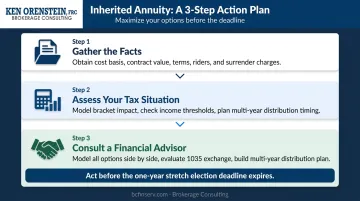
Three steps can help you protect more of what you've inherited from unnecessary taxes.
Step 1 — Gather the facts immediately. Contact the insurance company to obtain:
- The original owner's cost basis (total premiums paid)
- The current contract value
- A full review of contract terms, riders, surrender charges, and payout options
The sooner this information is in hand, the more options remain available — especially given the one-year stretch deadline.
Step 2 — Assess your tax situation before taking any action. Determine your current marginal tax bracket and model how different distribution amounts would affect your annual tax liability. Pay close attention to income thresholds that could affect Medicare premiums or other income-tested benefits — spreading distributions across multiple tax years can lower your effective rate considerably.
Step 3 — Consult a financial advisor before making any irrevocable elections. Decisions like annuitization, electing or missing the stretch, or initiating a 1035 exchange can't be undone. A qualified advisor can:
- Model the tax impact of each distribution option side by side
- Evaluate whether a 1035 exchange into a better-suited contract makes sense
- Build a multi-year distribution plan that minimizes overall tax exposure
Ken Orenstein at Brokerage Consulting offers no-cost initial consultations — available by phone, virtually, or in person — for beneficiaries navigating inherited annuity decisions. Contact his office at (888) 315-3608 or visit bcfinserv.com to schedule.
Frequently Asked Questions
What is the best thing to do with an inherited non-qualified annuity?
For most beneficiaries, avoiding a lump-sum distribution saves significantly on taxes. The nonqualified stretch and 1035 exchange are the most tax-efficient paths — but the stretch election deadline is one year from the owner's death, so consult an advisor promptly after inheriting.
Are inherited non-qualified annuities taxable?
Yes — but only the earnings (growth) portion is taxable as ordinary income. The original principal is returned tax-free because the original owner funded the contract with after-tax dollars. The taxable amount depends on how much the contract grew beyond what was originally contributed.
Can you do a 1035 exchange with an inherited non-qualified annuity?
Yes, but the transfer must go directly between carriers — taking a personal check disqualifies the exchange. The exchange defers taxes rather than eliminating them, and Section 72(s) distribution obligations carry over to the new contract.
What is the five-year rule for inherited non-qualified annuities?
Non-spouse beneficiaries who don't elect the nonqualified stretch must fully distribute the inherited annuity within five years of the original owner's death. LIFO applies — gains are distributed and taxed first. There are no required annual minimums; you can time distributions within the five-year window as you choose.
Do I have to pay taxes immediately when I inherit a non-qualified annuity?
No. Simply inheriting the annuity does not trigger a tax event. Taxes are only owed when distributions are taken. Electing the nonqualified stretch, annuitizing, or executing a 1035 exchange all allow you to defer taxes until future distributions occur.
What happens if there are multiple beneficiaries on an inherited non-qualified annuity?
Each beneficiary can generally elect their own distribution method and use their own life expectancy for stretch calculations — provided the contract is split into separate inherited contracts. Coordinating with the insurance carrier early is essential, as each contract's provisions govern how multiple beneficiaries are administered.