
What happens in the next 30 days or so can determine whether your retirement savings continue working efficiently or trigger an unexpected tax bill, lock you into below-market rates, or quietly hand control back to the insurer through automatic renewal.
This guide covers exactly what annuity maturity means, the four main paths available to you, how renewal rates and bailout provisions work, tax consequences to weigh, and how to choose the right option based on your situation.
Key Takeaways
- Annuity maturity ends your guaranteed rate period; without action, the insurer auto-renews on their own terms
- You have four options: renew, roll over via 1035 exchange, annuitize, or withdraw
- A 1035 exchange lets you transfer tax-free to a new annuity with a potentially higher rate
- Lump sum withdrawals trigger the largest tax event; all gains are taxed as ordinary income
- The decision window is typically around 30 days; acting before it closes matters
What Does Fixed Annuity Maturity Mean?
A fixed annuity (specifically a Multi-Year Guaranteed Annuity, or MYGA) has an accumulation phase with a contractually locked interest rate. When that period ends, the contract reaches its maturity date. This is not the end of your annuity; it's a decision point.
This is worth distinguishing from an immediate annuity (SPIA), which begins paying income shortly after purchase and has no accumulation phase to mature.
The Grace Period Window
Most carriers provide a window — often 30 days — at or around the maturity date during which you can review your options and take action. Carrier documents from Pacific Guardian and F&G, for example, both reference a 30-day end-of-guarantee period window. However, this is a contract-specific term, not a universal legal standard — the exact length and timing varies by insurer and state.
What happens if you miss it? The contract automatically renews at a new rate set by the insurer.
Why Reading Your Contract Matters
Before your maturity date arrives, locate the following in your original contract:
- The exact maturity date and when the decision window opens
- The default renewal terms (rate, new surrender charge period)
- Any bailout provision language
- How and when the insurer notifies you of renewal rates
Missing this window doesn't just mean accepting whatever rate the insurer offers. It can also reset your surrender charge period, locking you into another multi-year term.
Your Options When a Fixed Annuity Matures
Four paths exist at maturity. The right one depends on your age, income needs, tax position, and how much of your retirement income is already guaranteed through other sources.
Renew (Auto-Renew) Your Contract
If you take no action, the insurer automatically renews the contract at a new declared rate based on current market conditions, not your original guaranteed rate.
Renewal can make sense when:
- The insurer's offered renewal rate is competitive with what's available elsewhere
- You want to continue tax-deferred growth with minimal disruption
- The surrender charge reset doesn't significantly limit your near-term flexibility
Renewal is less attractive when:
- The renewal rate is meaningfully lower than rates available from competing carriers
- A rollover to a new contract would deliver substantially higher guaranteed returns
- You're approaching a life stage where liquidity or income matters more
Surrender charges typically reset upon renewal — though California is a documented exception, where charges continue declining rather than resetting. Verify how your specific contract and state handle this before the renewal window closes.
Roll Over to a New Annuity (1035 Exchange)
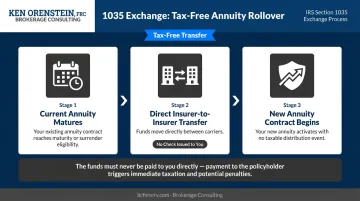
A 1035 exchange, authorized under IRS Revenue Procedure 2011-38, allows you to transfer funds from one annuity directly into a new annuity without triggering taxes on accumulated gains.
Key rules to follow:
- Funds must transfer directly between insurers — never paid out to you as a check
- The new contract resets your surrender charge period
- Existing surrender charges from your current contract may apply before the exchange completes
A 1035 exchange opens access to the broader market. If your insurer's renewal rate has dropped but another carrier offers a more competitive MYGA rate with stronger financial ratings, you can capture that difference without a tax consequence.
That comparison is most valuable before your grace period expires. Working with an independent broker like Ken Orenstein at Brokerage Consulting means renewal rates can be benchmarked against rollover rates across multiple carriers — factoring in financial strength ratings from A.M. Best, S&P, and Moody's alongside the rate itself.
Annuitize for a Guaranteed Income Stream
Annuitization converts your accumulated value into a series of periodic payments. The main payout structures and their trade-offs:
| Payout Option | What It Does | Trade-Off |
|---|---|---|
| Life-only | Pays for your lifetime | Maximizes income; payments stop at death |
| Joint and survivor | Covers two lives | Lower monthly payment than single-life |
| Life with period certain | Guaranteed minimum payment period | Beneficiary protection if you die early; lower income than life-only |
| Fixed period | Pays for a set term (e.g., 10–30 years) | No lifetime protection beyond the term |
Once you annuitize, the contract is generally irrevocable with no cash surrender value. That loss of liquidity deserves serious consideration before proceeding.
Your current insurer's annuitization rate may also not be the best available. Getting open-market income quotes from multiple carriers before committing can reveal meaningfully better payout options.
Take a Lump Sum or Use Systematic Withdrawals
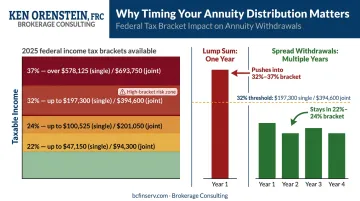
Lump sum withdrawal takes the full accumulated value in one payment. This may fit when large capital is needed for a specific purpose, but it typically triggers the largest tax event: all gains are taxable as ordinary income in the year of withdrawal, potentially pushing you into a higher marginal bracket.
Systematic withdrawals offer a middle ground — regular, self-directed payments while keeping remaining funds invested. The flexibility is real, but you'll need to monitor withdrawal rates to avoid depleting the contract ahead of schedule or creating unintended tax exposure across multiple years.
Renewal Rates and Bailout Provisions
The renewal rate is the new interest rate your insurer sets at the end of your guarantee period. It reflects the insurer's current investment portfolio conditions — not the rate environment when you originally purchased. Renewal rates can be lower than your initial rate, particularly when prevailing interest rates have declined.
LIMRA reported that lower interest rates in the second half of 2024 directly undermined demand for fixed-rate deferred annuities — confirmation that insurer renewal rates follow broader market conditions closely.
Before accepting any renewal, compare that rate against:
- Current MYGA rates available in the open market
- The insurer's historical track record for renewal rate competitiveness
- Any new surrender charge period that would apply
Bailout Provisions
Some fixed annuity contracts include a bailout provision — a clause allowing you to surrender the contract without penalty if the renewal rate falls below a specified floor (the "bailout rate"). If your contract includes this, it allows penalty-free surrender if the renewal rate falls below the contractual floor.
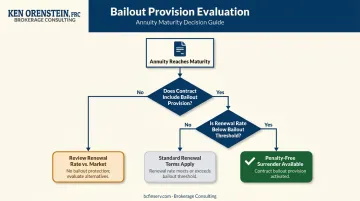
Not every contract includes this protection, so verify your terms before assuming it applies:
- Bailout provisions are optional contract features, not a regulatory requirement
- The bailout threshold and triggering terms vary by contract
- Review your original contract language before relying on this clause
If a bailout provision exists and the renewal rate triggers it, you have a defined window to surrender without penalty and move your funds to a more competitive option — making it one of the most valuable clauses to locate before your contract matures.
Tax Implications to Consider at Maturity
Tax treatment differs based on whether your annuity is qualified or non-qualified:
Non-qualified annuities (purchased with after-tax dollars):
- Only the gains are taxable as ordinary income upon withdrawal
- The original principal is returned tax-free
- For pre-annuity-starting-date withdrawals, IRS Publication 575 confirms that amounts allocable to income are taxable
Qualified annuities (funded with pre-tax dollars through an IRA or employer plan):
- The full distribution is generally taxable when received
- Subject to Required Minimum Distribution (RMD) rules beginning at age 73 (or age 75 for those born in 1960 or later)
Early Withdrawal Penalty
Under IRS Notice 2022-6, Section 72(q)(1) imposes a 10% additional tax on taxable amounts received from a non-qualified annuity before age 59½. Two ways around this penalty:
- 1035 exchange — the IRS treats the transfer to another annuity as a no-gain/no-loss event, deferring tax entirely
- SEPP (Substantially Equal Periodic Payments) under Section 72(q)(2)(D) — lets pre-59½ holders take structured periodic distributions without triggering the penalty
Bracket Risk from Lump Sums
Avoiding the early withdrawal penalty is only part of the tax picture. How you time a full distribution matters just as much — a large lump sum can push your taxable income into a higher bracket in a single year. For reference, the 2025 IRS brackets reach 32% above $197,300 for single filers and $394,600 for joint filers — and 37% above $626,350 and $751,600, respectively.
A tax professional can help you apply the right approach:
- Spreading withdrawals across multiple tax years
- Coordinating withdrawals with deductions or lower-income years
- Using a 1035 exchange to defer the tax event entirely
How to Choose the Right Option for Your Retirement
A simple decision framework:
| Your Priority | Likely Best Path |
|---|---|
| Continue tax-deferred growth, don't need income yet | Rollover (1035 exchange) or renewal |
| Need guaranteed monthly income | Annuitization — compare across carriers first |
| Need liquidity or large capital access | Lump sum or systematic withdrawal (weigh tax cost) |
The rate environment should also factor into whichever path you choose. When rates are falling, locking into a new multi-year guaranteed rate sooner can protect your returns. When rates may rise, shorter terms or a straight renewal preserve flexibility.
Federal Employees and FERS Retirees
Federal retirees receiving a FERS pension already have guaranteed income from the Basic Benefit Plan, Social Security, and the Thrift Savings Plan. That baseline changes the math: annuitizing a fixed annuity on top of an existing pension is rarely the highest-value move. In most cases, a rollover that keeps the contract growing tax-deferred makes more sense.
There are several FERS-specific factors to coordinate at maturity:
- Pension income already covers baseline expenses — additional annuitization may be redundant
- TSP distribution timing affects overall taxable income and bracket management
- RMD obligations kick in at age 73 for qualified annuities held inside an IRA or retirement plan
- 1035 exchange timing should account for existing income streams to avoid bracket creep
Missing an RMD on a qualified annuity carries a 25% excise tax on the shortfall — a costly oversight that's straightforward to avoid with proper coordination.
Ken Orenstein at Brokerage Consulting holds the Federal Retirement Consultant (FRC) designation and specifically addresses this intersection — coordinating FERS pension income, TSP distribution strategy, and annuity decisions into one coordinated retirement income plan. A no-cost consultation is available by calling (888) 315-3608 or visiting bcfinserv.com.
The maturity window is short. Auto-renewal at a below-market rate or a missed RMD are both avoidable — but only if you start the review process before the deadline, not after.
Frequently Asked Questions
What should I do when a fixed annuity matures?
At maturity, you have four primary options: renew, roll over to a new annuity via 1035 exchange, annuitize for guaranteed income, or withdraw. The decision window is typically around 30 days from the maturity date, so reviewing your options early — ideally with an independent advisor — helps you avoid defaulting into an auto-renewal you didn't choose.
What happens if I do nothing when my fixed annuity matures?
The contract automatically renews at a new rate set by the insurer, which may be lower than your original guaranteed rate. The renewal can also reset your surrender charge period, limiting your flexibility for the next several years.
Can I roll over a fixed annuity without paying taxes?
Yes. A 1035 exchange allows a tax-free transfer from one annuity to another, but funds must move directly insurer-to-insurer. If a check is issued to you instead, the transaction becomes a taxable distribution — and triggers the 10% early withdrawal penalty if you're under 59½.
How long do I have to decide what to do at annuity maturity?
Most contracts provide roughly a 30-day window at or around the maturity date, though this is contract-specific rather than a universal standard. Review your contract terms and act before the window closes to avoid an unintentional auto-renewal.
What are the tax consequences of cashing out an annuity at maturity?
For non-qualified annuities, gains are taxed as ordinary income while principal returns tax-free. Qualified annuity distributions are fully taxable. Either way, those under 59½ face an additional 10% federal penalty on the taxable portion under Section 72(q).
Is it better to renew or roll over a fixed annuity at maturity?
It depends on whether your insurer's renewal rate is competitive with the open market. If another carrier offers a meaningfully higher rate or stronger contract terms, a 1035 exchange rollover will generally deliver more value — an independent advisor can compare rates across carriers to make that call clear.