
Introduction
Fixed indexed annuities have become one of the most popular retirement vehicles in the country — U.S. FIA sales hit $127.9 billion in 2025, part of a record $464.1 billion total annuity market. The appeal is straightforward: index-linked growth potential with a floor that protects your principal.
That principal protection comes with conditions, and FIA contracts contain provisions that often go unread until they matter. The Market Value Adjustment — MVA — is one of them. Many contract holders don't encounter it until they try to access funds early, sometimes facing a significant reduction to what they expected to receive.
Understanding the MVA before you commit to a contract — not after — is what separates a well-structured retirement income plan from an expensive surprise.
Key Takeaways
- An MVA adjusts your payout on early excess withdrawals from an FIA, based on interest rate movements since your contract was issued
- Rising rates since purchase = negative MVA (you receive less)
- Falling rates since purchase = positive MVA (you may receive more)
- MVA only applies to withdrawals above the penalty-free amount, typically 10% of account value per year
- Surrender charges and MVA are separate fees — both can apply to the same withdrawal at the same time
- Holding through the full surrender period eliminates MVA exposure entirely
What Is a Market Value Adjustment in a Fixed Indexed Annuity?
The NAIC Annuity Disclosure Model Regulation (Model #245) defines an MVA as "a positive or negative adjustment that may be applied to the account value and/or cash value of the annuity upon withdrawal, surrender, annuitization, or death benefit payment" at a time other than a specified guaranteed benefit date.
If you take money out early, the MVA adjusts what you actually receive based on where interest rates have moved since you purchased the contract.
Why MVAs Exist
Insurance companies invest annuity premiums in long-duration bonds. When you exit early, the insurer may need to liquidate those bonds — at a gain or a loss depending on the rate environment. The MVA transfers that economic effect to you, the contract holder.
As EquiTrust describes it in their carrier disclosure: "An MVA allows the client to share in the investment risk associated with early surrender or withdrawal." In exchange for accepting this risk, MVA-bearing contracts typically offer more competitive caps, participation rates, or crediting rates than non-MVA alternatives.
What an MVA Is Not
Three important clarifications:
- Can work in your favor — if rates have fallen since purchase, the MVA may actually increase your payout
- Separate from surrender charges — these are two distinct mechanisms that can both apply to the same contract (covered below)
- Not included in every FIA — it's a contract-specific feature; always verify in the product disclosure before purchasing
How Does MVA Work in a Fixed Indexed Annuity?
The MVA compares the benchmark interest rate at contract issue to that same rate at withdrawal. The gap between the two drives the adjustment applied to your payout.
The Benchmark Comparison
Each carrier chooses its own external benchmark index — and they vary considerably:
| Carrier | MVA Benchmark |
|---|---|
| EquiTrust | Moody's Bond Indices – Corporate Average |
| Allianz Life | Proprietary MVA Reference Rate (published daily) |
| North American Company | Insurer's current new-money rate |
The Insurance Compact standards require this benchmark to be a "publicly available interest rate index external to the insurance company" — making the comparison objective rather than insurer-controlled. Always verify which index your specific contract uses.
The directional logic works like this:
- If rates rise after your purchase, the insurer's existing bonds lose relative value — a negative MVA offsets that loss at your expense
- If rates fall after your purchase, those bonds gain relative value — a positive MVA can flow back to you
Positive vs. Negative MVA in Practice
When the MVA hurts you: Say you bought an FIA in 2021 when rates were near zero. Rates then rose sharply. If you withdraw beyond your penalty-free amount, the insurer applies a downward adjustment — you receive less than your account value on that excess.
When the MVA helps you: Say you bought near the July 2023 rate peak of 5.25–5.50%, and rates have since dropped to 3.50–3.75% (as of early 2026). An early withdrawal now could trigger an upward adjustment, partially offsetting any surrender charge on the excess amount.
The MVA Formula
The size of that adjustment depends on a formula each insurer discloses in the contract. EquiTrust's publicly filed version offers a clear representative example:
MVA Factor = (s − c) × (n ÷ 12)
Where:
- s = MVA benchmark rate at contract issue date
- c = MVA benchmark rate at time of withdrawal
- n = number of complete months remaining in the surrender period
The Insurance Compact also permits a compound structure: [(1+I) / (1+J+K)]^N − 1. Here, I = credited rate, J = current rate, K = adjustment factor, and N = time variable.
Two things amplify the MVA's magnitude: a larger rate change and more time remaining in the surrender period.
Worked Example
Contract details: $200,000 FIA, 10% annual penalty-free withdrawal, Year 3 of a 10-year surrender period, rates have risen 2% since issue.
| Component | Calculation | Amount |
|---|---|---|
| Account value | — | $200,000 |
| Penalty-free amount (10%) | $200,000 × 10% | $20,000 |
| Amount requested to withdraw | — | $50,000 |
| Excess above penalty-free | $50,000 − $20,000 | $30,000 |
| MVA applied to excess | −2% rate change × 7 yrs remaining ≈ −14% | −$4,200 |
| Amount received on excess | $30,000 − $4,200 | $25,800 |
| Total received | $20,000 + $25,800 | $45,800 |
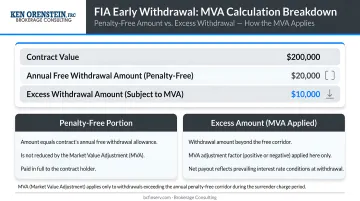
The MVA applies only to the $30,000 excess — not the full $50,000 withdrawal. The penalty-free portion passes through untouched.
When Does MVA Apply — and When Does It Not?
The MVA has a defined scope. It does not apply universally to all withdrawals.
MVA triggers when:
- You withdraw more than the annual penalty-free allowance (typically 10% of account value)
- The contract is still within its surrender charge period
- You fully surrender the contract — the highest-exposure scenario, since the entire excess is subject to both MVA and surrender charges simultaneously
MVA does NOT apply when:
- Withdrawals stay within the annual penalty-free amount
- The surrender period has expired
- Death benefit payouts to beneficiaries (commonly waived, though carrier-discretionary)
- Hardship waivers — nursing home confinement (typically requiring 90+ consecutive days), terminal illness diagnosis — where offered; these are competitive features, not NAIC mandates, so verify in your specific contract
The MVA period and the surrender charge period are often aligned — but not always identical. Some contracts carry staggered timelines, so verify both in your contract documents rather than assuming they expire on the same date.
That's where the guaranteed benefit date becomes the key planning checkpoint. On that date, your contract value is available without any MVA, regardless of rate movements — and timing a large withdrawal around it is a straightforward way to eliminate MVA exposure entirely.
MVA vs. Surrender Charges: Understanding the Difference
These two provisions are frequently confused, and mixing them up can lead to costly surprises.
| Feature | Surrender Charge | Market Value Adjustment |
|---|---|---|
| Nature | Fixed percentage fee | Market-driven adjustment |
| Direction | Always reduces payout | Can be positive or negative |
| Basis | Contract schedule | Interest rate environment |
| Predictability | Known in advance | Unknown until withdrawal |
| After surrender period | Does not apply | Does not apply |
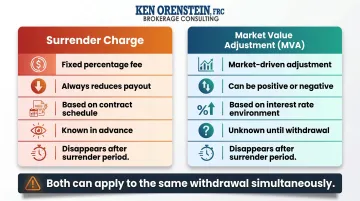
Surrender charges are fixed, schedule-based deductions — typically starting at 7–10% and declining annually to zero over a 6–10 year period. They always reduce your payout. There is no "positive" surrender charge.
When Both Apply Simultaneously
On an early excess withdrawal, both the surrender charge and the MVA can apply to the same dollar amount. As OceanView Life confirms in their product documentation: "An MVA, along with a surrender charge, will be applied if withdrawals exceed the 10% penalty-free amount."
Combined impact example:
| Component | Amount |
|---|---|
| Excess withdrawal subject to charges | $30,000 |
| Surrender charge (e.g., 6%) | −$1,800 |
| Negative MVA (e.g., −4.5%) | −$1,350 |
| Net received on excess | $26,850 |
| Total reduction from $30,000 | −$3,150 |
In a rising-rate environment, these stack: a contract holder faces both a fixed fee and a market-driven reduction on the same dollars.
The reverse is also true. In a falling-rate environment, a positive MVA can partially or fully offset the surrender charge. Insurers typically offer higher baseline rates on MVA products because the mechanism lets them share some upside with contract holders when rates fall.
How MVA Affects Your Retirement Strategy
For most FIA holders — those who hold the contract through its full term — the MVA is largely a non-issue. FIAs are designed as long-term retirement vehicles, and the MVA disappears entirely once the surrender period ends. For these investors, the higher crediting rates that MVA products often carry represent a net benefit.
The calculus changes if you anticipate needing access to more than your annual penalty-free amount during the surrender period. In that situation, the MVA is a material risk factor, not a footnote.
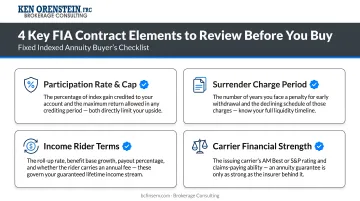
Before selecting any FIA, review these four contract elements:
- MVA formula: which benchmark index, and what formula structure
- Surrender period length: how many years before MVA and charges disappear
- Penalty-free withdrawal percentage: typically 10%, but verify
- Hardship waiver language: nursing home, terminal illness, and death benefit provisions, and whether they're included
This matters especially for anyone managing a transition period, such as federal employees bridging the gap between retirement and Social Security eligibility, or pre-retirees still building their liquidity reserves. If your income needs during that window could exceed the penalty-free amount, an MVA-bearing product may not be the right fit.
Working with an independent advisor like Ken Orenstein at Brokerage Consulting means comparing MVA provisions, surrender schedules, and penalty-free allowances across multiple carriers — not just reviewing whichever contract lands on your desk first. That kind of side-by-side analysis is what connects the right contract structure to your actual liquidity needs.
Frequently Asked Questions
What is the MVA on a fixed index annuity?
The MVA in a fixed indexed annuity is a contractual adjustment applied to early excess withdrawals, based on how a benchmark interest rate has moved since your contract was issued. It can be positive or negative, depending on which direction rates have moved since you purchased the contract.
Can a market value adjustment increase my payout?
Yes. If interest rates have fallen since you purchased the annuity, the MVA can be positive, meaning you receive more than your unadjusted account value on the excess withdrawal. This can partially or fully offset any surrender charge applied to the same amount.
How is the MVA different from a surrender charge?
Surrender charges are fixed percentage fees that always reduce your payout, declining on a schedule until the surrender period ends. MVAs fluctuate with interest rates and can be positive or negative. Both can apply to the same withdrawal at the same time, making the combined impact potentially significant in a rising-rate environment.
Does the MVA apply after the surrender period ends?
No. Once the surrender period has expired, withdrawals and full surrenders are free of any market value adjustment, regardless of how much interest rates have moved since the contract was issued.
What is a Secure Term MVA fixed annuity?
"Secure Term MVA Fixed Annuity" is a specific product issued by New York Life Insurance and Annuity Corporation (NYLIAC) — not a generic industry category. It's a single-premium fixed deferred annuity with 3- to 8-year interest rate guarantee periods, where the MVA applies during the guarantee period and is waived on the guaranteed benefit date.
Is there a difference between a fixed annuity and a fixed indexed annuity?
A traditional fixed annuity credits a guaranteed interest rate set by the insurer. A fixed indexed annuity links growth potential to a market index, with a floor protecting against loss and caps or participation rates limiting upside. FIAs carry more complex contract features — including, in many contracts, an MVA provision.