
Fixed period installments offer a middle path: structured, predictable income over a defined term, with interest continuing to accrue on the unpaid balance. According to FINRA, the right payout method depends on your other income sources, health, and comfort with investment risk — meaning there is no universal "best" option. The structure you choose shapes your cash flow, tax bill, and what passes to your beneficiaries.
This guide explains exactly how fixed period installments work, how they compare to alternatives like life-only and joint-and-survivor annuities, and who this option actually fits.
Key Takeaways
- Fixed period installments pay equal amounts over a chosen term (commonly 5–30 years), with remaining funds earning interest on deposit with the insurer
- Each payment includes both a return of principal and an interest component — total payout often exceeds your original premium
- If you die during the period, a named beneficiary continues receiving the remaining payments
- Once the term ends, payments stop — longevity risk is yours to manage
- Best for retirees with other lifetime income sources who want structured, time-limited payouts with beneficiary protection
What Are Fixed Period Installments?
Fixed period installments are a payout structure available for both annuities and life insurance death benefits.
With an annuity, the accumulated contract value is distributed in equal periodic payments over a chosen term — rather than as a lump sum or for life. The annuitant selects the term at the outset, typically ranging from 1 to 30 years depending on the carrier, and the payment amount is calculated based on the total funds, the chosen term, and the applicable interest rate.
With life insurance, a fixed-period settlement option pays the death benefit proceeds over an elected number of years — with the potential right to withdraw the present value of unmade payments depending on contract terms.
How the Interest Component Works
Funds not yet disbursed stay on deposit with the insurer and continue earning interest throughout the payout period. Each installment therefore includes both a return of principal and an interest component, and the total you receive over the term will generally exceed the original balance.
IRS Publication 939 defines a fixed-period annuity as one that pays definite amounts at regular intervals for a specified length of time — the fixed period must be at least 13 months for IRS expected-return calculation purposes.
Fixed Period vs. Lump Sum
The core trade-off is simple:
- Lump sum — full immediate access, maximum flexibility, no further growth from the insurer, no income structure
- Fixed period — organized, regular cash flow over time, interest continues accruing, less flexibility after payments begin
The right fit comes down to your cash flow needs. If you have no immediate use for a large sum and want organized income over a defined window, fixed period payouts put the full balance to work longer. If circumstances change — a major expense, estate need, or reinvestment opportunity — the lump sum keeps more options open.
How Fixed Period Installments Work
The Payment Calculation
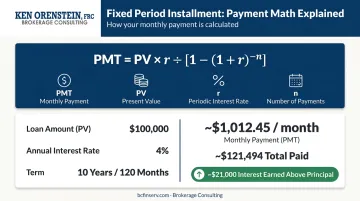
The math behind fixed period payments is standard time-value-of-money arithmetic. The formula for solving payment amount is:
PMT = PV × r ÷ [1 − (1 + r)^−n]
Where PV is the current value, r is the periodic interest rate, and n is the number of payments.
Illustrative example (not a carrier quote — actual rates vary by insurer and contract): A $100,000 annuity value paid monthly over 10 years at a 4% annual nominal rate produces approximately $1,012.45 per month, or roughly $121,494 total. The roughly $21,000 excess above the original principal reflects interest earned during the payout period.
Insurers typically offer monthly, quarterly, or annual payment frequency.
Beneficiary Continuation
If you die before the fixed period ends, the remaining payments don't disappear. Washington State's Office of the Insurance Commissioner provides a clear example: choose a 15-year fixed period, die after 10 years, and your beneficiary receives the remaining 5 years of payments — as ongoing installments or a lump sum equal to the present value of remaining payments. This feature is common but contract-specific, so always verify the terms with your carrier.
Tax Treatment
Tax treatment splits three ways depending on the contract type:
| Contract Type | Tax Rule | Practical Impact |
|---|---|---|
| Non-qualified annuity (after-tax funds) | IRS Pub. 939 exclusion ratio: each payment split between tax-free basis recovery and taxable earnings | Only the earnings portion is taxable until basis is fully recovered |
| Qualified annuity (pre-tax funds) | Generally fully taxable as ordinary income per IRS Pub. 575 | Every dollar of every payment is taxed |
| Life insurance death benefit installments | Principal generally income-tax-free; amounts above the excludable death-benefit portion are taxable interest per IRS Pub. 525 | Beneficiary owes tax only on the interest portion |
What Happens When the Period Ends
Payments stop. No residual value is returned, and no income stream continues. If you're still alive when the term expires, you need other income sources in place. That's the core planning risk of fixed period installments, which is why this option works best for people who already have separate guaranteed lifetime income covering their baseline needs.
Fixed Period Installments vs. Other Annuity Payout Options
Quick Comparison
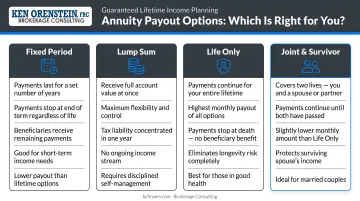
| Payout Option | Income Duration | Payment Amount | Beneficiary Protection | Longevity Risk |
|---|---|---|---|---|
| Fixed Period | Chosen term (e.g., 10–20 years) | Moderate to high | Yes — payments continue to named beneficiary | Yes — income stops at term end |
| Straight Life (Life-Only) | Lifetime of annuitant | Highest (single life) | None — payments cease at death | Eliminated |
| Lump Sum | One-time | Full value upfront | Yes — remaining assets pass through estate | High — depends on spending discipline |
| Joint & Survivor | Lifetime of two people | Lower (covers two lives) | Yes — survivor continues at reduced percentage | Eliminated for both spouses |
Straight Life Annuity
A straight life (life-only) annuity pays income for as long as you live — even well beyond actuarial projections. The trade-off: nothing passes to beneficiaries at death. Fixed period installments preserve beneficiary continuation when that matters. Straight life eliminates longevity risk entirely, but heirs receive nothing if you die early.
Lump Sum
A lump sum offers maximum flexibility and immediate access to the full contract value. Without a structured payout schedule, though, retirees can exhaust the funds too quickly — and the predictable income that fixed period installments provide is gone.
Joint and Survivor Annuity
Payments continue for the lifetime of two annuitants — typically spouses. The IRS defines a qualified joint and survivor annuity as requiring the survivor benefit to be 50%–100% of the original payment amount. This protects against longevity risk for both spouses but typically yields lower monthly payments than a fixed period option.
Benefits and Limitations
Key Benefits
- Predictable, equal payments — consistent cash flow that simplifies monthly budgeting
- Interest accrual — the total received often exceeds the original principal (as the illustrative example shows, roughly $21,000 more on a $100,000 base over 10 years at 4%)
- Beneficiary continuation — funds are not forfeited if the recipient dies during the term
- Defined endpoint — a fixed term makes it easier to coordinate payouts with other planned income events, such as Social Security claiming or pension start dates
Those advantages come with real trade-offs worth understanding before committing to a term.
Core Limitations
- Longevity risk — income stops at the end of the term, regardless of how long you live
- No inflation adjustment — FINRA notes that fixed annuity payments typically don't include cost-of-living adjustments, meaning purchasing power erodes over a long term
- Irrevocability — the NAIC confirms that once annuitization begins, you typically cannot withdraw additional funds or change the payment amount; the structure is locked in
The Term-Length Trade-Off
A shorter term produces larger individual payments but ends sooner. A longer term stretches income further but delivers less each month.
The right term matches the gap in your income plan. Map your guaranteed sources — Social Security, a pension, other annuity income — then size the fixed-period payout to fill what's missing. A no-cost consultation with Ken Orenstein can help you match term length to your actual income needs.
Who Should Choose Fixed Period Installments?
The Primary Candidate
Fixed period installments fit best when you already have guaranteed lifetime income from other sources and want your annuity proceeds to supplement that income for a defined window. Specific scenarios where this works well:
- Delay Social Security claiming until 70 and use fixed period income to cover the gap years, locking in a higher permanent benefit
- Bridge ages 62–65 before Medicare Part A and Part B eligibility with predictable monthly income
- Replace earned income for the first 10 years of retirement while other assets continue growing
Federal employees with FERS or CSRS pensions are strong candidates. With a federal pension providing a guaranteed monthly benefit and Social Security layered on top, a 10- or 20-year fixed period annuity can serve as a defined-term income rung within a broader retirement income architecture — without competing against the lifetime income foundation already in place.
Secondary Candidates
- Individuals who want to pass remaining value to a beneficiary rather than maximize their own lifetime income
- Life insurance beneficiaries who want structured income rather than a lump sum that may be mismanaged or spent too quickly
Getting the Structure Right
The term you select, payment frequency, tax implications, and estate goals all require a personalized review — no two retirement income pictures are identical.
Ken Orenstein at Brokerage Consulting, a Federal Retirement Consultant and independent annuity specialist licensed across NJ, NY, MD, VA, DC, and additional states, evaluates fixed period structures alongside lifetime income options from multiple carriers through a no-cost initial consultation to identify the payout structure that fits your specific situation.
Frequently Asked Questions
What is a fixed period installment?
A fixed period installment is a payout option for annuities or life insurance settlements where proceeds are paid in equal payments over a predetermined number of years. The remaining unpaid balance earns interest on deposit with the insurer throughout the payout period, meaning total payments typically exceed the original principal.
Do I get all my money back with a Return of Premium (ROP) rider?
An ROP rider guarantees your beneficiary receives the difference if you die before recouping the original premium paid. It protects principal but adds cost — Annuity.org reports fees commonly range from 0.30% to 1.50% annually, though terms vary by contract.
What happens to remaining payments if I die during the fixed period?
Most fixed period contracts include beneficiary continuation — remaining payments go to a named beneficiary as continued installments or as a lump sum equal to their present value. This is standard, but verify the specific terms in your contract before signing.
Are fixed period installment payments taxable?
It depends on the source. Non-qualified annuity payments are partially taxable (earnings only); qualified annuity payments are fully taxable as ordinary income. For life insurance death benefits paid as installments, the principal is generally income-tax-free, but interest earned during the payout period is taxable.
Can I switch my payout option after payments have started?
No — once annuitization begins, the election is typically irrevocable. The structure cannot be changed after the first payment is made. It's the most common source of regret in annuity planning, which is why a side-by-side comparison of all payout options before locking in is essential.