
This guide is written for individuals nearing retirement, federal employees evaluating supplemental options, or anyone who has been offered a variable annuity and wants to understand the trade-offs before signing anything.
TLDR: Key Takeaways
- Variable annuities are insurance contracts with tax-deferred, market-linked growth through investment subaccounts
- Key advantages: tax deferral with no contribution limits (non-qualified), lifetime income options, and a death benefit
- Core drawbacks include layered fees often exceeding 3% annually, surrender charges, limited liquidity, and ordinary income tax on gains
- They work best for investors who have already maxed out other tax-advantaged accounts and have a 10+ year time horizon
- Federal employees with FERS and TSP have substantial guaranteed income; a variable annuity suits only select situations
What Is a Variable Annuity and How Does It Work?
As defined by the SEC's Variable Annuities Guide, a variable annuity is a contract between an investor and an insurance company where the insurer agrees to make periodic payments — either immediately or at a future date.
Your purchase payments are allocated among investment options called subaccounts, which function similarly to mutual funds. Because these subaccounts are market-linked, your account value rises and falls with investment performance.
The Two Phases
Accumulation phase: You contribute purchase payments, allocate them across subaccounts, and the account value grows — or declines — based on market performance. This phase can last decades for younger investors.
Distribution/payout phase: You begin drawing income from the contract, either as a lump sum or as periodic payments structured for life or a set term.
Qualified vs. Non-Qualified
- Qualified variable annuities are funded with pre-tax dollars inside an IRA or retirement plan
- Non-qualified variable annuities are funded with after-tax personal dollars and have no IRS annual contribution limits — particularly useful for investors who've already maxed out their 401(k) and IRA contributions
Either way, early withdrawals carry a cost: taxable distributions before age 59½ trigger an additional 10% tax penalty on top of ordinary income tax, per IRS Publication 575.
Optional Add-On Riders
Most contracts offer optional living benefit riders — Guaranteed Lifetime Withdrawal Benefits (GLWBs), Guaranteed Minimum Income Benefits (GMIBs), and death benefit enhancements. These features carry additional annual fees and are evaluated separately in the sections below.
The Key Advantages of Variable Annuities
Tax-Deferred Growth and No Contribution Limits
Money inside a variable annuity compounds without being taxed year-over-year. The SEC confirms that transfers between subaccounts within the contract don't trigger taxable events , making portfolio rebalancing far more tax-efficient than in a taxable brokerage account.
For non-qualified contracts specifically, there are no annual contribution limits. This is a genuine advantage for high earners who have already maxed out a 401(k) and IRA but want additional tax-deferred growth capacity.
Guaranteed Lifetime Income Options
Variable annuities can be structured to generate income for one or two lifetimes. The most widely used option is the Guaranteed Lifetime Withdrawal Benefit (GLWB), which allows withdrawals up to a maximum percentage of a benefit base regardless of investment performance , so income continues even if the account value drops to zero.
According to a 2018 Society of Actuaries report citing LIMRA data, 72% of variable annuity owners elected a GLWB when one was available in 2015. That adoption rate reflects how much retirement investors value income certainty, particularly after experiencing market volatility firsthand.
Understanding what those riders actually cost matters as much as what they guarantee. Ken Orenstein at Brokerage Consulting evaluates GLWB, GMIB, and GMAB riders by weighing the guaranteed benefit against the ongoing rider cost, which typically runs 1.0–1.5% annually on the income base.
Death Benefit and Legacy Protection
Variable annuities include a built-in death benefit that protects beneficiaries if the account owner dies before withdrawals begin. The core structure offers two tiers:
- Standard death benefit: Beneficiaries receive the greater of current account value or total purchase payments (minus withdrawals)
- Enhanced death benefit riders: Step up the baseline using the highest historical account value or a guaranteed growth rate — these carry additional annual charges
Market-Linked Growth Potential
Unlike fixed annuities, variable annuities give long-term investors direct access to equity and bond market performance through subaccounts. For investors with a 15–20 year horizon, this creates growth potential that outpaces fixed or CD-based alternatives. Many contracts also include a fixed account option for more conservative allocation within the same contract.
Creditor Protection
In many states, annuity benefits are protected from creditors. New York, for example, provides this protection under N.Y. Insurance Law Section 3212, per a New York Department of Financial Services opinion. State rules vary significantly , so confirm the rules for your specific state with a licensed advisor before relying on this benefit.
The Major Drawbacks of Variable Annuities
High, Layered Fees
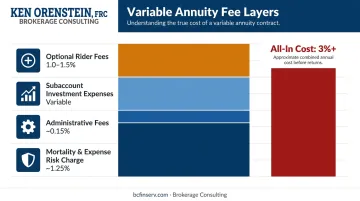
Variable annuities don't carry one fee — they carry several, stacked on top of each other:
- Mortality & expense (M&E) risk charge: The SEC cites a typical figure of approximately 1.25% annually
- Administrative fees: Often a flat annual amount (around $25–$30) or approximately 0.15% of account value
- Subaccount investment expenses: Additional fees for each underlying fund option
- Optional rider fees: Living benefit riders typically add 1.0–1.5% annually on the income base
When you combine these layers, all-in variable annuity costs routinely exceed 3% per year. That fee drag compounded over 20–30 years can significantly reduce the net return a contract delivers — a point Ken Orenstein addresses explicitly in client fee disclosure conversations before any placement.
Unfavorable Tax Treatment on Gains
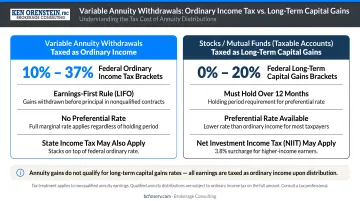
Tax deferral sounds attractive, but the other side of that coin matters. Per IRS Publication 575, all distributions from a variable annuity (beyond return of principal) are taxed as ordinary income — not at the lower long-term capital gains rate.
By contrast, IRS Topic 409 confirms that most long-term capital gains are taxed at no more than 15%, with some taxpayers qualifying for 0% or 20%. Investors holding low-dividend index funds in a taxable account for 10+ years may actually face a lower effective tax rate than annuity holders do on the same nominal gains.
That tax disadvantage extends beyond your lifetime. Annuity gains don't receive a step-up in cost basis at death, meaning heirs owe ordinary income tax on accumulated gains — a meaningful estate planning consideration.
Surrender Charges and Limited Liquidity
The SEC reports that surrender charge periods often run 6–8 years, while FINRA notes they can extend to 8 years or more. During this period, withdrawals above the free withdrawal allowance (typically 10–15% of account value annually) trigger surrender charges — which can reach as high as 9% on a 1035 exchange (a tax-free contract swap) into a new contract that restarts the clock.
Layer those surrender charges on top of the IRS's 10% early withdrawal penalty for anyone under 59½, and these products become highly illiquid for investors who haven't adequately planned for short-term cash needs.
Sales Commission Conflicts
According to HBS Working Paper 21-018, variable annuity commissions in their sample ranged from 0% to over 10%, with a median near 7%. The SEC notes directly that surrender charges are often used to fund the financial professional's commission.
That compensation structure creates a real conflict of interest. FINRA Rule 2330 exists specifically to address this — requiring firms to conduct suitability reviews and principal-level oversight for variable annuity recommendations. Before accepting any variable annuity recommendation, ask your advisor directly how they're compensated on the transaction.
Redundant Inside an IRA
The SEC is explicit on this: if a variable annuity is purchased inside an IRA, it provides no additional tax-deferral benefit beyond what the IRA already provides. Investor.gov echoes the same warning. Yet investors still pay M&E fees, rider fees, and subaccount expenses — for a tax benefit they're already receiving for free. Unless the income guarantees or death benefit have substantial standalone value for your situation, a variable annuity inside an IRA is typically a poor use of retirement dollars.
Who Should (and Shouldn't) Consider a Variable Annuity
Profiles That May Benefit
The strongest candidates for a variable annuity share several characteristics:
- Already maxed out 401(k), IRA, and other tax-advantaged accounts
- Long time horizon — ideally 10+ years before needing distributions
- Higher risk tolerance and comfort with market fluctuation
- Strong desire for guaranteed lifetime income as a supplement to other assets
- Sufficient liquid savings held outside the annuity contract
At Brokerage Consulting, the typical variable annuity client is a retiree aged 65–73 with at least $250,000 in deployable assets, existing guaranteed income coverage from a pension or Social Security, and a desire for supplemental market participation.
Profiles That Should Be Cautious or Avoid
Variable annuities are a poor fit for:
- Investors who need liquidity in the near term
- Those in or near retirement with a short time horizon
- Cost-sensitive investors who prioritize low-expense portfolio construction
- Anyone who already receives ample guaranteed income and doesn't need additional income protection

A Note for Federal Employees
Federal employees under FERS receive benefits from three sources: the Basic Benefit Plan pension, Social Security, and the Thrift Savings Plan (TSP) — per the Office of Personnel Management. Most private-sector workers don't enter retirement with that level of built-in income coverage.
With that income foundation already in place, a variable annuity only makes sense for federal employees in specific circumstances — for example:
- Supplementing income beyond what TSP and FERS already provide
- Pursuing additional tax-deferred growth after maxing out TSP contributions
The added cost needs to be justified by a real gap in the retirement income picture, not layered on top of an already well-structured plan.
That's exactly the kind of evaluation Ken Orenstein, Federal Retirement Consultant and author of The Informed Fed: A Survival Guide to Federal Employee Benefits, conducts with federal employees. A no-cost consultation is available by phone, virtually, or in person — contact Brokerage Consulting at (888) 315-3608.
Key Questions to Ask Before Buying a Variable Annuity
Before signing any contract, get clear answers to these:
1. What are all the fees — explicitly? Request a complete breakdown: M&E charge, administrative fees, each subaccount's expense ratio, and any rider fees. Compare the all-in annual cost against what a comparable index fund portfolio would cost. If the total exceeds 3%, understand exactly what you're receiving for that.
2. Do the guarantees actually match your situation? A GLWB rider only provides value if you need guaranteed lifetime income that your other assets don't already cover. If Social Security, a pension, or fixed annuities already handle that role, you're paying 1.0–1.5% annually for a guarantee you've already funded elsewhere.
3. What's your liquidity position? Before committing, work through three concrete checks:
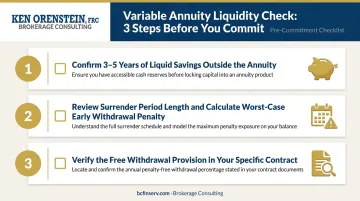
- Confirm you have 3–5 years of accessible liquid savings outside the annuity
- Review the surrender period length and calculate the worst-case early withdrawal penalty
- Ask specifically about the free withdrawal provision in the contract being offered
4. Is this going inside an IRA? If yes, revisit the IRA redundancy point from the drawbacks section. The tax-deferral benefit disappears inside a retirement account, and you're left paying insurance fees for features that need to justify their cost entirely on their own merits.
Frequently Asked Questions
What happens to variable annuities when the market crashes?
The account value declines along with the subaccounts, since returns are directly tied to investment performance. Variable annuities with GLWB riders can continue paying a guaranteed minimum income even if the account value drops significantly — during the 2008 financial crisis, for example, guarantee values held while account values fell sharply. That protection comes at an ongoing annual rider cost.
Can you lose money in a variable annuity?
Yes. Without living benefit riders, the account value can fall if underlying subaccounts decline, and surrender charges can compound losses if you withdraw early. Guaranteed minimum benefit riders limit downside income risk but don't eliminate market risk on the account value itself.
Are variable annuities a good investment for retirement?
They can be valuable for high earners who've maxed out other tax-advantaged accounts and want guaranteed lifetime income. They're generally not appropriate for fee-sensitive investors, those needing near-term liquidity, or anyone who already has ample guaranteed income from pensions or Social Security.
What is the difference between a variable annuity and a fixed annuity?
Fixed annuities pay a set guaranteed interest rate with predictable income and no market exposure. Variable annuities link returns to market-based subaccounts — offering growth potential but also market risk. Variable annuities typically carry significantly higher fees and greater complexity than fixed alternatives.
What fees should I expect with a variable annuity?
Expect M&E charges (around 1.25%), administrative fees (roughly 0.15%), subaccount investment expenses, and optional rider fees (typically 1.0–1.5% on the income base). All-in costs frequently exceed 3% annually, plus surrender charges for early withdrawals in the first several years.
Are variable annuities suitable for federal employees?
Federal employees already have a strong income foundation — FERS pension, Social Security, and TSP. A variable annuity may make sense for supplemental growth once TSP contributions are maximized, but the added cost needs to be weighed carefully against that existing coverage.