
This guide walks through how to systematically evaluate any annuity product — not just what an annuity is, but how to scrutinize its benefits, costs, and fit for your specific situation. That means understanding the contract terms, assessing the insurer's financial strength, and comparing options across the market before signing anything.
Key Takeaways
- Annuities aren't one product — fixed, indexed, and variable types require different evaluation criteria
- The core benefits (lifetime income, tax deferral, market protection) each come with specific conditions and trade-offs
- Variable annuity fees can easily exceed 3% annually; always request a full cost breakdown
- Insurer ratings from AM Best, Moody's, S&P, and Fitch matter more than most buyers realize (annuities are not FDIC-insured)
- The best annuity fills a specific income gap; it shouldn't be your entire retirement strategy
What Makes Annuities Worth Evaluating in the First Place
An annuity is a contract between you and an insurance company: you contribute a lump sum or series of payments, and the insurer provides guaranteed future income — either immediately or starting at a future date. LIMRA reported $461.3 billion in U.S. retail annuity sales in 2025, up 6% from the prior year. That volume reflects genuine demand — but it also means more products, more complexity, and more reason to know what you're evaluating before you buy.
The Two Phases That Shape Your Strategy
Every annuity has two distinct phases:
- Accumulation phase — your money grows inside the contract, typically tax-deferred
- Payout (distribution) phase — the contract converts to income, either for a set term or for life
Where you are in your timeline determines which phase matters most and which evaluation criteria to prioritize.
Not All Annuities Are the Same
The term "annuity" covers dramatically different products:
| Type | How Returns Are Generated | Risk Level |
|---|---|---|
| Fixed | Guaranteed interest rate | Lowest |
| Fixed Indexed | Tied to a market index with caps | Moderate |
| Variable | Invested in sub-accounts (like mutual funds) | Highest |
| SPIA/DIA | Immediate or deferred income conversion | Varies |
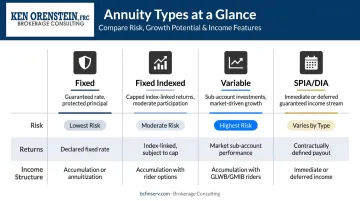
Fixed annuities are the easiest to evaluate — the guaranteed rate is disclosed upfront. Variable and indexed annuities require closer scrutiny: their fee structures and return calculations are more complex, and small differences in contract terms can meaningfully affect long-term income.
The Core Benefits of Annuities and How to Assess Them
Each benefit that gets highlighted in annuity marketing comes with conditions worth understanding before you accept the pitch at face value.
Guaranteed Lifetime Income
The most cited benefit is income you cannot outlive. There's a critical distinction to make first: guaranteed income for life is not the same as income for a set term (called a "period certain").
Before signing any contract, confirm exactly what type of guarantee applies. A period-certain annuity stops paying when the term ends, even if you're still alive. According to SSA actuarial data, a 65-year-old woman can expect to live another 20+ years — meaning a 10-year period-certain annuity could leave a real income gap in her late 70s.
Tax-Deferred Growth
Money inside a nonqualified annuity grows without annual tax liability, letting compounding work more efficiently over time. There's an important caveat: if you place an annuity inside an already tax-advantaged account like an IRA or 401(k), the tax-deferral benefit disappears. The SEC explicitly states this arrangement provides no additional tax advantage beyond what the retirement account already offers.
Any decision to use an annuity inside a qualified account should rest on the income guarantee or insurance features alone — not tax deferral.
Protection from Market Losses
Fixed and indexed annuities can shield your principal from market downturns. Variable annuities offer no such protection. For indexed annuities, the trade-off is straightforward: the insurer caps your upside (limiting how much index gain you receive) in exchange for protecting your downside. The right call depends on your risk tolerance — specifically, how much growth potential you're willing to trade for principal protection.
Death Benefits and Payout Structure Trade-Offs
Many annuities include provisions that pass the remaining contract value to a named beneficiary. The payout structure you choose directly affects your monthly income:
- Single life — highest monthly payment, stops at your death
- Joint and survivor — lower monthly payment, continues for a surviving spouse
- Life with period certain — income guaranteed for life, with a minimum payment period even if you die early
Evaluate this choice based on your family situation and whether you have a spouse who depends on your income.
Inflation Considerations
Fixed annuity payments don't automatically rise with inflation. Over a 20-year retirement, even modest inflation can cut your purchasing power significantly — a real risk for retirees on fixed income.
Inflation riders, available on some products (particularly SPIAs), adjust payments annually at 1%, 2%, 3%, or a CPI-linked rate. The trade-off is a lower starting payment in exchange for future increases. How much that matters depends on your other income sources and how long you expect to rely on the annuity.
A Practical Framework for Evaluating Any Annuity
Start With the Payout Calculation
Ask one specific question: How much monthly income will I receive for my deposit? Get this number in writing and compare it across at least three providers. For fixed and immediate annuities, this figure is calculable upfront.
For variable annuities, ask specifically about a Guaranteed Minimum Income Benefit (GMIB) rider if you need a floor on income, and factor in that rider's cost before comparing it to simpler alternatives.
As a rough benchmark, a $100,000 immediate annuity purchased at age 65 could pay approximately $625–$651 per month for a single-life income stream, depending on gender, state, interest rates, and insurer — always get a personalized quote for accuracy.
Fees and Cost Transparency
Fee structures differ sharply by annuity type:
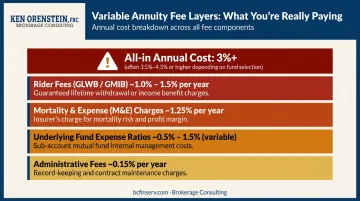
Variable annuities:
- Mortality and expense (M&E) charges — typically ~1.25% annually
- Administrative fees — often $25–$30/year or ~0.15% of account value
- Underlying fund expense ratios — an additional layer on top
- Rider fees (GLWB, GMIB, long-term care) — commonly 1.0–1.5% annually on the income base
All-in costs on a variable annuity with living benefit riders can exceed 3% per year, which creates a significant drag on growth. Request a complete fee breakdown before making any purchase decision.
Fixed and indexed annuities:
- Insurers embed costs in the credited interest rate, participation rate cap, or spread. There's no explicit fee line, but the implicit cost is real.
- Ask what the uncapped index return would be versus what you'd actually receive
Regardless of annuity type, two questions apply universally:
- What conditions trigger each rider benefit, and what does it cost?
- Will you realistically use it — or are you paying for coverage that won't apply to your situation?
Surrender Charges and Liquidity
Most annuities impose surrender charges if you withdraw money early. According to the SEC, surrender periods commonly run 6–8 years and can extend to 10 years, with a typical schedule starting around 7% in year one and declining by one percentage point annually.
Before committing, ask yourself honestly: Can I leave this money untouched for the full surrender period?
Some contracts allow penalty-free annual withdrawals of 10–15% of contract value. Confirm whether this provision exists in any contract you're evaluating and build it into your liquidity plan. Also note that IRS early withdrawal penalties (an additional 10% tax) may apply if you're under age 59½, separate from any insurer surrender charge.
How to Evaluate the Insurance Provider
An annuity guarantee is only as reliable as the company standing behind it. Unlike bank CDs, annuities are not FDIC-insured.
Financial Strength Ratings
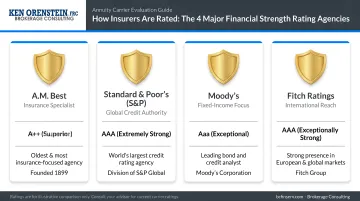
Four agencies assess insurer financial strength:
- AM Best — the most widely used for insurance companies; look for A- (Excellent) or better
- Moody's — ratings from Aaa (highest) to C
- S&P — forward-looking opinion on ability to pay policyholder claims
- Fitch — additional cross-check for comprehensive assessment
Using all four agencies — rather than just one — gives a fuller view of insurer stability. If three agencies rate a carrier highly but a fourth flags a concern, that discrepancy warrants a closer look before committing.
State Guaranty Associations as a Backstop
If an insurer fails, state guaranty associations provide some protection. Key points to understand:
- NOLHGA reports member associations cover at least $250,000 in annuity benefits, with some states allowing limits up to $500,000
- Coverage limits vary by state and may fall short of the full contract value on larger premiums
- Treat guaranty association coverage as a secondary safety net, not a substitute for choosing a financially strong insurer
The Independent Advisor Advantage
A captive agent can only present products from their single affiliated carrier. An independent advisor can compare options across the broader market, evaluating insurer ratings, income rider growth rates, caps, participation rates, and surrender schedules side by side.
Ken Orenstein at Brokerage Consulting, for example, uses ratings from AM Best, Moody's, S&P, and Fitch together when evaluating carriers for annuity placement, rather than relying on a single agency's assessment.
Matching an Annuity to Your Retirement Goals
Assess the Income Gap First
Annuities make the most sense for the portion of retirement savings dedicated to covering non-negotiable monthly expenses — housing, healthcare, food. The framework that works in practice:
- Layer 1: Social Security (optimize the claiming strategy first)
- Layer 2: Pension income — including FERS/CSRS for federal employees
- Layer 3: Annuity income — to fill any gap between Layers 1–2 and essential expenses
- Layer 4: Investment portfolio — for growth, discretionary spending, and legacy
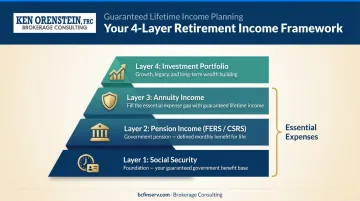
If Social Security and a pension already cover your essential expenses, an annuity is less critical. If there's a shortfall, an annuity can be a targeted solution for that specific gap — not a replacement for your entire portfolio.
Timing and Interest Rates Matter
Age at purchase directly affects payout. Older buyers receive higher monthly income because insurers anticipate paying for fewer years. This dynamic is called a mortality credit: the pooled risk across many annuity holders means those who live longest benefit from those who don't. Mortality credits can partially compensate for a low-rate environment, making annuities worth evaluating even when rates sit below historical averages.
Two timing factors to weigh before locking in a contract:
- Purchase age — buying later means higher monthly income but fewer years to accumulate deferred growth
- Rate environment — locking in a 10-year MYGA during a high-rate period is a different decision entirely than doing so at historic lows
Payout Structure and Family Situation
Once you've accounted for timing, the payout structure should reflect your household's specific income needs and risk of outliving a spouse. Consider the options:
- Single with no dependents — single life maximizes monthly income
- Married couple — joint and survivor protects the surviving spouse but reduces monthly payments
- Concerned about dying early — life with period certain guarantees a minimum payout period to your estate
An annuity laddering approach — stacking multiple contracts with staggered surrender periods or income activation dates — can balance liquidity needs with guaranteed income across different time horizons.
Mistakes to Avoid When Evaluating Annuities
Three mistakes consistently undermine annuity decisions — often after it's too late to reverse course.
1. Chasing the headline payout. A higher monthly income guarantee can be offset by higher fees or more restrictive surrender terms. Always evaluate net value, not just the top-line number.
2. Placing a nonqualified annuity inside an IRA. Putting a nonqualified annuity inside a tax-advantaged account eliminates one of its primary benefits. If you're using a qualified annuity (including QLACs, which let you defer RMDs on up to $200,000), the decision should be driven by the income guarantee or RMD-deferral benefit — not tax deferral that already exists in the account.
3. Not knowing how your advisor is compensated. Two distinct standards govern annuity recommendations:
- Suitability standard (brokers) — recommendations must be suitable, but not necessarily optimal
- Fiduciary standard (investment advisors) — legally required to act in the client's best interest
Ask directly: Is this person acting as a fiduciary? How are they paid? For insurance-based annuity products, carriers pay the commission directly. At Brokerage Consulting, Ken Orenstein's fiduciary duty applies to investment advisory work through Brookstone Capital Management. For insurance products including annuities, compensation is commission-based. This distinction is disclosed to clients before placement.
Frequently Asked Questions
How much does a $100,000 annuity pay per month?
Monthly income varies widely based on age, annuity type, payout option, current interest rates, and insurer. A rough illustration: a $100,000 immediate annuity at age 65 might pay approximately $625–$651 per month for a single-life income option. Get a personalized quote from multiple providers for an accurate figure.
What fees should I look for when evaluating an annuity?
For variable annuities, watch for M&E charges (~1.25%), administrative fees (~0.15%), fund expense ratios, and rider fees (often 1.0–1.5% of the income base). Fixed and indexed annuities embed costs in the interest rate or participation rate cap rather than itemized fees. Always ask about surrender charges separately.
How do I know if an annuity is right for my retirement plan?
An annuity fits best when there's a gap between your guaranteed income (Social Security, pension) and your essential monthly expenses, when longevity risk is a real concern, and when you can afford to lock up a portion of savings without needing short-term access to those funds.
What is the difference between a fixed and variable annuity for a retiree?
A fixed annuity offers a guaranteed interest rate and predictable income with minimal risk. A variable annuity ties returns to market performance, which means potentially higher income but with investment risk and typically much higher fees. The right choice depends on your risk tolerance, income needs, and how much guaranteed protection you require.
What does an insurer's financial rating mean for my annuity?
Ratings from AM Best, Moody's, and S&P reflect the insurer's ability to meet its long-term obligations. Since annuity guarantees are backed solely by the issuing carrier, not federal deposit insurance, financial strength is a primary evaluation factor. Use AM Best ratings of A- or better as a starting screen.
Can I get out of an annuity after purchasing it?
Most states require a free-look period, with the NAIC model minimum at 15 days; states like Texas and California extend this to 20–30 days for some buyers. After that window closes, withdrawals are subject to surrender charges that can be steep, particularly in the first few years of the contract.