
Introduction
Picture this: a federal employee approaching retirement puts $150,000 into a fixed annuity and assumes it carries the same federal backing as his bank CD. It's a reasonable assumption — both offer guaranteed interest rates, neither exposes your money to market swings, and both are conservative, predictable choices.
But here's the direct answer: no, fixed annuities are not FDIC insured. Not from any carrier, under any circumstances.
That said, "not FDIC insured" does not mean "unprotected." Fixed annuities operate under a separate safety net — state guaranty associations — that covers policyholders across all 50 states, D.C., and Puerto Rico. What that protection covers, and where its limits are, is what the rest of this guide breaks down.
Key Takeaways
- Fixed annuities are insurance contracts, not bank deposits — FDIC rules do not apply
- All 50 states, D.C., and Puerto Rico have state guaranty associations as a safety net
- Most states protect $250,000 per person, per insurance company, though limits range from $100,000 to $500,000+
- Insurance company insolvencies are rare, and state regulators intervene well before a failure occurs
- Spreading holdings across multiple top-rated carriers can multiply your total protected coverage
Why Fixed Annuities Are Not FDIC Insured
The FDIC exists for one specific purpose: protecting deposits held at FDIC-member banks. According to the FDIC's own guidance on financial products not covered by deposit insurance, that coverage extends to checking accounts, savings accounts, money market deposit accounts, and CDs — and nothing else.
Fixed annuities fall completely outside that mandate. They are insurance contracts issued by life insurance companies, not bank deposits. As the NAIC's consumer guidance on annuities clarifies, annuities are insurance products regulated at the state level by insurance commissioners — not by federal banking regulators like the FDIC or OCC.
Three points clarify the scope:
- No annuity type qualifies for FDIC coverage — fixed, indexed, or variable
- This holds true even if you purchase the annuity through a bank branch
- There is no federal equivalent to FDIC for insurance products — protection comes through a state-based system instead
The two systems work differently in ways that matter for retirement planning. State guaranty associations — the insurance industry's equivalent backstop — typically cover fixed annuity values up to $250,000 per insurer, though limits vary by state. Unlike FDIC coverage, this protection is not federally funded or uniformly guaranteed, which means the financial strength of the issuing insurance carrier carries real weight when selecting a fixed annuity.
How Fixed Annuities Are Actually Protected
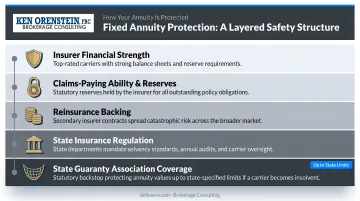
Rather than a single backstop, fixed annuities benefit from a layered protection structure. Each layer reduces the likelihood that any policyholder suffers a loss.
Insurer Financial Strength: The First Line of Defense
Before any safety net comes into play, the issuing insurance company itself stands behind the contract. State insurance regulators require life insurers to:
- Maintain strict reserve requirements relative to their liabilities
- Pass regular financial examinations conducted by state regulators
- Meet risk-based capital standards that signal financial health
- Adhere to conservative investment guidelines for their general accounts
This regulatory framework — overseen by state insurance commissioners and coordinated through the NAIC — is specifically designed to keep insurers solvent. Guaranty association coverage exists as a backstop if that framework fails.
State Guaranty Associations: Your Safety Net
Every state, plus D.C. and Puerto Rico, has a nonprofit state life and health insurance guaranty association. Membership is mandatory for any insurer licensed to sell annuities in that state. If an insurer becomes insolvent, the association steps in.
According to NOLHGA, which coordinates the national network of state associations, covered benefits for annuity contracts typically include:
- Present value of annuity benefits
- Net cash surrender and withdrawal values
- Death benefits
Coverage is subject to dollar limits set by state law. The most common limit is $250,000 per person, per insurance company in present value of annuity benefits — but this varies. Some states are higher (New York covers up to $500,000; North Carolina covers $300,000 for most annuities), while Puerto Rico's limit is $100,000.
You can look up your specific state's limits at NOLHGA's state contact and law summary tool.
Reinsurance: An Additional Layer
Many life insurers transfer a portion of their risk to reinsurance companies. A reinsurer acts as a financial backstop for the primary insurer: if claims or obligations exceed expectations — say, from policyholders living longer than projected — the reinsurer contributes capital to cover the gap.
This mechanism is invisible to policyholders but strengthens the capital structure backing every fixed annuity contract.
FDIC Insurance vs. State Guaranty Protection: Key Differences
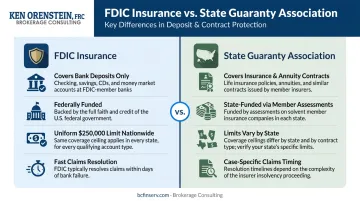
Neither system is universally superior — they're designed for different products. Here's how they compare across four key dimensions:
| Feature | FDIC Deposit Insurance | State Guaranty Association |
|---|---|---|
| Legal nature | Independent U.S. government agency; backed by full faith and credit of the U.S. | State-level nonprofit organizations under state law; no federal guarantee |
| Covered products | Bank deposits (checking, savings, CDs, money market accounts) | Life, health, and annuity contracts from member insurers |
| Standard limit | $250,000 per depositor, per insured bank, per ownership category | Commonly $250,000 per person, per company — varies significantly by state |
| Funding | Pre-funded from ongoing bank assessments and U.S. government securities | Assessed from member insurers after an insolvency occurs |
| Claims timing | Typically paid within days — often by the next business day | Case-specific; depends on receivership, liquidation, and state law |
A few practical takeaways from this comparison:
- FDIC maintains a pre-funded reserve, while guaranty associations collect assessments only after an insolvency — which can slow payouts
- Coverage limits look the same on paper ($250,000 in most states), but FDIC limits are uniform nationwide while guaranty limits vary by state
- Knowing which framework applies matters: annuities fall under state guaranty protection, not FDIC, regardless of where you buy them
That last point has real implications for larger annuity positions. Since guaranty coverage applies per person, per company, spreading $1 million across four separate highly rated insurers keeps the full amount within protection limits — a straightforward strategy for investors who exceed a single carrier's threshold.
How to Evaluate an Insurer Before Buying a Fixed Annuity
The quality of the insurer you choose matters more than most people realize. Here's a practical approach:
Check Independent Financial Strength Ratings
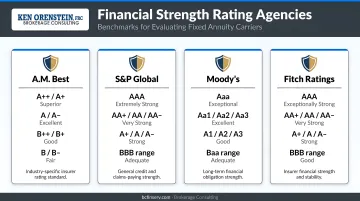
Four major agencies rate insurance company financial strength:
- A.M. Best — the most insurance-specific of the four; look for ratings of A- or better (Excellent or Superior categories)
- Moody's — uses Aaa through C notation; Aa3/A1 or better signals strong financial health for an insurer
- Standard & Poor's — rates insurer financial strength from AAA down to D; AA- or better is a solid benchmark
- Fitch — rates insurer financial strength from AAA through C
At Brokerage Consulting, Ken Orenstein reviews ratings from all four agencies when evaluating fixed annuities and MYGAs for clients — ensuring the guaranteed rate is backed by a financially sound issuer, not just an attractive number.
Comdex scores offer a useful shortcut: they aggregate ratings from multiple agencies into a single 1–100 composite score, making side-by-side carrier comparisons easier for clients who don't want to reconcile four different rating scales.
Spread Holdings Across Multiple Carriers
If your total fixed annuity investment exceeds your state's guaranty limit, the solution is straightforward:
- Confirm your state's specific guaranty association coverage limit at NOLHGA's law summaries page
- Divide your total investment across multiple highly rated carriers, keeping each allocation within the state limit
- For example, in a $250,000-limit state, four separate carrier contracts could protect up to $1 million in total
Retirees with larger nest eggs routinely use this multi-carrier approach — and it's simpler to execute when working with an independent broker who represents multiple carriers rather than a single company.
Work With an Independent Advisor
Executing a multi-carrier strategy is far easier when someone can compare options across the full market. An independent advisor can evaluate financial strength ratings, product features, surrender schedules, and income rider structures across carriers — not just one company's lineup.
Ken Orenstein at Brokerage Consulting incorporates carrier financial strength review as a standard part of every fixed annuity consultation, drawing on relationships with multiple highly rated carriers to match clients with financially sound issuers. This is particularly relevant for federal employees building guaranteed income alongside TSP distributions and FERS pension benefits — where a fixed annuity can serve as a third income layer independent of market swings.
To discuss your specific situation, you can reach Ken at (888) 315-3608 or request a no-cost consultation at bcfinserv.com.
Frequently Asked Questions
Are there any fixed annuities that are FDIC insured?
No. FDIC coverage applies only to bank deposits — checking accounts, savings accounts, money market deposit accounts, and CDs. No fixed annuity from any carrier qualifies for FDIC protection. Fixed annuities are insurance products backed by state guaranty associations, not federal deposit insurance.
What happens to my fixed annuity if the insurance company fails?
Your state's guaranty association steps in to either transfer your policy to a financially sound insurer or pay covered benefits directly, up to your state's limit. NOLHGA has coordinated the guaranty association system since 1983, supporting insolvency resolutions across the country.
Are fixed annuities as safe as CDs?
Both are considered conservative, low-risk options. CDs carry FDIC's federal backing and very fast claims resolution. Fixed annuities rely on state guaranty associations, which may take longer to process claims and vary by state. Both are sound choices when held with highly rated institutions and within coverage limits.
How much of my annuity is protected by a state guaranty association?
The most common limit is $250,000 per person, per insurance company, measured in present value of annuity benefits. State limits range from $100,000 to $500,000 or more — check your specific state's limit at NOLHGA's contact and law summaries resource.
How do I know if my insurance company is financially strong?
Check ratings from A.M. Best, Moody's, S&P, and Fitch. For A.M. Best, look for companies rated A- or better. Comdex scores, which consolidate ratings from multiple agencies into a single number, can simplify comparisons across carriers.
Can I protect more than $250,000 in fixed annuities?
Yes. Coverage limits apply per insurance company, so purchasing fixed annuities from multiple highly rated carriers multiplies your total protected amount. This is a straightforward strategy for retirees with larger retirement savings.