
The stakes are real. The wrong choice can mean outliving your savings by a decade, handing a surviving spouse a dramatically reduced income, or losing years of potential investment growth to a guaranteed-but-shrinking monthly check. And yet roughly 73% of pension participants choose the lump sum when the option is available — often without fully modeling the long-term consequences.
This guide breaks down both options clearly: how each works, who each fits, and the four factors that should actually drive your decision.
Key Takeaways
- Lump sum = full control, investment potential, and estate flexibility — but requires disciplined management and carries longevity risk
- Annuity = guaranteed income for life, zero market exposure, simplified cash flow — but fixed payments lose purchasing power over time
- Your decision hinges on four factors: life expectancy, risk tolerance, tax situation, and spousal income needs
- Tax timing matters: skipping a rollover on a lump sum can push you into the 37% federal bracket in one year — annuity payments spread that liability over decades
- A hybrid approach (partial lump sum into a private annuity, remainder invested) is worth modeling before you commit to either option
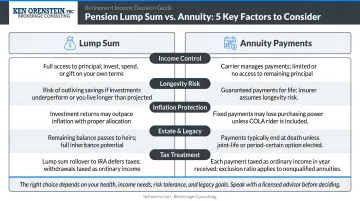
Lump Sum vs. Annuity: Quick Comparison
Here's how the two pension payout options stack up across the factors that matter most in retirement planning:
| Factor | Lump Sum | Annuity |
|---|---|---|
| Payment structure | Full pension value paid once | Guaranteed monthly income for life |
| Tax timing | Taxed in full the year received (unless rolled to IRA) | Taxed gradually across years |
| Flexibility | Unrestricted — invest, spend, or pass on | Fixed payments, limited adjustment |
| Inflation protection | Can be invested in inflation-hedging assets | Most fixed annuities have no COLA |
| Estate planning | Unused balance passes to heirs | Payments typically end at death (without survivor benefit) |
What Is a Pension Lump Sum?
A pension lump sum is a one-time payment of the present value of your entire benefit. Your employer calculates this using IRS segment rates under IRC Section 417(e) and mortality tables. The interest rate piece matters more than most retirees realize: when rates are high, the present value of future payments is lower, meaning smaller lump sum offers.
IRS segment rates in 2024–2025 ranged from roughly 4.53% to 5.64% — meaningfully higher than the near-zero rates of 2020–2021. That gap is why lump sum offers have shrunk for many workers over the past few years.
Core Advantages
- Full capital access: invest, pay off debt, or fund large expenses on your own timeline
- Growth potential: a well-managed lump sum can outpace lifetime annuity payments
- Estate flexibility: any unused balance passes directly to heirs
- Full control: you decide how, when, and where the money works
Key Risks
- Requires disciplined management to avoid early depletion
- Exposes you to market volatility and sequence-of-returns risk
- Carries longevity risk — if you live longer than expected, the money may run out
Who Should Consider a Lump Sum?
A lump sum is a strong fit if:
- You already have reliable guaranteed income from Social Security, a second pension, or existing annuities covering your essential expenses
- You have investment experience or work with a trusted advisor who can manage the drawdown
- Estate planning is a priority — you want assets available to pass on
- Your health history or family longevity suggests a shorter-than-average retirement
The IRA Rollover Advantage
If you take the lump sum as a cash distribution, your employer is required to withhold 20% for federal taxes automatically — and the full amount gets added to your taxable income for that year. A direct rollover to a traditional IRA avoids this entirely. Under IRC Section 402(c), a trustee-to-trustee transfer avoids the 20% withholding entirely and defers all taxation until you take withdrawals. For most retirees receiving a large pension buyout, the direct rollover is the only tax-sensible path if they want lump sum flexibility.
What Is a Pension Annuity?
A pension annuity converts your accumulated benefit into a series of guaranteed monthly payments, funded and managed by the pension plan. Payments are designed to draw down over your projected life expectancy — regardless of how markets perform.
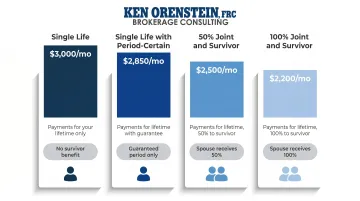
Common Annuity Types in Pension Plans
- Single life — highest monthly payment; ends at your death
- Single life with period-certain — if you die early, payments continue to beneficiaries for the guaranteed period (commonly 10 or 20 years)
- 50% joint and survivor — spouse receives half your payment after you die; your monthly benefit is reduced modestly (typically 5–10%)
- 100% joint and survivor — spouse receives your full payment; your monthly benefit takes the largest reduction (often 10–20%+)
Core Advantages
- Eliminates longevity risk — payments never stop, regardless of how long you live
- No investment management required
- Insulates retirement income from market volatility
- Simplifies monthly cash flow
Key Risks
- Fixed payments lose purchasing power over time — at 2.5% average inflation, a fixed payment loses roughly 40% of its real value over 20 years
- Limited financial flexibility once payments begin
- If you die early, total lifetime payouts may fall well short of the lump sum equivalent
Who Should Consider an Annuity?
An annuity is a strong fit if:
- You're in good health and expect to live into your 80s or 90s
- Social Security is your only other guaranteed income source
- You prefer predictable monthly income over managing a portfolio
- A surviving spouse depends on continued income after your death
If you check most of those boxes, the next step is putting a number on it. The break-even age tells you exactly when the annuity starts outpaying the lump sum.
Understanding the Break-Even Age
Divide the lump sum offer by the annual annuity payment to find how many years of payments equal the lump sum value.
Example: A $300,000 lump sum vs. $1,470/month ($17,640/year) annuity at age 65:
- Break-even: $300,000 ÷ $17,640 = ~17 years (age 82)
- At age 90 (25 years): cumulative annuity payments = $441,000
- At age 95 (30 years): cumulative annuity payments = $529,200

If you live past the break-even age, the annuity delivers more total value. If you don't, the lump sum wins. Your personal health history and family longevity determine which side of that line you're likely to land on — which is exactly why this decision deserves more than a quick calculation.
How to Choose: Key Factors That Should Drive Your Decision
Life Expectancy and Health
This is the single most influential variable. A 65-year-old male has a life expectancy of roughly 17–19 additional years; a female, 20–22 years — but these are averages. Half of 65-year-olds will outlive those figures. If your family history, current health, and lifestyle suggest you could reach 85 or 90, the annuity's cumulative payments become substantially more valuable than the lump sum. Poor health history tilts the math toward the lump sum.
Risk Tolerance and Income Dependency
Ask yourself: how much of your retirement income already depends on market performance? If your portfolio is mostly market-linked, adding an annuity brings stability. If you already have multiple guaranteed income sources covering fixed expenses, lump sum flexibility may be worth the risk.
These two factors — how long you might live and how much risk you can stomach — set the foundation. The next variable adds a layer most retirees underestimate.
The Society of Actuaries' 2024 Retirement Risk Survey found that 48% of retirees worry about outliving their assets and 83% worry about inflation eroding their purchasing power. Those two fears pull in opposite directions — which is exactly what makes this decision hard.
Tax Implications
The tax math on a lump sum can be brutal if handled wrong. For 2025, the top federal marginal rate of 37% kicks in at $626,350 for single filers and $751,600 for married filing jointly. A large pension lump sum taken as cash can push a retiree into that bracket in a single year.
Annuity payments spread taxable income across decades — naturally keeping most retirees in lower marginal brackets. The direct IRA rollover neutralizes the immediate tax hit on a lump sum, but it also triggers Required Minimum Distribution obligations starting at age 73.
Spousal and Beneficiary Needs
If your spouse is significantly younger or in good health, survivor benefit options on a pension annuity may produce more total household lifetime income than a self-managed lump sum. The trade-off: selecting a 100% joint-and-survivor annuity typically reduces your monthly benefit by 10–20% or more compared to a single-life election.
Under ERISA, married retirees must obtain written spousal consent to waive the default joint-and-survivor annuity — a safeguard designed to prevent one spouse from unilaterally giving up the other's income protection.
Inflation and Purchasing Power
Most private-sector pension annuities are fixed — no cost-of-living adjustment. Over a 20–30 year retirement, that's a meaningful erosion in real value. A lump sum invested with a modest equity allocation has historically had a better chance of keeping pace with inflation, but that requires accepting market risk.
The core tension comes down to two competing protections:
- Longevity protection — the annuity pays as long as you live, no matter what
- Inflation protection — a invested lump sum can grow, but markets don't guarantee it
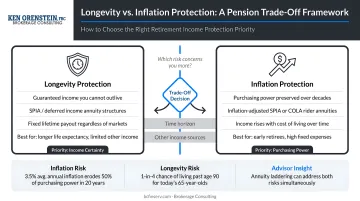
Neither option solves both problems. Your job — ideally with a retirement income specialist — is to decide which risk you can least afford to take.
Which Option Fits Your Situation?
Choose a Lump Sum If You:
- Have multiple guaranteed income sources already covering essential expenses
- Work with an investment advisor or have the experience to manage a long-term drawdown
- Have estate planning goals — passing remaining assets to children or other beneficiaries
- Have health concerns that meaningfully reduce expected lifespan
Core priority: flexibility and growth potential
Choose an Annuity If You:
- Are in good health with strong family longevity
- Have limited guaranteed income beyond Social Security
- Want a simplified retirement without portfolio management
- Have a younger spouse who needs income protection after your death
Core priority: security and simplicity
Consider a Hybrid Approach
Taking the lump sum doesn't mean going all-in on market investing. A hybrid strategy uses a portion of the lump sum to purchase a private fixed annuity or SPIA — covering essential monthly expenses — and invests the remainder for growth and inflation protection.
Private market annuities from top carriers sometimes offer higher monthly payouts than the original employer pension plan, so it's worth running the comparison before you commit.
That general framework shifts considerably for federal employees. FERS participants don't face a traditional lump-sum buyout the way private-sector retirees do — the FERS basic benefit is paid as a monthly annuity, with a separate TSP distribution decision running alongside it. They call for separate analysis. Ken Orenstein at Brokerage Consulting works with federal employees to model FERS pension, Social Security, and TSP income strategies together, mapping tax-efficient approaches for each client's specific retirement picture.
Conclusion
There's no universal right answer here. The correct pension payout choice depends on your health, income sources, risk tolerance, spousal situation, and long-term goals. Both options carry real advantages — for the right person, in the right situation.
What's non-negotiable is making this decision with full information before the deadline. Pension elections are typically irrevocable, which means this choice warrants a careful, informed review — not a rushed judgment made under deadline pressure.
If you're approaching a pension election and want to model both scenarios side by side, Ken Orenstein at Brokerage Consulting offers no-cost initial consultations by phone, virtually, or in person. You can reach the firm at (888) 315-3608 or request a consultation at bcfinserv.com/request-a-quote.
Frequently Asked Questions
Is it better to take a lump sum or an annuity?
Neither is universally better — it depends on your life expectancy, risk tolerance, and other income sources. Healthy retirees with no other guaranteed income typically benefit more from an annuity; those with investment experience and multiple income streams may prefer the lump sum's flexibility.
What is the 6% rule for pension buyouts?
Divide your annual pension payment by the lump sum offer. If the result is 6% or higher, the annuity is generally considered the stronger deal. Below 6%, the lump sum may generate competitive income if invested prudently. Use it as a starting point, not a final verdict.
What is the best thing to do with a lump sum pension payout?
The most tax-efficient move is a direct rollover into a traditional IRA, which defers taxation entirely. From there, you can purchase a private annuity for baseline income, invest the remainder in a diversified portfolio, or both — a financial advisor can help structure the right split.
Why do people take the lump sum instead of an annuity?
Common reasons: desire for investment control, estate planning goals, concerns about the pension fund's solvency, or health issues that make decades of payments unlikely. The lump sum also "feels" like more money — which is psychologically powerful, even when the math doesn't always support it.
Can I put a lump sum into an annuity?
Yes. You can roll a pension lump sum into a traditional IRA and use those funds to purchase a private fixed annuity or SPIA — sometimes at higher payout rates than the original employer pension offered. An independent annuity broker can compare rates across multiple carriers.
Should you roll over a pension?
A direct rollover into a traditional IRA avoids immediate taxation and preserves flexibility. It makes the most sense when the lump sum is substantial and you have a clear income strategy. If the pension's annuity rate is strong, rolling over means giving that up — run the comparison before committing.