
The answer is more complicated than most sellers let on. Under federal law, variable annuities are classified as both securities and insurance products simultaneously — not one or the other. That dual classification isn't a technicality. It determines who can legally sell the product, what disclosures you're entitled to, and which regulatory protections actually apply to your money.
This article explains why variable annuities carry this dual classification, how other annuity types compare, and what the overlapping regulatory framework means for you as a buyer.
Key Takeaways
- Variable annuities are both securities and insurance under federal law — the investor bears market risk, which triggers the securities classification
- Fixed annuities are insurance products only, with no SEC registration or FINRA oversight required
- Variable annuities require SEC registration and FINRA-licensed sellers, on top of state insurance regulation
- That dual classification directly affects what disclosures you receive, who can sell the product, and what legal protections apply
- RILAs (Registered Index-Linked Annuities) are securities; most traditional fixed indexed annuities are not
What Is a Variable Annuity?
A variable annuity is a contract between a buyer and an insurance company. The insurer agrees to make periodic payments — either immediately or at a future date — but unlike a fixed annuity, the contract's value isn't guaranteed. It fluctuates based on how the underlying investment options perform.
Those investment options are called subaccounts. They function like mutual funds and are typically invested in stocks, bonds, money market instruments, or some combination. The buyer chooses how to allocate premiums among the available subaccounts, and the account value rises or falls with market performance.
The Two Phases
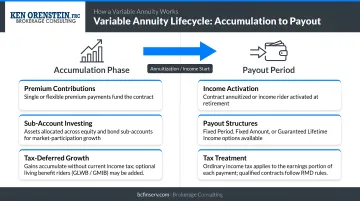
Every variable annuity moves through two distinct phases:
- Accumulation phase — Premiums go into subaccounts and grow tax-deferred until you take withdrawals
- Payout phase — The insurer begins making income payments, structured to last a set period or for life
What Makes Variable Annuities Different
Several features set variable annuities apart from other annuity types:
- Subaccount earnings grow tax-deferred until you take distributions
- A death benefit typically guarantees heirs receive at least the amount contributed, even if account value has dropped
- Living benefit riders — GLWBs and GMIBs — can lock in an income floor regardless of market performance
- Unlike fixed annuities, you carry real market risk: if subaccounts perform poorly, you can lose money
Is a Variable Annuity a Security, Insurance, or Both?
Both. This isn't a gray area — it's settled federal law.
Why Variable Annuities Are Securities
According to the SEC and Investor.gov, variable annuities are registered securities under the Securities Act of 1933. The variable annuity's separate accounts — where subaccount money is held — are also registered as investment companies under the Investment Company Act of 1940.
In a variable annuity, the buyer absorbs all market risk through the subaccounts. That exposure to loss triggers the securities classification — regardless of the fact that an insurance company issues the contract.
As non-exempt securities, variable annuities must go through full SEC registration. The issuing company must provide a prospectus — a disclosure document covering fees, risks, investment options, and contract terms. You have a legal right to receive this before purchase.
Why Variable Annuities Are Also Insurance
Variable annuities are genuine insurance products — not just by label, but by structure and function:
- They are issued by state-licensed insurance companies
- They include a death benefit, which is a core insurance feature
- They offer the option of guaranteed lifetime income payments, a function only insurance companies are legally permitted to provide
State insurance commissioners regulate these components, and the contract is governed by state insurance law alongside federal securities law.
What About State-by-State Variation?
Variable annuities are always securities under federal law — that's uniform. But states differ in how they layer on their own oversight. Some states regulate variable annuities under both state insurance and state securities law; others treat them primarily as insurance products at the state level. NASAA recommends that buyers contact both their state insurance regulator and state securities regulator to understand jurisdiction-specific requirements.
How Different Annuity Types Are Classified
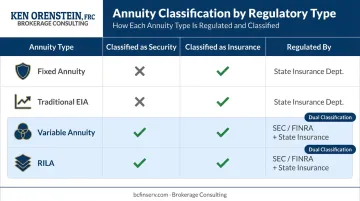
Not all annuities carry the same regulatory burden. Here's how the major types compare:
| Annuity Type | Classified as a Security? | Classified as Insurance? | Regulated By |
|---|---|---|---|
| Fixed Annuity | No | Yes | State insurance department |
| Traditional Equity-Indexed Annuity (EIA) | Generally no | Yes | State insurance department |
| Variable Annuity | Yes | Yes | SEC, FINRA + state insurance |
| Registered Index-Linked Annuity (RILA) | Yes | Yes | SEC, FINRA + state insurance |
Fixed Annuities: Insurance Only
Fixed annuities are not securities. The insurance company bears all investment risk and guarantees a minimum rate of return and a specified payout. Because the buyer has no market exposure, there's no basis for securities classification. A state insurance license is the only credential required to sell them.
Indexed Annuities: The Split Category
Traditional equity-indexed annuities sit closest to fixed annuities. Principal is usually protected, and the insurance company absorbs most market risk — so most EIAs are regulated as insurance only.
Registered Index-Linked Annuities (RILAs) work differently. Unlike traditional EIAs, the buyer absorbs a portion of downside risk in exchange for higher upside potential. That partial market exposure is enough to trigger securities classification — RILAs must be SEC-registered and are subject to FINRA oversight. RILA sales reached $47.4 billion in 2023, more than five times the $9.2 billion sold in 2017, reflecting rapid growth in this category.
The deciding factor across every annuity type comes down to one question: who bears the investment risk? The answer determines everything about how a product is regulated — and who is licensed to sell it.
What Dual Regulation Means for You as a Buyer
The overlapping regulatory framework creates real protections — but also real complexity.
The Prospectus Requirement
Because variable annuities are securities, the issuing company must file a prospectus with the SEC and deliver it to you before purchase. Read it. The prospectus discloses:
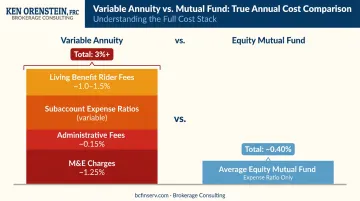
- Mortality and expense (M&E) charges — typically around 1.25% per year
- Administrative fees — often $25–$50 annually or roughly 0.15% per year
- Subaccount expense ratios — varies by fund selection
- Living benefit rider fees — typically 1.0–1.5% annually on the income base
- Surrender charges — may start around 7% and decline over several years
Per the SEC's investor bulletin, these layers stack up. For context, the average equity mutual fund expense ratio fell to 0.40% in 2024, per ICI data — a fraction of what a fully loaded variable annuity with riders can cost. All-in VA costs can exceed 3% annually when living benefit riders are included.
FINRA Oversight and Reg BI
Variable annuity sellers are subject to FINRA's conduct rules, including Regulation Best Interest (Reg BI). This requires sellers to recommend products that are genuinely in your best interest — not merely suitable. FINRA Rule 2330 establishes additional supervisory obligations specific to deferred variable annuity transactions.
You can use FINRA's BrokerCheck tool at brokercheck.finra.org to verify a seller's registration status and review any complaint history prior to purchasing.
State Insurance Protections — and Their Limits
State insurance departments regulate the insurance components of variable annuities. State guaranty associations provide a safety net if an insurer becomes insolvent, with most states offering at least $250,000 in annuity-benefit protection — though limits vary by state and typically do not cover the variable (market-risk) portion of the contract.
Two important things variable annuities are not covered by:
- FDIC insurance — annuities are not bank deposits
- SIPC protection — SIPC covers brokerage account failures, not annuity contracts
These gaps make it important to work with an advisor who understands both the investment and insurance sides of a variable annuity. At Brokerage Consulting, Ken Orenstein reviews VA cost structures within a broader tax-efficient retirement income plan. That includes assessing whether a VA's fees are justified given a client's existing guaranteed income sources, or whether a 1035 exchange into a lower-cost fixed indexed annuity would better serve their goals.
Who Can Legally Sell Variable Annuities
Because variable annuities are securities, selling them requires credentials beyond a standard insurance license.
The Dual Licensing Requirement
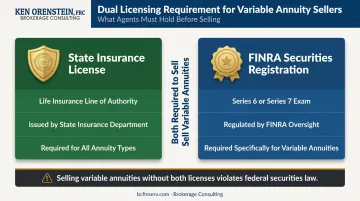
To legally sell a variable annuity, a person must hold both:
- A state insurance license (life insurance line of authority)
- A FINRA securities registration — typically via the Series 6 (Investment Company and Variable Contracts) or Series 7 (General Securities Representative) exam
Selling a variable annuity without the appropriate FINRA registration violates federal securities law — regardless of whether the person holds a valid insurance license. This distinction matters when someone recommends a variable annuity over a fixed annuity or FIA, where only an insurance license is required.
How to Verify a Seller's Credentials
Before doing business with anyone selling a variable annuity:
- Check FINRA registration: Use BrokerCheck at brokercheck.finra.org — free, public, and searchable by name or firm. Look for registration status, exam history, and any disclosed complaints or disciplinary actions.
- Verify the insurance license: Use the NAIC's state insurance department directory to reach your state's regulator and confirm the license is active.
If either credential is missing or shows disciplinary history, that's a red flag worth addressing before moving forward.
Frequently Asked Questions
Is a variable annuity a security?
Yes. Variable annuities are classified as securities under federal law because their value depends on the performance of market-linked subaccounts — the investor bears market risk. This triggers the securities classification under the Securities Act of 1933, regardless of the fact that an insurance company issues the contract.
Are variable annuities regulated by the SEC and FINRA?
Yes. Variable annuities must be registered with the SEC, sellers are subject to FINRA oversight rules including Regulation Best Interest, and the contracts are also regulated by state insurance commissioners — creating a three-layer regulatory framework.
Which annuities are securities?
Variable annuities and Registered Index-Linked Annuities (RILAs) are both SEC-registered securities subject to FINRA oversight. Traditional fixed annuities and most equity-indexed annuities (EIAs) are not securities — they are regulated only by state insurance departments.
Are variable annuities non-exempt securities?
Yes. Variable annuities are non-exempt securities, meaning they must go through full SEC registration and the issuer must provide a prospectus to buyers. Unlike exempt securities, there are no carve-outs from federal registration and disclosure requirements.
How are variable annuities taxed?
Variable annuities grow tax-deferred, meaning no taxes are owed on earnings until withdrawals are taken. Per IRS Publication 575, withdrawals are taxed as ordinary income, not capital gains. Withdrawals before age 59½ may also trigger a 10% IRS early withdrawal penalty, unless an exception applies.