
A Multi-Year Guaranteed Annuity (MYGA) sits in that gap — offering a fixed, contractually guaranteed rate that typically outpaces CD rates, with interest growing tax-deferred until withdrawal.
Fixed-rate deferred annuity sales hit $164.9 billion in 2023 — more than triple 2021's $53.1 billion — driven largely by savers seeking exactly this combination of predictability and protection.
This article covers what a MYGA is, how it works, its benefits and drawbacks, how it compares to CDs, and who it's best suited for.
TL;DR: Key Takeaways
- A MYGA locks in a guaranteed interest rate for a set term (typically 3–7 years) through an insurance company contract
- Interest grows tax-deferred — you owe nothing until you make withdrawals
- MYGA rates frequently outpace comparable CD rates by a meaningful margin
- Early withdrawals trigger surrender charges from the insurer
- Withdrawals before age 59½ may also incur a 10% IRS penalty
- Ideal for conservative savers nearing or in retirement who can commit funds for the full term
What Is a Multi-Year Guaranteed Annuity (MYGA)?
A MYGA is a fixed deferred annuity contract issued by an insurance company. You deposit a lump-sum premium, and in return, the insurer credits your account with a fixed interest rate for the entire contract term — no market exposure, no rate fluctuation mid-term.
The "Multi-Year" Distinction
This is where MYGAs differ from traditional fixed annuities. Standard fixed annuities may only guarantee the initial rate for the first year or two before resetting. A MYGA locks that rate in for the full agreed-upon term — making your growth completely predictable from day one.
According to LIMRA, 88% of fixed-rate deferred annuity sales are 3-year and 5-year contracts, though terms commonly range from 3 to 7 years. Some carriers also offer 2-year and 10-year options.
What a MYGA Is Not
Understanding what you're not buying matters:
- Not a variable annuity — no sub-accounts, no market-linked performance
- Not a fixed indexed annuity (FIA) — no index-linked crediting or participation rates
- Not a bank product — MYGAs are not FDIC-insured; they're backed by the issuing insurance company's claims-paying ability and state guaranty associations, which provide a safety net if an insurer becomes insolvent. According to NOLHGA, all member associations cover $250,000 or more in annuity benefits, though limits vary by state.
Typical Structure
Here's how most MYGA contracts are structured across common carriers:
| Feature | Details |
|---|---|
| Term lengths | Commonly 3, 5, 7 years (some carriers offer 2 or 10) |
| Minimum premium | Varies by carrier (e.g., Nationwide: $10,000; Pacific Life: $25,000) |
| Funding sources | Maturing CD, IRA/401(k) rollover, TSP rollover, pension lump sum, savings |
| Rate variability | Varies by insurer and term; always compare across carriers |
How Does a MYGA Work?
The Purchase and Accumulation Phase
You sign a contract, choose your term, and deposit your premium. The insurer immediately begins crediting your account at the guaranteed rate. Interest compounds tax-deferred throughout the term — meaning the full balance, including what would otherwise go to annual taxes on a CD, keeps working for you.
That compounding happens uninterrupted until you take money out. On a CD, the IRS taxes interest each year whether you withdraw it or not — with a MYGA, those dollars stay invested and keep growing.
Withdrawals During the Term
Most MYGAs allow penalty-free withdrawals of up to 10% of account value per year. Beyond that, surrender charges apply — typically starting higher in early contract years and declining toward zero by the end of the term.
A 7-year product, for example, might carry a 7% surrender charge in years one through three, then step down to 0% by year eight. The exact schedule varies by carrier and contract.
Two additional withdrawal considerations:
- IRS early withdrawal penalty: Distributions before age 59½ generally trigger a 10% additional tax on the taxable portion, per IRS Publication 575
- Market Value Adjustment (MVA): Some MYGAs include an MVA clause, which adjusts the surrender value up or down based on interest rate changes since purchase. If you hold to maturity, the MVA does not apply
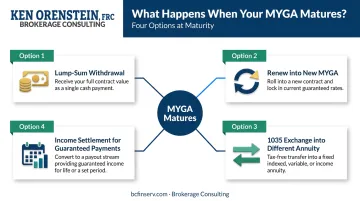
At Maturity: Your Four Options
Understanding these withdrawal rules makes the end-of-term decision clearer. When your MYGA matures, you have full flexibility:
- Lump-sum withdrawal — take the full accumulated value
- Renew — roll into another MYGA at the prevailing rate
- 1035 exchange — transfer tax-free into a different annuity product
- Income settlement — elect guaranteed income payments
Key Benefits of a MYGA
Guaranteed, Predictable Growth
The rate is written into the contract. You can calculate your exact balance at maturity before you ever sign. For retirement planning, that kind of certainty has real value — particularly when you're coordinating income from multiple sources like Social Security, a pension, or TSP distributions.
Tax-Deferred Compounding
Every dollar that would otherwise go to annual taxes on a CD stays invested and compounds. For savers in higher tax brackets, deferring income recognition until retirement can improve net returns over a 5–7 year term — especially if you expect to be in a lower bracket when withdrawals begin.
Principal Protection
Your premium and guaranteed interest are never exposed to stock market losses. LIMRA has tied the surge in fixed-rate deferred annuity sales directly to equity market volatility and growing demand for principal protection — two factors that make MYGAs a reliable core holding in a retirement portfolio.
Death Benefit
Most MYGA contracts allow the full accumulated value to pass directly to named beneficiaries upon the annuitant's death. Key provisions typically include:
- Spouses can often continue the contract under its existing terms
- Non-spouse beneficiaries generally receive the full payout directly
- Surrender charges are typically waived at death
Potential Drawbacks to Know Before You Buy
Limited Liquidity During the Surrender Period
MYGAs are designed for money you won't need immediate access to. The 10% annual penalty-free withdrawal provision helps, but exceeding that triggers surrender charges — which can be substantial in early contract years. Commit only funds you can genuinely leave untouched for the full term.
Fixed Rates and Inflation Risk
CPI rose 2.7% in 2025, and if inflation accelerates during your term, the real purchasing power of a fixed return erodes. MYGAs work best as one component of a diversified retirement plan, not the sole source of growth.
No Federal Deposit Insurance
Inflation risk is one concern — counterparty risk is another. Unlike bank CDs, MYGAs aren't FDIC-insured. Protection comes from the insurer's financial strength and state guaranty associations. Before purchasing, check ratings from AM Best, S&P, and Moody's:
- AM Best A++ / A+: Superior
- AM Best A / A-: Excellent
- S&P A: Strong capacity to meet obligations
- Moody's A: Good financial security
Stick with insurers with A-range ratings or better, and don't chase the highest rate from an unrated or lower-rated carrier.
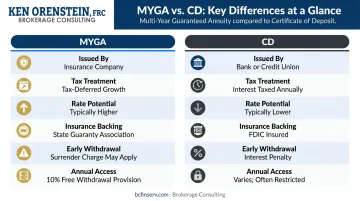
MYGA vs. CD: Key Differences
Both MYGAs and CDs offer a fixed rate, a set term, and principal protection. The differences often determine which is the better fit.
| Feature | MYGA | CD |
|---|---|---|
| Issued by | Insurance company | Bank or credit union |
| Tax treatment | Tax-deferred until withdrawal | Taxed as ordinary income annually |
| Rate potential | Often higher than comparable CD terms | Generally lower |
| Insurance backing | State guaranty association ($250K+) | FDIC ($250K per depositor) |
| Early withdrawal | Surrender charges + possible MVA | Typically 3–6 months of interest |
| Annual access | Usually 10% penalty-free per year | Often restricted to earned interest |
How Tax Deferral Widens the Return Gap
CD interest is taxable each year — even if you leave it untouched. MYGA interest compounds without an annual tax drag. Over a 5–7 year term, this difference compounds in your favor, especially if you're in a higher tax bracket now than you expect to be in retirement.
The Liquidity Trade-Off
CDs typically penalize early withdrawals with 3–6 months of lost interest — relatively modest. MYGAs carry steeper surrender charges, but most contracts offset this with a 10% annual penalty-free withdrawal provision that CDs rarely match. For a retiree drawing supplemental income, that annual access window often provides enough flexibility to avoid triggering surrender charges at all.
If your timeline is short or you need quick access to funds, a CD is the simpler choice. If you're saving toward retirement and can leave the money in place, a MYGA's tax deferral and higher rate potential typically make it the stronger option.
Who Is a MYGA Best Suited For?
The Ideal Buyer Profile
According to LIMRA, the typical annuity buyer is around 65 years old — and that tracks with how MYGAs are most often used in practice. The ideal MYGA candidate:
- Is within 5–10 years of retirement or already retired
- Has a lump sum they can commit for the full term (from a maturing CD, IRA/401(k) rollover, TSP rollover, or savings)
- Wants guaranteed, predictable growth without market risk
- Benefits from deferring taxable interest income to a lower-bracket year
Federal employees approaching retirement are a particularly strong fit. FERS pension income and TSP distributions often create situations where deferring additional taxable interest — rather than triggering it annually through a CD — meaningfully improves after-tax outcomes.
Who a MYGA Is Likely NOT Right For
- Younger investors who need long-term equity-level growth
- Anyone who may need frequent or flexible access to those funds
- Those who require FDIC-level federal deposit insurance
Getting the Right MYGA for Your Situation
MYGA rates, surrender schedules, term lengths, and carrier financial strength vary across the market, so comparing options across multiple insurers — rather than accepting the first quote — is essential.
At Brokerage Consulting, Ken Orenstein works as an independent broker representing multiple top carriers, enabling side-by-side MYGA comparisons across 3-year, 5-year, 7-year, and 10-year contracts. Each comparison covers:
- Current rates and term options
- Free withdrawal provisions
- Surrender charge schedules
- Carrier financial strength ratings
For clients holding older annuities at below-market rates, 1035 exchange analysis can move accumulated gains into a current-market MYGA without triggering taxes.
A no-cost initial consultation is available by phone, virtual, or in-person. You can reach Ken Orenstein at (888) 315-3608 or request an appointment at bcfinserv.com.
Frequently Asked Questions
What is a multi-year guaranteed annuity?
A MYGA is a fixed deferred annuity contract with an insurance company that locks in a set interest rate for a defined term — typically 3 to 7 years. Interest grows tax-deferred until you make withdrawals, making it a predictable, principal-protected savings vehicle.
Who is a MYGA best suited for?
MYGAs work best for retirees, pre-retirees, and federal employees who want guaranteed, tax-deferred growth without market exposure — and who can commit their funds for the full contract term without needing regular access.
Do MYGAs offer a guaranteed rate of return?
Yes. The interest rate is locked into the contract at signing and does not change for the full term — regardless of what happens in the market or with interest rates. That rate certainty is what separates MYGAs from most other savings and investment vehicles.
Can you lose money in a MYGA?
Your principal is contractually protected and your rate is guaranteed. However, surrendering the contract early could trigger surrender charges that reduce the net value you receive. MYGAs are also not FDIC-insured, so carrier financial strength matters.
What happens when a MYGA matures?
At maturity, you have four main options:
- Take a full lump-sum withdrawal
- Renew into another MYGA at the current rate
- Execute a tax-free 1035 exchange into a different annuity
- Elect a settlement option for guaranteed income payments
How are MYGA withdrawals taxed?
Earnings grow tax-deferred and are taxed as ordinary income upon withdrawal. If funded with pre-tax money (such as an IRA rollover), the entire withdrawal is taxable. If funded with after-tax money, only the earnings portion is taxed.