Below, we cover exactly what a 403(b) is, who qualifies, how contributions and taxes work, withdrawal rules, and how it stacks up against the more familiar 401(k).
TL;DR: Key Takeaways
- A 403(b) is a tax-advantaged retirement plan for public school, nonprofit, hospital, and church employees
- Contributions can be pre-tax (traditional) or after-tax (Roth), with tax-deferred or tax-free growth depending on contribution type
- The 2026 employee contribution limit is $24,500, with catch-up options for those 50 and older
- Early withdrawals before age 59½ trigger a 10% penalty plus ordinary income taxes, with limited exceptions
- A 403(b) shares most features with a 401(k) but includes a 15-year service catch-up provision not found in a 401(k)
What Is a 403(b) Retirement Plan?
A 403(b) is an employer-sponsored, tax-advantaged retirement savings plan established under Section 403(b) of the Internal Revenue Code. It works much like a 401(k) but is available exclusively to employees of public schools, nonprofits, and religious organizations. You'll also hear it called a tax-sheltered annuity (TSA) plan, which refers to the same account structure.
Inside a 403(b), individual accounts take one of two forms:
- Annuity contracts — provided through insurance companies
- Custodial accounts — invested in mutual funds
Some church employees may also use a retirement income account, which can hold annuities, mutual funds, or a combination of both.
Who Can Participate?
Eligible employer types include:
- Public K–12 schools and school districts
- Colleges and universities
- 501(c)(3) tax-exempt nonprofits
- Nonprofit hospitals (via 501(c)(3) status) and cooperative hospital service organizations
- Churches and qualifying ministry organizations
For-profit, private-sector companies cannot sponsor a 403(b) plan.
Employee eligibility follows the "universal availability rule": if an employer allows one employee to make salary deferrals, that opportunity must extend to all employees. Common exceptions include:
- Employees working fewer than 20 hours per week
- Nonresident aliens
- Students performing services for the employer
- Employees contributing $200 or less annually
How Does a 403(b) Work?
The mechanics are straightforward. An employee elects a dollar amount or percentage of each paycheck to contribute. That amount is deducted automatically—before it ever hits a bank account—and deposited into an individual retirement account that grows through investments over time.
Traditional vs. Roth 403(b) Contributions
Most plans offer two contribution tracks:
Traditional (pre-tax):
- Contributions reduce your taxable income today
- Investments grow tax-deferred
- Withdrawals in retirement are taxed as ordinary income
Roth (after-tax):
- Contributions are made with money you've already paid taxes on
- Qualified withdrawals—including all earnings—are completely tax-free
- To qualify, you must meet a 5-year holding requirement and be at least age 59½, disabled, or deceased
Not every employer plan includes a Roth option, so check with your HR department.
Employer Contributions and Compounding
Many employers sweeten the deal with matching contributions (for example, dollar-for-dollar on the first 3% of salary) or non-elective contributions that go to all eligible employees regardless of whether they contribute themselves. That employer match is free money. Leaving it on the table by under-contributing is one of the most common retirement planning mistakes.
Investment returns that generate their own returns over time can turn consistent monthly contributions into substantial savings across a 20- or 30-year career. A few factors accelerate that growth:
- Pre-tax contributions mean you're investing a larger base amount than you would from an after-tax paycheck
- Time in the market matters more than the size of your initial contribution
- Reinvested earnings build on themselves each year, multiplying the effect over time
403(b) Contribution Limits and Tax Advantages
For 2026, the standard employee elective deferral limit is $24,500, per IRS Notice 2025-67. This figure adjusts annually for inflation — check IRS.gov each year for the updated number. The combined employer-plus-employee annual additions limit sits at $72,000 for 2026, excluding catch-up contributions.
Eligible employees can push those limits higher through catch-up contributions.
Catch-Up Contributions
| Age Group | Additional Contribution (2026) | Total Limit |
|---|---|---|
| Age 50–59 or 64+ | $8,000 | $32,500 |
| Age 60–63 (super catch-up) | $11,250 | $35,750 |
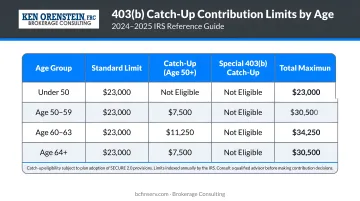
Starting in 2026, employees who earned more than $150,000 in 2025 wages from the same plan sponsor must direct catch-up contributions to a Roth balance only.
403(b) plans also offer a 15-year service catch-up that 401(k) plans don't provide. Employees with 15+ years at the same qualifying organization can contribute up to $3,000 more per year, subject to a $15,000 lifetime cap — provided the plan allows it and prior contributions meet IRS thresholds.
Qualifying organizations include schools, hospitals, health and welfare agencies, and churches.
Tax Advantages at a Glance
- Pre-tax contributions reduce your taxable income in the year they're made
- Investments grow tax-deferred until withdrawal (traditional) or tax-free (Roth)
- Qualified Roth withdrawals—including all earnings—are never taxed
- Employer contributions don't count against your personal elective deferral limit
403(b) Withdrawal Rules and Required Minimum Distributions
Early Withdrawal Rules
Penalty-free withdrawals from a traditional 403(b) can begin at age 59½, at which point distributions are taxed as ordinary income. Withdrawing before 59½ adds a 10% early withdrawal penalty on top of regular income taxes.
Exceptions that waive the 10% penalty include:
- Death or permanent disability
- Separation from service during or after the year you turn 55
- Qualified domestic relations orders (QDROs)
- Terminal illness diagnosis
- Emergency personal expense withdrawals up to $1,000 once per calendar year (under SECURE 2.0)
Some plans also permit loans (up to $50,000 or 50% of your vested balance) and hardship withdrawals under strict IRS guidelines, though neither avoids ordinary income taxes on the amount withdrawn.
Required Minimum Distributions (RMDs)
Once early withdrawal rules are clear, the next milestone to plan for is RMDs. Starting at age 73, participants must begin taking annual RMDs from their traditional 403(b). If you're still employed by the sponsoring organization at 73, you can delay RMDs until you retire.
Key RMD details:
- Roth 403(b) accounts are exempt from RMDs while the owner is alive
- Missing an RMD triggers a 25% excise tax on the un-withdrawn amount, reducible to 10% if corrected within two years
- Pre-1987 403(b) contributions held in a separately tracked balance follow a different rule — those funds aren't required to be distributed until age 75 or the year after retirement
403(b) vs. 401(k): What's the Difference?
The fundamental distinction is the employer type. A 401(k) can be offered by any non-government employer, while a 403(b) is reserved for public education institutions, 501(c)(3) organizations, and churches. Beyond eligibility, the two plans share most core features.
| Feature | 403(b) | 401(k) |
|---|---|---|
| Eligible employers | Public schools, nonprofits, churches | Private-sector and other non-government employers |
| 2026 contribution limit | $24,500 | $24,500 |
| Roth option | Yes (if plan allows) | Yes (if plan allows) |
| Age-50 catch-up | $8,000 | $8,000 |
| Early withdrawal penalty | 10% before 59½ | 10% before 59½ |
| 15-year service catch-up | Yes (unique to 403(b)) | No |
| Nondiscrimination testing | Simplified for eligible orgs | Full ADP/ACP testing required |
| Investment options | Annuities and mutual funds | Broader menu typically available |
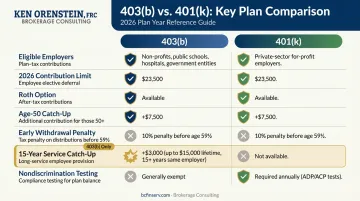
The table highlights the overlap, but two 403(b)-specific features are worth understanding in detail. First, the 15-year service catch-up gives long-tenured employees an extra savings runway unavailable in a 401(k). Second, many 403(b) plans—particularly governmental and church plans—are exempt from nondiscrimination testing that 401(k) plans must pass annually. That exemption simplifies administration considerably for the sponsoring organization.
The main limitation: 403(b) investment choices are traditionally restricted to annuity contracts and mutual funds offered within the plan. If a plan's menu is thin or fee-heavy, that can quietly erode long-term returns. A GAO analysis found that investment fees in surveyed 403(b) plans ranged from 0.01% to 2.37%—a wide spread that makes it worth comparing your plan's fees carefully.
Is a 403(b) a Good Retirement Plan?
For eligible employees, yes—generally. But the honest answer is: it depends on the specifics of your plan.
A 403(b) works well when:
- Your employer offers a match and you contribute enough to capture it
- You start early enough for compounding to build meaningful growth
- You use catch-up contributions as you approach retirement
The limitations are real, though. Investment menus can be narrow. Administrative fees vary considerably across plans. And if your employer's plan hasn't been reviewed recently, you may be paying more than necessary for fewer choices than you'd have in a rollover IRA.
According to PSCA data, the average 403(b) balance was $125,400 in Q2 2025 across roughly 9 million participants—but higher education employees, who tend to have longer tenure and higher savings rates, averaged $369,000. The gap illustrates how much plan quality, tenure, and contribution habits matter.
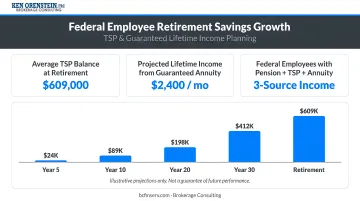
Those numbers also underscore a broader point: a 403(b) works best as one piece of a larger retirement picture, ideally coordinated with an IRA, Social Security timing, and potentially an annuity-based income strategy. That's where a retirement planning advisor adds real value—helping you build a coherent income plan across all your accounts, not just manage individual fund selections.
Ken Orenstein at Brokerage Consulting offers no-cost initial consultations (phone, virtual, or in-person) for individuals evaluating their retirement strategies. Whether you're deciding how much to contribute, considering a rollover at retirement, or wondering whether your 403(b) allocation still fits where you're headed, a personalized review can identify gaps or opportunities you might otherwise miss.
Reach the office at (888) 315-3608 or request a consultation at bcfinserv.com.
Frequently Asked Questions
What is a 403(b) retirement plan and how does it work?
A 403(b) is an employer-sponsored retirement plan for public school, nonprofit, and religious organization employees. Contributions are deducted directly from your paycheck and invested in an individual account, growing tax-deferred (traditional) or tax-free (Roth) until retirement.
Can I cash out my 403(b) at any time?
Technically yes, but withdrawing before age 59½ typically triggers a 10% early withdrawal penalty plus ordinary income taxes—making it costly in most situations. Common exceptions include disability, death, separation from service after 55, terminal illness, and limited emergency withdrawals.
What is the best thing to do with a 403(b) when you retire?
Your main options are: leave funds in the plan, roll over to an IRA for broader investment choices, begin taking distributions, or convert to a Roth IRA. The right move depends on your tax situation, income needs, and estate planning goals—a financial advisor can help you weigh all three before committing.
Is a 403(b) a good retirement plan?
Yes, for eligible employees—especially when an employer match is available and contributions start early. Its value depends on the plan's investment options, fee structure, and how it fits with your other retirement accounts.
What is a good amount to have in a 403(b) at retirement?
Fidelity's commonly cited benchmark is saving 10 times your final salary by age 67. Your personal target will vary based on Social Security income, other savings, lifestyle expectations, and your planned retirement age. A financial advisor can help you calculate a number specific to your situation.