
Introduction
Most people saving for retirement understand the basic tradeoff: accept market risk for higher growth, or accept lower returns for safety. Declared rate fixed annuities sit squarely in the "safety" camp — but the mechanics behind them are more nuanced than many buyers realize.
The declared rate is the interest rate an insurance company formally commits to crediting your account for a set period. It sounds simple enough. The confusion sets in when people discover that this rate isn't permanent, that "guaranteed" means something specific and limited, and that what happens at renewal can meaningfully change their retirement projections.
Fixed-rate deferred annuity sales reached $164.9 billion in 2023 — up 46% from the prior year's record. That level of growth reflects real demand — yet product popularity rarely moves in lockstep with product literacy.
This article covers:
- What a declared rate is and how it differs from a permanent guarantee
- How insurance companies set and reset declared rates
- What consumer protections exist at renewal
- How declared rate annuities compare to similar products
- Who this type of annuity actually suits
Key Takeaways
- Declared rate is the insurer-set interest rate credited to your annuity — renewed annually for traditional fixed annuities
- Your principal and previously credited interest cannot decline due to market performance
- At renewal, the rate resets — up or down, but never below the contractual minimum floor
- More flexible than MYGAs (which lock rates for the full term), with less growth potential than fixed index annuities
- Best suited for risk-averse savers and retirees who want tax-deferred growth with annual rate flexibility
What Is a Declared Rate Fixed Annuity?
According to the NAIC's Buyer's Guide to Fixed Deferred Annuities, money in a fixed deferred annuity earns interest at a rate set by the insurer, that rate is fixed for a period — "usually a year" — and may change after that period. Every contract also includes a minimum guaranteed rate.
That's the clearest regulatory definition available. The insurer declares the rate, it applies for a stated term, and a contractual floor protects against the worst-case scenario.
How Interest Crediting Works in Practice
The declared rate isn't tied to any index, negotiated by the policyholder, or derived from market performance. It's a design parameter set entirely by the insurance company. At each crediting interval, the insurer applies that rate to the account value — and the growth compounds tax-deferred until withdrawal.
Three product types share similar DNA but work differently:
- Traditional declared rate fixed annuity — rate set by insurer, typically renewed each policy year
- MYGA (Multi-Year Guaranteed Annuity) — rate locked for the full contract term (commonly 3, 5, or 7 years)
- Fixed Index Annuity (FIA) — interest credits linked to an external index formula using caps, participation rates, or spreads
This article focuses on the annually-renewable declared rate structure — not the multi-year lock common to MYGAs.
Regulatory Framework
That distinction also determines how these products are regulated. Declared rate fixed annuities are insurance products overseen by state insurance commissioners — not the SEC or FINRA. Sellers must hold a state insurance license, and these contracts are not securities products. That matters because state-regulated annuities are backed by state guaranty associations, which provide a layer of policyholder protection if an insurer becomes insolvent (coverage limits vary by state).
How the Declared Rate Is Set, Reset, and Protected
What Drives the Rate
Insurers don't set declared rates arbitrarily. The primary inputs are:
- General account portfolio yield — U.S. life insurers held $5.3 trillion in general account assets in 2021, with $3.5 trillion in bonds, 94% of which were investment grade, according to ACLI Fact Book data
- Prevailing interest rate environment — when rates rise broadly, declared rates tend to follow; when rates fall, they compress
- Insurer operating costs and profit margins — the company needs to earn enough on its portfolio to cover obligations, expenses, and returns
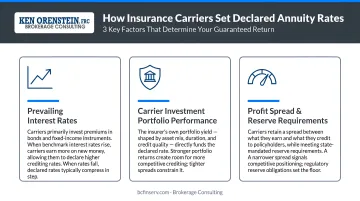
Policyholders don't influence this rate directly — the insurer sets it based on its own portfolio and business economics.
The Annual Reset
At the end of each policy year, the insurer declares a new rate based on current economic conditions. The rate you received in year one is not necessarily the rate you'll receive in year two.
This matters for retirement planning. A drop from 5% to 2% at renewal is the mechanism working exactly as designed — but it can still meaningfully affect how much your account accumulates over time.
If the surrender period has ended when a significant rate reduction occurs, that's the moment to compare current rates across carriers and consider whether reallocation makes sense.
Brokerage Consulting regularly conducts this type of review for clients holding older fixed annuities at below-market rates, including 1035 exchange analysis to move into higher-yielding contracts without triggering taxes on accumulated gains.
The Minimum Guaranteed Floor
Every declared rate contract includes a contractual minimum below which the renewal rate can never fall. This is legally required.
NAIC Model Law #805 — the Standard Nonforfeiture Law for Individual Deferred Annuities — specifies a formula tied to the 5-year Constant Maturity Treasury rate, reduced by 125 basis points, with the resulting minimum rate capped at 3% and floored at 0.15%. The specific floor depends on when and where the contract was issued.
Two terms worth distinguishing:
| Term | What It Means |
|---|---|
| Declared rate | What you actually earn each term — set by the insurer annually |
| Minimum guaranteed rate | The absolute contractual floor — the only rate truly fixed for the contract's life |
Most insurers declare rates well above the floor. But in a prolonged low-rate environment — like the decade following 2008 — the floor becomes meaningful protection against a 0% crediting scenario.
Key Features of Declared Rate Fixed Annuities
Principal Protection
The initial premium and all previously credited interest are fully shielded from market loss. A market downturn cannot reduce your account value. The declared rate applies regardless of how the insurer's investment portfolio performs in broader markets — unlike equities, mutual funds, or variable annuities, where losses are possible.
Tax-Deferred Growth
Per IRS Publication 575, annuity earnings are not taxed until distributed. Withdrawals are taxed as ordinary income, and withdrawals before age 59½ typically trigger an additional 10% IRS penalty unless an exception applies.
The tax deferral compounds over time in a way that isn't obvious at first glance. When taxes aren't eroding growth annually, the full credited interest compounds — effectively giving you a larger base each year than a taxable equivalent earning the same rate.
Surrender Charges and Liquidity
Most declared rate annuities impose surrender charges for early withdrawals during the surrender period. A typical declining schedule might look like 9-8-7-6-5-4-3-2-1-0% over ten years, with shorter schedules available on some products.
Most contracts include a free withdrawal provision — commonly 10% of the account value annually — without penalty. Liquidity beyond that comes at a cost during the surrender period.
Read the full surrender schedule before purchasing. Anyone who may need access to their principal within the surrender window should select a product with a shorter surrender period or plan around the free withdrawal provision.
Guaranteed Income for Life
Declared rate fixed annuities — like all fixed deferred annuities — include contractually guaranteed annuitization options. At some point, the policyholder can convert the accumulated value into a guaranteed income stream they cannot outlive. Key points on this feature:
- No additional rider required — annuitization is built into the base contract
- Income riders are available on many products to increase payout amounts or add flexibility
- Joint-life payout options can extend guaranteed income to a surviving spouse
Declared Rate Annuity vs. MYGA vs. Fixed Index Annuity
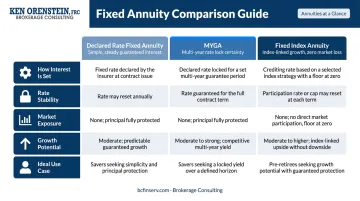
| Feature | Declared Rate Fixed Annuity | MYGA | Fixed Index Annuity |
|---|---|---|---|
| How interest is set | Insurer-declared, typically annual | Locked for full term (3, 5, 7+ years) | Linked to index formula (caps, participation rates) |
| Rate stability | Changes at each renewal | Fixed for entire term | Varies by crediting period and index performance |
| Market exposure | None | None | No direct exposure; credits tied to index formula |
| Growth potential | Moderate | Moderate | Higher ceiling, but subject to caps |
| Ideal use case | Savers expecting rates to rise; those wanting annual flexibility | Savers wanting rate certainty for a defined period | Savers wanting principal protection with index-linked upside |
When the Declared Rate Structure Has a Specific Edge
The annually renewable structure has a real advantage in a rising-rate environment. A saver who locks into a 5-year MYGA at 4% and watches rates climb to 5.5% has no way to capture that improvement until the MYGA matures. The declared rate structure, by contrast, gives the policyholder the opportunity to benefit from rate increases at each anniversary.
Declared Rates Inside FIAs
That same flexibility carries into how declared rate accounts function within a broader product. Declared rate accounts frequently appear as the fixed account allocation inside a Fixed Index Annuity. Policyholders can split their premium between a declared rate component and an index-linked component. The fixed allocation credits a known, steady rate; the index portion offers potential growth tied to market performance. Allianz and Athene both offer this structure, with the fixed allocation crediting interest daily at a rate declared at the start of each allocation year.
Who Should Consider a Declared Rate Fixed Annuity?
Declared rate fixed annuities aren't for everyone — but for the right saver, they're a practical, low-maintenance tool. Here's where they fit best.
Strong Candidates
- Risk-averse savers who prioritize capital preservation over growth potential
- Retirees and near-retirees who need predictable accumulation without equity market exposure
- Savers expecting rates to rise who want to avoid locking into a multi-year rate commitment
- Federal employees approaching retirement who already have FERS pension income and TSP distributions, and want to add a complementary layer of guaranteed, tax-deferred savings
That last point is worth expanding. With nearly 2.9 million active FERS employees and over 4 million FERS TSP participants averaging $194,131 in account balances, many federal workers are well-positioned to use fixed annuities as a low-risk complement to their existing retirement architecture.
Ken Orenstein at Brokerage Consulting works with federal employees to assess whether a declared rate fixed annuity fits within their broader FERS, TSP, and Social Security income plan.
Not a Good Fit For
- Investors seeking market-linked upside without caps (a FIA or variable annuity may be more appropriate)
- Anyone who needs full liquidity during the surrender period
- Savers who want rate certainty for a multi-year horizon (a MYGA is likely better)
- Early-stage accumulators with decades until retirement and the risk tolerance to pursue equity growth
Common Misconceptions About Declared Rate Annuities
"The declared rate is guaranteed for the full contract term"
Unless the product is specifically a MYGA, the declared rate is not locked for the life of the contract. It renews periodically — typically annually — and can change at each reset. The only rate truly fixed for the contract's life is the minimum guaranteed floor.
Many buyers assume the initial rate they received will persist indefinitely. It won't. The floor is the permanent guarantee. The declared rate is a renewable commitment that resets on schedule.
"A declared rate annuity works just like a bank CD"
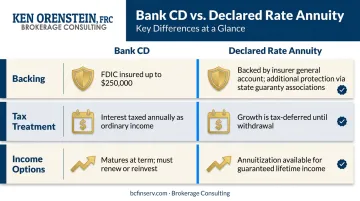
They share surface similarities — both offer fixed returns for a set period — but differ in important ways:
- Backing: CDs are FDIC-insured up to $250,000 per depositor per bank. Annuities are backed by the insurer's general account and state guaranty associations (many states provide $250,000 in annuity-benefit coverage through these associations — but this is not FDIC insurance)
- Tax treatment: CD interest in a non-IRA account is taxable annually per IRS Publication 550. Declared rate annuity growth is tax-deferred until withdrawal
- Income options: CDs are term deposits — they mature and renew. Annuities include annuitization options that can convert accumulated value into guaranteed lifetime income
"A lower declared rate at renewal means the contract is failing"
Rate reductions at renewal reflect broader interest rate conditions, not insurer instability. During the near-zero rate environment from roughly 2010 to 2021, declared rates across the industry dropped sharply. That was a market reality, not a sign of carrier trouble.
That said, a meaningful rate drop does warrant a closer look, especially once the surrender period has ended. A 1035 exchange lets you move from a below-market contract into a higher-yielding product without triggering taxes on accumulated gains, per IRS Revenue Ruling 2007-24. Brokerage Consulting includes this analysis as part of its annuity advisory process.
Conclusion
The declared rate is the central mechanism in a fixed annuity contract — it determines how much your money grows each year, resets on a schedule, can move in either direction, and is bounded by a contractual floor that represents the true long-term guarantee.
Understanding how that rate is set, what triggers a reset, and what your options are when renewal rates shift gives you a clear basis for deciding whether this product belongs in your retirement plan.
Working with an independent advisor who can compare current declared rates across multiple top-rated carriers and align the product to your income timing, liquidity needs, and tax situation makes a meaningful difference in the outcome.
Brokerage Consulting offers no-cost initial consultations — phone, virtual, or in-person — to help individuals, federal employees, and retirees assess whether a declared rate fixed annuity fits their financial picture. Reach Ken Orenstein at (888) 315-3608 or through bcfinserv.com.
Frequently Asked Questions
How does a declared rate fixed annuity work?
The insurer sets a guaranteed interest rate for a defined period — typically one year — and credits that rate to the account value on a tax-deferred basis. At the end of the term, the insurer declares a new rate for the next period, subject to a contractual minimum floor that prevents the rate from falling below a set level.
Who would you recommend a declared rate fixed annuity to?
This product suits conservative savers, retirees, and near-retirees who want guaranteed principal protection and tax-deferred growth without equity market exposure. It's especially well-matched for those who prefer annual rate flexibility over committing to a locked multi-year rate.
Can the declared rate change every year?
Yes. In a traditional declared rate annuity, the rate typically renews annually and can go up or down based on the insurer's assessment of current market conditions. It can never fall below the contractual minimum guaranteed floor stated in the contract.
How is a declared rate annuity different from a MYGA?
A MYGA locks in a fixed rate for the entire contract term — commonly 3, 5, or 7 years. A declared rate annuity renews its rate periodically, typically each year. That means more flexibility, but also exposure to rate changes at each renewal.
Are declared rate fixed annuities safe?
These products carry low risk, backed by the insurer's general account and state insurance guaranty associations. Contractual principal protection ensures the account value cannot decline due to market performance — though they are not FDIC-insured like bank deposits.
What happens if the insurance company significantly lowers the declared rate at renewal?
The rate can never fall below the contractual minimum floor. If the surrender period has ended, the policyholder can compare alternative products — including a 1035 exchange into a higher-rate annuity — without triggering taxes on accumulated gains.