
That's exactly what a fixed annuity does. Unlike stocks or mutual funds, where you absorb every market swing personally, a fixed annuity shifts the burden of investment performance to a regulated insurance company. The question isn't whether you'll earn a return — it's guaranteed. The real question is understanding who is responsible for what, and where your exposure genuinely lies.
For retirees prioritizing income certainty over growth, that distinction matters more than almost anything else in a retirement plan.
Key Takeaways
- The insurance company — not you — bears all investment risk in a fixed annuity
- Your guaranteed rate is contractually locked in, no matter how the insurer's own portfolio performs
- You retain three risks: inflation erosion, insurer insolvency (counterparty risk), and liquidity constraints from surrender charges
- Fixed annuities contrast with variable annuities, where the owner absorbs all market risk
- Selecting a financially strong insurer is the most critical decision a fixed annuity buyer makes
The Simple Answer: The Insurance Company Bears It All
In a fixed annuity contract, the insurance company assumes all investment risk. Once you hand over your premium, the obligation to generate the promised return shifts entirely to the insurer. According to FINRA, the insurance company guarantees both the rate of return and the payout — meaning any shortfall between what the insurer earns on its investments and what it promised you is the insurer's problem to solve, not yours.
What "Investment Risk" Actually Means Here
In a stock portfolio or mutual fund, investment risk means your account value can fall below what you put in. If the market drops 30%, your balance drops 30%. You absorb the shortfall.
In a fixed annuity, that dynamic reverses. The insurer promises a specific rate — or at minimum, a guaranteed floor — and must deliver it regardless of what its own portfolio does. The institution absorbs any underperformance — not you.
That's a meaningful structural difference. A fixed annuity is a legal contract, not a market position — and the insurer's financial strength is what stands behind the guarantee.
The Transfer of Risk Framework
Buying a fixed annuity is a deliberate trade:
- You give up potential for higher market returns
- You receive a contractually guaranteed floor, principal protection, and income certainty
- The insurer takes on full responsibility for funding that guarantee — regardless of how its own portfolio performs
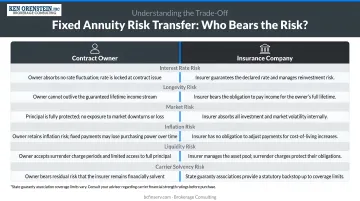
Your principal is also protected. Unlike a brokerage account where your balance can fall below your original deposit, a fixed annuity preserves what you put in — as long as you hold to term and avoid early withdrawals.
Because the insurer's balance sheet backs every guarantee, evaluating the carrier's financial strength ratings — from agencies like AM Best or Moody's — becomes the central due diligence step before signing any contract.
How Insurance Companies Manage the Risk They've Taken On
When you pay your premium, the insurer places it into what's called the General Account — a pooled portfolio shared across all policyholders, invested on your behalf by the institution.
What's Actually In the General Account
NAIC's 2024 Life Industry Report shows that U.S. life insurers held $6.1 trillion in general account assets at year-end 2024. The investment mix is deliberately conservative:
| Asset Class | Share of Portfolio |
|---|---|
| Bonds | 67.6% |
| Mortgage loans | 14.0% |
| Cash and short-term investments | 3.5% |
| Other (BA assets, derivatives, etc.) | 14.9% |
95.1% of the bond portfolio is investment grade — meaning insurers aren't reaching for yield in junk bonds. They're holding high-quality corporate bonds, government securities, and mortgage-backed instruments that align with their long-dated liabilities.
The Spread Model and Reserve Requirements
Insurers profit through a simple mechanism: they earn a return on their general account that exceeds the guaranteed rate they promised you. If they promised 4% and earn 5%, they keep the difference.
If their portfolio underperforms, they must draw on reserves to honor the contract. State regulations — overseen by the National Association of Insurance Commissioners (NAIC) — dictate what insurers can invest in, how much in reserves they must hold, and how much risk-based capital insurers must maintain. These rules exist precisely to prevent insurers from making aggressive bets with policyholder money.
If an Insurer Fails: The Guaranty Association Backstop
Because the insurer bears all investment risk, your key residual exposure is whether the insurer stays solvent. Every state has a Life and Health Insurance Guaranty Association that steps in when a licensed insurer is liquidated.
Coverage limits vary by state — most cover up to $250,000 in present value of annuity benefits, but several states go higher:
- Connecticut, New York, Utah, Washington: $500,000
- Arkansas, DC, Oklahoma, South Carolina, Wisconsin: $300,000
- California: 80% of contract value, capped at $250,000

The guaranty association provides meaningful protection, but it has limits. Concentrating a large sum with a lower-rated insurer and expecting the association to cover the shortfall is not a sound approach — carrier financial strength still matters.
Risks the Annuity Owner Still Carries
The insurance company absorbs investment risk — but that doesn't mean you're entirely risk-free. Three specific risks remain on your side of the contract.
Inflation Risk (Purchasing Power Erosion)
This is the primary risk you keep. A fixed annuity pays a guaranteed dollar amount, but what those dollars buy can shrink if inflation outpaces your rate.
Consider the recent inflation picture from the Bureau of Labor Statistics:
- 2021: 7.0%
- 2022: 6.5%
- 2023: 3.4%
- 2024: 2.9%
If your annuity pays 3% and inflation runs at 5%, your real purchasing power declines every year. Over a 20-year retirement, that erosion adds up significantly.
Some annuities offer inflation-adjusted riders — including COLA options at 1%, 2%, 3%, or CPI-linked increases — but they come at a cost: lower initial payments. Ken Orenstein at Brokerage Consulting evaluates inflation-adjusted SPIA structures for clients where protecting purchasing power takes priority over maximizing early income.
Counterparty (Insurer Insolvency) Risk
Even with guaranty associations as a backstop, insurer insolvency can mean delays in claims processing or partial recovery if your balance exceeds the state coverage limit. Insurer financial strength ratings are the most direct measure of guarantee durability — not a formality, but a core part of evaluating any annuity contract.
Liquidity and Surrender Risk
Fixed annuities are not liquid. Accessing funds early typically triggers:
- Surrender charges from the insurer (e.g., a 10-year schedule might run 9-8-7-6-5-4-3-2-1-0%)
- A 10% IRS early withdrawal penalty on taxable amounts if you're under age 59½
Most contracts allow a free withdrawal of roughly 10% of contract value per year without penalty — but full liquidity requires waiting out the surrender period. If your financial situation changes before the surrender period ends, you'll face real costs to access your own money.
Fixed vs. Variable Annuities: Who Bears What
The risk allocation between these two product types is fundamentally different.
| Feature | Fixed Annuity | Variable Annuity |
|---|---|---|
| Who bears investment risk | Insurance company | You (the owner) |
| Principal protection | Yes | No — can lose principal |
| What drives the return | Insurer's general account | Sub-account investment performance |
| Trade-off | Give up upside; gain certainty | Keep upside; absorb all downside |
| Best suited for | Retirees prioritizing income certainty | Higher-risk-tolerance investors with guaranteed income base |
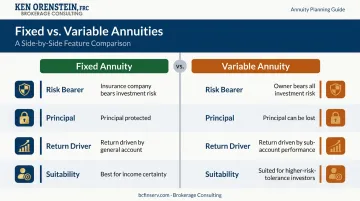
That trade-off plays out directly in how each product behaves. Variable annuities allocate premiums into sub-accounts similar to mutual funds. If those funds drop, your account balance drops. The potential for higher growth is real, but so is the potential for meaningful loss.
Fixed indexed annuities (FIAs) sit between the two. Returns are tied to a market index (like the S&P 500), with a floor that prevents losses and a cap that limits gains. Principal is protected, but growth varies depending on index performance. Regulators classify them as fixed insurance products because the floor holds, though they behave differently than a straight fixed annuity.
For clients who've already secured a base of guaranteed income through Social Security or a pension, variable annuities can serve a supplemental role. For retirees whose primary concern is that income shows up reliably every month, fixed annuities are the more suitable structure. That's the client Brokerage Consulting works with most — and it shapes how Ken Orenstein evaluates every annuity recommendation.
How to Evaluate an Insurance Company's Financial Strength
With fixed annuities, your guaranteed return is only as reliable as the company backing it — which makes carrier financial strength a critical factor in any annuity decision.
What the Rating Agencies Actually Tell You
Four independent agencies evaluate insurer financial strength. Here's what their A-range ratings mean in plain terms:
| Agency | Rating | Meaning |
|---|---|---|
| AM Best | A++ / A+ | Superior ability to meet obligations |
| AM Best | A / A- | Excellent ability to meet obligations |
| S&P | AA | Very strong financial security |
| S&P | A | Strong financial security |
| Moody's | Aa | Excellent financial security |
| Moody's | A | Good financial security |
| Fitch | AA | Very high credit quality |
| Fitch | A | High credit quality |
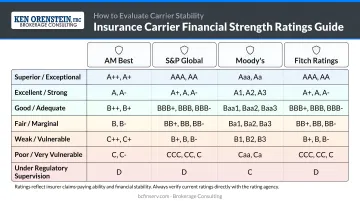
No single agency tells the full story, and ratings are opinions rather than guarantees — comparing across multiple agencies gives a more complete and reliable picture.
Brokerage Consulting's Approach to Carrier Evaluation
In every annuity consultation, Ken Orenstein reviews AM Best, S&P, Moody's, and Fitch ratings alongside the guaranteed rate — because a higher rate from a lower-rated carrier may not be the better deal.
As an independent broker representing multiple top carriers, Brokerage Consulting can compare financial strength and rates across the market rather than steering clients toward any single company's product. That independence matters when the guarantee is only as good as the institution backing it.
Frequently Asked Questions
Who bears the investment risk in a fixed annuity?
The insurance company bears all investment risk. The insurer is contractually obligated to pay the guaranteed interest rate and payout regardless of how its own portfolio performs — any shortfall is the insurer's obligation to cover from its reserves.
What risks does the annuity owner still carry in a fixed annuity?
Owners retain three risks:
- Inflation risk — fixed payments lose purchasing power if inflation outpaces the guaranteed rate
- Counterparty risk — insurer insolvency, even with state guaranty associations as a backstop
- Liquidity risk — surrender charges for early withdrawal and a potential 10% IRS penalty before age 59½
What happens to my fixed annuity if the insurance company fails?
State Life and Health Insurance Guaranty Associations provide coverage when a licensed insurer is liquidated — most states cover up to $250,000 in present value of annuity benefits, though limits vary (some states go to $500,000). Checking a carrier's AM Best or Standard & Poor's rating before purchasing is a practical first step, not an afterthought.
How is a fixed annuity different from a variable annuity in terms of risk?
In a variable annuity, you bear all investment risk through market-linked sub-accounts — your balance can fall below what you contributed. In a fixed annuity, the insurer assumes that risk and guarantees both the rate of return and your principal, as long as you hold to term.
Does the insurance company guarantee my principal in a fixed annuity?
Yes. Your principal is protected in a fixed annuity as long as you hold the contract to term and don't make early withdrawals that trigger surrender charges. "Hold to term" typically means completing the surrender charge period, which ranges from 3 to 10 years depending on the contract.
Is a fixed annuity a good choice for retirees who want to avoid market risk?
Fixed annuities suit retirees who prioritize income certainty and principal protection over growth. The key trade-off is inflation risk — fixed payments can lose real purchasing power over a long retirement. Ken Orenstein at Brokerage Consulting offers no-cost consultations to match the right structure to your income needs — call (888) 315-3608 or visit bcfinserv.com.