
For many people in exactly this position, the answer is a single premium deferred annuity (SPDA). This article breaks down what an SPDA is, how it works, the real benefits and drawbacks, and who it's actually suited for — so you can decide whether it belongs in your retirement plan.
TL;DR: Key Takeaways
- An SPDA is funded with one lump-sum payment and grows tax-deferred until you're ready to receive income
- SPDAs come in fixed, variable, and indexed forms, each with different risk and return profiles
- Benefits include tax-deferred compounding, no IRS contribution limits on non-qualified contracts, and optional lifetime income
- Trade-offs to weigh: limited liquidity during the surrender period, potential fees, and ordinary income tax on withdrawals
- Best suited for people 5–15 years from retirement with a large lump sum they don't need immediate access to
What Is a Single Premium Deferred Annuity?
A single premium deferred annuity is a contract between you and an insurance company. You make one upfront lump-sum payment, the money grows tax-deferred during an accumulation phase, and then at a future date you choose, it converts to income.
Two features define the product right in its name:
- "Single premium" — one payment, not ongoing contributions
- "Deferred" — income payments are delayed, often until retirement, rather than starting immediately
How It Compares to Similar Products
| Product | Funding | When Income Starts |
|---|---|---|
| Single Premium Deferred Annuity (SPDA) | One lump sum | Future date you choose |
| Flexible Premium Deferred Annuity | Multiple contributions over time | Future date you choose |
| Single Premium Immediate Annuity (SPIA) | One lump sum | Almost immediately (within 12 months) |
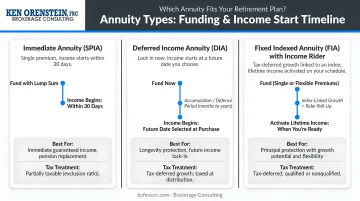
The SPDA is purpose-built for long-term accumulation. If you need income right away, a SPIA fits better. If you want to contribute gradually over time, a flexible premium annuity makes more sense.
Qualified vs. Non-Qualified SPDAs
Tax treatment depends on how the annuity is funded:
- Qualified SPDA — purchased with pre-tax dollars (via an IRA or 401(k) rollover). The entire distribution is taxed as ordinary income at withdrawal.
- Non-qualified SPDA — purchased with after-tax dollars. Only the earnings portion is taxed at withdrawal; your original principal comes back tax-free.
SPDAs are insurance products regulated by state insurance departments — not FDIC-insured bank deposits. A few things to know before purchasing:
- State guaranty associations serve as a safety net if an insurer fails. NOLHGA reports all member associations cover at least $250,000 in annuity benefits per resident policyholder.
- Check the issuer's financial strength ratings from A.M. Best, Moody's, or S&P before committing.
How a Single Premium Deferred Annuity Works
The SPDA lifecycle moves through three phases:
- Purchase — you make a single lump-sum payment to the insurer
- Accumulation — the money grows tax-deferred based on the contract type (fixed rate, market-linked, or index-linked)
- Income phase — at your chosen date, you select how to receive payouts
Types of SPDAs
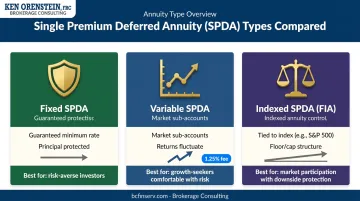
Growth mechanics differ across the three main types:
Fixed SPDA — the insurer guarantees a minimum interest rate; your principal and growth are protected. LIMRA reported $164.9 billion in fixed-rate deferred annuity sales in 2023 — more than triple the $53.1 billion sold in 2021 — driven largely by rising interest rates. Best for: risk-averse investors who prioritize certainty.
Variable SPDA — your premium is invested in sub-accounts similar to mutual funds; returns fluctuate with market performance. The SEC notes a typical mortality and expense charge of 1.25% of account value annually, plus administrative fees. Best for: investors comfortable with market risk seeking higher long-term growth potential.
Indexed SPDA (FIA) — growth is tied to a market index like the S&P 500, with a floor protecting against losses but a cap or participation rate limiting upside. FINRA explains that crediting formulas using participation rates, caps, and spreads can be complex — confirm exactly how each formula calculates your credited interest before signing. Best for: investors who want market participation with downside protection.
Payout Options
When you're ready to start collecting, you choose from three payout structures:
- Lump-sum distribution — withdraw the full contract value at once
- Systematic withdrawals — take distributions over a specified period
- Annuitization — convert the contract value into a guaranteed income stream, which can be structured as:
- Straight life — payments for as long as you live
- Life with period certain — payments guaranteed for a minimum period (e.g., 10 years), continuing to a beneficiary if you die early
- Joint and survivor — payments continue until both you and a named co-annuitant have passed
Of course, not everyone reaches the income phase on schedule. Most SPDAs address this with a death benefit: if you die during the accumulation phase, a named beneficiary receives the remaining contract value — making the SPDA a useful estate planning tool as well.
Key Benefits of a Single Premium Deferred Annuity
Tax-Deferred Growth
During the accumulation phase, earnings compound without annual tax drag. Unlike a taxable brokerage account — where dividends and capital gains are taxed each year — SPDA growth is untouched until withdrawal.
Over a 10–15 year horizon, this difference adds up, especially if you expect to be in a lower tax bracket in retirement.
No IRS Contribution Limits on Non-Qualified Contracts
For 2025, IRA contributions are capped at $7,000 ($8,000 if you're 50 or older), and 401(k) elective deferrals are limited to $23,000. Non-qualified SPDAs have no IRS-imposed annual premium limit — you can deposit a $500,000 inheritance or pension payout in a single transaction. For anyone moving a pension buyout, inheritance, or proceeds from a business sale into a tax-deferred vehicle, that flexibility is hard to match.
Guaranteed Lifetime Income
Through annuitization, you can convert an SPDA into income you cannot outlive. Transamerica's 2024 research found 32% of retirees cite outliving their savings as one of their greatest fears. No purely market-based vehicle can contractually replicate that guarantee.
Optional Riders
For added protection (at additional cost), many contracts offer:
- Guaranteed minimum withdrawal benefits (GLWB)
- Guaranteed minimum income benefits (GMIB)
- Long-term care or nursing home waivers
- Living benefit riders typically carry annual fees of 1.0–1.5% on the income base — weigh that cost against the specific protection before adding one
Potential Drawbacks to Consider
Limited Liquidity and Surrender Charges
Once your lump sum is deposited, those funds are largely locked in during the surrender period — commonly six to ten years. The SEC's variable annuity guide gives a representative example: a 7% surrender charge in year one, declining by one percentage point annually until it reaches zero after year seven.
Most contracts allow penalty-free withdrawal of up to 10% of contract value per year, but beyond that, charges apply. On top of surrender penalties, IRS Publication 575 confirms that withdrawals before age 59½ are subject to an additional 10% early withdrawal tax on the taxable portion.
Fees and Inflation Risk
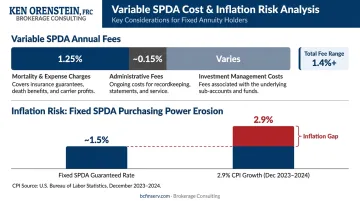
Variable SPDAs carry layered fees that add up over time:
- Mortality and expense charges: ~1.25% annually
- Administrative fees: ~0.15% or a flat $25–$30 per year
- Investment management costs: vary by sub-account selection
For fixed SPDAs, the guaranteed rate may not keep pace with inflation. The BLS reported 2.9% CPI growth from December 2023 to December 2024 — a locked-in rate below that quietly erodes real purchasing power.
Tax Treatment at Withdrawal
Tax deferral does not mean tax-free. Withdrawals from an SPDA are taxed as ordinary income — not at the lower long-term capital gains rate. For non-qualified contracts, IRS Publication 575 clarifies that withdrawals are allocated to earnings first, meaning you'll pay taxes before recovering your principal. That makes distribution timing consequential: coordinating SPDA withdrawals with Social Security income, other taxable sources, and potential Roth conversions can meaningfully reduce your tax bill in retirement.
Who Should Consider a Single Premium Deferred Annuity?
The SPDA is well-matched to a specific profile. Strong candidates include:
- Someone 5–15 years from retirement with a large, accessible lump sum (401(k) rollover, pension buyout, inheritance, or property sale)
- Investors who've maxed out IRA and 401(k) contributions and want additional tax-deferred growth
- Those seeking a contractually guaranteed future income stream, especially those without a pension
LIMRA notes the average fixed-rate deferred annuity buyer is 62, and that households transferred $670 billion from employer-sponsored plans to traditional IRAs in 2022 alone — a significant pool of potential SPDA candidates. Of those rolling over, 85% transferred their entire account balance in one transaction.
An SPDA is less appropriate for:
- Individuals who may need near-term liquidity or face unpredictable expenses
- Early-career investors with decades to allocate to higher-growth vehicles
- Anyone committing their entire retirement savings to a single annuity with no other accessible assets
For federal employees specifically, the SPDA is a natural fit for TSP rollover funds at retirement, converting an accumulated lump sum into guaranteed income that supplements FERS or CSRS pension payments.
Because SPDAs vary significantly across carriers in rates, surrender schedules, rider options, and financial strength, working with a qualified retirement advisor before purchasing is a smart step. Ken Orenstein at Brokerage Consulting works with federal employees, individuals, and seniors to evaluate annuity products as part of a tax-efficient retirement strategy, with no-cost initial consultations available at (888) 315-3608 or bcfinserv.com.
Frequently Asked Questions
Do I have to pay taxes on a deferred annuity?
Not during the accumulation phase — growth is tax-deferred. When withdrawals begin, taxes depend on how the annuity was funded: qualified contracts (pre-tax dollars) are fully taxable at distribution, while non-qualified contracts tax only the earnings portion. Either way, distributions are taxed as ordinary income, not capital gains.
What is the difference between a single premium and a flexible premium deferred annuity?
A single premium deferred annuity requires one upfront lump-sum payment. A flexible premium deferred annuity allows the owner to contribute multiple payments over time. Both defer income to a future date; the difference is purely in how the contract is funded.
Can I withdraw money from a single premium deferred annuity early?
Yes, but it typically comes with costs. Surrender charges apply during the surrender period (often 6–10 years), and a 10% IRS early withdrawal penalty applies if you're under 59½. Most contracts allow penalty-free withdrawals of up to 10% of contract value annually.
What happens to my SPDA if I die before payouts begin?
Most SPDAs include a death benefit provision. If you die during the accumulation phase, a named beneficiary receives the remaining contract value per the contract's terms. This makes the SPDA useful for estate planning, not just retirement income.
Is a single premium deferred annuity the same as a CD?
No. Both offer fixed returns and protect principal, but they're structured differently. CDs are FDIC-insured bank deposits; SPDAs are insurance contracts with no federal deposit insurance. SPDAs also provide tax deferral on earnings and an option to convert to lifetime income — benefits CDs don't offer.
What is the minimum amount needed to purchase a single premium deferred annuity?
Minimums vary by insurer and contract type. At Brokerage Consulting, the typical deployable lump sum for annuity placement starts at $250,000, though specific carrier minimums differ. Contact Ken Orenstein directly to review minimums for the specific carriers available to you.