Introduction
Imagine you're offered a choice: accept a $150,000 lump sum today, or receive $1,200 per month starting 10 years from now for the rest of your life. Which is worth more?
Most people can't answer that question without a formula. The present value of a deferred annuity converts future payment streams into today's dollars, giving you a single number to compare against any alternative.
This guide is for pre-retirees, federal employees, and anyone evaluating an annuity contract who wants to understand the math — not just take the offer at face value. U.S. retail annuity sales reached $464.1 billion in 2025, with deferred income annuity (DIA) sales alone hitting $4.4 billion — yet most buyers never verify whether the payout is actually worth what they're handing over. This guide walks through the present value formula, the step-by-step calculation, and how to use the result to evaluate a real offer.
Key Takeaways
- A deferred annuity pays out after a deferral period — the present value (PV) tells you what those future payments are worth in today's dollars
- The formula has two stages: calculate PV at the payment start date, then discount that figure back through the deferral period
- Four variables drive the result: payment amount (PMT), discount rate (r), payment periods (n), and deferral length (t)
- Higher discount rates and longer deferral periods both reduce PV sharply
- Ordinary annuities and annuity-due use different formulas; confusing the two produces incorrect results
What Is the Present Value of a Deferred Annuity?
FINRA defines a deferred annuity as a contract where the owner contributes a lump sum or premiums over time, and the payout phase is delayed until a future date. The present value of that annuity answers one specific question: what is the entire future payment stream worth right now, in today's dollars?
The Time Value of Money
Money received today is worth more than the same amount received later, because today's money earns interest. Present value reverses this logic by discounting future payments back to their current worth.
A $1,000 payment arriving in 15 years is not worth $1,000 today. At a 5% discount rate, it's worth considerably less. The PV formula makes that reduction precise.
Deferred vs. Immediate Annuities
With an immediate annuity, payments begin almost right away, and the PV calculation involves discounting one stream of payments. With a deferred annuity, there's a waiting period before payments start at all, which means the math has an additional step:
- Discount the payment stream to its value at the payment start date
- Discount that value further back through the deferral period
Because of this two-stage structure, a standard annuity formula applied without the deferral adjustment will overstate the true present value.
The Deferred Annuity Present Value Formula Explained
The formula reflects the two-stage structure directly. Before any payment arrives, two time segments must be accounted for: the deferral period (Stage 1) and the payment period (Stage 2).
The Formula for an Ordinary Deferred Annuity
For an ordinary deferred annuity (payments at the end of each period — the most common structure in retirement income annuities):
PV = PMT × {[1 − (1 + r)^−n] / r} × (1 + r)^−t
| Variable | Definition |
|---|---|
| PMT | Payment amount per period |
| r | Effective interest/discount rate per period |
| n | Total number of annuity payments |
| t | Number of deferral periods |
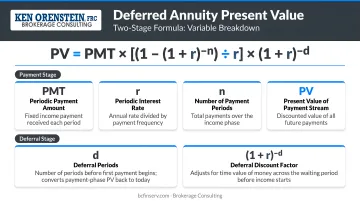
The formula has two working parts:
- PMT × {[1 − (1 + r)^−n] / r} — this is the standard ordinary annuity PV formula. It calculates the value of the entire payment stream at the moment payments begin, not at today's date.
- × (1 + r)^−t — this multiplier discounts that payment-phase value back through the deferral period to arrive at today's present value. Drop this term, and you're calculating what the payments are worth when they start — not what they're worth right now.
The Formula for a Deferred Annuity Due
Not all annuities pay at period-end. When payments occur at the beginning of each period — an annuity due structure — multiply by an additional factor of (1 + r):
PV = PMT × (1 + r) × {[1 − (1 + r)^−n] / r} × (1 + r)^−t
The (1 + r) adjustment shifts every payment one period earlier, which increases the present value. Here's where each version applies:
- Ordinary annuity — retirement income annuities, deferred income annuities (DIAs), QLACs
- Annuity due — lease payments, insurance premiums, certain structured settlement arrangements
If you're evaluating a deferred annuity for retirement income, the ordinary annuity formula is almost always the correct starting point.
How to Calculate the Present Value of a Deferred Annuity: Step-by-Step
Each stage below builds directly on the previous one: you gather your inputs, value the payment stream at its start date, then discount that value back to today.
Step 1: Identify Your Variables
Before running any numbers, pin down your four inputs:
- PMT — the periodic payment amount (e.g., $500/month)
- r — the periodic interest rate. If given an annual rate, divide by the number of payments per year (e.g., 5% annual ÷ 12 = 0.4167% per month)
- n — total number of payments (e.g., 15 years × 12 payments/year = 180)
- t — deferral periods in the same units as r (e.g., 10 years × 12 = 120 months)
The most common error at this step: using an annual rate with monthly periods without converting. This produces a wrong answer.
Step 2: Calculate PV at the Payment Start Date
With your variables confirmed, apply the standard ordinary annuity formula to find what the entire payment stream is worth at the moment payments begin:
PV_annuity = PMT × {[1 − (1 + r)^−n] / r}
Worked example:
- PMT = $500/month
- Annual rate = 5%, so r = 5% ÷ 12 = 0.004167
- Payment period = 15 years, so n = 180
Calculation:
- (1 + 0.004167)^−180 = 0.4741
- 1 − 0.4741 = 0.5259
- 0.5259 ÷ 0.004167 = 126.22
- $500 × 126.22 = $63,110
This $63,110 is the value of the payment stream at the date payments begin — not today's value.
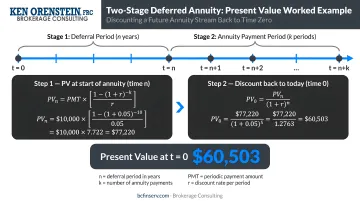
Step 3: Discount Back Through the Deferral Period
Now apply the deferral discount factor:
PV_today = PV_annuity × (1 + r)^−t
Using the same example, with a 10-year deferral:
- t = 10 years × 12 = 120 months
- (1 + 0.004167)^−120 = 0.6083
- $63,110 × 0.6083 = $38,386
The $63,110 shrinks to $38,386 in today's dollars. That gap — roughly $24,700 — represents the cost of waiting a decade to receive the first payment.
Step 4: Verify Timing (Ordinary Annuity vs. Annuity Due)
This step catches a common off-by-one error. Consider a simple timeline:
Today ──── [10-year deferral] ──── Payment Start ──── [15-year payment period] ──── End
- Ordinary annuity: First payment arrives one period after the payment start date. The deferral period ends one period before the first payment.
- Annuity due: First payment arrives on the payment start date.
Getting this wrong shifts every payment by one period, producing a PV that's off by a factor of (1 + r). In this example that's roughly $160 — and on a $500,000 contract, the same timing mistake runs into the thousands.
Key Variables That Affect the Present Value Calculation
Interest/Discount Rate (r)
The discount rate does double work in the deferred annuity formula — it reduces the payment-stream PV and amplifies the deferral discount. A higher rate shrinks both components simultaneously.
At 4%, a 10-year deferral discounts the payment-phase PV to about 67% of its value. At 6%, the same deferral reduces it to roughly 55%. That 2-percentage-point difference costs over 10% of the present value before a single payment has been received.
This is why selecting the correct discount rate matters. Using the annuity contract's guaranteed interest rate, rather than a general market rate, produces a more accurate comparison.
Deferral Period (t)
Every additional year of deferral pushes all payments further into the future, compressing their present value. This is the central trade-off of deferred annuities:
- Longer deferral → larger payments when they begin (roll-up rates accumulate)
- Longer deferral → lower present value today
For QLACs, which commonly begin payments at age 80 or 85, this trade-off is significant. The longevity protection is real, but the present value of that protection, discounted back 15-25 years, is considerably lower than the nominal payment stream suggests.
Payment Amount and Number of Payments (PMT and n)
Larger or more numerous payments increase PV proportionally at the payment-start date. However:
- Fixed at purchase by the annuity contract and cannot be changed after issuance
- Gains from larger PMT can be partially offset by a high deferral discount, especially with long t values
The interplay between n and t matters most when evaluating DIAs or QLACs where the deferral period approaches or exceeds the payment period.
Common Mistakes When Using the Deferred Annuity PV Formula
Overlapping the Deferral and Payment Periods
A 10-year deferral followed by a 15-year payment period means the annuity ends 25 years from now — not 15. These are consecutive, not concurrent. Many people assume the payment period runs parallel to part of the deferral, which shortens their timeline and overstates the present value.
When in doubt, draw a timeline before calculating.
Using the Wrong Interest Rate Format
Two related errors appear frequently:
- Annual rate applied to monthly periods without dividing by 12 — produces a drastically overstated discount and understated PV
- Confusing nominal rate with effective rate — a 6% nominal rate compounded monthly has an effective annual rate of approximately 6.17%
The rate used in the formula must match the payment frequency. Every time.
Assuming PV Equals the Contract Price
The PV formula produces the theoretical present value of the payment stream. What an insurance company charges (the actual premium) is a different number — reflecting mortality assumptions, administrative expenses, profit margin, and conservative reserve requirements.
The gap between theoretical PV and actual premium exists in every annuity contract. As the Society of Actuaries has noted, market annuity prices reflect multiple factors beyond the actuarial present value alone — treat the formula output as a comparison tool, not a price quote.
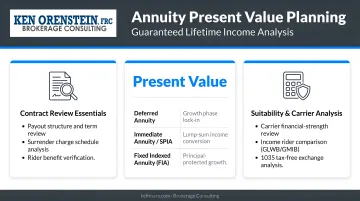
For federal employees balancing FERS pension income, TSP distributions, and deferred annuity options, a Federal Retirement Advisor like Ken Orenstein at Brokerage Consulting can help translate that output into a full retirement income picture.
Frequently Asked Questions
How do you find the present value of a deferred annuity?
Use a two-step process: first, calculate the PV of the payment stream at the date payments begin using the ordinary annuity formula. Then multiply that result by (1 + r)^−t to discount it back through the deferral period to today's date.
What is the difference between a deferred annuity and an immediate annuity?
An immediate annuity begins payments within roughly one month of purchase. A deferred annuity delays payments for a specified deferral period — which lowers the present value but typically results in larger individual payments when income does begin.
What is the deferral period in an annuity?
The deferral period is the gap between when the annuity is purchased and when income payments begin. During this time, no payments are received and the invested funds typically earn interest or accumulate through a guaranteed roll-up rate.
How does the interest rate affect the present value of a deferred annuity?
A higher discount rate lowers the present value, because future payments are discounted more steeply. This effect is amplified when the deferral period is long — even a 1% rate increase can sharply reduce the calculated PV over a 10-15 year deferral.
What is the difference between an ordinary annuity and annuity due in a deferred context?
An ordinary annuity pays at the end of each period; an annuity due pays at the beginning. This shifts the first payment one period earlier, requiring a (1 + r) adjustment factor in the PV formula, which produces a slightly higher present value for the annuity due.
Is calculating PV enough to make a retirement decision?
No. The PV formula doesn't account for inflation, tax treatment, longevity risk, or how the annuity fits within your broader income plan. It's a strong starting point, but a financial or retirement advisor should be involved before making any commitment.