Introduction
Traditional pensions are disappearing fast. According to the Bureau of Labor Statistics, access to defined-benefit plans among private-industry workers fell from 20% in 2010 to just 15% in 2023 — and only 9% of private-industry workers actually participate in one today. That leaves most Americans responsible for building their own guaranteed income from scratch.
The anxiety is real. The 2026 EBRI Retirement Confidence Survey found that only 57% of workers believe their savings will last their lifetime. That concern makes sense given how long retirement can actually last — per SSA actuarial data, a 65-year-old woman today has roughly a 1-in-3 chance of reaching age 90.
Deferred income annuities (DIAs) were built precisely for this problem. They function as longevity insurance: contracts that lock in guaranteed income starting at a future date — often decades away — in exchange for premiums paid today. Unlike savings vehicles, a DIA isn't meant to grow wealth. It's meant to ensure you don't outlive it.
This guide covers how DIAs work, the types available (including QLACs), their key benefits and drawbacks, and who they're best suited for.
Key Takeaways
- DIAs are longevity insurance contracts, not savings accounts — they guarantee income starting at a future date you choose
- The longer you defer, the larger the eventual payout, thanks to compound growth and mortality credits
- QLACs are IRS-recognized DIAs for qualified accounts — the 2026 contribution limit is $210,000, reducing your RMD burden
- Watch for illiquidity, inflation erosion, and insurer financial stability before committing
- DIAs work best as one layer in a broader retirement income strategy
What Is a Deferred Income Annuity and How Does It Work?
A deferred income annuity is a contract between you and an insurance company. You pay a lump sum or a series of premiums today. In return, the insurer promises to pay you a guaranteed income stream starting at a specific future date — often 10, 20, or even 30 years from now.
FINRA describes DIAs as "immediate annuities with a delayed payout phase." That framing is useful: think of a DIA less like a savings account and more like a private pension you fund yourself.
A "deferred annuity" is a broad term that covers accumulation-focused products like fixed deferred annuities and variable annuities. A DIA is narrower — it's specifically designed to generate guaranteed income at a future date, not to grow a cash value you can access freely.
The Two Phases
Every DIA has two distinct phases:
- Deferral phase — Your premium grows tax-deferred. No income is paid. This phase can last anywhere from 2 to 40 years, depending on when you want payments to begin.
- Payout phase — Guaranteed income payments begin on the pre-selected date and continue for life (or a chosen period).
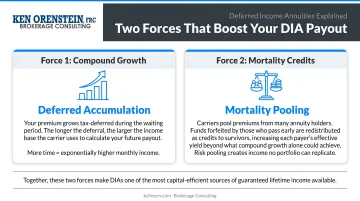
The length of the deferral period directly affects your payout. Two forces amplify income the longer you wait:
- Compound growth — more time means more accumulation before payments begin
- Mortality credits — when policyholders die before collecting, insurers pool their unused premiums and redistribute them to survivors, boosting payouts for those who live longer
DIA vs. Immediate Annuity
| Feature | DIA | Immediate Annuity (SPIA) |
|---|---|---|
| When income starts | Years or decades from now | Within 12 months of purchase |
| Best for | Pre-retirees planning ahead | Current retirees needing income now |
| Payout size | Larger per dollar invested | Smaller (no deferral period) |
The longer the deferral, the more those two forces — compound growth and mortality credits — work in your favor, which is why DIAs can generate meaningfully higher monthly income than a comparable SPIA purchase.
Types of Deferred Income Annuities
Single Premium vs. Flexible Premium
DIAs come in two funding structures:
- Single-premium DIA — One lump-sum payment funds the entire contract. Common for retirees using a rollover or inheritance to lock in future income.
- Flexible-premium DIA — Multiple contributions over time build toward the eventual payout. Useful for pre-retirees who want to gradually shift assets toward guaranteed income.
Qualified Longevity Annuity Contracts (QLACs)
A QLAC is an IRS-recognized DIA purchased inside a qualified retirement account — a 401(k), traditional IRA, 403(b), or eligible governmental 457(b) plan.
The key advantage: funds used to buy a QLAC are excluded from the account balance used to calculate your Required Minimum Distributions (RMDs) until payments begin. That means you can defer both taxes and income well into your 80s.
Current QLAC rules (per IRS Notice 2025-67 and the SECURE 2.0 Act):
- 2026 premium limit: $210,000 (indexed for inflation; the prior $125,000 cap was raised to $200,000 by SECURE 2.0, which also eliminated the old 25% account-balance limit)
- Payments must begin no later than age 85
- QLACs cannot have variable or equity-indexed features — they must be fixed
For federal employees weighing a TSP-to-IRA rollover, QLAC planning is one of the more practical tools for managing RMD exposure — and worth discussing with an advisor before initiating any rollover.
Interest-Crediting Options
Beyond funding structure and tax treatment, the crediting method determines how your money grows during the deferral phase. DIAs fall into three categories:
- Fixed — Guaranteed rate, no market exposure, predictable growth
- Variable — Tied to sub-account investments, carries market risk
- Indexed — Linked to an index like the S&P 500, with downside protection (note: QLACs cannot use variable or indexed crediting)
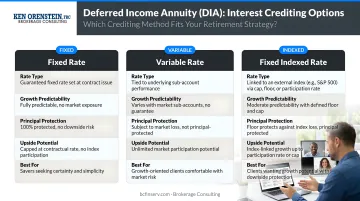
Fixed crediting suits those who prioritize predictability; indexed crediting appeals to pre-retirees who want some growth upside without full market exposure.
Key Benefits of a Deferred Income Annuity
Guaranteed Lifetime Income
The core value of a DIA is simple: income you cannot outlive. Unlike drawing down a portfolio — which can be depleted by bad markets, unexpected expenses, or simply living longer than projected — a DIA transfers that risk to the insurance company.
For retirees without a pension, this is the closest thing to recreating one. The income floor activates in late retirement, when cognitive or physical limitations may make active portfolio management impractical.
Tax-Deferred Growth and Tax Treatment
During the deferral phase, your premium grows without annual income tax. When payments begin, the tax treatment depends on how the DIA was funded:
- Non-qualified DIA: Funded with after-tax dollars. Only the earnings portion is taxable; the principal returned is tax-free under the IRS exclusion ratio.
- Qualified DIA: Funded through an IRA or 401(k). The entire payment is taxable as ordinary income, since no after-tax contributions were made.
In either case, DIA income is taxed as ordinary income — never at the lower capital-gains rate.
Non-Qualified DIAs and Contribution Flexibility
Unlike IRAs and 401(k)s, non-qualified (after-tax) DIAs aren't subject to IRS annual contribution limits. For higher-income individuals who have already maxed out tax-advantaged accounts, a non-qualified DIA can extend tax-deferred growth further — though contribution flexibility is governed by annuity rules rather than retirement-plan caps.
Death Benefit Options
Basic DIAs may not pay heirs if the annuitant dies before income begins. Most insurers offer optional riders to address this:
- Return-of-premium rider — Pays beneficiaries the original premium if you die before collecting
- Period-certain rider — Guarantees a minimum number of payments; if you die early, payments continue to a beneficiary
The trade-off: these riders reduce your monthly income amount. Whether that reduction is worthwhile depends on your beneficiary situation and overall income plan — a comparison Brokerage Consulting works through with clients during the rider review process.
Important Drawbacks and Risks to Know
Illiquidity — The Biggest Constraint
A DIA is generally an irrevocable decision. Once premium is paid, you typically cannot withdraw it as a lump sum. You're trading liquidity for the guarantee of future income.
You must have sufficient accessible savings outside the DIA before committing. Medical expenses, home repairs, and family emergencies don't pause because assets are locked in an annuity contract.
Inflation Erodes Fixed Payments
Most DIA payments are fixed in dollar terms and don't automatically adjust for inflation. Using BLS CPI-U data, a fixed $1,000 monthly payment in 2004 had purchasing power of roughly $602 in 2024 — a 39.8% erosion over 20 years. A 25-year payout period compounds this problem significantly.
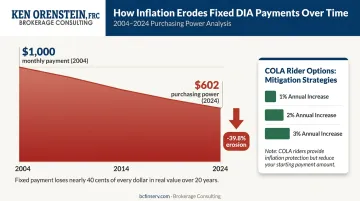
Some insurers offer cost-of-living adjustment (COLA) riders — commonly 1%, 2%, or 3% annual increases. The trade-off: your starting payment is lower when you elect a COLA rider. Per Brokerage Consulting's internal guidance, COLA riders are appropriate for clients who prioritize long-term purchasing power over maximizing initial cash flow.
Ordinary Income Tax Burden
The IRS taxes DIA payments as ordinary income on the earnings portion — not at capital-gains rates. For higher earners, this creates a real cost that can erode net income in retirement. If the DIA is funded through a qualified account, the entire payment is taxable, with no exclusion ratio available.
Insurer Risk
A DIA guarantee is only as strong as the financial stability of the issuing insurance company. If an insurer fails, state guaranty associations provide a backstop — but coverage limits vary. NOLHGA reports that most member guaranty associations cover $250,000 or more in annuity benefits, with deferred annuity coverage commonly at $250,000.
Before placing any annuity, Ken Orenstein reviews insurer ratings from AM Best, Moody's, S&P, and Fitch — a documented step in the practice's suitability review. If you're close to or over a guaranty association's coverage limit with a single carrier, splitting premium across two highly rated insurers is a straightforward mitigation strategy.
Who Should Consider a Deferred Income Annuity?
The Ideal Candidate
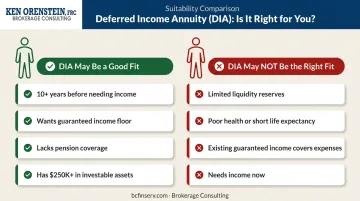
A DIA tends to work best for someone who:
- Has 10+ years before needing income
- Wants guaranteed income to supplement — not entirely replace — Social Security and other assets
- Lacks pension coverage and wants a reliable income floor in their 80s
- Has minimum investable assets around $250,000 and can commit a portion without jeopardizing liquidity
Federal employees with FERS benefits are one group where a layered approach makes particular sense. FERS provides a pension base, Social Security adds another layer, and a DIA or QLAC can cover additional late-retirement expenses when other income sources may fall short. Ken Orenstein's practice integrates DIA and QLAC strategies into federal retirement income planning, including TSP-to-IRA rollover analysis and Social Security timing coordination.
For federal employees considering a TSP rollover to an IRA, a QLAC funded from that rollover could simultaneously reduce RMD exposure and lock in guaranteed income starting at age 80 or later — a dual benefit not available through most other retirement vehicles.
When a DIA Is NOT the Right Fit
DIAs aren't suited for everyone. Consider alternatives if:
- You may need liquidity for healthcare costs or unexpected expenses and lack sufficient outside reserves
- You're in poor health — if life expectancy is limited, you may not collect enough payments to justify the premium
- Your existing guaranteed income (Social Security + pension) already covers essential expenses
- You need income now, not in a decade or more — in that case, a SPIA or FIA with a GLWB rider may be more appropriate
Getting the Analysis Right
Choosing the right DIA involves more than comparing payout rates. Carrier financial strength, payout structure, rider selection, deferral period, tax classification, and how the DIA fits within your broader income strategy all matter.
Ken Orenstein at Brokerage Consulting specializes in guaranteed lifetime income planning and represents multiple top carriers. A no-cost consultation can evaluate whether a DIA, QLAC, or another annuity structure fits your situation. Reach out at (888) 315-3608 or visit bcfinserv.com.
Frequently Asked Questions
Are deferred income annuities a good idea?
For people without pension coverage who want guaranteed income in late retirement, DIAs can be a strong tool. Suitability depends on health, liquidity needs, and existing income sources. They're most effective as one component of a broader retirement income plan, paired with liquid savings and other income sources.
How long does a deferred annuity last?
The payout phase lasts the annuitant's lifetime if structured as a life annuity, or a set term if a period-certain option is chosen. The deferral phase (before payments begin) can range from a few years to several decades, depending on purchase date and when income is scheduled to start.
What is a QLAC and how does it differ from a regular DIA?
A QLAC is a DIA purchased inside a qualified retirement account (401(k) or IRA). Funds used to buy a QLAC are excluded from RMD calculations until payments begin, up to the 2026 IRS limit of $210,000. That makes it a useful tool for deferring taxes while securing late-retirement income.
What are institutional annuities?
Institutional annuities are group contracts purchased by employers or pension plan sponsors on behalf of employees, typically at lower cost than retail annuities. Unlike individual DIAs, access comes through an employer's plan decision rather than a direct purchase.
Can you lose money in a deferred income annuity?
With a fixed DIA, the payout is guaranteed and principal is protected. The real risk is opportunity cost: if you die before collecting sufficient payments and have no death benefit rider, the premium may not be recovered. Variable DIAs carry market risk and could lose value during the deferral period.
How is a deferred income annuity taxed?
For non-qualified DIAs funded with after-tax dollars, only the earnings portion of each payment is taxable as ordinary income; the returned principal is tax-free under the exclusion ratio. For qualified DIAs (IRA or 401(k) funds), the entire payment is taxable as ordinary income when received.