
FIA sales hit $128.2 billion in 2025, marking five consecutive years of growth — so client interest is real. The challenge isn't demand; it's communication.
This guide gives financial advisors a practical, step-by-step framework for presenting FIAs in a way that builds trust, resonates with clients, and moves the conversation forward without overwhelming them.
Key Takeaways
- Start with the client's goals and fears, not product mechanics
- Explain a FIA using three concepts only: principal protection, index-linked growth, locked-in gains
- Present one crediting method clearly with real numbers; leave the others out
- Walk through the product illustration packet to show real scenarios across market cycles
- Close with a question: "Which of these benefits matters most to you right now?"
Step 1: Start With the Client's Goals, Not the Product
Before you say the words "fixed indexed annuity," pause. Restate what you already know about the client — their timeline, income needs, and what keeps them up at night financially. This signals that what follows is a personalized recommendation, not a canned pitch.
Ground the Conversation in Real Fears
Most clients sitting across from an advisor aren't thinking in product categories. They're thinking about specific fears. According to 2025 EBRI/Greenwald Retirement Confidence Survey data:
- 71% of workers worry the stock market will be volatile and unpredictable
- 46% of retirees spend less than they could because they fear running out of money
- 56% of workers say healthcare costs are already undermining their ability to save
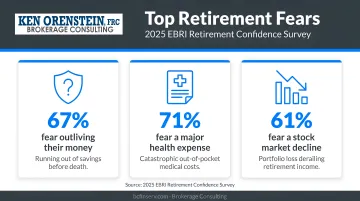
Use a short checklist of common retirement concerns to anchor the discussion. Ask clients to identify which ones feel most urgent:
- Outliving their money
- Market losses near or in retirement
- Needing access to funds for healthcare or long-term care
- Leaving something behind for family
This isn't a survey — it's a focusing exercise. When clients name their own concerns, the product recommendation that follows feels like a response to their situation, not a sales script.
The Federal Employee Context
Advisors who work with federal employees face a specific version of this conversation. FERS and CSRS retirees often have pension income covering baseline expenses, but that doesn't mean they're financially secure. The gap is usually in supplemental growth and longevity protection — covering what the pension doesn't.
Ken Orenstein at Brokerage Consulting applies this needs-first approach across all client types — federal retirees, seniors, and pre-retirees alike. Recommendations start with the client's income gaps and concerns, not with product features.
Only after the client has articulated their concerns should you introduce the product: "Based on what you've told me, I want to walk you through something that addresses several of these at once." That framing makes the FIA feel like a direct answer — because, at that point, it is.
Step 2: How to Explain a FIA in Plain Language
The name itself is the obstacle. "Fixed indexed annuity" sounds like three things that don't go together. Break it apart.
The Three-Word Explanation
| Word | Plain Meaning |
|---|---|
| Fixed | Your principal is protected from market losses |
| Indexed | Growth is linked to a market index like the S&P 500 |
| Annuity | A contract with an insurance company that can provide income |
Three words, three ideas. Stop there for now.
Anchor to Something Familiar
Connect the FIA to something the client already understands:
- If they have a CD or MYGA: explain a FIA works similarly for principal protection, but offers more growth potential when markets perform well
- If they have money in the market: contrast the downside exposure they currently face with the floor a FIA provides
The NAIC defines fixed indexed annuities as contracts where the interest rate is guaranteed never to be less than zero — even if the market index declines. That's the core protection. The client is not directly investing in the market — they're earning interest based on index performance. That distinction matters when explaining where the protection actually comes from.
The Three-Step Growth Concept
Walk through this slowly, pausing after each step:
- Your principal is protected — if the market falls, your account doesn't drop
- When the market rises, your account earns interest based on that performance, up to a defined limit
- Gains are locked in at the end of each period — a future downturn can't take them back
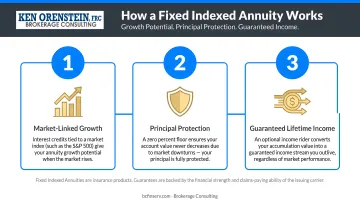
Use a real scenario to make it tangible. A 65-year-old retiree with $100,000 who can't afford market losses but doesn't want her money sitting in a low-yield CD: in a good year, she earns interest tied to the index. In a bad year, she earns zero — but she also loses nothing. Her principal stays intact.
Write these steps on paper or a simple handout while you talk. Clients absorb the concept faster when they can follow along visually — not just listen.
Step 3: Presenting Key FIA Features Without Overwhelming Your Client
Here's where most presentations go wrong: advisors try to explain everything. Caps, participation rates, spreads, multiple indexing methods, income riders, tax deferral — all in one meeting. Clients don't absorb it. They shut down.
Pick One Crediting Method — and Stick With It
Choose the method that applies to the specific product you're recommending. Explain it once, clearly, with real numbers.
Participation rate example: "If the market goes up 10% and the participation rate is 85%, you earn 8.5%. You don't get all of the upside — but you also don't get any of the downside."
One method, one example, one outcome. Don't introduce caps and spreads and participation rates in the same conversation unless the client specifically asks.
Lead With the Floor
Repeat this more than once: "Zero is your floor."
If the index declines, the client's account stays flat. They earn nothing for that period — but they lose nothing. NAIC confirms that once interest is credited at the end of an index term, those gains are locked in and cannot be reversed by subsequent market declines. That's the central protection, and it deserves emphasis.
Cover Tax Deferral Briefly
Unlike a taxable CD or savings account, FIA interest compounds without being taxed each year. Taxes apply only when withdrawals are taken. A simple illustration makes this tangible: show $100,000 growing at 4% over 15 years in a taxable account versus a tax-deferred account. That comparison lands without turning the meeting into a tax seminar.
Income Riders: Only If Relevant
If the client has expressed concern about outliving their money, briefly introduce income riders. Many FIAs offer an optional guaranteed lifetime withdrawal benefit (GLWB) that pays income regardless of market performance — a supplement to Social Security or a pension.
Keep this section short. Cover only what's relevant to that client:
- What the GLWB guarantees (income for life, regardless of account value)
- The typical rider cost (often 1.0–1.5% of the income base annually)
- How it complements — not replaces — other income sources
Only go here if it directly addresses what the client told you in Step 1.
Step 4: Handling Objections and the Risk Spectrum Conversation
Anticipate objections before they arise. Clients rarely voice every concern — they just stop engaging.
The Three Most Common Objections
"What if the market crashes?" Point to the principal protection floor. The client's account doesn't lose value due to index performance — that's the core of what FIAs offer. This objection is usually the quickest to resolve.
"What if I need my money?" Most FIAs allow free withdrawals of up to 10% of account value per year without surrender charges, per NAIC. Many contracts also include exceptions for nursing home confinement or terminal illness. Be specific about the product you're recommending.
"This seems too complicated." Pull back and return to the three concepts from Step 2. Cover only the features relevant to what the client said they need. When a client says "too complicated," the presentation has gone too deep — reset and re-anchor to their stated goals.
Use a Risk Spectrum Visual
Once objections are addressed, a risk spectrum visual reinforces the positioning. Show clients where FIAs sit relative to other products:
- Above the line (principal at risk): Stocks, mutual funds, variable annuities
- FIAs: Principal protected, growth potential linked to index performance
- Below (limited growth potential): CDs, bank money markets, savings accounts
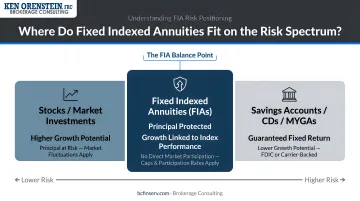
Morningstar notes that FIAs carry more upside potential than fixed-rate annuities but limit downside because the account balance cannot decrease due to index performance. This positioning is useful for clients comparing FIAs to both CDs and market investments simultaneously.
Be Transparent About Surrender Periods
State this clearly and early: FIAs are long-term products, typically with 5- to 10-year surrender periods. Early withdrawals beyond the free withdrawal amount may incur surrender charges that decrease over time. Clients who need frequent liquidity aren't a good fit — and saying so builds credibility rather than losing the sale.
Step 5: What to Leave Out and How to Close Strong
Resist the Temptation to Explain Everything
Every additional feature you introduce adds cognitive load. The more details you stack, the more likely the client is to feel overwhelmed and delay a decision indefinitely. Pick the one crediting method that applies. Explain it once and move forward.
Pull out the historical illustration from the product packet and walk through it — including the down years. Showing how the product actually behaved across market cycles is more persuasive than any hypothetical, and it demonstrates the floor in action rather than just describing it.
Close With a Question, Not a Pitch
End the presentation with: "Of everything we've covered — the principal protection, the growth potential, the tax deferral, and the income option — which of those matters most to you right now?"
That question helps the client self-identify their priority without feeling pushed. It also surfaces exactly where to focus the follow-up conversation.
Schedule the Follow-Up Before You Leave
Whether the client is ready to complete paperwork or needs time to think, leave the meeting with a specific date and time on the calendar. Before you wrap up:
- If they need to discuss it with a spouse, offer a written summary or a one-page recap of the key points
- If they're close to deciding, confirm the next step explicitly — date, time, and what they need to bring
Leaving without a scheduled next step is where most FIA conversations go quiet.
Frequently Asked Questions
How long should a FIA presentation take?
Most effective presentations run 20–30 minutes: covering client goals, the core three-concept explanation, one product with one crediting method, and a closing question. Long enough to educate, short enough to keep the client engaged throughout.
What are the most common mistakes advisors make when presenting FIAs?
Two stand out: explaining too many features at once (which overwhelms clients and stalls decisions) and leading with the product instead of the client's stated goals (which reads as a sales pitch rather than a recommendation).
Should I always explain caps and participation rates in a FIA presentation?
Explain whichever mechanism applies to the product you're recommending — but only one. Use concrete numbers, not abstract definitions. "If the market rises 10% and your participation rate is 85%, you earn 8.5%" lands far better than a textbook description.
How do I know if a client is a good fit for a fixed indexed annuity?
Ideal FIA clients are near or in retirement, prioritize principal protection over maximum market gains, have a medium-to-long time horizon, and want tax-deferred growth or guaranteed income options. Clients who need frequent liquidity or who want full market participation are typically better served elsewhere.
What visual aids work best in a FIA presentation?
Three tools do the job: a one-pager covering principal protection, index-linked growth, and locked-in gains; a product illustration showing historical scenarios including down years; and a basic risk spectrum chart. Fewer visuals, used well, outperform elaborate slide decks every time.
Can FIAs be appropriate for federal employees?
Yes. Federal employees with FERS or CSRS pension income often have baseline expenses covered, making FIAs a strong complement for tax-deferred supplemental growth and longevity protection. They're particularly useful for clients converting TSP distributions into additional guaranteed income alongside existing federal benefits.