
Fidelity data shows the average 401(k) balance for Americans aged 65–69 is just $251,400 — a number that needs to last 20+ years given current life expectancy. Meanwhile, 39% of men and 44% of women over 65 rely on Social Security for at least half their income. The math is uncomfortable: most retirees need more than one income source.
This article breaks down how 401(k)s and annuities actually work, where each fits in your retirement plan, and why the smartest strategy usually involves both.
Key Takeaways
- A 401(k) is an employer-sponsored investment account best used during working years to accumulate wealth
- An annuity converts savings into guaranteed income — often for life — and can be purchased at any age
- Both grow tax-deferred; both penalize early withdrawals before age 59½
- 401(k)s offer employer matching and growth potential but carry market risk and contribution caps
- Annuities provide income regardless of market conditions, though they typically carry higher fees and less flexibility
- For most retirees, the strongest approach combines both: a 401(k) to build savings, and an annuity to generate a reliable income floor
Annuity vs. 401(k): Quick Comparison
Here's how these two retirement vehicles stack up across five dimensions that matter most to pre-retirees:
| Feature | 401(k) | Annuity |
|---|---|---|
| Funding source | Employer-sponsored; payroll deductions | Purchased independently from an insurance company |
| Contribution limits | IRS-capped ($24,500 in 2026 for employee deferrals) | No government-imposed limits on non-qualified annuities |
| Income type | Market-dependent; no guaranteed payout | Contractually guaranteed; often lifetime |
| Tax treatment | Pre-tax (traditional) or post-tax (Roth); taxed on withdrawal | After-tax growth, earnings taxed on withdrawal (non-qualified); fully taxed if funded with pre-tax dollars |
| Fee structure | Generally low and transparent | More complex — M&E charges, surrender fees, optional rider costs |
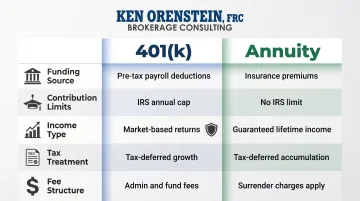
Key similarity: both vehicles grow tax-deferred and both impose a 10% early withdrawal penalty before age 59½. The difference is in how they generate income — one tracks the market, the other guarantees it by contract.
What Is a 401(k)?
A 401(k) is an employer-sponsored defined contribution plan where employees direct a portion of their pre-tax paycheck into a tax-deferred investment account. Roth 401(k) variants accept after-tax contributions and allow tax-free withdrawals in retirement. Understanding the contribution rules, investment options, and tax treatment helps clarify when this vehicle makes the most sense.
Contribution Limits and Employer Matching
The IRS set the 2026 employee deferral limit at $24,500, with the following catch-up provisions:
- Age 50+: Additional $8,000 catch-up contribution
- Ages 60–63 (SECURE 2.0 enhanced catch-up): $11,250 additional, meaning those in this window can defer up to $35,750 in 2026
- Combined employee + employer limit: $73,000
The employer match is where the 401(k) becomes especially powerful. Vanguard's 2025 How America Saves report found the average employer match is 4.6% of pay — essentially free money that instantly boosts your return. Capturing the full employer match before directing money elsewhere is the clearest priority in retirement savings.
Investment Options and Tax Mechanics
401(k) investment menus typically include mutual funds, index funds, bonds, and target-date funds. Options are limited to what your employer offers, but automatic payroll deductions make consistent investing straightforward.
Tax rules to know:
- Traditional 401(k) contributions reduce taxable income now but are taxed as ordinary income upon withdrawal
- Required Minimum Distributions (RMDs) must begin at age 73 (for those born 1951–1959) or age 75 (for those born 1960 or later)
- Early withdrawals before 59½ trigger a 10% penalty plus ordinary income taxes
- 401(k) loans are available as a liquidity option, though they carry their own risks
Your balance at retirement is not guaranteed — it reflects contribution consistency, investment performance, and market timing over your working years.
When a 401(k) Makes the Most Sense
401(k)s are most powerful during the accumulation phase: ideal for employees who want decades of tax-deferred compounding, particularly when employer matching is on the table.
For federal employees, the Thrift Savings Plan (TSP) isn't technically a 401(k), but it operates virtually identically. Every comparison point in this guide applies directly to TSP planning.
What Is an Annuity?
An annuity is a contract between an individual and an insurance company. The buyer makes a lump-sum or series of payments; in return, the insurer provides guaranteed periodic income — either immediately or at a future date.
The Three Main Annuity Types
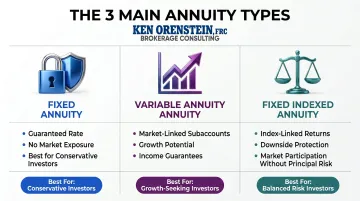
Choosing the right annuity starts with understanding how each type handles risk:
| Type | How It Works | Best For |
|---|---|---|
| Fixed annuity | Guaranteed interest rate; no market exposure | Conservative investors who prioritize certainty |
| Variable annuity | Returns tied to investment subaccounts; market risk applies | Investors who want growth potential with income guarantees |
| Fixed indexed annuity (FIA) | Returns linked to a market index (e.g., S&P 500) with downside protection | Those who want market participation without principal risk |
Total U.S. annuity sales hit $464.1 billion in 2025 — the fourth consecutive year of record sales — driven largely by demand for indexed products, which now represent 45% of the market.
Tax Treatment and Contribution Rules
- Non-qualified annuities (funded with after-tax dollars): growth is tax-deferred; only earnings are taxed upon withdrawal
- Qualified annuities (funded via 401(k) rollover or pre-tax IRA): distributions are fully taxable as ordinary income
- No IRS contribution limits apply to non-qualified annuities — making them a useful overflow savings vehicle once 401(k) limits are reached
Longevity Protection and Fee Awareness
The defining benefit of an annuity is guaranteed lifetime income. The SSA reports that life expectancy at 65 now exceeds 20 years, up from roughly 14 years in 1940. Annuities directly address the fear of outliving savings by transferring longevity risk to the insurance carrier.
That guarantee comes with costs. Variable annuities carry:
- Mortality & expense (M&E) charges: ~1.25% of account value annually
- Administrative fees: ~$25–$30/year or ~0.15% of account value
- Surrender charges: often 7% in year one, declining over time
- Surrender periods: typically 6–8 years, sometimes up to 10
Fixed and indexed annuities generally have lower explicit fees but may limit returns through caps and participation rates. Before committing, ask for a full cost illustration — including any caps, participation rates, and surrender schedules — so you can compare apples to apples across products.
When an Annuity Makes the Most Sense
Annuities deliver the most value during the decumulation phase — when you've accumulated a nest egg and need to convert part of it into predictable income. They're also valuable for:
- Self-employed individuals without 401(k) access
- Workers who've maxed out qualified plan contributions
- Anyone seeking additional tax-deferred savings beyond IRS caps
Key Differences Between Annuities and 401(k)s
Four key areas set these two vehicles apart: access rules, income guarantees, contribution limits, and how each handles your estate.
Accessibility
A 401(k) requires employer sponsorship — no employer plan, no participation (though self-employed individuals can open a Solo 401(k)). An annuity can be purchased directly from an insurance company by anyone, at any time, with no employment requirement.
Income Guarantees vs. Market Exposure
A 401(k)'s retirement income depends on contributions, investment performance, and withdrawal strategy — there's no floor. A fixed or indexed annuity provides a contractually guaranteed income stream that continues regardless of market conditions or how long you live.
Contribution Limits and Flexibility
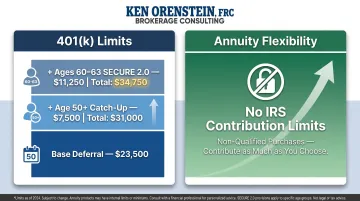
- 401(k): IRS employee deferral limit of $23,500 for 2026; age 50+ can add $7,500 (total $31,000), and ages 60–63 qualify for an enhanced $11,250 catch-up under SECURE 2.0 (total $34,750)
- Annuity: No government-imposed limits on non-qualified purchases — you can contribute as much as the carrier will accept
Inheritance and Estate Planning
- 401(k): Balances pass to named beneficiaries and can be rolled into an inherited IRA; most non-spouse beneficiaries must distribute the full balance within 10 years
- Annuity: Death benefits vary significantly by contract — some end at the annuitant's death; others include spousal continuation or death benefit riders at added cost
Before purchasing an annuity for estate planning purposes, compare whether the contract includes a return-of-premium death benefit, a spousal continuation option, or a standard period-certain payout — the differences can be substantial.
Which Is Right for Your Retirement?
The Decision Framework
Start with the 401(k) if:
- Your employer offers matching contributions (free money — always capture it first)
- You're in the accumulation phase with 10+ years until retirement
- You want broad investment flexibility and low fees
Add an annuity when:
- You're approaching or in retirement and need reliable income
- Social Security alone won't cover essential expenses
- You've maxed out 401(k) contributions and want additional tax-deferred savings
- Longevity risk concerns you more than market risk
The Combined Strategy in Practice
For most retirees, the most effective approach treats these as complementary tools. Use the 401(k) to build the nest egg during working years, then convert a portion of accumulated assets into an annuity at or near retirement to create a guaranteed income floor.
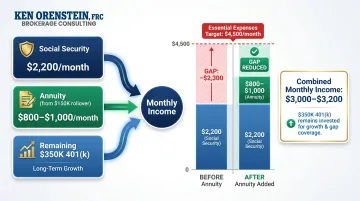
Here's a simple example: Say you retire with $500,000 in your 401(k) and receive $2,200/month from Social Security. Your monthly essential expenses are $4,500 — leaving a $2,300 gap. Using $150,000 of your 401(k) to purchase an annuity could generate roughly $800–$1,000/month for life, closing most of that gap while leaving $350,000 invested for growth and flexibility.
Research from EBRI supports this approach: 37% of low-asset retirees with guaranteed income streams preserved at least 80% of their assets over 21–22 years post-retirement — compared to those without income floors who depleted assets significantly faster.
The Federal Employee Angle
That income-gap framework applies directly to federal employees — who are already working with a built-in version of this layered strategy:
- Layer 1: Social Security
- Layer 2: FERS pension (already functions like an annuity)
- Layer 3: TSP savings (the 401(k) equivalent)
Because the pension covers a portion of essential income, federal retirees often need less additional annuity coverage than private-sector workers — but the income gap analysis still matters. TSP distribution decisions (lump sum, installment payments, TSP lifetime annuity through MetLife, or IRA rollover) are among the most consequential and often irreversible choices federal employees face.
Ken Orenstein at Brokerage Consulting works specifically at this intersection — mapping FERS pension, Social Security, and TSP income together, identifying remaining gaps, and modeling whether an FIA, SPIA, or deferred income annuity fills that gap most efficiently. As an independent advisor representing multiple top carriers, his process covers the full decision lifecycle:
- Suitability review and carrier financial-strength analysis
- Income rider comparison (GLWB/GMIB)
- Annuity laddering strategy for phased income
Conclusion
There's no universal winner between a 401(k) and an annuity. The right approach depends on your career stage, income needs, access to employer plans, and tolerance for market risk. Most people benefit most from treating them as complementary tools: the 401(k) builds wealth during working years through tax deferral and employer matching; the annuity creates income certainty and protects against outliving your savings in retirement.
The harder questions — how much to annuitize, which type of annuity fits your situation, and when to convert — are where the details matter most. That's exactly what a personalized review helps clarify.
For a no-pressure conversation about how to structure your retirement income, contact Brokerage Consulting at (888) 315-3608 or visit bcfinserv.com to schedule a no-cost consultation via phone, virtual, or in-person.
Frequently Asked Questions
Which is better for retirement: an annuity or a 401(k)?
Neither is universally better — they serve different purposes. A 401(k) is better for accumulating assets during working years, while an annuity is better for generating guaranteed income in retirement. Many retirees benefit from using both.
Should you convert your 401(k) to an annuity?
Rolling a portion — not all — of a 401(k) into an annuity at or near retirement can make sense to secure guaranteed income. Full conversion sacrifices growth potential and flexibility, so the right amount depends on your income gap, expenses, and other guaranteed income sources.
Is a tax-deferred annuity the same as a 401(k)?
Both offer tax-deferred growth, but they're different products. A 401(k) is an employer-sponsored investment account; a tax-deferred annuity is an insurance contract. The two differ in contribution limits, fee structures, investment options, and how income is eventually paid out.
What is the difference between a retirement plan and an annuity?
A retirement plan like a 401(k) or IRA is a savings and investment vehicle used to accumulate money over time. An annuity is an income product that converts accumulated savings into regular payments. In short, the 401(k) grows the money — the annuity turns it into a paycheck.
Should I choose a lump sum or an annuity payout?
It depends on your health, longevity expectations, and income needs. A lump sum gives flexibility and legacy potential but requires careful self-management. An annuity payout eliminates longevity risk but may pay out less if you die early.
What is the smartest way to withdraw from a 401(k)?
A few strategies worth considering:
- Delay withdrawals as long as practical to maximize tax-deferred growth
- Take only RMDs if you don't need additional income
- Consider Roth conversions during low-income years to reduce future tax exposure
- Use a portion to purchase an annuity that creates a guaranteed income floor for essential expenses