
In the US, this waiting window is more commonly called the elimination period in disability insurance policies. Both terms describe the same mechanism: the pre-agreed waiting window before your monthly benefits begin. This article uses both interchangeably.
Here's what we'll cover: what the deferred period actually means, the standard length options, how to choose the right one based on your financial situation, and the mistakes that leave people exposed at the worst possible time.
Key Takeaways
- The elimination period is the time you must be continuously unable to work before income protection benefits begin — starting when a physician certifies your disability, not when symptoms first appear.
- Common options run from 30 days to 12 months; 90 days is the most common selection for long-term disability (LTD) policies.
- The right period ends where your existing income sources — sick pay, short-term disability, savings — run dry.
- Federal employees with accrued sick leave and high earners with strong cash reserves can often justify a longer period to cut premiums.
- Getting this wrong in either direction creates a real income gap during a time when you're least able to manage one.
What the Deferred Period Actually Means
The deferred period (or elimination period) is the pre-agreed window between the onset of a qualifying disability and the date your monthly benefit payments begin. As the NC Department of Insurance defines it: it is the period after disability begins during which no benefits are payable.
How the Clock Works
According to The Standard's individual disability income policy language, the waiting period is "measured from the first day of Your Disability" — not from your first symptom, diagnosis date, or claim filing date. Benefits begin on the day immediately following completion of that waiting period.
In practice, delayed reporting to your insurer can cost you days or even weeks of the elimination period. Notify your insurer and get physician certification as soon as you are medically unable to work.
What You're Relying on During the Wait
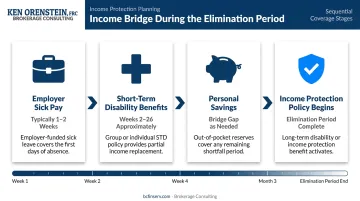
During the elimination period, you receive no benefit payments. Your income sources during this window typically include:
- Employer sick pay — if your employer provides salary continuation for illness or injury
- Short-term disability (STD) benefits — group STD plans often kick in after 7–14 days and pay for 13–26 weeks
- Personal savings — liquid assets covering essential monthly expenses
- A partner's income — where applicable
Social Security Disability Insurance (SSDI) is one source people mistakenly count on — it won't help in the short term. According to the SSA, an initial SSDI decision generally takes 6 to 8 months, and SSDI carries its own 5-month waiting period before first payment. It cannot serve as a near-term bridge.
Terms That Are Commonly Confused
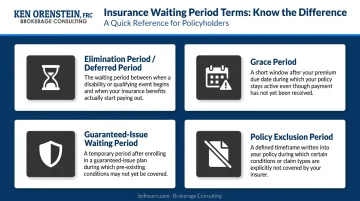
| Term | What It Actually Means |
|---|---|
| Elimination period / deferred period | Waiting window before disability benefits begin |
| Grace period | ~31 days after a missed premium before a policy lapses |
| Guaranteed-issue waiting period | Period before a death benefit pays on no-exam life insurance |
| Policy exclusion period | Specific conditions permanently or temporarily excluded from coverage |
Common Elimination Period Lengths
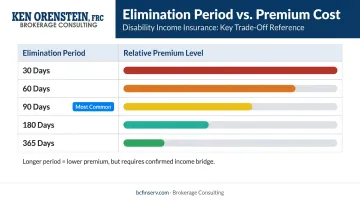
Guardian Life identifies the standard options as 30, 60, 90, 180 days, or one year — with 90 days as the most common selection across most carriers. The Bureau of Labor Statistics confirms that most LTD plan participants have a waiting period of 3–6 months, or until sick leave or STD benefits are exhausted.
Shorter Periods: 30–60 Days
Best suited for:
- Self-employed workers whose income stops the moment they can't work
- Employees with little or no employer sick pay
- Those with minimal liquid savings
The tradeoff is real: shorter elimination periods carry higher premiums because the insurer faces greater exposure (including for illnesses that would have resolved before a longer period expired).
The 90-Day Standard
Ninety days has become the default benchmark for a reason. It aligns with common employer sick pay durations, typically marks the point where STD coverage ends and LTD begins in employer benefit structures, and offers a reasonable premium-to-coverage balance. It's where most financial advisors and insurers start the conversation.
Longer Periods: 180–365 Days
Choosing a 180- or 365-day period can make strategic sense if:
- You're a federal employee with significant accrued sick leave
- You're a high earner with 6+ months of liquid savings
- Your primary goal is minimizing premium cost
One critical caution: a longer elimination period is only financially responsible if your income bridge during that window is confirmed, not assumed. Choosing a 365-day period and discovering your savings run out at month four is a serious problem.
A Note for Federal Employees
Federal employees have a built-in advantage here. Per OPM, full-time federal workers accrue 4 hours of sick leave per biweekly pay period (equal to 13 days, or 104 hours, per year). Key provisions include:
- No accumulation cap — leave banks grow indefinitely with each pay period
- 130+ days banked is realistic for a 10-year employee who has rarely used sick leave
- Up to 30 days can be advanced by agencies for employees incapacitated by illness or injury
For many federal employees, that banked leave effectively extends salary continuation well into the waiting window, making a 180-day or longer elimination period a rational and cost-effective choice. Ken Orenstein, author of The Informed Fed: A Survival Guide to Federal Employee Benefits, advises FERS and CSRS employees on exactly these layered benefit decisions.
How to Choose the Right Elimination Period
The core principle: your elimination period should end approximately where your existing income sources run dry. Starting it too early wastes premium dollars; starting it too late creates an income gap you'll have to cover out of pocket.
Map your income in sequence: employer sick pay → STD benefits → personal savings → income protection policy.
Step 1: Audit Your Employer Sick Pay
Find out:
- How many weeks does your employer pay full or partial salary during illness?
- Does your employer offer a group STD plan, and when does it start paying?
- When does that STD coverage end?
Your LTD elimination period should begin where STD ends. For federal employees, factor in your current accrued sick leave balance — check your most recent leave and earnings statement.
Step 2: Calculate Your Savings Runway
Divide your total liquid savings by your monthly essential expenses (housing, utilities, food, debt payments). The result is your runway in months.
Example: $18,000 in liquid savings ÷ $6,000 monthly essentials = 3 months. Combined with 60 days of employer sick pay, a 90-day elimination period is appropriate. If savings stretched to $36,000, a 180-day period might work, but only after stress-testing whether those numbers hold in a realistic scenario.
Step 3: Address Pre-Existing Conditions First
If you have a health history — back problems, mental health treatment, diabetes, cardiovascular issues — don't optimize the elimination period before you've secured favorable underwriting terms.
Different insurers assess the same medical history very differently. One carrier may offer standard rates; another may apply a premium loading or exclude your condition entirely. Locking in with the wrong insurer first limits your options going forward.
That's why shopping the elimination period in isolation misses the point. An independent broker who represents multiple carriers can show you how different insurers would underwrite your specific profile before you commit to any policy. Brokerage Consulting works across top carriers for exactly this reason — so clients can compare underwriting outcomes side by side.
Step 4: Confirm Continuous Coverage Requirements
Most policies require the elimination period to run continuously. The Standard's individual DI policy language specifies that the insured must be disabled throughout the waiting period. If you return to work briefly and then relapse, the clock may reset, though some group LTD plans include a temporary recovery exception.
This is policy-specific language. Read your contract carefully, or ask your advisor to walk through it before you sign.
How the Deferred Period Affects Your Premiums
Longer deferred periods mean lower premiums — the NC Department of Insurance confirms that policies with longer elimination or waiting periods generally cost less than those with shorter ones.
The logic from the insurer's perspective: a 30-day elimination period means the insurer might pay out for illnesses that resolve in 60 days. A 180-day period eliminates those shorter claims entirely, reducing expected payouts and therefore reducing price.
A few additional points:
- The premium difference can be substantial — enough that selecting a longer period and self-insuring the gap with savings is the more cost-efficient strategy for those with adequate financial cushion.
- Choosing a longer period is legitimate cost reduction, but only when the bridge income is real and confirmed, not theoretical.
- Most policies lock the elimination period at inception. Mid-policy changes are rarely permitted, so your initial selection matters — particularly if your health may change over time.
Common Misconceptions About Elimination Periods
"The period starts when I feel too sick to work."
It starts when a licensed physician certifies you are medically unable to perform your occupational duties. Symptom onset doesn't count. The date you personally decide you can't manage doesn't count either — delayed medical certification means a delayed clock start.
"Shorter is always better."
Not if you have solid employer sick pay or six months of savings. Paying for a 30-day elimination period when your short-term disability coverage runs 90 days means you're buying coverage that can't be triggered during that window. Match the period to your actual gap.
"I can adjust it later if my situation changes."
Adjusting the elimination period after policy inception typically triggers a review of your current health, meaning any conditions that developed since you first bought the policy could affect the revised terms. Getting the selection right from the start avoids that risk entirely.
Frequently Asked Questions
What does a deferred period mean in income protection insurance?
A deferred period (called an elimination period in US disability insurance) is the length of time you must be continuously unable to work before your income protection benefits begin. No payments are made during this window; benefits start the day after it ends.
How does the elimination period length affect my monthly premiums?
Longer periods mean lower premiums because the insurer is statistically less likely to pay — since many illnesses resolve before 90 or 180 days expire. Shorter periods increase the insurer's payout risk and are priced accordingly.
What elimination period should I choose if I have no employer sick pay?
Choose the shortest period your budget allows — typically 30 or 60 days. Without salary continuation from an employer, you have no income bridge during the wait, so faster policy benefits are essential.
Can I change my elimination period after my policy starts?
Generally, yes, but changes typically trigger a policy review. Any health developments since your policy was issued may affect the new terms, which is why getting the period right at the outset matters.
What's the difference between a deferred period and an elimination period?
They describe the same thing. "Deferred period" is standard terminology in UK and international markets, while "elimination period" is the term used in US individual and group disability insurance policies.
What happens if I return to work during the elimination period and then relapse?
Most individual policies require the elimination period to be continuous, so a return to work followed by a relapse may reset the clock. Some group LTD plans include temporary recovery provisions that avoid a full reset — review your specific policy language carefully.