
Introduction
One of the biggest fears for today's retirees is simple but serious: running out of money. While Social Security and pensions provide essential baseline income, many retirees discover a troubling gap between their guaranteed monthly income and actual living expenses. According to the Pension Rights Center, Social Security provides 50% or more of income for three in five beneficiaries aged 65 and older, with a median annual benefit of just $20,520 in 2024. That gap can leave retirees exposed to market downturns, longevity risk, and rising healthcare costs.
A guaranteed income rider (GIR) on an annuity is one tool built to close that gap. This contractual add-on provides a lifetime income stream regardless of market performance, giving retirees a reliable income floor beneath their retirement plan.
What follows covers:
- What a guaranteed income rider is and how it works
- How it compares to traditional annuitization
- What it costs
- How to determine if it fits your retirement income strategy
Key Takeaways
- A GIR guarantees lifetime income payments even if your annuity's account value drops to zero
- Income benefit base grows separately from your cash value at a contractually guaranteed rollup rate
- You retain access to your account's cash value for emergencies, unlike traditional annuitization
- Trigger age, life expectancy, and carrier terms drive payout amounts—not just interest rates
- Annual fees run 0.5%–1.5%, a trade-off most retirees find worthwhile for predictable lifetime income
What Is a Guaranteed Income Rider?
A guaranteed income rider (GIR) is an optional add-on to a deferred annuity — most commonly a fixed indexed annuity or variable annuity — that guarantees a lifetime income stream regardless of market performance. Unlike a traditional immediate annuity, a GIR lets you retain access to your account value while still collecting guaranteed income for life.
Once a GIR is attached to your annuity, two distinct values exist simultaneously:
- Account value — The actual cash value of your annuity that you can access for withdrawals or leave to beneficiaries
- Rider value (income benefit base) — A separate, notional value used solely to calculate your future income payments. This is not a cash account you can withdraw from directly
The rider value typically grows at a guaranteed rollup rate during the deferral period before you trigger income. For example, your income benefit base might increase by 5% or 6% per year (depending on the carrier and rider terms). This rollup rate is contractually guaranteed and not dependent on market performance — so you know exactly how your income base grows, year by year.
How a GIR Differs from a Traditional SPIA
With a SPIA (Single Premium Immediate Annuity), you hand over a lump sum and permanently give up access to the principal in exchange for guaranteed payments.
With a GIR, you keep access to the account value for emergencies — medical expenses, home repairs, or unexpected costs — while still receiving guaranteed lifetime income. For retirees who want income certainty without surrendering all control of their money, that difference matters.
Key Terms to Know
Understanding these terms will help you evaluate any guaranteed income rider:
- Rollup rate: The guaranteed annual percentage increase applied to your income benefit base during the deferral period
- Payout rate: The percentage of the income benefit base paid out annually once you trigger income (typically age-based)
- Income benefit base: The notional value used to calculate your guaranteed annual income (not available as a lump sum withdrawal)
- Trigger date: The date you elect to begin receiving guaranteed income payments
- Surrender period: The initial period (often 5–10 years) during which accessing funds beyond allowed free withdrawals may incur surrender charges
How a Guaranteed Income Rider Works in Practice
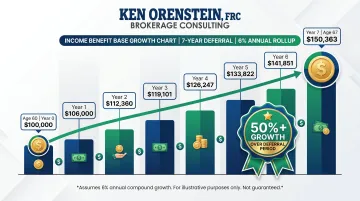
Consider a 60-year-old who invests $100,000 in a fixed indexed annuity with a guaranteed income rider attached. The rider includes a 6% annual rollup rate during a 7-year deferral period.
During the Deferral Period (Ages 60–67)
- Year 1: Income benefit base = $100,000 × 1.06 = $106,000
- Year 2: Income benefit base = $106,000 × 1.06 = $112,360
- Year 7: Income benefit base reaches approximately $150,363
By age 67, the income benefit base has grown to roughly $150,000—even if the actual account value grew more slowly due to modest index returns.
Calculating Annual Income at Age 67
The carrier multiplies the income benefit base by an age-based payout rate. According to industry examples, a single-life payout rate for someone aged 65–69 might be 4.75%. Using this rate:
Annual Income = $150,000 × 4.75% = $7,125 per year (about $594/month)
This payment continues for life—even if the account value eventually reaches zero. The insurance company bears the longevity risk, not you.
What Happens If You Delay Triggering Income?
If you wait until age 70, the income benefit base continues to grow, and the payout rate increases. For ages 70–74, the payout rate might be 5.25%. If the benefit base reaches $168,000 by age 70:
Annual Income = $168,000 × 5.25% = $8,820 per year (about $735/month)
Waiting just three years could increase your guaranteed annual income by nearly 24%.
Accessing Your Account Value While Receiving Income
Most GIRs allow withdrawals from the account value (within free withdrawal limits, often 10% annually), but doing so reduces the income benefit base proportionally. For example, if you withdraw $10,000 from a $100,000 account value, your income benefit base might also drop by 10%, reducing future guaranteed payments accordingly. A $10,000 withdrawal today could permanently reduce your lifetime income — a tradeoff worth calculating before taking any lump sum.
Single-Life vs. Joint-Life Options
GIRs can be structured as single-life (covering only you) or joint-life (covering you and your spouse). Joint-life options typically pay a slightly lower annual amount—4.25% vs. 4.75% for ages 65–69—but provide income for as long as either spouse is alive. For a married couple, that slightly lower rate buys a meaningful guarantee: income that doesn't stop when one spouse dies.
Why a Guaranteed Income Rider Matters at Retirement
Americans are living longer than ever. According to the CDC, life expectancy at age 65 in 2024 was 19.7 years overall—20.8 years for females and 18.4 years for males. That means a 65-year-old woman today can expect to live into her mid-80s, and many will live well beyond that. The core risk this creates is straightforward: outliving your savings.
The traditional 4% withdrawal rule from a portfolio is not a guarantee. Morningstar's 2025 research now suggests a starting withdrawal rate of just 3.9% for a 30-year retirement at a 90% success probability. Markets can decline precisely when retirees need income most, and sequence-of-returns risk can devastate portfolios early in retirement.
Building a guaranteed income floor:
A reliable retirement plan starts with guaranteed income sources covering non-negotiable monthly expenses: housing, utilities, food, insurance, and healthcare. For most retirees, this floor begins with Social Security. Some have pensions. But according to the BLS, only 15% of private-sector workers had access to a defined benefit pension plan in 2024, compared to 70% with access to a defined contribution plan. Most retirees lack the traditional pension safety net their parents enjoyed.
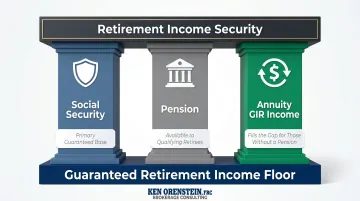
A guaranteed income rider allows retirees to lock in a predictable income stream that complements Social Security, filling the income gap without market exposure. That structure forms a three-legged retirement income stool:
- Social Security — your primary guaranteed base
- Pension (if available) — a second income stream for qualifying retirees
- Annuity income from a GIR — fills the gap for those without a pension
Relevance for federal employees:
Many federal employees rely on FERS or CSRS pensions and Social Security, but those sources may not fully cover retirement lifestyle costs, especially as healthcare and long-term care costs climb in later years. The numbers are significant:
- Fidelity's 2025 Retiree Health Care Cost Estimate projects $172,500 in healthcare spending for a 65-year-old retiring in 2025, excluding long-term care
- The Federal Long Term Care Insurance Program estimates nursing home semi-private room costs at $112,420 per year in 2024, projected to reach nearly $186,000 in 20 years
For federal employees, a guaranteed income rider can serve as a third income pillar that provides certainty beyond government benefits, helping cover rising healthcare costs and maintain purchasing power throughout retirement.
Income plus liquidity:
Unlike irrevocably annuitizing a policy, a GIR preserves access to remaining account value for emergencies: medical expenses, home repairs, family needs. For retirees worried about being "locked out" of their own money, that distinction matters. Guaranteed lifetime income and meaningful flexibility are not mutually exclusive with this structure.
Guaranteed Income Rider vs. Annuitization: What's the Difference?
Annuitization means irrevocably converting your annuity account into a stream of payments. When you annuitize—such as with a Single Premium Immediate Annuity (SPIA) or Deferred Income Annuity (DIA)—you hand over the principal to the insurance company in exchange for guaranteed lifetime payments. This is a one-way door: once annuitized, you cannot access the lump sum again.
A guaranteed income rider works differently. Payments under a GIR are technically structured as withdrawals against your account. The insurance company does not take ownership of the principal, but it guarantees payments will continue even after the account value reaches zero. Three practical differences separate the two approaches:
Liquidity
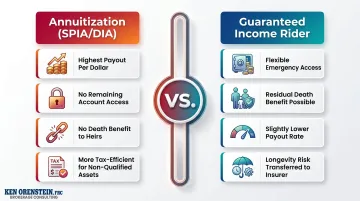
With a GIR, you preserve some access to your account value. You can typically withdraw funds (within limits) for emergencies, though doing so reduces your income benefit base and future payments. With annuitization, there is no remaining account value—you've permanently exchanged the lump sum for the income stream.
Taxation (for Non-Qualified Money)
Most GIR payments follow LIFO (last-in, first-out) accounting under IRS Publication 575. This means gains are taxed first as ordinary income until all earnings are withdrawn, then remaining withdrawals return basis tax-free.
Annuitized payments from non-qualified money may qualify for the exclusion ratio (General Rule under the same IRS publication), which treats a portion of each payment as a tax-free return of basis. For non-IRA assets, this can make annuitization more tax-efficient than a GIR—depending on your cost basis and life expectancy.
When Each Makes Sense
- Annuitization (SPIA/DIA): Often delivers the highest contractual payout per dollar invested and may be more tax-efficient for non-qualified assets. Best when you want maximum guaranteed income and don't need access to principal.
- Guaranteed Income Rider: Preferable when you want flexibility, the ability to leave a residual death benefit to heirs, or emergency access to your account value.
The best way to decide is to compare actual quotes side by side—because the numbers, not the concepts, will tell you which option fits your retirement picture.
What Does a Guaranteed Income Rider Cost — and Is It Worth It?
Most guaranteed income riders charge an annual fee deducted from the account value, typically expressed as a percentage of the income benefit base or account value. According to Charles Schwab Advisor Services, GLWB riders average around 1.0% per year, though Thrivent notes typical fees range between 1% and 3% of the benefit base annually, depending on the contract. Some carriers price the cost into the product structure rather than charging a visible separate fee, so always review your prospectus for exact costs.
Is it worth it?
For retirees who want predictable income they cannot outlive, the cost of a guaranteed income rider is justified by the financial certainty it provides—especially compared to the risk of drawing down a portfolio in a bear market. The rider fee transfers longevity risk from you to the insurance company. If you live longer than expected or markets perform poorly, the rider continues paying for life.
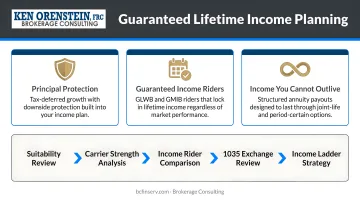
The tradeoff: you accept lower net account growth in exchange for contractually guaranteed lifetime income.
Does it fit your plan?
The right answer depends on several factors specific to your situation:
- Retirement timeline and income needs
- Existing guaranteed income sources (Social Security, pension)
- Whether your funds are IRA or non-IRA assets
- Risk tolerance and portfolio withdrawal strategy
Working with an advisor lets you compare rider options across top-rated carriers and model how a guaranteed income rider fits your complete income strategy.
Ken Orenstein at Brokerage Consulting works with federal employees, individuals, and seniors to evaluate annuity options and build retirement income strategies across top-rated carriers. To get started, call (888) 315-3608 for a no-cost consultation.
Frequently Asked Questions
How much would a $100,000 guaranteed income annuity pay per month?
Monthly payouts from a $100,000 premium depend on your age when income starts, whether it's single or joint life, the rollup period, and the carrier's payout rate. Using industry examples, a 65-year-old with a 4.75% payout rate might receive about $395/month; at age 70 with a 5.25% rate, roughly $437/month. Request quotes from multiple carriers to compare your specific numbers.
What are the pros and cons of a guaranteed income annuity?
Pros:
- Lifetime income you can't outlive
- Protection from longevity and market risk
- Potential emergency access to remaining account value
- Predictable cash flow for retirement planning
Cons:
- Annual rider fees reduce net account growth
- Payments are taxed as ordinary income
- Early surrender charges may apply before the surrender period ends
What is the difference between a guaranteed income rider and annuitization?
Annuitization permanently converts your account into income payments with no remaining access to principal. A guaranteed income rider is an add-on that guarantees payments continue even if the account value reaches zero, but preserves some liquidity and potential death benefit for heirs.
Does a guaranteed income rider cost extra?
Yes, most guaranteed income riders carry an annual fee (typically 1.0%–1.5% of the benefit base or account value), deducted from your account. Some carriers incorporate the cost into the product structure rather than charging a visible separate fee. Always review the prospectus for exact costs.
Can you still access your money if you have a guaranteed income rider?
Yes, most riders allow withdrawals within set limits (often 10% per year). However, withdrawals reduce the income benefit base proportionally, which lowers your future guaranteed payments — so weigh this carefully before taking lump sums.
When should you trigger the income from a guaranteed income rider?
Deferring income lets your benefit base grow via the rollup rate and unlocks higher age-based payout rates — often meaningfully increasing lifetime income. The right trigger date depends on your cash flow needs, health, and existing income sources.