There's no single right answer here — the best age depends on your retirement timeline, health, existing income sources, and which annuity type you're considering. This guide walks through each life stage, the factors that should drive your decision, and the warning signs that suggest you should wait.
Key Takeaways
- The 50–75 window covers most optimal purchase scenarios, but your individual circumstances determine the real answer
- Annuity type matters as much as age: deferred builds future income for pre-retirees; immediate annuities convert a lump sum to income now
- Four factors drive timing: income gap, health and life expectancy, liquidity needs, and the current interest rate environment
- Buying too early risks surrender charges and illiquidity; buying too late means fewer years to offset the purchase cost
- A retirement or federal benefits advisor can identify the right type, carrier, and timing before you commit
Why Timing Matters When Buying an Annuity
Actuarial Pricing Rewards Later Buyers
Annuity payouts are calculated using actuarial tables — insurers price monthly income based on how long they expect to pay you. Older buyers receive higher monthly payments because the expected payout period is shorter.
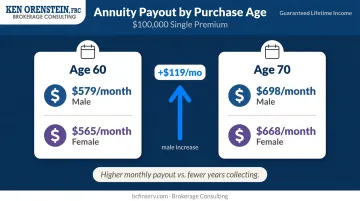
The difference is significant. According to SmartAsset citing Schwab Income Annuity Estimator data, a $100,000 single-life immediate annuity would pay approximately:
| Buyer Age | Male (Monthly) | Female (Monthly) |
|---|---|---|
| Age 60 | $579 | $565 |
| Age 70 | $698 | $668 |
That's roughly $119/month more for a male buyer who waits 10 years — but waiting also means 10 fewer years of collecting payments. Neither choice is universally superior; the math depends on how long you live.
Tax Rules That Affect Your Buy-and-Start Window
Two IRS rules create hard constraints around annuity timing:
- Pre-59½ withdrawals: IRS Publication 575 states that a 10% additional tax applies to the taxable portion of annuity distributions taken before age 59½ — on top of ordinary income taxes. IRC Section 72(q) lists narrow exceptions, including disability and substantially equal periodic payments
- RMDs at age 73: Qualified annuities held inside retirement accounts become subject to Required Minimum Distributions starting at age 73 (rising to 75 in 2033 under SECURE 2.0). This affects timing decisions for anyone considering a QLAC or qualified deferred annuity inside a TSP or IRA
Interest Rates Change the Fixed Annuity Math
Fixed and fixed-indexed annuity payouts are directly tied to interest rates at the time of purchase. When rates are high, insurers credit higher guaranteed rates — and those rates lock in for the contract term.
LIMRA reported fixed-rate deferred annuity sales of $164.9 billion in 2023, more than triple 2021 levels, driven entirely by the rate environment. For fixed products, buying during a high-rate period can lock in materially better income for the life of the contract.
Opportunity Cost for Early Buyers
Money committed to an annuity is no longer available for equity market participation. For buyers 20+ years from retirement, this trade-off often disadvantages the annuity — equities have historically outperformed insurance product crediting rates over long time horizons. As retirement nears — typically within 10 years — the calculus shifts: sequence-of-returns risk grows, and guaranteed income starts outweighing potential equity upside.
Best Age to Buy an Annuity: A Life-Stage Breakdown
The "best age" is a range shaped by how close you are to needing income, your risk tolerance, and which product you're considering.
Under 50: Rare but Not Impossible
Most people under 50 gain little from annuities as a primary strategy. The IRS penalty on early withdrawals creates real downside risk, and the opportunity cost of locking funds away from equity growth is highest when retirement is decades away.
One narrow exception: a non-tax-deferred fixed annuity can serve as a conservative savings vehicle for those who want principal protection and guaranteed growth without market exposure. It's a specialized use case, not a foundation for retirement planning.
Ages 50–64: The Pre-Retirement Window
This is where deferred annuities make the most sense for most buyers. You're close enough to retirement to project income needs with reasonable accuracy, but far enough away to let the accumulation phase work in your favor.
Key advantages of purchasing in this window:
- A guaranteed income rider locked in today accumulates at the roll-up rate (commonly 5–7% compound) during the deferral period — earlier placement can mean a larger guaranteed income amount when activated
- Fixed-indexed annuities provide downside protection while participating in index-linked growth, useful for those who want market exposure without direct market risk
- Surrender charge periods (typically 5–10 years) align with retirement timelines rather than creating a liquidity conflict
Brokerage Consulting's practice specifically serves pre-retirees aged 55–68 with deferred annuity strategies, designed around the principle of locking in guaranteed income today that activates at a future retirement date. The minimum deployable lump sum for placement is typically $250,000.
Ages 65–75: Securing Retirement Income
Once you've stopped receiving employment income, immediate annuities become the most relevant tool. A Single Premium Immediate Annuity (SPIA) converts a lump sum into guaranteed monthly payments that begin within 30 days of purchase.
Kiplinger, citing Annuity.org figures, shows a 65-year-old purchasing a $100,000 life-only SPIA would receive approximately $629/month (male) or $599/month (female) — a concrete benchmark for income gap planning.
Three reasons this age range is well-suited for SPIAs:
- Payouts are higher than at younger ages due to shorter life expectancy pricing
- The income gap problem is concrete and measurable — you know what Social Security pays and what your expenses are
- SPIAs remain the most straightforward conversion tool: one lump sum, one guaranteed payment, no ongoing management required
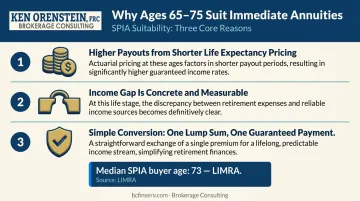
LIMRA data shows the median SPIA buyer age is 73, confirming that most buyers wait until their early-to-mid 70s to make this move.
Ages 75 and Beyond
Purchasing at 75+ is possible — most insurers set maximum issue ages between 85 and 95 depending on the product. But options narrow considerably:
- Fixed-indexed annuities from carriers like Pacific Life cap annuitant issue age at 85
- Variable annuities similarly cap annuitant issue age at 85 in many cases
- Immediate annuities (SPIAs) remain broadly available — some insurers accept applications through age 90 or 95
- Deferred products become largely inaccessible beyond age 85
For buyers in this range, the goal shifts from accumulation to protection — specifically, converting assets into guaranteed income that covers late-life and long-term care costs regardless of how long those costs run.
Key Factors That Should Drive Your Purchase Decision
Retirement Income Gap Analysis
The most important question before buying any annuity: how large is the gap between your projected monthly retirement expenses and your guaranteed income sources?
Social Security replaces approximately 43% of pre-retirement earnings for median earners and around 28% for higher earners, according to SSA data. For those without a pension, this gap can be substantial. An annuity makes the most sense when this gap is real, persistent, and not covered by portfolio withdrawals you're comfortable with.
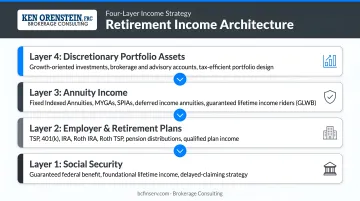
For federal employees, this analysis is more layered. FERS pension income, TSP distributions, and Social Security all interact, and the sequencing and taxation of each affects the actual income gap. Ken Orenstein's practice at Brokerage Consulting structures this through a four-layer income architecture:
- Social Security — with claiming-strategy and spousal benefit optimization
- FERS/CSRS pension — for federal employees
- Guaranteed lifetime income via annuity — to fill remaining gaps
- Discretionary portfolio assets — for growth, emergencies, and legacy
A no-cost consultation at Brokerage Consulting can help quantify this gap before any purchase decision is made.
Health and Life Expectancy
Annuities are financially advantageous the longer you live, because the insurance carrier absorbs your longevity risk. Those with serious health conditions or significantly shortened life expectancy may not collect enough payments to recover the premium paid.
Those with strong family longevity history, on the other hand, are ideal annuity candidates. The lifetime income guarantee is most valuable precisely when you're likely to need it for 20–30 years.
Liquidity Readiness
Annuities are illiquid during their surrender charge period. A typical declining schedule might look like 9-8-7-6-5-4-3-2-1-0% over 10 years. A full surrender in year one on a $100,000 contract costs $9,000 before taxes. The SEC's example schedule starts at 7%, costing $7,000 in year one on the same premium.
Before committing:
- Your emergency fund should cover 6–12 months of expenses
- High-interest debt should be resolved
- You should be confident you won't need access to the premium during the surrender period
- Most contracts allow up to 10% annual withdrawals without surrender charge — verify this provision before purchasing
Annuity Type Alignment
Choosing the wrong product type for your life stage is as costly as choosing the wrong timing. A practical reference:
| Life Stage | Best-Fit Annuity Type |
|---|---|
| 50–64, still working | Deferred (FIA, Fixed, MYGA) |
| 65–75, recently retired | Immediate (SPIA), Fixed Indexed with income rider |
| 75+, covering late-life gaps | SPIA, QLAC, Deferred Income Annuity |
Signs You're Ready — and When You Should Wait
Timing an annuity purchase comes down to two questions: does it fill a real gap, and have you cleared the financial prerequisites? Use these checkpoints before committing.
You're Ready If:
- You have a quantified income gap that Social Security, pension, and savings withdrawals won't reliably fill
- Your emergency fund is fully funded and high-interest debt is cleared
- Your retirement timeline aligns with the annuity's accumulation or payout start date
- You've evaluated how the purchase interacts with RMDs, Social Security claiming, and any pension income
If any of the following apply, stepping back — or exploring alternatives first — is the smarter move.
Don't Buy an Annuity If:
- You anticipate needing access to the funds within the surrender charge period. Surrender penalties and potential IRS taxes can erode your principal quickly on an early exit.
- Your existing income sources already cover projected retirement expenses. Adding an annuity introduces fees, complexity, and illiquidity without solving an actual gap.
- Your health limits your life expectancy. Direct portfolio withdrawals or long-term care coverage may serve your goals better — a candid conversation with an advisor will clarify which path fits your situation.
Frequently Asked Questions
Can you buy an annuity at age 90?
Some insurers accept applications through age 90 or even 95 — Gleaner Life's SPIA, for example, lists issue ages up to 95. However, deferred products are largely unavailable at this stage, and options narrow considerably. Immediate income annuities remain the most accessible product type past 90.
Should a 55-year-old buy an annuity?
Age 55 is often favorable — particularly for fixed or fixed-indexed deferred annuities that can accumulate value for 7–10 years before retirement. Locking in a guaranteed income rider at 55 with a 7% roll-up rate compounds significantly before activation at 65.
How much would a $100,000 annuity pay each month?
It depends on age, annuity type, interest rates, and payout period. For a 65-year-old purchasing a $100,000 single-life immediate annuity in 2025, Kiplinger data shows approximately $629/month for a male and $599/month for a female. Payouts rise meaningfully with age — a 70-year-old male would receive approximately $698/month on the same premium.
What is the "annuity age 75 rule" and should you follow it?
The "age 75 rule" holds that waiting until 75 maximizes monthly payouts — mathematically true, but it ignores the 10 years of income forfeited in the meantime. A buyer starting at 65 collects a lower monthly amount across a decade of additional payments, which typically outweighs the higher payout of waiting. It's an oversimplification that doesn't apply to most real purchase decisions.
Is it better to buy an annuity when interest rates are high?
Yes, particularly for fixed and fixed-indexed annuities. Higher rates allow insurers to offer more attractive guaranteed crediting rates, and those rates lock in for the contract term. Rate timing is a secondary but real factor — compare fixed annuity rates across a rate cycle before committing.
What happens if I withdraw from an annuity before age 59½?
Early withdrawals from tax-deferred annuities trigger a 10% IRS penalty on the taxable portion, plus ordinary income taxes. Most contracts allow up to 10% annually in penalty-free withdrawals — but that's a contract feature, not an IRS exemption. Exceeding that limit triggers both the surrender charge and the IRS penalty at the same time.
Ken Orenstein at Brokerage Consulting specializes in guaranteed lifetime income planning for individuals, seniors, federal employees, and businesses. No-cost consultations are available by phone, virtually, or in-person. Contact (888) 315-3608 or visit bcfinserv.com to schedule.