
In plain terms, an FIA is a tax-deferred insurance contract issued by an insurance company. The interest it earns is tied to the performance of a market index — most commonly the S&P 500 — but your money is never directly invested in the stock market. If the index rises, you earn credited interest. If it falls, you earn zero, not a loss.
LIMRA reported $127.9 billion in FIA sales in 2025 — the fifth consecutive annual record — which says something about how many Americans are gravitating toward this middle ground between growth and safety.
Key Takeaways
- Interest is linked to a market index, but your principal is never directly exposed to stocks
- When the index rises, you earn credited interest (subject to caps or participation rates); when it falls, credited interest is zero — not negative
- Growth is tax-deferred, principal is protected, and optional lifetime income riders are available
- Surrender periods typically run six to ten years, making FIAs a long-term commitment
- Best suited to conservative or moderate investors in or approaching retirement who want growth potential without full market risk
How Does a Fixed Indexed Annuity Work?
The Accumulation Phase
You make a lump-sum or series of premium payments to an insurance company. The insurer invests those funds — typically in fixed-income instruments like bonds — and uses a portion of the earnings to purchase index options. Those options generate your indexed interest credits without putting your principal at direct market risk.
At the end of each crediting period (usually one year), the insurer measures the change in your chosen index. If it's positive, interest is credited to your account using the product's formula. If it's negative, your credited interest is simply zero — your account value stays where it was.
Index options vary by product. Ken Orenstein at Brokerage Consulting typically presents clients with several choices, each carrying different risk-return profiles within the same principal-protected structure:
- S&P 500 — large-cap U.S. equity benchmark, the most widely used FIA index
- Russell 2000 — small-cap U.S. exposure with higher historical volatility
- MSCI EAFE — developed international markets outside North America
- Proprietary volatility-controlled indexes — designed specifically for FIA contracts to manage crediting stability
The Dividend Gap
FIA interest calculations are based on price movement only — dividends are excluded. According to Hartford Funds research, dividend income averaged 33% of S&P 500 total return from 1940 to 2025. That's a meaningful return gap compared to owning an index fund directly.
Surrender Periods and Early Withdrawal
FIAs are long-term contracts. Withdrawals during the first six to ten years after purchase may trigger surrender charges — penalties that can reach up to 15% in early contract years, according to FINRA. Beyond surrender charges, IRS Publication 575 states that most distributions from nonqualified annuity contracts before age 59½ are subject to an additional 10% tax on the taxable portion, with limited exceptions.
FIA vs. Fixed vs. Variable Annuities
| Feature | Fixed Annuity | Fixed Indexed Annuity | Variable Annuity |
|---|---|---|---|
| Growth mechanism | Guaranteed set rate | Index-linked credits | Sub-account investments |
| Principal risk | None | None (0% floor) | Full market exposure |
| Upside potential | Limited | Moderate (capped) | Highest |
| Complexity | Low | Moderate | High |
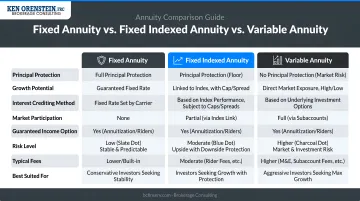
For retirees and pre-retirees who want market-linked growth without risking their principal, that middle position is often where the most practical retirement income strategies begin.
Key Terms: Caps, Participation Rates, and Spreads
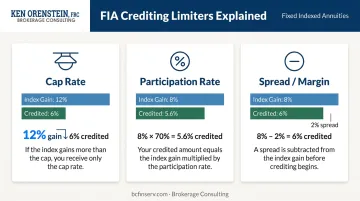
Understanding these three terms is essential before comparing any FIA products. The NAIC Buyer's Guide for Fixed Deferred Annuities defines all three clearly.
Cap Rate
The cap rate is the maximum interest the insurer will credit in a given period, regardless of how high the index climbs.
Example: The index gains 12%. Your cap is 6%. You're credited 6%.
Caps can be reset by the insurer at renewal, which is worth watching closely over a long contract.
Participation Rate
The participation rate determines what percentage of the index's gain gets credited to your account.
Example: The index gains 8%. Your participation rate is 70%. You're credited 5.6%.
Some products apply both a participation rate and a cap, so you'd take the lower of the two outcomes.
Spread (Margin or Asset Fee)
A spread is a fixed percentage subtracted from positive index returns before interest is credited. It only applies when the index is positive.
Example: Index gains 8%. Spread is 2%. You're credited 6%.
Caps, participation rates, and spreads all govern how gains are credited. The next two terms — floor and buffer — govern how losses are handled.
Floor vs. Buffer
These two terms are frequently confused:
- Floor (FIA standard): The worst credited interest is zero. Your principal and previously credited interest are locked in.
- Buffer (RILA standard): The insurer absorbs losses up to a specified percentage (say 10%), but you bear any losses beyond that threshold. Buffers appear in registered index-linked annuities (RILAs), not standard FIAs.
Optional Riders
Income riders, enhanced death benefit riders, and liquidity riders can all be added to an FIA — but each comes at a cost. Ken Orenstein's practice routinely evaluates rider suitability as part of the annuity review process. Key facts to know:
- GLWB (Guaranteed Lifetime Withdrawal Benefit) and GMIB (Guaranteed Minimum Income Benefit) are the most common income rider types
- Typical annual rider fees run 1.0–1.5% of the income base
- Fees are deducted from account value, which reduces net credited returns
- Every rider warrants a careful cost-benefit analysis before adding one
Key Benefits of a Fixed Indexed Annuity
Principal Protection
With a standard 0% floor, your premium and any previously credited interest are shielded from market downturns. Once interest is credited, it's locked in — a future down year cannot claw it back. For someone approaching retirement, that downside backstop can meaningfully reduce sequence-of-returns risk.
Tax-Deferred Growth
Earnings inside an FIA are not taxed until withdrawal, allowing the account to compound without annual tax drag. For funds held outside already tax-advantaged accounts, this matters most — a nonqualified FIA becomes a practical third tier of tax-deferred savings once your 401(k) and IRA contributions are maxed.
This makes FIAs particularly useful for:
- High earners who have exhausted contribution limits on qualified accounts
- Pre-retirees building an additional tax-deferred layer before Social Security begins
- Federal employees supplementing TSP savings with outside tax-deferred vehicles
Guaranteed Lifetime Income
Through annuitization or an income rider, FIAs can generate payments you cannot outlive. The demand for this feature is real: Allianz Life's 2025 Annual Retirement Study found that 64% of Americans worry more about running out of money than about death itself. A lifetime income rider converts that concern into a predictable monthly payment — one that continues regardless of how long you live or how markets perform.
Potential Drawbacks and Limitations
Capped Upside
The same features that provide downside protection also limit what you capture in strong bull markets. In a year the S&P 500 returns 25%, a 6% cap means you earn 6%. Combined with the dividend exclusion mentioned above, FIA credited returns will always trail what a direct index fund investment would produce over a long bull run.
Complexity and Lack of Transparency
FIA contracts involve multiple interacting variables (cap rates, participation rates, spreads, crediting methods, index options, rider fees) that can be difficult to compare across products on equal terms. Annual point-to-point crediting calculates gains differently than monthly averaging or monthly sum methods, and those differences can significantly affect your returns.
Key steps to protect yourself:
- Review the full contract disclosure before signing
- Compare products on the same crediting method and index
- Ask how often the insurer resets cap rates at renewal
- Work with a licensed advisor who can run side-by-side illustrations
A qualified advisor should review annuity disclosure forms and surrender charge schedules with you in writing before placement — this is a requirement under NAIC suitability and best-interest standards.
Liquidity Constraints
FIAs are not suitable for money you might need in the near term. Surrender charges in early contract years can be substantial, and the IRS 10% early withdrawal penalty applies before age 59½.
One strategy to manage this is annuity laddering : stacking multiple contracts with staggered surrender periods, freeing up a portion each year instead of locking everything up at once.
Who Is a Fixed Indexed Annuity Right For?
Who Gets the Most from an FIA
FIAs make the most sense for:
- Individuals within 5–15 years of retirement or already retired who want to protect accumulated savings while still capturing some market growth
- Those who have maxed out 401(k) and IRA contributions and want an additional tax-deferred vehicle
- Investors with conservative-to-moderate risk tolerance who prioritize capital preservation and income certainty over maximum returns
- Anyone with a lump sum to deploy — such as a TSP rollover, pension buyout, or inheritance — who needs that capital converted into reliable income

In practice, the FIA sweet spot skews toward clients in the 65–73 age range with a minimum of $250,000 in deployable funds. Younger investors with long time horizons and the ability to ride out market volatility are generally better served by direct equity investments.
Federal Employees: A Particularly Good Fit
Federal employees under FERS receive retirement income from three sources: the Basic Benefit pension, Social Security, and the Thrift Savings Plan. The pension and Social Security provide guaranteed income floors, while the TSP — particularly the C Fund, which tracks the S&P 500 — carries full market exposure and inflation risk.
An FIA can serve as Layer 3 in the income architecture: guaranteed income that sits alongside the pension and Social Security, without adding more market risk to a portfolio that already includes a market-exposed TSP. For federal employees whose pension covers baseline expenses but leaves a gap, an FIA with an income rider can fill that gap with contractually guaranteed payments for life.
Ken Orenstein, a Federal Retirement Consultant and author of The Informed Fed: A Survival Guide to Federal Employee Benefits, works specifically with federal employees to evaluate how an FIA fits within the broader FERS + Social Security + TSP picture. His no-cost initial consultation — available by phone, virtually, or in person — includes income rider comparisons, carrier financial-strength analysis, and a full review of caps, participation rates, and surrender schedules.
Frequently Asked Questions
How much does a $100,000 fixed indexed annuity pay per month?
Monthly payments vary widely based on the payout option chosen, the policyholder's age, contract terms, and current crediting rates. A financial advisor can run a personalized income illustration — no estimate is reliable without those specifics.
What's the average return on a fixed indexed annuity?
No reliable industry-wide average exists — credited returns depend entirely on each product's cap, participation rate, spread, crediting method, and index performance. As FINRA notes, FIAs offer more potential return than a fixed annuity but less than a variable annuity, and returns always lag direct index performance due to caps and dividend exclusion.
What is the difference between a fixed annuity and a fixed indexed annuity?
A fixed annuity credits a guaranteed, predetermined interest rate regardless of market performance. An FIA links credited interest to index movement — offering the potential for higher returns in good markets but zero interest (not a loss) in down markets. You gain market-linked upside potential in exchange for giving up the guaranteed rate a fixed annuity provides.
Can you lose money in a fixed indexed annuity?
Standard FIAs with a 0% floor protect principal from negative index performance. However, rider fees and administrative charges reduce the account value over time, and surrender charges apply if funds are withdrawn early. The most common source of "loss" in an FIA is fees and early withdrawal — not market declines.
Are fixed indexed annuities safe?
FIAs are considered low-risk insurance products backed by the claims-paying ability of the issuing insurer. State guaranty associations in all 50 states provide a protection layer if an insurer fails (limits vary by state, commonly $250,000 for annuities). Always verify the insurer's A.M. Best rating before purchasing.
What happens to a fixed indexed annuity when the market goes down?
When the linked index posts a negative return, credited interest for that period is zero — the account value does not decrease due to market performance, though rider fees may still apply. All previously credited interest locks in permanently; future downturns cannot reverse it.