
The tax rules alone deserve careful attention. A trust that doesn't meet IRS requirements loses the annuity's tax-deferred treatment entirely, exposing gains to annual taxation at some of the highest rates in the tax code. And once the trust is established, there's no going back.
This article covers what an irrevocable annuity trust is, how the ownership structure works, what the tax rules actually say, and which situations genuinely benefit from this approach — versus when it creates more problems than it solves.
TLDR: Key Takeaways at a Glance
- A trust can own an annuity, but a living person must always serve as the annuitant
- Tax deferral survives only if the trust qualifies as an agent for a natural person under IRC Section 72(u)
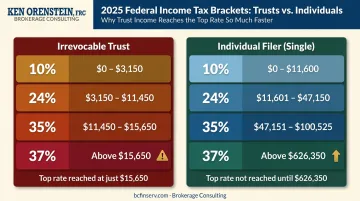
- Irrevocable trusts reach the 37% federal tax bracket above just $15,650 in 2025 — far sooner than individual filers
- Transferring assets into an irrevocable trust is a completed gift that cannot be undone
- High-net-worth individuals use this structure for estate tax reduction, structured inheritance, or long-term care planning
What Is an Irrevocable Annuity Trust?
An irrevocable annuity trust is a legal arrangement where an irrevocable trust holds ownership of one or more annuity contracts. The trust acts as the contract owner, a living person is named as the annuitant, and the trust or its beneficiaries receive income or death benefit proceeds according to the trust's terms.
Revocable vs. Irrevocable: A Critical Distinction
A revocable trust lets the grantor retain full control: they can modify, dissolve, or reclaim assets at any time. That flexibility comes at a cost. Revocable trusts offer no estate tax protection and no shield from creditors, because the IRS and courts treat those assets as still belonging to the grantor.
An irrevocable trust operates on the opposite principle. Once established, the grantor permanently relinquishes ownership and control — and that surrender is what unlocks the benefits:
- Assets removed from the grantor's taxable estate
- Protection from the grantor's personal creditors
- Structured distribution terms that survive the grantor's death
Why the Trust Can't Be the Annuitant
Insurance companies calculate annuity payments based on a living person's life expectancy. A trust has no life expectancy. It's a legal entity, not a human being. Under IRC Section 72, the annuitant must be an individual whose life events determine payout timing and amounts. The trust holds the owner role only. The annuitant is always a person — typically a trustee, beneficiary, or the original grantor.
How an Irrevocable Annuity Trust Works: Roles, Structure, and Setup
Defining the Three Core Roles
Every trust-owned annuity involves three distinct parties:
- The trust (contract owner) — holds legal title, controls asset management, and directs distributions according to trust terms
- The annuitant — a living individual whose life expectancy determines payment calculations; cannot be the trust itself
- The beneficiary — receives income distributions or death benefit proceeds per the trust document

How these roles are assigned directly determines the annuity's tax treatment — and the IRS draws sharp distinctions based on structure and beneficiary type.
IRC Section 72(u): The Tax Deferral Gatekeeper
IRC 72(u)(1) sets the default rule: if the owner is not a natural person, the contract loses annuity treatment and gains are taxed as ordinary income annually.
The exception is narrow — if the trust holds the annuity as an agent for a natural person, tax deferral is preserved. Qualifying structures include:
- A grantor trust generally qualifies
- A non-grantor trust with a single individual as the sole beneficiary may qualify — PLR 202118002 ruled in favor of this structure
- A trust with multiple beneficiaries or non-individual beneficiaries (such as a charity) typically does not qualify
Note that PLRs are fact-specific and not binding precedent under IRC 6110(k)(3) — they show the IRS's reasoning but don't guarantee the same outcome for a different taxpayer's structure.
Setting Up the Structure
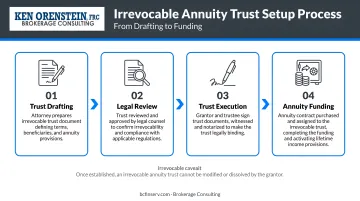
The general process involves several steps:
- Draft the trust with an estate planning attorney — irrevocability must be expressly stated in the terms
- Appoint a trustee to manage the trust assets
- Fund the trust — either purchase a new annuity with trust assets, or transfer an existing annuity by requesting a change-of-ownership form from the issuing carrier (most carriers require notarized signatures from both the grantor and trustee)
- Fully relinquish control — any retained interest (the ability to revoke, amend, or direct distributions) can cause the IRS to pull the assets back into the taxable estate
One common question arises at step three: can a grantor transfer an existing annuity using a 1035 exchange to avoid an immediate tax hit?
On 1035 exchanges: An annuity-for-annuity exchange under IRC 1035 may defer tax consequences of the transfer. However, primary IRS sources confirm this treatment in trust contexts mainly where the trust remains the owner before and after the exchange — not in a straightforward individual-to-trust ownership change. This is a narrow area of law, and professional guidance is essential before proceeding.
Tax Implications of Placing an Annuity in an Irrevocable Trust
Tax Deferral: When It Applies and When It Doesn't
Tax deferral is the primary reason most people choose annuities. Place one in the wrong trust structure, and that advantage disappears entirely. Under IRC 72(u), a non-qualifying trust must recognize annuity gains as ordinary income each year — eliminating the compounding advantage that makes annuities useful in the first place.
The Compressed Bracket Problem
Even when a trust qualifies for deferred treatment, the tax benefit can erode quickly. Retained trust income faces severe bracket compression. Per IRS Rev. Proc. 2024-40, the 2025 federal income tax brackets for estates and trusts are:
| Taxable Income | Rate |
|---|---|
| Up to $3,150 | 10% |
| $3,150 – $11,450 | 24% |
| $11,450 – $15,650 | 35% |
| Over $15,650 | 37% |
Compare that to individual filers: a single taxpayer doesn't hit 37% until income exceeds $626,350. A married couple filing jointly doesn't reach it until $751,600. For a trust accumulating annuity income, the top rate kicks in almost immediately.
Gift and Estate Tax Considerations
Transferring assets into an irrevocable trust is a completed gift for tax purposes. Under Treasury Regulation 26 CFR 25.2511-2, a gift is complete when the donor fully relinquishes dominion and control — meaning the moment the trust is funded, gift tax rules apply.
Key 2025 thresholds to know:
- Annual gift tax exclusion: $19,000 per recipient
- Lifetime basic exclusion amount: $13.99 million
- Top federal estate tax rate: 40%
The estate planning benefit: once the annuity is properly held by the irrevocable trust with no retained interest, its value — including future appreciation — is removed from the grantor's taxable estate.
One critical caution: all withdrawals from a trust-owned annuity are taxed at ordinary income rates, not the lower capital gains rates. Withdrawals before age 59½ may also trigger a 10% additional tax under IRC 72(q), unless a statutory exception applies.
Estate Planning and Generational Wealth Transfer Benefits
Controlled Distribution
The trustee manages when and how income flows to beneficiaries, which is a meaningful advantage when heirs include minors, individuals with special needs, or those prone to financial mismanagement. The grantor's instructions, embedded in the trust document, govern distributions long after the grantor is gone.
Pass-In-Kind Titling for Multi-Generational Transfer
IRS Private Letter Ruling PLR 199905015 (released February 5, 1999) addressed whether distributing trust-owned annuity contracts to individual beneficiaries triggered a taxable event. The IRS ruled that, on those specific facts, retitling the annuities from trust ownership to individual beneficiaries did not create taxable income. This gives insurance planning professionals a framework — not binding precedent — for structuring multi-generational annuity transfers that potentially extend tax deferral into the next generation.
Asset Protection
Assets properly held in an irrevocable trust are generally beyond the reach of the grantor's personal creditors. Under the Uniform Trust Code, creditor access to irrevocable trust assets is limited to amounts actually distributable to or for the grantor's benefit — which in a well-structured irrevocable trust is typically zero. This makes the arrangement especially relevant for professionals, business owners, and federal employees with complex financial profiles and meaningful liability exposure.
When Irrevocable Annuity Trusts Make Sense — and When They Don't
Situations Where This Strategy Works Well
Three client profiles tend to benefit most:
- High-net-worth individuals with taxable estates — those with estates approaching or exceeding the $13.99 million federal exemption can use this structure to shift annuity assets and future appreciation out of their estate
- Medicaid planning scenarios — a Medicaid Compliant Annuity can convert countable assets into a non-countable income stream; it must be immediate, irrevocable, non-transferable, actuarially sound, and name the state as the primary remainder beneficiary per CMS DRA guidance. Annuity payments count as income, and state rules vary — professional guidance is essential here
- Multi-generational wealth transfer — families wanting to pass assets to children or grandchildren in a structured, trustee-managed way

When to Avoid This Structure
Not every situation calls for this level of complexity. Several common misunderstandings lead people into this strategy unnecessarily:
- Probate avoidance alone is not a reason — annuities already pass directly to named beneficiaries and bypass probate without a trust; adding an irrevocable trust for this purpose only creates complexity
- If future access to funds is possible — irrevocability is permanent; if there's any chance the grantor may need these assets, this structure is wrong
- If the trust has multiple non-individual beneficiaries — a trust with a charity, business, or multiple mixed beneficiaries may not qualify under IRC 72(u), resulting in annual ordinary income taxation at compressed trust rates
- If the annuity doesn't qualify — a non-qualifying structure eliminates the annuity's core tax advantage while locking assets away with no recourse
Before committing to this structure, consult with Ken Orenstein at Brokerage Consulting — (888) 315-3608 — to confirm that the annuity selection, trust design, and tax classification all fit your specific situation.
Frequently Asked Questions
What is an irrevocable annuity?
An irrevocable annuity is a contract that, once annuitized, cannot be surrendered or cashed out. Payments are locked in according to contract terms, and the owner permanently gives up the right to withdraw principal as a lump sum in exchange for a guaranteed income stream.
Can an irrevocable trust own an annuity and still receive tax-deferred treatment?
Under IRC Section 72(u), tax deferral is preserved only if the trust qualifies as an agent for a natural person — such as a grantor trust or one with a single individual as the sole beneficiary. Otherwise, gains are taxed as current ordinary income at compressed trust rates.
What is the difference between a revocable and irrevocable annuity trust?
A revocable trust lets the grantor modify or dissolve it at any time, but offers no estate tax or creditor protection. An irrevocable trust permanently removes assets from the grantor's estate and cannot be altered, providing stronger protection — at the cost of losing all control over those assets.
Does placing an annuity in an irrevocable trust protect assets from Medicaid?
A properly structured Medicaid Compliant Annuity can convert countable assets into a non-countable income stream to meet Medicaid's asset limit. However, payments count as income, state rules vary considerably, and structuring errors can trigger penalty periods — consulting an elder law attorney is strongly recommended.
Can you change the beneficiary of an annuity held in an irrevocable trust?
Generally no. Once the trust is irrevocable, the grantor cannot change beneficiaries — the trustee manages assets strictly according to the original trust document. Any modification would require court approval or specific provisions written into the trust at creation.
What happens to a trust-owned annuity when the annuitant dies?
The death benefit passes to the named beneficiary per the trust terms. Depending on how the annuity was titled, the benefit may be distributed as a taxable lump sum, spread over five years, or retitled to individual beneficiaries, which can extend tax deferral into the next generation.