The participation rate is one of the most important and most misunderstood features of any FIA. It directly determines how much of a market index's gain gets credited to your account. Get this wrong, and you'll spend years expecting returns that the contract was never designed to deliver.
This article breaks down exactly what participation rates are, how they're calculated, what drives them up or down, and how they compare to cap rates and spreads — so you can evaluate any FIA contract with clear eyes.
Key Takeaways
- Participation rate = the share of an index's gain your FIA credits — 80% participation on a 10% index gain means 8% credited to your account
- Participation rates are crediting limiters, not amplifiers — even 100% participation doesn't equal full market returns
- Guaranteed participation rates typically apply to the initial crediting period only — insurers can reset the rate at renewal
- Cap rates, spreads, and participation rates all limit credited gains — evaluate all three before choosing a crediting strategy
- FIAs were designed to deliver principal-protected, competitive returns — not stock market returns
What Is the Participation Rate in a Fixed Index Annuity?
The participation rate is the contractually stated percentage of a market index's positive performance used to calculate the interest credited to your FIA during a given crediting period. It functions as a formula multiplier — not an investment return, a guaranteed rate, or a direct share of index ownership. What it determines is how much of the index's growth actually shows up as credited interest in your account.
How FIAs Connect to Indexes
FIAs link interest crediting to an external index — commonly the S&P 500, Nasdaq-100, or Russell 2000 — but they don't invest directly in those indexes. As the NAIC's Buyer's Guide states plainly: "when you buy an indexed annuity, you aren't investing directly in the market or the index." The participation rate is the bridge between index performance and what actually gets credited to your account.
The Dividend Exclusion Problem
Here's a detail that rarely gets explained upfront: when the S&P 500 serves as the reference index, dividends are excluded from the calculation. FIAs credit interest based on price return only — not total return.
Why does this matter? According to Hartford Funds and Morningstar data, from 1940–2025, dividend income accounted for an average of 33% of the S&P 500's total return. That means before the participation rate even applies, roughly one-third of historical market gains are already excluded from your crediting calculation.
The Trade-Off Behind the Rate
That exclusion is part of a deliberate structural exchange built into every FIA. The participation rate exists because you give up full upside in return for downside protection: if the index loses value during the crediting period, you're credited zero rather than a loss. The participation rate caps the upside; principal protection eliminates the downside.
For retirees prioritizing income predictability over growth maximization, that's often a rational trade. Brokerage Consulting works with clients on exactly this decision — evaluating whether an FIA's crediting structure fits their retirement income goals rather than treating FIAs as direct equity substitutes.
How Participation Rates Are Applied: A Step-by-Step Walkthrough
The crediting process always starts with measuring the index change over a defined crediting period using a specific indexing method. Which method applies determines how much of that index gain actually reaches your account.
Indexing Methods Shape the Base Gain
The same participation rate produces different credited interest depending on which crediting method is used:
| Crediting Method | How It Works | Key Trade-Off |
|---|---|---|
| Annual Point-to-Point | Compares index value at start and end of the year | Simple; ignores intra-year swings |
| Monthly Point-to-Point | Each month's gain is individually capped, then 12 months are summed | Monthly caps can significantly compress credited interest in strong years |
| Monthly/Daily Averaging | Uses the average index value over the term | Smooths volatility but typically produces lower credited interest than point-to-point in rising markets |
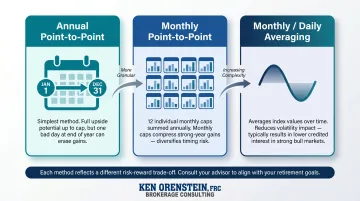
As FINRA warns, "because of the variety and complexity of the methods used to credit interest, investors will find it difficult to compare one EIA to another." The participation rate headline doesn't tell you which method applies.
A Worked Example
A simple example shows the math clearly. Assume the S&P 500 gains 10% over the crediting period, and your FIA has an 80% participation rate:
- Credited interest: 10% × 80% = 8%
- If index is flat or negative: 0% credited — but principal is protected
Now scale up. If the index gains 20% in a strong year:
- Credited interest: 20% × 80% = 16%
That's how the math always works with participation rates — your credited interest scales with the index gain, capped by your participation percentage. One important benefit: credited interest is typically locked in at the end of each crediting period (the annual reset or ratchet method). That locked-in gain becomes the new baseline — it can't be taken back by a later down year. Over a multi-decade retirement horizon, that means gains stack without reversal — each strong year permanently raises the floor your next crediting period builds from.
What Factors Influence the Participation Rate?
Participation rates aren't set arbitrarily. They reflect real financial mechanics tied to how insurers fund the principal protection guarantee.
The Options Budget Mechanism
Insurers invest the majority of FIA premiums into their general account (bonds, commercial real estate, structured assets). A smaller portion — the "option/hedge budget" — purchases index derivatives that fund the indexed credits. The American Academy of Actuaries confirms that caps and participation rates are set based on "current investment yields, option costs, market volatility, premium volumes, the competitive environment, and profit objectives."
Rising interest rates expand the options budget, allowing carriers to offer higher participation rates. Falling rates compress that budget — and crediting parameters follow.
Key Variables That Drive Rate Differences
- Interest rate environment — higher rates generally support higher participation rates
- Index selected — more volatile or complex indexes cost more to hedge, typically resulting in lower participation rates
- Crediting method — the strategy design directly affects options costs
- Insurer pricing margins — competitive positioning and profit objectives vary by carrier
The Renewal Risk Nobody Talks About Enough
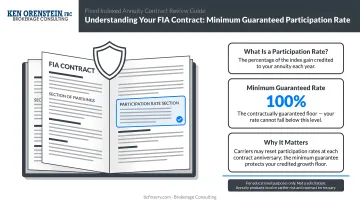
Most FIA contracts only guarantee the participation rate for the initial crediting period. After that, the insurer can adjust the rate at renewal — within contractual minimums, but sometimes by a wide margin.
FINRA warns explicitly that "some EIAs allow the insurance company to change participation rates, cap rates, or spread/asset/margin fees either annually or at the start of the next contract term."
The practical risk: a 10-year surrender charge period does not mean a 10-year participation rate guarantee. Always ask for — and verify in the contract — the minimum guaranteed participation rate. That floor is the only number that cannot change as long as you own the contract.
Participation Rate vs. Cap Rate and Spread
Participation rates, cap rates, and spreads are all crediting limiters. Understanding how each works — and how they may interact — is the only way to evaluate an FIA's true growth potential.
Cap Rate
A cap rate is the maximum interest that can be credited in a period, regardless of index performance. If the cap is 6% and the index gains 15%, you receive 6%.
Some contracts apply a cap on top of a participation rate, compressing returns further. Example: 80% participation on a 15% index gain would normally credit 12% — but a 6% cap cuts it to 6%.
Spread (Margin)
A spread is a percentage subtracted from the index gain before crediting. FINRA provides a clear example: if the index gains 10% and the spread is 3.5%, the effective credited gain is 6.5%.
Spreads function as an internal cost embedded in the crediting formula. Unlike caps, which set a ceiling, spreads reduce the base from which the participation rate (if any) is applied.
Comparing the Three Methods
Using the same 10% index gain scenario:
| Limiter Type | Structure | Credited Interest |
|---|---|---|
| Participation Rate Only | 80% × 10% | 8.0% |
| Cap Rate Only | Cap at 6%; index gains 10% | 6.0% |
| Spread Only | 10% − 2% spread | 8.0% |
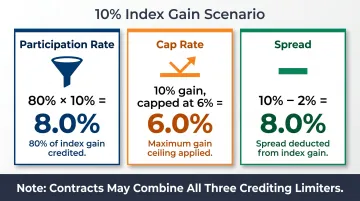
Some contracts use only one limiter; others combine two or all three. A product might advertise a 100% participation rate while also applying a 5% cap and a 1% spread — the headline rate alone tells you almost nothing.
That complexity is exactly why independent access to multiple carriers matters. Ken Orenstein at Brokerage Consulting compares FIA products across the market — evaluating participation rates, caps, spreads, crediting methods, and income rider terms side by side — rather than presenting a single carrier's offering. You can request a no-cost consultation at bcfinserv.com or by calling (888) 315-3608.
Common Misconceptions About Participation Rates
"A high participation rate means I'm participating in the market."
No. A participation rate is a limiter, not an amplifier. Even a 100% participation rate in a FIA doesn't deliver full market returns — dividends are excluded (historically ~33% of S&P 500 total return), the crediting method shapes the measured gain, and caps or spreads may further reduce credited interest. You're getting a fraction of price return, not total return.
"My participation rate is locked in for the life of the contract."
Rarely true. Most FIAs guarantee the initial rate for one crediting period only. After that, the insurer has discretion to adjust within contractual minimums. Before purchasing any FIA, ask specifically: What is the minimum guaranteed participation rate, and where is it stated in the contract?
"A higher participation rate always means a better FIA."
Not necessarily. Consider two products side by side:
- 120% participation rate paired with a volatility-controlled index that historically gains 3–4% annually, plus a spread of 1–2% applied on top
- 70% participation rate on the S&P 500 with no cap — which could outperform in a strong market year
The participation rate is one variable in the total crediting formula. What actually matters is how all the terms interact: the index, the cap, the spread, and the crediting method together determine your outcome.
Frequently Asked Questions
How often can insurance companies change the participation rate on a FIA?
Most FIAs reset participation rates annually at the start of each new crediting period. While insurers must honor a contractual minimum floor, the declared rate can shift significantly year to year based on interest rate conditions and company pricing decisions. Never rely on the initial illustrated rate as a long-term projection.
What is a good rate for a fixed index annuity?
Participation rates vary widely across products, carriers, and index strategies. What matters more than the headline rate is the combined effect of all crediting limiters and whether the product's design aligns with your retirement income goals and timeline.
Do fixed annuity rates change?
It depends on the product type. Traditional fixed annuities and MYGAs lock in a guaranteed rate for the entire contract term. FIAs are different — participation rates, caps, and spreads can be adjusted at each crediting period renewal within contractual minimums, meaning your credited interest may vary year to year.
What does participation rate mean in IUL?
In Indexed Universal Life insurance, the participation rate determines how much of the index's gain is credited to the policy's cash value — the same concept as in FIAs. The key difference: IUL deducts cost-of-insurance charges from the account, which reduces net credited growth and complicates any direct comparison with FIAs.
Can a participation rate exceed 100%?
Yes — some FIA products advertise participation rates above 100%, but these are typically paired with volatility-controlled indexes that produce lower returns than broad market indexes, or they carry spreads that offset the amplified participation. For example, a 150% rate on an index gaining 3% credits 4.5% — while a 70% rate on an S&P 500 year gaining 15% credits 10.5%. The underlying index matters as much as the headline rate.
Should I choose a high participation rate or a high cap rate?
It depends on expected index performance and the specific contract terms. In high-growth market years, a low cap rate becomes the binding constraint. In moderate-growth years, a higher participation rate often delivers more credited interest. Model both scenarios against realistic return expectations rather than picking based on the higher headline number.