
This comparison matters because the stakes are asymmetric. A retiree who loses 13% in a bond fund the year they retire faces a very different outcome than one who earned 0% and preserved every dollar. Choosing between FIAs and bonds shapes how reliable your income is, how long it lasts, and how much you owe in taxes — not just what your statement shows.
This article breaks down both instruments side by side, covering principal protection, income generation, tax treatment, and which situations call for each.
Key Takeaways
- FIAs are insurance contracts that credit interest linked to a market index (like the S&P 500) with a contractual 0% floor — you never lose principal to market declines
- Bonds pay fixed interest and return principal at maturity, but their market value falls when interest rates rise — bond funds carry ongoing, daily price risk
- FIAs provide tax-deferred growth, no market risk to principal, and lifetime income guarantees when riders are elected
- Bonds offer greater liquidity, lower entry barriers, and simpler access for short-term needs
- Neither is universally superior — the right choice depends on your income needs, time horizon, tax situation, and tolerance for illiquidity
- A combined approach often works best — FIAs anchor a guaranteed income floor, while bonds handle flexibility and short-term liquidity
Fixed Index Annuities vs. Bonds: Quick Comparison
| Feature | Fixed Index Annuity | Individual Bond | Bond Fund/ETF |
|---|---|---|---|
| Principal protection | Contractual 0% floor | Par value at maturity (if held) | None — NAV fluctuates daily |
| Return potential | Capped by cap rate/participation rate | Fixed coupon; no upside | Varies with bond prices |
| Income guarantee | Lifetime income riders available | Payments until maturity only | No lifetime guarantee |
| Liquidity | Limited (5–10 yr surrender period; 10% free withdrawal/yr) | Moderate (secondary market) | High (daily redemption) |
| Tax treatment | Tax-deferred until withdrawal | Taxable as ordinary income annually | Taxable as ordinary income annually |
| Interest rate risk | No mark-to-market loss; caps may improve | Unrealized loss if sold early | Mark-to-market losses (daily) |
| Minimum investment | Typically $100,000–$250,000 | Varies ($1,000+ per bond) | Low (ETF share price) |
| Insolvency protection | State guaranty associations (up to $250,000) | FDIC/government backing (Treasuries) | Issuer credit risk |
The principal protection gap is sharpest when comparing FIAs to bond funds rather than individual bonds. Bond funds carry no maturity date and reprice daily, exposing holders to realized losses in rising-rate environments. Individual bonds held to maturity sidestep that risk entirely, which makes the comparison between FIAs and individual bond ladders considerably closer than FIAs versus ETFs.
What Are Fixed Index Annuities?
FIAs are insurance contracts where you deposit a lump sum premium and earn interest credits tied to a market index — typically the S&P 500, Nasdaq, or similar benchmark. The critical feature: a contractual guarantee that your account value will never drop below zero due to index losses.
How Crediting Mechanisms Work
Insurance companies limit your upside in exchange for the downside guarantee through three main mechanisms:
- Cap rate — the maximum gain credited in a period (e.g., if the S&P 500 gains 15% and the cap is 10%, you receive 10%)
- Participation rate — the percentage of index gain credited (e.g., 65% participation on a 12% gain = 7.2% credit)
- Spread — a fixed percentage deducted before crediting (e.g., 2% spread on an 8% gain = 6% credited)
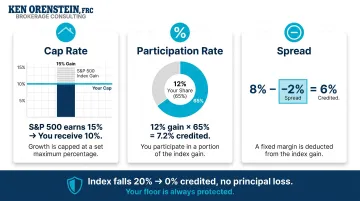
If the index falls 20%? Your account is credited 0%. You don't gain anything, but you don't lose principal either.
Tax Deferral and IRMAA Management
FIA earnings grow tax-deferred under IRC Section 72 — no annual tax bill on credited interest, and you control when you recognize income. That timing control matters more than most people realize.
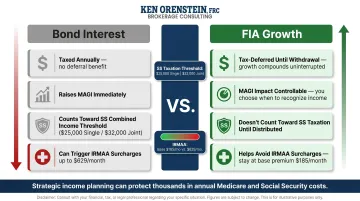
Bond interest (except from municipal bonds) counts toward your Modified Adjusted Gross Income (MAGI) every year it's earned, even if you don't spend it. That can push you above 2025 IRMAA thresholds, where Medicare Part B premiums jump from the standard $185/month to as high as $629/month for high earners. FIA growth, by contrast, doesn't appear in MAGI until withdrawn — giving you meaningful control over Medicare costs year to year.
Lifetime Income and Longevity Risk
Most FIAs offer optional income riders (GLWB or GMIB) that convert accumulated value into guaranteed monthly payments for life — a feature bonds structurally cannot replicate. A bond ladder must be sized to fund income through your longest possible lifespan, which means holding more capital in reserve than you may actually need. Annuities solve this through risk-sharing among thousands of policyholders, allowing the insurer to pay more per dollar of premium than any single person can sustain by self-insuring to age 95+.
The Liquidity Tradeoff
FIAs typically carry surrender charge periods of 5–10 years. Most contracts allow:
- 10% annual free withdrawals without penalty
- Hardship provisions for nursing home confinement or terminal illness
- Continued crediting during the surrender period
This illiquidity is the primary cost of the protections FIAs provide. Before committing, confirm that the assets you're placing in an FIA won't be needed for liquidity within the surrender period.
What Are Bonds?
Bonds are debt instruments where you loan money to a government or corporation for a fixed term, receive regular interest (coupon) payments, and get your principal back at maturity.
Key types relevant to retirees:
- U.S. Treasuries — lowest credit risk, backed by the federal government, highly liquid
- Municipal bonds — often exempt from federal income tax, useful for higher-bracket retirees
- Corporate bonds — higher yields, but carry issuer default risk
The Risks Retirees Underestimate
Most retirees focus on bond yields — and overlook these three risks:
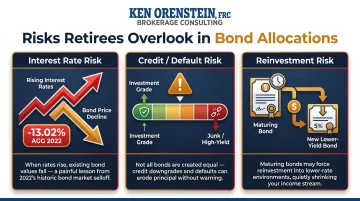
- Interest rate risk: When rates rise, existing bond prices fall. Selling before maturity can mean realizing a loss.
- Credit/default risk: Lower-rated corporate bonds can default; even investment-grade bonds aren't risk-free.
- Reinvestment risk: Maturing proceeds may need to be reinvested at lower prevailing rates.
Bond funds amplify the first risk because they're marked to market daily with no guaranteed maturity date. The Bloomberg U.S. Aggregate Bond Index lost more than 13% in 2022 — the worst year on record for U.S. bonds — after the Fed raised rates seven times.
Long-dated zero-coupon bonds fell 39.2% that same year. Retirees who needed to sell locked in those losses permanently.
Where Bonds Win: Liquidity
Bonds carry real risks — but they also offer something FIAs cannot match: immediate access to your money.
U.S. Treasuries are among the most liquid instruments in the world. Bond ETFs trade like stocks. This flexibility is bonds' strongest advantage over FIAs — for short-term needs, portfolio rebalancing, or expenses within the next 1–5 years, bonds are far more accessible.
Fixed Index Annuities vs. Bonds: Key Differences That Matter in Retirement
Principal Protection
FIA principal is contractually protected — even in a severe market downturn, the account value stays flat. Bond principal is only safe if held to maturity. Bond fund investors can lose principal any time rates move against them.
2022 is the clearest case study. FIA holders with the 0% floor saw no reduction in account value from index-linked crediting. AGG holders lost -13.02% on a total return basis. Individual bondholders who held to maturity avoided realized losses but sacrificed liquidity in the interim.
Income Generation Efficiency
Bonds pay only until maturity. FIAs with income riders pay for life — no matter how long that is. Because income annuities use mortality pooling (spreading longevity risk across many annuity holders), the insurer can pay a higher periodic income per dollar of premium than a bond ladder must reserve for one individual funding income potentially to age 95+.
Research published in the Journal of Financial Planning by David Blanchett and Michael Finke examined this dynamic directly, finding that annuitized income allows for more optimal capital allocation in retirement portfolios than bond-only income strategies.
Tax Treatment
| Bond Interest | FIA Growth | |
|---|---|---|
| When taxed | Year earned (annually) | Upon withdrawal only |
| Type | Ordinary income | Ordinary income (on gains) |
| MAGI impact | Immediate | Deferred until withdrawal |
| Social Security effect | Counts toward combined income | Doesn't count until withdrawn |
Social Security taxation begins when combined income (AGI + nontaxable interest + half of SS benefits) exceeds $25,000 for single filers / $32,000 for joint filers. Bond interest counts immediately; FIA growth doesn't until you take it out. For retirees managing multiple income sources, this distinction can shift whether 50% or 85% of your Social Security benefits are taxable in a given year.
Interest Rate Sensitivity
Both products respond to prevailing interest rates — just differently:
- Bonds: Rising rates reduce existing bond prices (mark-to-market loss)
- FIAs: No mark-to-market; existing account values don't decline when rates rise. However, new FIA contracts in a higher-rate environment typically offer better caps and participation rates, since insurers have more "option budget" available after funding the guaranteed floor
Some FIA contracts also include a Market Value Adjustment (MVA) provision, which can positively or negatively adjust the surrender value based on interest rate changes since the contract was issued — worth understanding before signing.
How Bonds and FIAs Are Actually Connected
Here's a structural fact that rarely surfaces in this debate: insurance companies fund FIA guarantees primarily by investing in bonds. Per NAIC Capital Markets Bureau data, U.S. life insurers hold approximately 65.6% of their $6.1 trillion portfolios in bonds — nearly $4 trillion in bond holdings.
When you buy an FIA, you're effectively buying access to an institutionally managed bond portfolio with contractual protections layered on top. The insurer's bond holdings generate the cash flows that fund the 0% floor guarantee; the spread between what they earn and the minimum guaranteed rate is used to purchase index options.
In other words, you're not choosing between bonds and something fundamentally different. You're choosing between direct bond ownership and a bond-backed product with principal protection, tax deferral, and longevity pooling added.
Which Is Better for Your Retirement?
The honest answer: it depends on what role the money needs to play.
Choose bonds (or bond ETFs) if you:
- Need liquidity within 1–5 years
- Have a short time horizon before a planned large expense
- Want simplicity and daily access to your money
- Are in a lower tax bracket where annual interest income is less costly
Choose FIAs if you:
- Want principal protection without monitoring interest rate cycles
- Need guaranteed lifetime income that bonds can't structurally provide
- Have a 5–10+ year horizon before tapping the funds
- Are in a higher bracket where tax deferral meaningfully reduces your MAGI
- Want to manage IRMAA exposure or Social Security taxation
Federal employees deserve a specific note here. FERS retirees already have a pension covering a meaningful income floor (calculated at 1% to 1.1% of high-3 salary per year of service). For them, the FIA vs. bond decision isn't about creating a primary income floor — it's about optimizing what comes next. An FIA can serve as Layer 3 in a four-layer income architecture (Social Security → Pension → Guaranteed Annuity Income → Discretionary Portfolio), extending guaranteed income while keeping TSP or bond assets available for flexibility.
In practice, most retirees don't fit neatly into either column — and they don't need to.
The Case for a Hybrid Approach
Most retirement income research — and most experienced advisors — recommend a blend rather than a binary choice. A practical framework:
- FIAs for essential, non-discretionary expenses — cover the income floor that must be there regardless of market conditions or how long you live
- Bonds or bond ladders for medium-term liquidity — fund 1–5 year spending needs and maintain portfolio flexibility
- Keep a liquid reserve separate from both, sized for 6–12 months of expenses
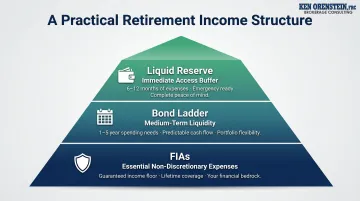
This structure ensures you're never forced to sell a bond fund at a loss to cover expenses, never subject to surrender charges on money you actually need short-term, and never uncertain about whether your guaranteed income will continue.
Navigating FIA product features — caps, participation rates, income rider structures, surrender schedules, carrier financial strength — alongside a bond ladder requires personalized analysis. No two retirement income plans look the same.
Ken Orenstein at Brokerage Consulting focuses on low-cost, tax-efficient retirement income planning for federal employees and individuals, with carrier financial strength reviewed using A.M. Best, Moody's, S&P, and Fitch ratings before any recommendation is made. Schedule a no-cost initial consultation — by phone, virtually, or in person — at bcfinserv.com.
Frequently Asked Questions
Which is better for retirement portfolios: fixed index annuities or bonds?
Neither is universally better. Bonds offer liquidity and simplicity; FIAs provide principal protection, tax deferral, and lifetime income guarantees bonds can't replicate. Most retirement income strategies benefit from both, with the allocation depending on your income needs, tax situation, and time horizon.
How much does a $100,000 fixed annuity pay per month?
Payout amounts vary based on age, gender, contract type, and prevailing interest rates. As a general benchmark, the CANNEX PAY Index indicates a $100,000 immediate annuity for a 65-year-old male pays approximately $617/month. Rates shift with market conditions, so confirm current figures with a licensed advisor or carrier before finalizing any decisions.
Are fixed index annuities safer than bonds?
FIAs protect principal contractually with a 0% floor, while bonds can lose market value if sold before maturity or held in a fund during rising-rate periods. FIAs also carry insurer solvency risk, though state guaranty associations provide coverage up to $250,000 for deferred annuities. Neither is entirely risk-free.
What are the main tax differences between fixed index annuities and bonds?
Bond interest (except from municipal bonds) is taxed as ordinary income in the year it's earned. FIA growth is tax-deferred until withdrawal under IRC Section 72. This distinction can significantly reduce a retiree's effective tax rate, lower Medicare Part B premiums, and reduce the percentage of Social Security benefits subject to tax.
Can you lose money in a fixed index annuity?
FIAs have a 0% floor — the account value won't decline due to index losses. However, surrendering early during the surrender charge period can result in a net loss due to penalties. The insurer's financial strength matters, though state guaranty associations provide a backstop up to applicable limits.
Should I replace my bond allocation with a fixed index annuity?
A wholesale replacement is generally not advisable. Consider what role each plays: bonds typically provide liquidity and short-term flexibility, while FIAs deliver guaranteed income, tax deferral, and principal protection. A qualified advisor can help determine the right balance for your specific situation.