
A Guaranteed Lifetime Withdrawal Benefit (GLWB) rider is one tool designed to put a guaranteed income floor under a retirement portfolio — ensuring withdrawals continue even if the underlying account is fully depleted. But it's also one of the most misunderstood features in the annuity market.
This article explains what a GLWB actually is, how its two key values (benefit base and accumulated value) work together, what determines your guaranteed withdrawal amount, and what the real costs and trade-offs look like before you sign anything.
Key Takeaways
- A GLWB guarantees a minimum annual withdrawal for life, even if the account balance hits zero
- Your guaranteed withdrawal = benefit base × payout rate (not your actual account balance)
- Step-up and roll-up features can grow the benefit base; excess withdrawals can permanently reduce it
- Rider fees typically run 1%–1.5%+ of the benefit base annually, paid as an add-on to certain annuities
- GLWBs work best when held long-term and withdrawals stay within the guaranteed limits
What Is a GLWB and How Does It Work?
A GLWB is an optional contract provision — called a rider — available on certain annuities, most commonly variable annuities and fixed index annuities (FIAs). For an annual fee, it guarantees the owner can take a set annual withdrawal for life, even if the underlying account is fully exhausted.
The Key Difference from Annuitization
A GLWB is not the same as annuitizing a contract. When you annuitize, you irrevocably exchange your account value for an income stream — you lose ownership of the asset. With a GLWB, as FINRA notes, you maintain control of the underlying account while the income guarantee sits on top of it. The remaining balance continues to earn interest or investment returns, and you can take additional lump sums if needed (within limits).
When Withdrawals Begin
You don't have to start withdrawals immediately. Most contracts allow deferral, during which the benefit base can grow. Waiting often increases both the benefit base and the applicable payout rate — meaning a larger guaranteed withdrawal amount when you do start.
The Settlement Phase
This is the moment a GLWB earns its purpose: if the accumulated account value reaches zero due to withdrawals and rider fees while you're still living, the insurer continues making the guaranteed annual payment. There is one condition that can void this protection: the settlement phase only applies when the account depletes under normal, within-limit withdrawals. If an excess withdrawal drains the account, the guarantee can be voided or permanently reduced.
No Universal Standard
A rider labeled "GLWB" on one contract may function quite differently from one at another company. Key terms that vary by insurer and product design include:
- Payout rates and how they change with deferral age
- Benefit base growth mechanics (roll-up rates, step-up provisions)
- Annual rider fee structures
- Excess withdrawal penalty terms
Comparing these details across carriers is where the real analysis happens — marketing materials rarely tell the full story. An independent advisor who works across multiple insurers can run that comparison for you.
The Benefit Base and Accumulated Value: Two Values, One Contract
Every GLWB contract runs on two parallel numbers. Confusing them is the single most common mistake buyers make.
Accumulated Value
The accumulated value is the real, actual market value of the annuity — what you'd receive if you surrendered the contract today. In a variable annuity, it rises and falls with sub-account investment performance. In a fixed index annuity, it grows with credited interest. Withdrawals, rider fees, and market losses all reduce it.
Benefit Base
The benefit base is a separate, notional figure (meaning it exists on paper, not as cash) maintained by the insurer. It typically starts equal to your initial premium and grows according to specific contract rules.
It is not money you can withdraw as a lump sum. If you surrender the contract, you receive the accumulated value — not the benefit base. As SEC-filed Brighthouse contract language states directly, the GLWB Base cannot be withdrawn in a lump sum, paid as a death benefit, or guaranteed to be returned.
The benefit base serves one purpose: multiplied by the payout rate, it determines your guaranteed annual withdrawal amount.
How the Benefit Base Can Grow
Two common features can increase the benefit base over time:
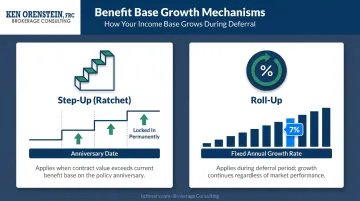
- Step-up (ratchet): On contract anniversary dates, if the accumulated value exceeds the benefit base, the contract automatically increases the benefit base to match. This locks in market gains permanently and raises future guaranteed income.
- Roll-up: Some contracts guarantee the benefit base grows by a fixed percentage — Morningstar cites examples such as 7% annually — during the deferral period when no withdrawals are taken, regardless of market performance. Whether this is simple or compound interest varies by contract and changes the long-term result meaningfully.
How Withdrawals Reduce the Benefit Base
Growth features work in your favor — but withdrawals can work against you. Normal withdrawals (within the guaranteed annual limit) reduce the benefit base dollar-for-dollar. Excess withdrawals — anything above the guaranteed annual limit in a given contract year — can reduce the benefit base proportionally, often by more than the dollar amount taken out.
For example: if your benefit base is $200,000 and your accumulated value is $150,000, taking an excess withdrawal triggers a reduction ratio that magnifies the damage to the benefit base. This permanently lowers all future guaranteed income payments. Once the benefit base drops, there's no recovering those future income payments.
What Determines Your Guaranteed Annual Withdrawal Amount
The formula is straightforward:
Guaranteed Annual Withdrawal = Benefit Base × Payout Rate
Once the benefit base is established, market value and original premium no longer drive this number — the benefit base and payout rate do.
How Payout Rates Vary by Age
The payout rate is a percentage set in the contract, primarily determined by your age when you first begin GLWB withdrawals. Rates are lower at younger ages and increase as you defer longer. The Columbus Life 2025 FIA GLWB Client Guide provides a product-specific illustration of how these rates can look:
| Age at First Withdrawal | Single-Life Payout Rate (Illustrative) |
|---|---|
| Age 60 | 4.5% |
| Age 65 | 5.0% |
| Age 70 | 5.5% |
| Age 75 | 6.0% |
| Age 80 | 6.5% |
| Age 90+ | 7.5% |
Important: these are product-specific figures from one insurer's 2025 guide. Rates vary meaningfully across carriers, products, and contract years. The American Academy of Actuaries cites a common reference point of approximately 5% at age 65 for single-life coverage as a general benchmark — but actual rates depend entirely on the contract you're evaluating.
Single vs. Joint Life Coverage
The same age-based logic applies when coverage extends to two lives (typically spouses), but with one key difference: the payout rate is set using the younger person's age at first withdrawal. Joint payout rates are generally lower than single-life rates, given the longer combined life expectancy. Once the payout rate is set at first withdrawal, it doesn't change.
What Can Move the Guaranteed Amount After It's Set
- Step-up in benefit base → a higher benefit base produces a higher guaranteed withdrawal at the same payout rate
- Excess withdrawal → a reduced benefit base permanently lowers your guaranteed withdrawal amount
Costs, Risks, and Common Misunderstandings
What Rider Fees Actually Look Like
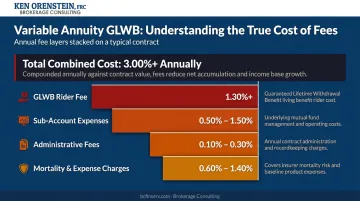
GLWB rider fees are typically charged as a percentage of the benefit base, not the accumulated value, and are deducted from the account annually — even in years when you take no withdrawals.
Documented examples from actual contracts:
- Nationwide/Fidelity product: 1.30% of the current income benefit base annually
- Columbus Life FIA product: 0.95% of the benefit base, with the right to increase to 1.50%
On fixed index annuity products, Morningstar notes that costs are sometimes embedded in reduced caps, spreads, or participation rates rather than appearing as an explicit line-item fee — which makes cost comparisons between FIA and variable annuity GLWB products less straightforward than they appear.
For variable annuities specifically, the GLWB rider fee is on top of mortality and expense charges, administrative fees, and sub-account expenses. Combined all-in costs on a VA with a GLWB rider can exceed 3% annually.
Three Misunderstandings Worth Addressing Directly
1. The benefit base is not a withdrawal account. Many buyers assume the benefit base represents money they can access. It doesn't. Surrender the contract and you receive the accumulated value. The benefit base has no cash-equivalent value outside the contract structure.
2. What's guaranteed is income, not principal. The GLWB guarantees the annual withdrawal amount, not the account balance. If the account reaches zero, withdrawals continue. The estate, however, inherits nothing from a depleted account — a meaningful gap for anyone with legacy goals.
3. Fixed income doesn't automatically keep up with inflation. A guaranteed withdrawal of $18,000 per year today may cover considerably less in purchasing power 20 years from now. Some contracts offer income increase features (at additional cost), but the base guarantee is typically fixed. That's a real trade-off, and one worth weighing carefully before committing.
Is a GLWB Rider Right for Your Retirement Plan?
When It Tends to Make Sense
A GLWB is most valuable for someone who:
- Wants market participation (through a variable or FIA) but cannot afford to lose their income floor in a downturn
- Has longevity risk concerns — family history or personal health suggesting a longer-than-average retirement
- Plans to hold the contract long-term and can commit to staying within the withdrawal limits
- Has limited guaranteed income from other sources (limited pension, reduced Social Security benefits)
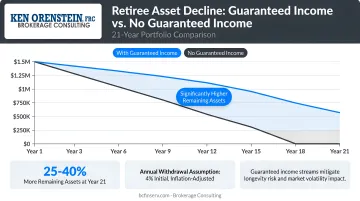
EBRI's 2026 research on guaranteed income streams found that retirees without defined benefit income experienced a 89% median asset decline over 21-22 years, compared to just 29% for those with DB income — a gap wide enough to significantly alter retirement security outcomes for those without a guaranteed income floor.
When It May Not Be the Right Fit
- Investors with a long time horizon who can genuinely tolerate market volatility without needing a guaranteed income floor
- Anyone who may need access to a lump sum — surrender charges may apply if you exit early (the Nationwide/Fidelity product cites a 2% surrender charge in the first five contract years; FINRA notes variable annuity surrender periods can extend eight years or more)
- Clients for whom the annual rider fees would meaningfully erode returns in a product they're unlikely to hold to maturity
A Note for Federal Employees
The suitability criteria above apply broadly — but for federal employees, the calculation gets more nuanced. Those with FERS pension income already have a guaranteed income base, which changes how a GLWB fits into the overall picture.
The American Academy of Actuaries notes that non-insured income strategies may be sufficient when a significant portion of basic needs is already covered by guaranteed sources such as Social Security or a DB pension. Whether a GLWB on top of FERS income improves retirement security — or simply adds cost — depends on the gap between guaranteed income and actual spending needs.
Ken Orenstein at Brokerage Consulting works through this analysis directly — mapping FERS pension income, TSP distribution strategy, and Social Security timing to identify whether a GLWB rider closes a real income gap or just adds fees. No-cost consultations are available by phone, virtual, or in-person.
Frequently Asked Questions
What is a guaranteed lifetime withdrawal benefit (GLWB) on an annuity and how does it work?
A GLWB is an optional rider added to certain annuities (most commonly variable and fixed index annuities) that guarantees a minimum annual withdrawal for life, even if the account balance reaches zero. The annual amount is calculated by multiplying a payout rate by the benefit base, and the rider is added at purchase for an annual fee.
What is the difference between a guaranteed minimum withdrawal benefit (GMWB) and a guaranteed lifetime withdrawal benefit (GLWB)?
A GMWB typically guarantees withdrawals only until the total premiums paid have been returned. A GLWB guarantees withdrawals for the remainder of the owner's life (regardless of how long that is). The GLWB is specifically designed to address longevity risk; the GMWB is not.
What does "guaranteed withdrawal balance" mean?
The guaranteed withdrawal balance (GWB) (also called the benefit base) is a notional figure maintained by the insurer used solely to calculate the annual guaranteed withdrawal amount and rider fees. It is not money the owner can withdraw as a lump sum or receive as a death benefit.
Can withdrawals be taken from the benefit base directly?
No. Withdrawals are taken from the annuity's accumulated (cash) value, not from the benefit base. The benefit base is a calculation figure only. Taking withdrawals reduces the accumulated value and, if withdrawals exceed the guaranteed limit, can also reduce the benefit base.
What happens if I withdraw more than my guaranteed annual withdrawal amount?
Taking withdrawals above the guaranteed annual limit is an "excess withdrawal." This can permanently reduce the benefit base — sometimes by more than the dollar amount withdrawn, through proportional recalculation — which lowers all future guaranteed income payments.
How much does a GLWB rider typically cost?
GLWB rider fees range from roughly 0.95% to 1.30% of the benefit base annually, with some contracts reserving the right to increase charges up to 1.50%. On fixed index annuities, costs may be embedded in reduced crediting rates rather than charged as a separate line item.