
That scale reflects a real shift in how Americans are approaching retirement. With only 15% of private-industry workers having access to a traditional pension, the burden of funding 20-plus years of retirement increasingly falls on individuals. Annuities can fill that gap — but only when you understand what you're buying.
The problem isn't that annuities don't work. It's that people make poor decisions about them because the contracts are complex and the terminology is dense. This guide cuts through that. Here's how annuities actually work — the mechanics, the benefits, the costs, and who they're right for.
Key Takeaways
- An annuity is a contract with an insurance company: you contribute money and receive guaranteed income in return — either immediately or at a future date.
- Annuities move through two phases — accumulation (tax-deferred growth) then distribution (regular income payments).
- Fixed, variable, and indexed annuities each carry different risk/reward trade-offs — knowing the difference matters.
- Key benefits: guaranteed lifetime income, tax-deferred growth, and a death benefit for named beneficiaries.
- Annuities work best as one layer of a broader retirement income plan, not as a standalone solution.
What Is an Annuity?
An annuity is a contract between you and an insurance company. You make one or more premium payments; the insurer guarantees a stream of income payments in return — for a fixed period or for the rest of your life.
They exist to solve a specific problem: the risk of outliving your savings. Unlike a brokerage account or savings account, a properly structured annuity can continue paying income regardless of how long you live. No standard investment product makes that same guarantee.
What an Annuity Is Not
Understanding what annuities are not is just as important as knowing what they are — the category gets lumped in with savings products and investments often enough to cause real planning mistakes.
- Your money isn't freely accessible — withdrawals before the surrender period often carry penalties
- Life insurance pays beneficiaries if you die early; an annuity protects you if you live a long time
- Annuities are insurance contracts, not securities — though variable annuities include investment components regulated by the SEC and FINRA
Two Categories Based on Timing
Immediate annuities begin paying income within 12 months of your initial premium. These are typically purchased at or near retirement with a lump sum — often used to convert savings or a pension buyout into a reliable paycheck.
Deferred annuities start paying at a future date, while your money grows during an accumulation period. These suit people who are still years from retirement and want to lock in guaranteed income ahead of time.
The Three Main Types
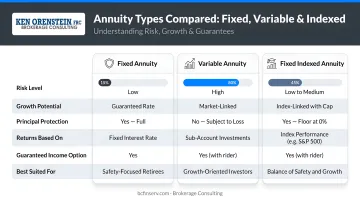
| Type | How Growth Works | Risk Level |
|---|---|---|
| Fixed | Guaranteed interest rate set by insurer | Low |
| Variable | Tied to market sub-account investments | Higher |
| Fixed Indexed | Linked to a market index (e.g., S&P 500) with downside protection and a cap on gains | Moderate |
How Does an Annuity Work?
Every annuity moves through three stages: funding, accumulation, and distribution. Each stage has specific rules and tax implications that determine what you ultimately receive.
The Funding Stage
You can fund an annuity two ways:
- Single lump-sum premium — common with immediate annuities and SPIAs
- Series of payments over time — more typical with deferred annuities
The source of funds determines how withdrawals are taxed. Money from a 401(k) or IRA rollover creates a qualified annuity (pre-tax dollars), meaning withdrawals are fully taxable. Money from personal savings creates a non-qualified annuity (after-tax dollars), which uses an exclusion ratio — so only the interest portion is taxed, not your original contribution.
One underused advantage: Unlike 401(k)s and IRAs, non-qualified annuities carry no IRS annual contribution limits. For higher-income earners who've already maxed out other tax-advantaged accounts, this creates an additional channel for tax-deferred savings with no cap.
The Accumulation Phase
During accumulation, your money grows — either at a fixed rate, linked to an index, or based on market performance — and that growth is tax-deferred. You owe nothing to the IRS until withdrawals begin.
Watch out for surrender charges. If you withdraw funds before the surrender period ends, you'll face a fee. Per SEC guidance, surrender periods typically run 6 to 8 years (sometimes up to 10), with charges as high as 9% in year one. A typical schedule looks like 7-6-5-4-3-2-1-0%, declining until they reach zero.
The IRS also imposes a 10% early withdrawal penalty on taxable amounts taken before age 59½. Most contracts offset this with a free withdrawal provision — usually up to 10% of account value annually — so you retain some access without triggering surrender charges.
The Distribution Phase
Distribution begins when the contract starts paying income. Once you annuitize — converting the account into an income stream — the decision is typically irrevocable: no lump-sum access, no changes to the payment structure.
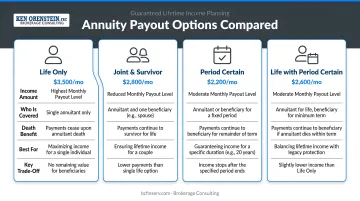
The main payout options:
- Life-only — payments for as long as you live; stop at death
- Period certain — payments for a defined number of years (e.g., 10 or 20); remaining payments go to a beneficiary if you die before the period ends
- Joint and survivor — income continues for both spouses, often at a reduced amount after the first spouse dies
- Life with period certain — lifetime income with a guaranteed minimum payout period protecting a beneficiary
Key Benefits of Annuities
Guaranteed Income and Longevity Protection
This is the core value proposition. According to SSA actuarial data, a 65-year-old male has a remaining life expectancy of roughly 16.9 years; for females, it's 19.5 years. Many people will live longer than those averages — and a surprising number are worried about it.
An Allianz Life study found that 64% of Americans worry more about running out of money than about dying.
An annuity directly addresses that fear. The income cannot be depleted by market downturns or an unexpectedly long retirement. For people without a traditional pension — which covers most private-sector workers and even some federal employees relying solely on the FERS supplement — that guaranteed floor can be the difference between a secure retirement and one spent rationing spending.
Tax-Deferred Growth
Because annuity earnings aren't taxed annually, the full balance compounds each year. Over a 20-year accumulation period, that gap between taxed and tax-deferred growth can be substantial.
At withdrawal, the tax treatment depends on the annuity type:
- Qualified annuity (funded with pre-tax dollars): withdrawals are fully taxable as ordinary income
- Non-qualified annuity (after-tax dollars): only the gain portion is taxed; the cost basis is recovered tax-free via the exclusion ratio
This makes non-qualified annuities particularly useful for higher-income earners who've exhausted 401(k) and IRA limits and want continued tax-deferred accumulation.
Death Benefit and Estate Planning
Most annuities include a basic death benefit — at minimum, returning the amount contributed to a named beneficiary. Enhanced death benefit riders can lock in higher values based on account growth.
For retirees planning to transfer wealth, annuity death benefits offer a key structural advantage: proceeds pass directly to named beneficiaries outside of probate. Common payout and planning options include:
- Lump-sum payout — beneficiary receives the full contract value at once
- Stretch payout — distributions spread over the beneficiary's life expectancy for continued tax deferral
- Period-certain continuation — income payments continue for a guaranteed minimum term regardless of the owner's death
- Return-of-premium rider — guarantees beneficiaries receive at least the original premium, even if the account hasn't grown
Potential Drawbacks and Costs to Know
Surrender Charges and Liquidity
Annuities are long-term commitments. During the surrender period, withdrawing more than the annual free-withdrawal allowance (typically 10%) triggers fees that can be substantial in the early years. This illiquidity is the most significant limitation for people who may need flexible access to funds.
That commitment comes with a real benefit: the income guarantee you receive in exchange has genuine value. The key question is whether the surrender timeline fits your financial situation before you sign.
Fees in Variable and Indexed Products
Variable annuities carry multiple cost layers:
- Mortality and expense (M&E) risk charge — typically around 1.25% per year per SEC data
- Administrative fees — often a flat $25–$30 annually or roughly 0.15% of account value
- Sub-account investment fees — underlying mutual fund expenses deducted from sub-account returns
Income riders (GLWB or GMIB) add further annual charges, often 1.0–1.5% on the income base. Fixed annuities generally carry no explicit annual fees, though insurers earn a margin between what they invest and what they credit to your account.
Complexity and Contract Terms
Those layered fees are only part of what makes variable annuities complex. According to FINRA, they rank among the top sources of investor complaints. The contracts are dense, rider language varies widely between carriers, and the features that make an annuity valuable — income guarantees, death benefits, free withdrawal provisions — all live in the details.
Before purchasing any annuity:
- Read the full contract, not just the summary brochure
- Understand every fee layer — M&E charges, rider costs, and sub-account expenses
- Work with a licensed advisor who can compare options across multiple carriers
Who Should Consider an Annuity?
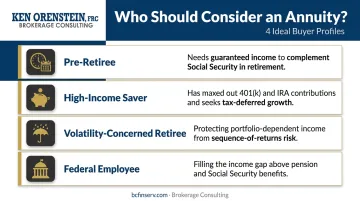
Profiles Most Likely to Benefit
- Pre-retirees approaching retirement who need guaranteed income to cover essential expenses alongside Social Security
- Savers who've maxed out 401(k) and IRA contributions and want additional tax-deferred growth
- Retirees concerned about market volatility eroding a portfolio they depend on for income
- Federal employees whose FERS or CSRS pension covers some but not all essential retirement expenses
For federal workers specifically, annuities can function as a third income layer — sitting beneath Social Security and pension income, above discretionary portfolio assets.
Ken Orenstein at Brokerage Consulting, a Federal Retirement Consultant (FRC) who has authored The Informed Fed: A Survival Guide to Federal Employee Benefits, works with federal employees to evaluate annuity options alongside FERS, CSRS, and TSP income strategies. The goal is a coordinated, tax-efficient income plan built with clear structure, not products stacked without purpose.
Who May Be Less Suited
- Those who need high liquidity or may require access to funds within the surrender period
- Investors with strong risk tolerance seeking maximum market growth without the cost of insurance features
- Anyone with a very short time horizon before needing the funds
Choosing the Right Type
The right annuity depends on your age, income timeline, risk tolerance, and tax situation. A no-cost initial consultation — available by phone, virtually, or in person through Brokerage Consulting at (888) 315-3608 or bcfinserv.com — helps map out which structure fits your retirement picture.
Frequently Asked Questions
How does an annuity work in simple terms?
You give an insurance company money — as a lump sum or periodic payments — and in return, they guarantee regular income payments to you, either for a set number of years or for the rest of your life. It converts savings into a predictable, recurring income stream.
Does your money grow in an annuity?
Yes. During the accumulation phase, annuity funds grow tax-deferred — at a fixed rate, linked to a market index, or tied to market investments, depending on the type. The growth rate and level of protection against losses depend on which annuity you hold.
How do I put money into an annuity?
You can fund an annuity with a single lump-sum payment or a series of contributions over time. Funds can come from personal savings (after-tax dollars) or as a rollover from a 401(k) or IRA (pre-tax dollars) — each method affects how future withdrawals are taxed.
Is an annuity really worth it?
For retirees who need guaranteed income and want protection against outliving their savings, annuities can be genuinely valuable. The right fit depends on your financial goals, time horizon, and the specific contract terms — so reviewing options with an advisor before purchasing makes sense.
Who receives the benefits in an annuity?
The annuitant receives income payments during their lifetime. Upon death, a named beneficiary may receive remaining payments or a death benefit, depending on the payout option chosen — such as period certain, joint and survivor, or a standard death benefit provision.
What is the best type of annuity to invest in?
The best annuity depends on your risk tolerance and retirement goals. Fixed annuities suit conservative investors wanting predictable, guaranteed returns. Fixed indexed annuities balance growth potential with downside protection. Variable annuities suit those comfortable with market risk seeking higher returns.