
This guide covers the core rules you need to know: how annuity income is taxed, withdrawal guidelines, payout options, early withdrawal penalties, Required Minimum Distributions (RMDs), and inherited annuity rules. These principles apply whether you hold a fixed, variable, or indexed annuity — and whether your contract is qualified or nonqualified.
TLDR: Key Annuity Rules at a Glance
- Annuity earnings grow tax-deferred and are taxed as ordinary income when withdrawn — not at capital gains rates
- Withdrawing before age 59½ triggers a 10% IRS early withdrawal penalty plus ordinary income tax — plus any insurer surrender charges
- Qualified annuity holders must begin RMDs by April 1 of the year after turning age 73, or face a 25% excise tax on missed amounts
- Non-spouse beneficiaries inheriting a nonqualified annuity must withdraw all funds within five years of the owner's death; the stretch option must be elected within one year
How Annuity Income Is Taxed
The Tax-Deferral Baseline
Annuity earnings — interest, dividends, and capital gains inside the contract — are not taxed until you take distributions. When you do, IRS Publication 575 (2025) is clear: the taxable portion is treated as ordinary income, not capital gains. That distinction matters — ordinary income rates reach up to 37%, while long-term capital gains top out at 20%.
Qualified vs. Nonqualified Annuities
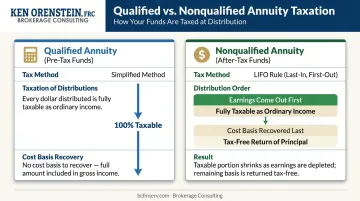
If all contributions were pre-tax (a qualified annuity held inside a 401(k), IRA, or 403(b)), every dollar distributed is fully taxable. There's no cost basis to recover.
If you used after-tax dollars (a nonqualified annuity purchased directly from an insurer), only the earnings portion is taxable. The return of your original investment — your cost basis — comes back to you tax-free.
How that split is calculated depends on the type of plan:
- Qualified employer plans and 403(b) annuities use the Simplified Method: divide your total investment by the anticipated number of monthly payments based on your age at the start date — that ratio sets the tax-free portion of each payment.
- Nonqualified annuities follow the LIFO rule (last in, first out): pre-annuitization withdrawals hit earnings first (fully taxable), then cost basis. You recover your principal only after all gains have been distributed.
The Net Investment Income Tax (NIIT)
Higher-income taxpayers face an additional 3.8% Net Investment Income Tax on nonqualified annuity earnings. According to the IRS NIIT page, the income thresholds are:
| Filing Status | MAGI Threshold |
|---|---|
| Single / Head of Household | $200,000 |
| Married Filing Jointly / Qualifying Widow(er) | $250,000 |
| Married Filing Separately | $125,000 |
If your income exceeds these thresholds, annuity gains face a combined federal rate of up to 40.8% — ordinary income tax at the 37% bracket plus the 3.8% surcharge.
Annuity Withdrawal Guidelines: Key Rules to Know
Understanding how the IRS categorizes your withdrawals determines how much of each payment is taxable — and when. Two classification rules govern this.
Periodic Payments vs. Nonperiodic Distributions
The IRS treats these two withdrawal types differently:
- Periodic payments — regular annuity income received on a schedule (monthly, quarterly, annually) for more than one year. Cost recovery (how you recoup your after-tax contributions tax-free) follows the Simplified Method or General Rule depending on plan type.
- Nonperiodic distributions — lump sums or one-time withdrawals. These follow LIFO (nonqualified) or a pro-rata formula (qualified plans).
Which rule applies also depends on timing — specifically, whether you withdraw funds before or after a key IRS benchmark.
The Annuity Starting Date
This date is the IRS reference point for cost recovery. Once you've crossed your annuity starting date, distributions are generally fully taxable (your cost basis has already been recovered through the exclusion ratio applied to each payment).
For withdrawals taken before the starting date:
- Nonqualified annuities → LIFO: gains come out first
- Qualified plans → Pro-rata formula: (Amount Withdrawn × Cost of Contract) ÷ Account Balance = Tax-Free Amount
Tax treatment is only part of the equation. Before taking any withdrawal, you also need to account for what the insurance contract itself allows.
Surrender Charges
Most annuity contracts impose surrender charges if you withdraw funds during the surrender period. According to FINRA and the NAIC Buyer's Guide:
- Surrender periods can run eight years or more
- The charge percentage typically decreases each year as the surrender period winds down
- These charges are imposed by the insurer — separate from any IRS early withdrawal penalty
Free Withdrawal Provisions
Most contracts include an annual free withdrawal allowance — typically up to 10% of the contract value — that lets you access funds during the surrender period without triggering insurer charges. Keep in mind: the insurer waiving the surrender charge doesn't eliminate the tax bill. Ordinary income taxes still apply to the earnings portion of any withdrawal, so factoring in both costs before taking funds out matters.
Annuity Payout Options and Income Strategy
When you reach the annuitization stage, you'll choose how income is structured. The choice is permanent in most cases, so understanding the trade-offs matters.
The Four Core Payout Structures
| Option | How It Works | Best For |
|---|---|---|
| Straight Life (Single-Life) | Highest monthly payment; stops at death | Single individuals with no heirs to protect |
| Life with Period Certain | Pays for life; if you die early, payments continue to beneficiaries for the guaranteed period (e.g., 10 or 20 years) | Those wanting minimum income security for heirs |
| Joint and Survivor | Continues payments while either spouse is alive; survivor receives 50–100% of original payment | Married couples coordinating retirement income |
| Fixed-Period | Pays for a set number of years regardless of lifespan | Those needing income for a defined window |
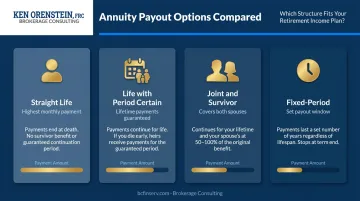
The single-life option delivers the largest monthly check but leaves nothing for a surviving spouse or beneficiaries. Joint-and-survivor protection reduces the monthly payment — sometimes substantially — but ensures income continues if you predecease your spouse.
Lump Sum vs. Annuitization
Surrendering an annuity for a lump sum triggers immediate taxation on all accumulated gains, plus possible surrender charges if you're still within the surrender period. Annuitization, by contrast, spreads the tax liability across the payment stream and locks in a guaranteed income floor.
That calculus gets more complex for federal employees and retirees coordinating with FERS or CSRS pension income, Social Security, and TSP distributions. Ken Orenstein, a Federal Retirement Consultant at Brokerage Consulting, works with clients to build a layered income plan: federal pension and Social Security as the foundation, with private annuities filling gaps and managing longevity risk.
This framework is especially useful for married federal retirees deciding whether a joint-life SPIA or a deferred annuity with a lifetime income rider better complements an existing survivor benefit election. Schedule a no-cost consultation at bcfinserv.com or by calling (888) 315-3608.
Early Withdrawal Penalties: The Age 59½ Rule
The 10% Additional Tax
Any taxable distribution from a qualified annuity or retirement plan before age 59½ is subject to a 10% additional tax on top of ordinary income tax — applied to the taxable (gains) portion only. Nonqualified annuities carry the same 10% penalty under IRC Section 72(q), with limited exceptions.
Exceptions to the 10% Penalty
The IRS recognizes several situations where the penalty doesn't apply:
- Substantially Equal Periodic Payments (SEPP / 72(t)) — fixed payment series that must continue for the longer of five years or until you reach 59½ (three calculation methods apply: RMD, fixed amortization, or fixed annuitization)
- Separation from service at age 55 or older (qualified plans only)
- Total and permanent disability
- Death of the owner
- Certain immediate annuity distributions from nonqualified contracts
- Disaster-related distributions under specific IRS relief provisions
- Pre-August 14, 1982 investment in a nonqualified contract

The SEPP method is the most commonly used strategy for accessing annuity funds before 59½. Once established, the payment schedule cannot be modified without triggering recapture of all avoided penalties, so careful planning before implementation is essential.
One more factor to account for: even when you qualify for an IRS penalty exception, insurer surrender charges may still apply, compounding the true cost of early access.
Required Minimum Distributions for Annuities
When RMDs Begin
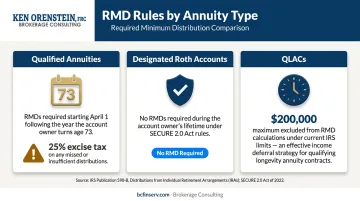
Under post-SECURE 2.0 rules, IRS Publication 590-B (2025) confirms that account holders must begin RMDs from qualified annuity plans — those held inside a 401(k), 403(b), or traditional IRA — by April 1 of the year following the year they turn age 73.
Missing that deadline is costly: a 25% excise tax applies to the amount that should have been distributed, dropping to 10% if corrected within the IRS correction window.
How RMDs Are Calculated
- Annuitized contracts — once you're in the payout phase, the periodic payments themselves typically satisfy the RMD requirement
- Non-annuitized qualified plans — the annual RMD equals the prior December 31 account balance ÷ the applicable IRS life expectancy factor from the Uniform Lifetime Table (Table III)
Important RMD Nuances
- Designated Roth accounts in 401(k) and 403(b) plans are not subject to RMDs during the account holder's lifetime under current SECURE 2.0 rules (effective 2024 tax year)
- Nonqualified annuities purchased outside retirement accounts are not subject to RMD rules, though the contract may impose its own annuitization deadlines or surrender schedules
- Qualified Longevity Annuity Contracts (QLACs), purchased inside an IRA or qualified plan, allow premiums up to $200,000 to be excluded from RMD calculations — an effective strategy for deferring income and reducing taxable distributions in late retirement
Inherited Annuity Rules and the 5-Year Rule
Nonqualified Inherited Annuities
When a non-spouse beneficiary inherits a nonqualified annuity, IRC Section 72(s) requires the entire balance to be distributed within five years of the owner's death. There are no annual distribution requirements during that period, but gains are taxed as ordinary income — and concentrating distributions into one or two years can push a beneficiary into a significantly higher bracket.
Three distribution paths are available:
- 5-Year Rule — full distribution by the end of the fifth year after the owner's death; no schedule required within that window
- Nonqualified Stretch Option — distributions spread over the beneficiary's life expectancy; must be elected within one year of the owner's death, or the 5-year rule applies automatically
- Spousal Exception — a surviving spouse may assume ownership of the contract and continue it as their own, bypassing the 5-year rule entirely
Qualified Inherited Annuities (Inside an IRA or Employer Plan)
Annuities held inside an IRA or employer plan operate under a different framework. These follow the SECURE Act's 10-year rule: most non-spouse beneficiaries must fully withdraw inherited IRA or plan assets by December 31 of the tenth year after the owner's death.
Annual RMD requirements during the 10-year period depend on whether the original owner had already begun taking distributions:
- Owner died before their required beginning date → no annual distributions required; full balance due by end of year 10
- Owner died on or after their required beginning date → beneficiaries must continue taking at least annual distributions throughout the 10-year window
Eligible designated beneficiaries — surviving spouses, minor children of the owner, disabled or chronically ill individuals, and individuals no more than 10 years younger than the deceased — may qualify for longer stretch distributions beyond the 10-year rule.
Frequently Asked Questions
How much will a $1,000,000 annuity pay per month?
Monthly income from a $1,000,000 annuity varies based on your age at the start date, the payout option selected (single-life versus joint-and-survivor), current interest rates, and the annuity type. A 65-year-old choosing a single-life payout will generally receive more per month than one selecting joint-and-survivor coverage. For current quotes based on your specific situation, consult an independent annuity specialist who can compare options across multiple carriers.
What is the annuity rule?
"The annuity rule" refers to the IRS and insurer regulations governing annuity access — the age 59½ early withdrawal threshold, ordinary income tax treatment of gains, and the RMD obligation at age 73 for qualified annuities. Insurance contracts add a separate layer through surrender charge schedules and free withdrawal provisions.
At what age can you withdraw from an annuity without penalty?
IRS early withdrawal penalties stop applying once you reach age 59½. Insurer surrender charges operate on a separate clock — they expire when the surrender period ends, regardless of your age. Certain exceptions, like SEPP distributions, allow penalty-free IRS access before 59½ if structured correctly.
Are annuity payments taxed as ordinary income?
Yes. The earnings (gain) portion of any annuity distribution is taxed at ordinary income rates — not the lower long-term capital gains rate. The return of your original after-tax contributions (cost basis) comes back tax-free, but gains do not receive preferential tax treatment.
What happens to my annuity when I die?
Most annuities include a death benefit that returns the remaining account value or total premiums paid to a named beneficiary. Tax obligations and withdrawal timelines depend on whether the annuity is qualified or nonqualified. Spouses can assume ownership; non-spouse beneficiaries follow the 5-year or 10-year distribution rules.
Can I withdraw a lump sum from my annuity?
Most annuities permit full surrender, but the costs are significant: immediate income tax on all accumulated gains, a possible 10% IRS early withdrawal penalty if you're under 59½, and insurer surrender charges if you're within the surrender period.