
According to the 2024 EBRI/Greenwald Retirement Confidence Survey, roughly one in four workers doesn't know how much pre-retirement income they'll need to replace. Yet 83% of workers in workplace retirement plans expressed interest in converting some savings into guaranteed lifetime income. That gap — between wanting guaranteed income and knowing how to get it — is exactly where annuity selection decisions go wrong.
This guide walks through the core annuity types, the six factors that determine which one fits your situation, and how to match your specific retirement profile to the right product.
Key Takeaways
- Annuities break into two timing structures (immediate vs. deferred) and three growth types (fixed, variable, indexed) — your timeline and risk tolerance narrow the options fast
- Six factors shape the decision: income timeline, risk tolerance, guaranteed income already in place, tax situation, liquidity needs, and legacy goals
- FERS pension holders should calculate their income gap first — buying income you already have wastes premium
- Read the full cost structure before signing: surrender charges, rider fees, and mortality expenses vary significantly by product
- An independent advisor who represents multiple carriers gives you side-by-side comparison across carriers, not a single company's product lineup
What Is an Annuity and How Does It Work?
An annuity is a contract with an insurance company. You deposit money (either as a lump sum or through ongoing contributions) and in return, the insurer provides guaranteed income payments, either for a fixed period or for life. All annuities grow on a tax-deferred basis, meaning you don't pay taxes on earnings until you take withdrawals.
Most deferred annuities have two distinct phases:
- Accumulation phase — your premium grows (at a fixed rate, through market-linked sub-accounts, or tied to an index)
- Distribution phase — the insurer pays out income based on your elected payout structure
Those two phases shape how each annuity type works. To compare products effectively, focus on two dimensions: when income begins (immediately or at a future date) and how your money grows.
The Main Annuity Types at a Glance
| Type | Growth Structure | Market Risk | Best For |
|---|---|---|---|
| Fixed | Guaranteed rate | None | Conservative, predictable income |
| Variable | Market sub-accounts | Full upside and downside | Higher risk tolerance, longer time horizon |
| Fixed Indexed (FIA) | Index-linked with floor | Capped upside, limited downside | Middle ground — growth potential with protection |
| Immediate (SPIA) | N/A — income starts now | N/A | Retirees needing income within 12 months |
| Deferred | Any of the above | Depends on type | Pre-retirees building future income |
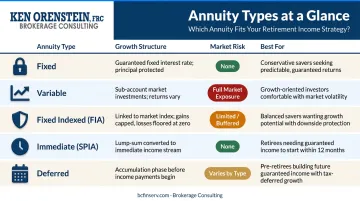
Fixed annuities offer a guaranteed interest rate set by the insurer. Your principal cannot decrease, making them the most predictable option for cautious buyers. Multi-Year Guaranteed Annuities (MYGAs) are a common subtype, offering locked rates across 3, 5, 7, or 10-year terms.
Variable annuities link growth to underlying investment sub-accounts, similar to mutual funds. They offer higher earning potential but carry real downside risk. The SEC notes that fees typically include mortality and expense charges (around 1.25% annually), administrative fees, underlying fund expenses, and optional rider charges. These costs compound meaningfully over time.
Fixed indexed annuities tie returns to a market index like the S&P 500, with a guaranteed minimum floor (often 0%) and a cap on upside gains. If the index returns 11% but your cap is 8%, you receive 8%. If the index drops, you receive 0% rather than a loss. That combination of downside protection and capped growth puts them squarely between fixed and variable options.
Why Retirees Use Annuities
- Longevity protection — the Society of Actuaries reports a 65-year-old couple has roughly a 50% chance that at least one spouse reaches age 92
- Predictable income to cover essential expenses regardless of market conditions
- Tax-deferred growth during the accumulation phase
- Complement to Social Security or pension income — filling the gap between guaranteed sources and total spending needs
Key Factors to Consider When Choosing the Right Annuity Type
Selecting the right annuity starts with understanding yourself — your timeline, risk tolerance, tax situation, and income gaps. The six factors below narrow the field from "all annuity types" to the one that actually fits your retirement plan.
Your Retirement Timeline and Income Start Date
How soon you need income is the first filter.
- Retirement within 1–2 years: An immediate annuity (SPIA) funded by a lump sum converts assets to income now, with no accumulation phase needed
- Retirement 5–15 years away: A deferred annuity gives tax-deferred growth time to work — the longer the deferral period, the higher your eventual payout rate tends to be
Buyers who push back their income start date typically lock in higher payout rates. If you're not yet at retirement's edge, deferred options are worth serious consideration.
Your Risk Tolerance
Risk tolerance directly determines growth structure:
- Cannot afford principal loss → fixed or indexed annuity
- Comfortable with market exposure for higher potential returns → variable annuity, but only as part of a diversified strategy
- Want growth potential with a floor → fixed indexed annuity
One risk factor many buyers overlook: sequence-of-returns risk. A $1 million portfolio drawing $40,000 annually while absorbing early losses — like the 2000 market downturn — can shed nearly half its value within three years, with little chance to recover. Variable annuities carry this exposure directly in early retirement.
Your Existing Guaranteed Income Sources
Before purchasing any annuity, inventory your current guaranteed income:
- Social Security (estimated monthly benefit)
- Employer pension (including FERS for federal employees)
- TSP or other retirement plan withdrawals
Calculate the gap between those guaranteed sources and your essential monthly expenses. That gap is what an annuity should fill — not your entire retirement income need.
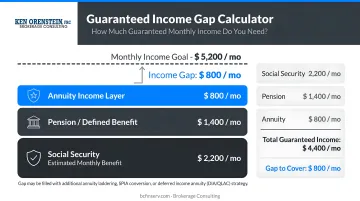
Federal employees with FERS pensions already have a meaningful guaranteed income foundation. If that pension plus Social Security covers essential costs, a fixed annuity doubling down on guaranteed income may not be the best use of premium dollars. A more growth-oriented or flexible structure might serve better.
Your Tax Situation
Once you've mapped your income gap, the next question is how the annuity gets funded — because the tax source determines how withdrawals are treated. Two categories matter here:
- Qualified annuities — funded with pre-tax dollars (inside an IRA, 401(k), or TSP rollover). Withdrawals are fully taxable as ordinary income
- Nonqualified annuities — funded with after-tax dollars. Only the earnings portion is taxed on withdrawal, using the exclusion ratio defined in IRS Publication 575
One frequently overlooked point: if you're buying an annuity inside an already tax-advantaged account, you're adding no additional tax deferral. Both the SEC and FINRA flag this directly — the annuity's other features would need to justify the purchase on their own merits.
If you expect to drop into a lower bracket in retirement, a qualified annuity's ordinary-income tax hit may be manageable. If your bracket stays the same or rises, a nonqualified annuity's exclusion ratio becomes a meaningful advantage.
Your Liquidity and Access Needs
Most deferred annuities carry surrender periods — often 6 to 10 years — during which early withdrawals trigger penalties. Key liquidity terms to confirm before signing:
- Surrender charges typically start around 7% and decline annually over the surrender period
- Most contracts allow penalty-free withdrawals of up to 10% of account value each year
- Withdrawals beyond that threshold trigger the full charge
If you might need funds for emergencies or health costs, over-allocating to annuities is a real risk. Keep separate liquid reserves — the money committed to an annuity should be earmarked specifically for income, not your entire nest egg.
Your Legacy and Beneficiary Goals
Your payout election determines whether anything passes to heirs:
- Life-only: Highest monthly payment, nothing to beneficiaries after death
- Period-certain: Payments continue to beneficiaries if you die within the guarantee period
- Joint and survivor: Continues payments based on two lives (at 100%, 75%, or 50% after one death)
- Cash refund: Beneficiary receives a lump sum if you die before receiving back your full premium
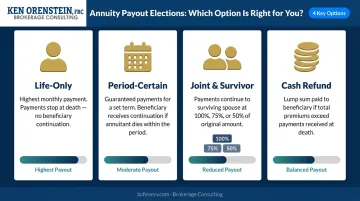
Higher monthly income and stronger legacy protection generally trade off against each other. Buyers with dependents or estate planning goals should weigh these options carefully.
How to Match Your Situation to the Right Annuity Type
Once you've assessed the six factors above, a clearer profile emerges. Here are three common scenarios:
Profile 1: Conservative Retiree with an Income Gap
Social Security covers basic expenses but leaves a noticeable income gap. Risk tolerance is low.
Best fit: Fixed immediate annuity (SPIA) — closes the income gap with predictable, guaranteed monthly payments starting right away.
Profile 2: Federal Employee, 10+ Years from Retirement
A FERS pension provides a future income foundation, but a supplemental stream would strengthen overall retirement security.
Best fit: Deferred fixed or fixed indexed annuity — accumulates during the deferral period, then activates as a complement to FERS income at retirement.
Profile 3: Higher Risk Tolerance, Mid-50s, Long Time Horizon
Market growth matters, and you can absorb some principal loss within a broader diversified portfolio.
Best fit: Variable or fixed indexed annuity with a guaranteed lifetime withdrawal benefit (GLWB) rider — provides upside participation with a guaranteed income floor.
No annuity type is universally better. A product that works for a colleague may be poorly structured for your situation. Before signing anything, run through these three checks:
- Insurer financial strength ratings from AM Best, Moody's, S&P, or Fitch
- Full fee disclosure — mortality charges, rider fees, and the complete surrender schedule
- Quotes from multiple carriers, not just one
How Brokerage Consulting Can Help You Choose the Right Annuity
Ken Orenstein and Brokerage Consulting specialize in guaranteed lifetime income planning for individuals, seniors, and federal employees. Ken holds the Federal Retirement Consultant (FRC) designation and authored The Informed Fed: A Survival Guide to Federal Employee Benefits.
That depth matters most for federal employees managing FERS, TSP distribution, and Social Security timing at the same time — where a misstep in one decision can affect all three.
Because Brokerage Consulting represents multiple top-rated carriers — including Aetna, Humana, TransAmerica, and others — clients receive objective comparisons across the market rather than a single-carrier pitch.
That carrier access shapes every step of the consultation. Here's what a typical engagement covers:
- Maps your guaranteed income gap — comparing FERS, Social Security, and TSP income against actual spending needs
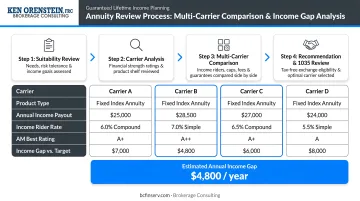
- Compares annuity products across multiple carriers and subtypes (FIAs, MYGAs, SPIAs, DIAs, QLACs, variable annuities)
- Reviews carrier financial strength using AM Best, Moody's, S&P, and Fitch ratings
- Analyzes income riders — GLWB and GMIB options compared across contracts
- Structures tax-efficient placement — qualified vs. nonqualified, QLAC for RMD reduction, and 1035 exchange review for existing contracts
- Builds an annuity laddering strategy for clients balancing liquidity with guaranteed income
Ken offers consultations by phone, virtually, or in person — the initial meeting is free. He is licensed in NJ, NY, NC, MD, VA, DC, and other states nationwide.
Conclusion
The right annuity is rarely the one with the highest quoted rate or the most heavily marketed name. It's the one that fits your income timeline, closes your specific guaranteed income gap, matches your risk tolerance, and supports your legacy goals without locking up cash you may need.
Annuity selection is also not a one-time decision. Income needs shift, tax laws change, and new products enter the market. Revisiting your strategy periodically with an advisor familiar with your income sources, tax situation, and timeline ensures your annuity still fits as your retirement picture evolves. If you're unsure where to start, a no-cost consultation with Ken Orenstein at Brokerage Consulting covers the full range of annuity types — from SPIAs and MYGAs to FIAs and deferred income annuities — so you can evaluate options across carriers before committing.
Frequently Asked Questions
How do I choose the right annuity for me?
Assess four things: when you need income to begin, how much risk you can accept, what guaranteed income you already have, and what legacy goals matter to you. Those factors — not product features alone — determine which annuity type fits your situation.
What is the difference between a fixed and variable annuity?
Fixed annuities guarantee a set interest rate and protect your principal from market loss. Variable annuities link growth to investment sub-accounts that rise and fall with the market — offering higher upside but real downside exposure, along with higher fees including mortality charges and fund expenses.
At what age should you buy an annuity?
There's no single ideal age. Immediate annuities are typically purchased near or at retirement — commonly between 60 and 70 — while deferred annuities are often purchased in one's 50s to capture accumulation benefits. The key driver is when you need guaranteed income to begin, not age itself.
Can you lose money in an annuity?
Fixed annuities protect principal — the account value cannot decline. Variable annuities can lose value if underlying investments drop. Fixed indexed annuities offer a floor (typically 0%) that limits loss but also caps gains through participation rates and caps.
Are annuities a good option for federal employees?
Federal employees often already have a FERS pension plus Social Security, which provides a baseline of guaranteed income. An annuity works best to fill a remaining income gap or fund specific goals — not to duplicate coverage already in place. A federal retirement specialist can map existing guaranteed income against actual spending needs before any product is recommended.
What fees should I watch out for when buying an annuity?
The main categories to review: surrender charges for early withdrawals (often starting around 7% and lasting 6–10 years), mortality and expense risk charges, administrative fees, underlying fund expenses (for variable annuities), and optional rider fees such as guaranteed lifetime withdrawal benefits. Fixed immediate annuities and MYGAs typically carry the lowest overall fee burden.