
The challenge isn't just understanding what these contracts do in theory. It's knowing whether what you own still makes sense for where you are in retirement planning right now — especially given how fees, surrender schedules, and income rider rules interact over time.
This article covers what ING variable annuities are, the product types ING offered, how key riders like ING LifePay Plus work, what fees you should expect, and who these contracts genuinely suit.
Key Takeaways
- ING USA Annuity and Life Insurance Company rebranded as Voya Insurance and Annuity Company in 2014 — all existing contract terms and guarantees transferred unchanged
- Variable annuities invest premiums in market-linked sub-accounts, with earnings growing tax-deferred until withdrawal
- ING LifePay Plus offered a 7% annual minimum compounding step-up to the withdrawal base for the first 10 contract years, with additional quarterly ratchet opportunities
- Total annual costs across all fee layers can exceed 3% per year — weigh this against the value of the guarantees before committing
- Early withdrawals beyond free withdrawal allowances trigger surrender charges and a 10% IRS penalty on top of ordinary income taxes if taken before age 59½
What Are ING Variable Annuities?
A variable annuity is an insurance contract where the premium is invested in sub-accounts (investment options that function similarly to mutual funds), with returns varying based on market performance. Earnings grow tax-deferred until withdrawn, at which point they're taxed as ordinary income.
ING USA Annuity and Life Insurance Company was the issuing entity for these contracts. When ING U.S. rebranded as Voya Financial in 2014, the legal entity was renamed Voya Insurance and Annuity Company. Voya confirmed that contract terms, guarantees, and rider provisions carried over unchanged for all existing policyholders.
How Variable Annuities Differ From Fixed and Indexed Products
| Product Type | Return Source | Downside Risk | Upside Potential |
|---|---|---|---|
| Variable Annuity | Market sub-accounts | Full market loss exposure | Unlimited |
| Fixed Indexed Annuity | Index-linked credits | Principal protected | Capped/participation-limited |
| Fixed Annuity | Declared interest rate | None | Limited to declared rate |
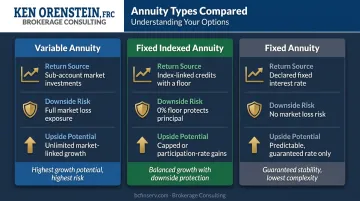
Variable annuities carry more investment risk than fixed or indexed alternatives, but they also offer uncapped growth potential — a meaningful difference for investors with longer time horizons before retirement.
Tax Rules That Apply to All Variable Annuities
These rules aren't ING-specific; they apply across the industry:
- Earnings grow tax-deferred, not tax-free
- Withdrawals are taxed at ordinary income rates, not the lower capital gains rate
- Withdrawals before age 59½ incur a 10% IRS penalty on top of applicable income taxes, per IRS Publication 575
- Variable annuities inside a tax-advantaged account (IRA or 401(k)) provide no additional tax benefit — a point the SEC flags specifically in its investor guidance
Understanding these tax rules upfront helps set realistic expectations for how ING/Voya variable annuities function as retirement income tools.
Types of ING Variable Annuity Products
ING USA Annuity offered two primary product categories: traditional variable annuities and the structured ING Potential Plus product.
Traditional Variable Annuities
Traditional ING variable annuities allowed contract owners to allocate premiums across a range of investment sub-accounts — equities, bonds, and balanced funds managed by professional investment teams. Performance tracked the chosen portfolios directly.
These contracts also offered a fixed account option, letting holders allocate a portion of their premium to a guaranteed interest rate alongside variable sub-accounts. This blended approach gave some downside stability without fully surrendering market participation.
ING Potential Plus (Structured Variable Annuity)
ING Potential Plus operated differently. Rather than open-ended sub-account investing, it linked returns to an equity index's performance up to a declared cap, while the issuer absorbed a defined portion of losses through a downside buffer.
Key product details, sourced from the Voya PotentialPLUS SEC prospectus:
- Minimum initial premium: $25,000 non-qualified; $5,000 qualified
- Segment terms available: 1, 3, 5, and 7 years
- Buffer: 10% confirmed at the prospectus date — the issuer absorbed the first 10% of index losses per segment term
- Free withdrawal allowance: 10% of accumulation value each contract year
- Surrender charge: Started at 8% in year one, declining to 0% after eight full years
The cap rate — the ceiling on index-linked gains — is set at the issuer's sole discretion and can change over time. Before any allocation decision, confirm the current cap rate in your contract's supplement documents, since a lower cap directly limits your upside potential.
Key Riders and Features
ING variable annuities were highly customizable through optional riders — add-ons purchased for an additional annual fee. The most significant was the ING LifePay Plus guaranteed lifetime withdrawal benefit.
ING LifePay Plus (Guaranteed Lifetime Withdrawal Benefit)
LifePay Plus guaranteed lifetime income withdrawals regardless of how long you live or how the underlying investments perform — directly addressing the risk of outliving your assets.
How the withdrawal base grows:
During the first 10 contract years, if no withdrawals are taken, the withdrawal base receives a guaranteed 7% annual minimum compounding increase. This protects income potential even during flat or declining markets — the withdrawal base grows regardless of actual account performance.
The quarterly ratchet feature:
The withdrawal base can also lock in market gains on a quarterly basis, both during the growth phase and after withdrawals begin. This means strong market performance gets captured into the guaranteed income floor, not just the market value of the account.
Withdrawal percentage tiers by age (updated 2008 version):
- Ages 59½–64: 4% maximum annual withdrawal
- Ages 65–69: 5% maximum annual withdrawal
- Age 70+: 6% maximum annual withdrawal
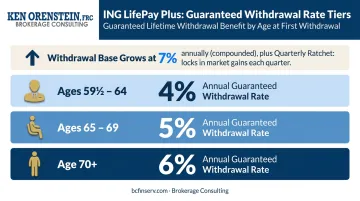
Withdrawals exceeding your maximum withdrawal percentage can reduce or permanently terminate the guaranteed benefit — making withdrawal discipline critical before distributions begin.
Rider costs varied by contract version. ING's SEC filings show LifePay Plus charges ranging from 0.60% to 1.05% annually (single vs. joint coverage, across different contract versions). Your specific contract documents will show the exact charge applied.
Death Benefits and Other Optional Riders
Most ING variable annuities included a standard death benefit protecting beneficiaries if the contract owner died during the accumulation phase. Additional optional riders available for extra cost included:
- Guaranteed minimum accumulation benefit (GMAB)
- Long-term care riders
- Cost-of-living adjustment features
Each added rider increased the total annual cost — so before stacking benefits, it's worth calculating the break-even point where the guarantee value exceeds what you've paid in rider fees.
Fees, Surrender Charges, and Withdrawal Rules
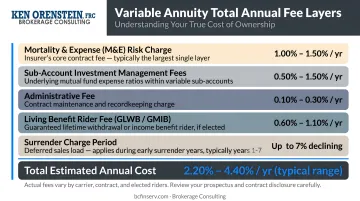
Variable annuity costs stack in layers. The SEC's investor guidance on variable annuities identifies the typical components:
| Fee Layer | Typical Range |
|---|---|
| Mortality & Expense (M&E) risk charge | ~1.25% annually |
| Administrative fee | ~0.15% or $25–$50/year |
| Sub-account investment expenses | Varies by fund selected |
| Optional rider charges (e.g., LifePay Plus) | 0.60%–1.05% annually |
Combined, all-in costs for a variable annuity with living benefit riders can exceed 3% per year. That's not inherently disqualifying, but it does mean the income guarantees in the contract need to justify those ongoing costs over time.
Surrender Charge Schedules
ING Potential Plus carried an 8-year surrender period, with charges starting at 8% in year one and declining to 0% after eight full years. Traditional ING variable annuities followed similar multi-year surrender structures.
The free withdrawal allowance — typically 10% of contract value per year — lets holders access some funds without triggering these charges. Taking more than that threshold during the surrender period means paying a declining but still meaningful penalty.
The Tax Treatment Many Contract Holders Misunderstand
Surrender charges are one layer of cost. Tax treatment is another — and it surprises more contract holders than almost any other feature. Two points stand out:
- All gains are taxed as ordinary income — not at the lower capital gains rate that applies to appreciated securities held outside an annuity
- Pre-59½ withdrawals add a 10% IRS penalty on top of ordinary income taxes
This combination makes unplanned early withdrawals expensive in ways that aren't always obvious at first glance. Before taking any distribution from an ING/Voya variable annuity, run a full tax projection — ideally with a financial advisor who can account for your current bracket, the size of the withdrawal, and any surrender charges that may also apply.
Who Benefits Most From ING Variable Annuities?
These contracts make the most sense for a specific profile:
- Long time horizon: 10+ years before needing income
- Moderate to high risk tolerance: Comfortable with sub-account market exposure
- Existing tax-advantaged accounts maxed out: TSP, 401(k), and IRA contributions already maximized
- Specific lifetime income need: The guaranteed withdrawal rider provides value that offsets the cost
Federal employees under FERS draw income from three sources — the Basic Benefit Plan pension, Social Security, and TSP — but that structure doesn't automatically cover every retirement income need. The average TSP participant balance in 2024 was $194,131, with a median of just $61,817.
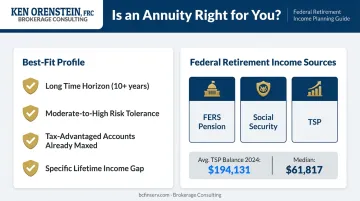
For employees who already have solid guaranteed base income from pension and Social Security, a guaranteed lifetime withdrawal rider like LifePay Plus can serve as a supplemental income layer without compromising essential expense coverage.
That evaluation — whether an existing ING/Voya variable annuity still fits, or whether a 1035 exchange into a lower-cost alternative with stronger income features makes more sense — is exactly the kind of analysis Ken Orenstein at Brokerage Consulting conducts with federal employees as part of a broader federal retirement income review.
Variable annuities are a poor fit for:
- Anyone who needs near-term liquidity (surrender charges make this expensive)
- Those already fully covered by guaranteed income sources with no additional income gaps
- Anyone who can't absorb the ongoing fee drag across a long holding period
- Investors who would be better served by a simpler, lower-cost tax-deferred vehicle
The fee structure only pays off when the guarantees — particularly lifetime income protection — provide clear value that exceeds those costs over the contract's life.
Frequently Asked Questions
Are ING variable annuities still available today?
ING USA Annuity and Life Insurance Company was renamed Voya Insurance and Annuity Company effective September 1, 2014. Existing contracts remain active under Voya with no changes to terms, and new contracts are issued under the Voya brand.
What is the ING LifePay Plus rider and how does it work?
LifePay Plus is a guaranteed lifetime withdrawal benefit rider providing income for life regardless of account performance. The withdrawal base earns a 7% annual minimum compounding increase during the first 10 contract years (when no withdrawals are taken), and a quarterly ratchet captures market gains during both accumulation and distribution.
What fees are associated with ING variable annuities?
ING variable annuities carried mortality and expense charges (typically around 1.25%), administrative fees, sub-account management expenses, and optional rider charges. Total annual costs for contracts with living benefit riders can exceed 3% — so weigh those costs against the guaranteed benefits in your specific contract.
What is the difference between ING Potential Plus and a traditional variable annuity?
Traditional ING variable annuities invested in open-ended sub-accounts with full market exposure — gains and losses tracked the chosen portfolios directly. ING Potential Plus was a structured product that linked returns to an equity index up to a declared cap, with a 10% downside buffer absorbing the first portion of index losses within each segment term.
What happens if I withdraw money early from an ING variable annuity?
Withdrawals beyond the free withdrawal allowance (typically 10% of contract value annually) trigger a surrender charge during the surrender period. All earnings are taxed as ordinary income, and withdrawals taken before age 59½ also incur a 10% IRS penalty tax in addition to applicable income taxes.
Who should consider an ING (now Voya) variable annuity?
These products suit long-term investors seeking tax-deferred growth and guaranteed lifetime income, particularly those who have maxed out other retirement accounts and can commit funds for 10 or more years. Anyone who may need the money sooner, or who can't absorb the annual fee drag, should weigh alternatives first.