
LIMRA's Secure Retirement Institute found that only 1 in 4 consumers can correctly answer at least 7 out of 10 basic annuity knowledge questions. Surrender period mechanics are almost certainly part of what trips them up.
This article breaks down exactly what surrender periods are in FIAs, how charge schedules decline over time, which exceptions allow penalty-free access, and how to evaluate whether a specific surrender period fits your retirement timeline.
Key Takeaways
- The surrender period — typically 5 to 10 years — is when withdrawing funds triggers a penalty called a surrender charge
- Charges usually start between 7%–10% in year one and decline by roughly 1 percentage point annually until reaching zero
- Most FIAs allow a free withdrawal of up to 10% of account value per year, even during the surrender period
- Longer surrender periods typically offer better crediting terms (higher caps or participation rates), trading liquidity for growth potential
- Matching the surrender period to your expected income start date is the planning variable most people overlook
What Is a Surrender Period in a Fixed Indexed Annuity?
A surrender period is the contractually specified timeframe during which withdrawing more than the allowed free amount triggers a surrender charge — a fee assessed as a percentage of the excess withdrawal. The IRI defines it as a "sales charge that may be assessed if you withdraw money from an annuity during the surrender period defined in the contract."
The insurer's rationale is simple: insurance companies fund long-term guarantees, index-linked crediting strategies, and administrative costs using policyholder premiums. The surrender period protects those commitments and discourages short-term use of a product designed for long-horizon accumulation.
One timing detail catches many buyers off guard: the surrender period begins at the contract issue date, not at your retirement date. The clock starts the day the annuity is funded, regardless of when you plan to draw income from it.
How FIAs Differ from Other Annuity Types
The surrender period is distinct from several other contract timelines buyers often confuse it with:
- The index crediting period — the interval used to measure index performance — runs on a separate clock
- Income rider activation follows its own schedule, unrelated to surrender charges
- Other contract terms (loan provisions, death benefits) each operate independently
FIAs typically carry longer surrender periods than traditional fixed annuities because the underlying hedging strategies are structured over longer time horizons.
FIA insurers use a portion of general account earnings to purchase options on market indexes. These are instruments with multi-year cost structures — and they require corresponding multi-year holding commitments to function as designed.
How FIA Surrender Charge Schedules Work
Surrender charges are expressed as a percentage of the withdrawal amount and almost universally follow a declining schedule — highest in year one, dropping by roughly one percentage point per year until reaching zero.
A Representative Schedule
Here's what a 10-year FIA surrender schedule might look like:
| Contract Year | Surrender Charge |
|---|---|
| 1 | 10% |
| 2 | 9% |
| 3 | 8% |
| 4 | 7% |
| 5 | 6% |
| 6 | 5% |
| 7 | 4% |
| 8 | 3% |
| 9 | 2% |
| 10 | 1% |
| 11+ | 0% |
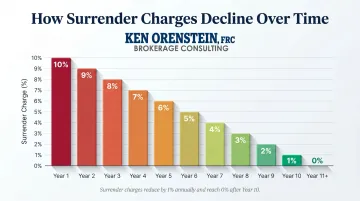
This is a representative example. Actual schedules vary significantly by carrier and product. Industry starting charges commonly range from 7% to 10% in year one.
Charges typically apply only to the amount withdrawn above the free withdrawal allowance — not necessarily to the entire contract value. Calculating the actual dollar impact requires knowing exactly how your contract defines that threshold, since the method varies by carrier.
Rolling Surrender Periods
When you add premium to an existing FIA contract, that additional deposit often starts its own separate surrender charge period from the date it's received. A single contract can carry multiple overlapping surrender schedules simultaneously — each tied to a different deposit date. Confirm whether your contract uses rolling periods before making additional deposits.
The Free Look Period
Every new FIA comes with a free look period — a brief window, typically 10 to 30 days after contract issuance (varying by state), during which you can cancel without penalty. California mandates 30 days; states like New Jersey and Connecticut require only 10, though several extend the window to 30 days for buyers age 65 and older.
Use this window to review the surrender schedule in writing before you're fully committed.
Exceptions: How to Access Funds Without a Surrender Charge
The surrender period doesn't mean your money is completely inaccessible. Several contract provisions allow penalty-free access — though each comes with its own conditions.
Free Withdrawal Provision
Most FIA contracts permit annual withdrawals of up to 10% of the account value without triggering a surrender charge. Some contracts restrict or reduce this allowance during the first contract year — read the specific contract terms rather than assuming the 10% rule applies from day one.
Required Minimum Distributions (RMDs)
For FIAs held inside a qualified retirement account (traditional IRA, 401(k)), IRS-required distributions are generally exempt from surrender charges. Under the SECURE Act 2.0, the RMD starting age is now 73 for those who turned 72 after December 31, 2022, rising to 75 in 2033.
Hardship and Life-Event Waivers
Many contracts waive surrender charges for:
- Confinement to a nursing home or long-term care facility
- Diagnosis of a terminal illness
- Total disability
These provisions are not universal. Qualifying criteria, documentation requirements, and waiting periods differ by carrier and contract — verify the exact terms before assuming coverage.
Death Benefit
Most contracts waive surrender charges upon the annuitant's death, allowing the designated beneficiary to receive the full contract value without penalty.
1035 Exchange Consideration
A 1035 exchange transfers funds between annuities without triggering a tax event — but it does not eliminate the surrender charge on the original contract. The outgoing insurer still assesses charges before transferring funds. Any exchange decision requires weighing whether the long-term benefits of the new contract outweigh the cost of exiting the old one.
What Surrender Period Length Signals About an FIA Product
Surrender period length isn't arbitrary: it reflects a real economic trade-off.
The Crediting-Liquidity Trade-Off
Shorter surrender periods (5–6 years) generally come with more conservative crediting terms — lower cap rates, lower participation rates — because the insurer has less time to amortize hedging costs. Longer periods (8–12 years) typically support more competitive terms because the insurer can spread costs over a longer horizon.
As of May 2026, top FIA cap rates reach approximately 10.50% on competitive products. S&P 500 participation rates run 60%–90% on standard strategies. These figures vary by carrier, product, and — critically — surrender period length.
Planning Fit by Period Length
| Surrender Period | Best Fit |
|---|---|
| 5–6 years | Closer to retirement; values liquidity over maximum crediting potential |
| 7–10 years | Early-to-mid 50s with a clear income start date several years out |
| 10+ years | Long accumulation horizon; evaluate carefully against realistic liquidity needs |
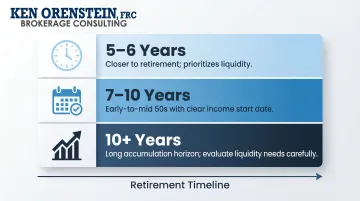
The market has shifted meaningfully toward shorter commitments. Products with surrender periods under 10 years now account for 42.8% of FIA sales, with 7-year products capturing 22.1% of the market. Competitive crediting is increasingly available without 10+ year lock-ups.
Comparing surrender schedules across carriers is a core part of Ken Orenstein's advisory process at Brokerage Consulting. As an independent broker, he evaluates caps, participation rates, income rider growth rates, and surrender schedules side by side to identify which contract fits a client's specific retirement timeline and liquidity needs — without being tied to a single carrier's product line.
The Real Cost of Withdrawing Early
Early withdrawal from an FIA during the surrender period doesn't just trigger the surrender charge. It can layer on multiple costs simultaneously.
The Triple-Cost Scenario
Consider a hypothetical $100,000 FIA with $15,000 in accumulated earnings, withdrawn in Year 2 by a 55-year-old in the 22% federal tax bracket:
| Cost Layer | Calculation | Amount |
|---|---|---|
| Surrender charge (8% in Year 2) | 8% × $100,000 | $8,000 |
| Federal income tax on earnings (22%) | 22% × $15,000 | $3,300 |
| IRS 10% early withdrawal penalty | 10% × $15,000 | $1,500 |
| Total cost | $12,800 |
That's approximately 12.8% of the contract value — gone before a dollar of net value reaches you.
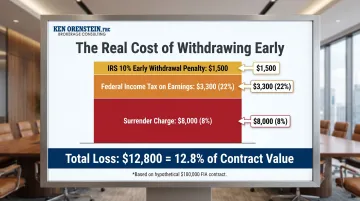
The immediate hit isn't the whole story. Partial withdrawals that exceed the free allowance reduce the account value used to calculate future index-linked credits — extending the cost well beyond the surrender charge itself.
Maintain a separate liquid reserve — an emergency fund or other accessible assets — alongside any FIA. If unexpected financial needs arise, you want to meet them without triggering this layered penalty structure.
Common Misconceptions About FIA Surrender Periods
A few persistent misunderstandings about surrender periods lead buyers to either overpay in charges or reject contracts that would have served them well. Here's what the fine print actually says.
Misconception: The Surrender Period Resets Every Year
The annual free withdrawal provision is a separate feature. Using it — or not using it — has no effect on the overall surrender period. The surrender period runs for its full contractual term regardless of how many free withdrawals you take along the way.
Misconception: Surrender Charges Always Apply to the Full Contract Value
Most FIA contracts apply the charge only to the amount withdrawn above the free withdrawal allowance — not to the entire contract value. Some contracts do calculate charges against the full value, though. That distinction can significantly change the actual dollar cost, so verify the calculation method in the contract before purchasing.
Misconception: A Longer Surrender Period Is Always a Disadvantage
For someone who genuinely doesn't need the funds for 10 or more years, a longer surrender period often comes with better crediting terms — higher caps or participation rates — that improve growth potential over time. The surrender period only works against you if your realistic holding timeline is shorter than the contract requires.
Frequently Asked Questions
What is the typical surrender period for a fixed indexed annuity?
FIA surrender periods most commonly range from 5 to 10 years, with 7- and 10-year periods being particularly prevalent given the longer-horizon crediting strategies used in index-linked products. The exact period is specified in the contract at issue and does not change after signing.
Can you surrender a fixed indexed annuity without a surrender charge?
Penalty-free full surrenders are only available after the surrender period ends. During the period, most contracts allow partial withdrawals up to an annual free withdrawal allowance (commonly 10%) without penalty. Hardship, nursing home, terminal illness, and death provisions may also waive charges, depending on the specific contract terms.
What is the average surrender fee for an annuity?
Initial surrender charges on FIAs commonly range from 7% to 10% in year one, declining by roughly 1 percentage point per year. The exact starting charge and full schedule vary by carrier and product — reviewing the specific contract's surrender schedule is essential before purchasing.
What is the longest surrender charge period for an annuity?
Most FIAs carry surrender periods of 5 to 10 years, though some products extend to 12 to 14 years. The NAIC Annuity Disclosure Model Regulation requires enhanced disclosure for any period exceeding 10 years. Longer periods often come with more competitive crediting terms — but only make sense if your liquidity timeline genuinely supports them.
Which annuities don't have surrender charges?
No-surrender-charge (or "no-load") FIAs exist and are offered by some carriers, though they generally carry lower crediting potential or ongoing advisory fees to compensate. Single Premium Immediate Annuities (SPIAs) also have no surrender period — funds are annuitized at purchase rather than accumulated, so the concept doesn't apply structurally.
When should you surrender an annuity?
Surrendering makes the most financial sense after the surrender period has expired, eliminating penalty costs entirely. If you're considering an early exit, weigh the full cost — surrender charge plus any tax liability — against your reason for needing the funds. A licensed advisor can run those numbers before you act; early surrenders frequently cost more than people initially expect.