Choosing the wrong vehicle matters. A mutual fund in a taxable account can trigger unexpected annual tax bills. A fixed annuity with a surrender period can trap funds you suddenly need. And fixed annuities are routinely conflated with variable annuities in popular content, leaving many readers with an inaccurate picture of what the "safe" option actually looks like.
This article breaks down exactly how each product works, how they differ across five critical dimensions — tax treatment, returns, principal protection, liquidity, and fees — and offers a practical framework for deciding which belongs in your retirement plan.
Key Takeaways
- Fixed annuities are insurance contracts that guarantee a set interest rate and protect your principal — no market exposure, no possibility of loss due to market performance.
- Mutual funds are market-based investments offering growth potential and liquidity, but returns are not guaranteed and principal can be lost.
- Fixed annuities grow tax-deferred; mutual funds in taxable accounts generate annual capital gains and dividend taxes, including on gains you never personally cashed out.
- Mutual funds offer daily liquidity; fixed annuities have surrender periods and IRS early-withdrawal penalties before age 59½.
- Neither is universally better — the right choice depends on your income needs, risk tolerance, and retirement timeline.
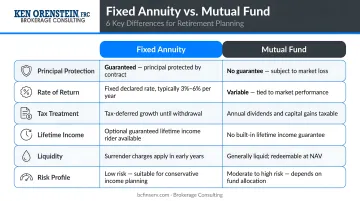
Fixed Annuity vs. Mutual Fund: At a Glance
| Dimension | Fixed Annuity | Mutual Fund |
|---|---|---|
| Product Type | Insurance contract issued by an insurer | Investment company pooling investor money into securities |
| Return Type | Contractually guaranteed interest rate | Variable — depends on market performance |
| Principal Protection | Fully protected from market loss | No protection — full market risk |
| Tax Treatment | Tax-deferred growth until withdrawal | Annual capital gains/dividend taxes in taxable accounts |
| Liquidity | Restricted — surrender periods apply; 10% IRS penalty before age 59½ | High — shares redeemable any trading day |
| Primary Purpose | Guaranteed income and principal protection | Long-term wealth accumulation and growth |
This comparison focuses specifically on fixed annuities — not variable or indexed annuities, which have distinct characteristics. Fixed annuities are the most conservative annuity type and the closest structural alternative to guaranteed bank products like CDs.
These two products are not mutually exclusive. Many well-constructed retirement plans include both — fixed annuities anchoring the income floor while mutual funds pursue long-term growth.
What Is a Fixed Annuity?
A fixed annuity is a contract between an individual and an insurance company. The insurer guarantees a fixed interest rate on the deposited premium for a set accumulation period. It is an insurance product, not a securities investment, regulated by state insurance departments rather than the SEC.
According to the NAIC Buyer's Guide for Deferred Annuities, fixed deferred annuities guarantee that money invested will earn at least a minimum interest rate, with guarantees depending on the financial strength and claims-paying ability of the issuing insurer.
How the Mechanics Work
- The insurer credits a guaranteed rate for the contract term (commonly 3, 5, 7, or 10 years for Multi-Year Guaranteed Annuities, or MYGAs)
- Earnings grow tax-deferred — no annual tax events until withdrawal
- Principal is fully protected from market loss — the account value cannot decline due to market performance
- After the accumulation period, the contract can convert to a predictable income stream
Key Benefits for Retirement Planning
- Guaranteed income floor regardless of market conditions
- Principal protection for risk-averse retirees
- Tax-deferred growth that compounds without annual drag
- Probate avoidance through named beneficiaries
Key Drawbacks
- Surrender charges if funds are withdrawn during the surrender period
- 10% IRS penalty on withdrawals before age 59½, per IRS Publication 575
- Inflation risk — fixed payments may lose purchasing power over time
- Lower upside than equity markets in strong bull runs
Several of these drawbacks are manageable with the right contract structure. Most fixed annuities include a free withdrawal provision — typically up to 10% of the account value per year — without triggering surrender charges. Ken Orenstein at Brokerage Consulting reviews these provisions alongside surrender charge schedules across multiple carriers before any placement, comparing MYGA terms from 3 to 10 years to match the right contract to each client's liquidity needs.
Who Fixed Annuities Work Best For
Fixed annuities suit a specific profile well:
- Retirees aged 65-73 who need predictable, principal-protected income replacement
- Individuals who have maximized other tax-deferred vehicles (401(k), IRA)
- Federal employees nearing retirement who want to supplement their FERS pension and TSP with a guaranteed income layer
- Lump-sum recipients — 401(k) rollovers, pension buyouts, inheritances — seeking safe deployment
A practical scenario: a 60-year-old deposits a lump sum into a 5-year MYGA, earns a guaranteed rate, and converts to lifetime income payments at 65. The income amount is known from day one — no market performance required.
What Is a Mutual Fund?
A mutual fund is a pooled investment vehicle where investors buy shares and collectively own a diversified portfolio of stocks, bonds, or other securities. According to Investor.gov, a mutual fund pools money from many investors and invests in securities such as stocks, bonds, and short-term debt — regulated by the SEC as an investment company.
Returns come from three sources: capital gains distributions, dividend income, and appreciation in share price. None of these are guaranteed, and principal can be lost.
Key Benefits
- Spreads risk across hundreds of securities in a single purchase (diversification)
- Lets active or passive fund managers handle all security selection
- Sells on any trading day, with proceeds settling within one business day (T+1, effective May 28, 2024)
- Covers the full risk spectrum — from conservative bond funds to aggressive growth funds
Key Drawbacks
- Full market exposure — no floor on losses
- No guaranteed income stream
- Embedded capital gains taxes in taxable accounts, even when the investor hasn't sold shares
- Fees vary by fund type and share class
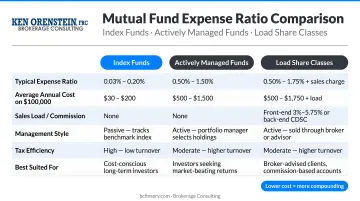
That last point — fees — deserves a closer look. ICI's 2025 data shows asset-weighted average expense ratios of 0.40% for equity mutual funds and 0.36% for bond mutual funds. Active equity funds averaged 0.63%; index equity funds, just 0.05%. Class A shares may also carry front-end sales loads — FINRA notes these typically run 2%–5%.
Who Mutual Funds Work Best For
- Investors with a longer time horizon who can absorb market volatility
- Those in the accumulation phase building toward retirement
- Retirees who already have guaranteed income sources and want a growth layer for discretionary expenses and legacy
One distinction worth noting: mutual funds held inside a traditional IRA or 401(k) grow tax-deferred, just like annuities — which narrows the tax advantage gap between the two products when both sit inside qualified accounts.
Key Differences: Fixed Annuity vs. Mutual Fund
Tax Treatment
Fixed annuities grow tax-deferred — no annual tax events occur until withdrawal. For nonqualified annuities, IRS Publication 575 states that withdrawals are allocated first to earnings, meaning the taxable portion comes out before the principal basis.
Mutual funds in taxable accounts are a different story. The IRS requires capital gain distributions to be reported on Form 1099-DIV and taxed as long-term capital gains — regardless of how long the shareholder owned fund shares. This creates embedded gain risk: you can owe capital gains tax on profits you never personally realized.
Vanguard explains that in a down market, fund manager redemptions may force the sale of holdings with built-in gains, generating a taxable event even when the fund's share price declined. You could lose money on paper and still owe taxes.
When mutual funds are held inside an IRA or 401(k), this distinction largely disappears — both products receive tax-deferred treatment until distribution.
Rates of Return
Fixed annuities offer a contractually guaranteed rate for the full contract term — the investor knows exactly what they will earn before signing.
Mutual funds offer no guaranteed return. Performance depends on markets, fund strategy, manager skill, and investor behavior. DALBAR's 2026 QAIB report found that over the 30 years ending December 31, 2025, the average equity fund investor earned 7.89% annually versus 10.22% for the S&P 500. That 2.33-percentage-point behavioral gap compounds into a substantial shortfall over time.
That gap traces back to panic selling, mistimed purchases, and performance chasing — behavioral patterns that a guaranteed-rate contract makes structurally impossible.
Principal Protection and Risk
- Fixed annuity: Principal is fully protected. The account value cannot fall below the original deposit due to market performance.
- Mutual fund: Principal carries full market risk. An investor can lose a portion — or all — of their investment.
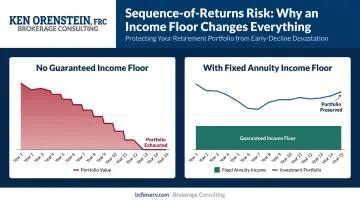
For retirees, this distinction is not abstract. A significant market decline early in retirement can permanently impair a portfolio's ability to generate income — a dynamic known as sequence-of-returns risk. Guaranteed income vehicles like fixed annuities isolate part of the income need from that risk entirely.
Liquidity and Accessibility
| Fixed Annuity | Mutual Fund | |
|---|---|---|
| Redemption timing | Subject to surrender period | Any trading day |
| Early penalty | 10% IRS penalty before age 59½ | None (outside qualified plans) |
| Free access | Typically 10% per year free withdrawal | Full balance available |
| Settlement | Contract-specific | T+1 (one business day) |
Liquidity is where mutual funds win clearly. Investor.gov notes that mutual fund companies must generally pay redemption proceeds within seven days of receiving a request — in practice, T+1 settlement applies to most transactions.
Fixed annuities require commitment. Surrender periods vary by contract, and the IRS imposes a 10% penalty on taxable withdrawals before age 59½ under IRC Section 72(q). Most contracts offset some of this restriction with a 10% annual free withdrawal provision.
Fees and Costs
Fixed annuities typically carry no annual management fee — the insurer's margin is built into the spread between what the insurer earns on its investments and the rate credited to the contract. Surrender charges apply if funds are withdrawn early.
Mutual fund costs are more visible but vary widely:
- Index equity funds: as low as 0.05% annually
- Active equity funds: averaging 0.63% annually
- Class A shares: front-end loads of 2%–5% on top of ongoing expenses
Expense ratios are only part of the cost picture. Embedded tax liabilities and behavioral investment mistakes each reduce net returns in ways that never show up in a fund's published fee disclosure.
Which Is Right for You?
The answer depends on where you are in retirement and what you need your money to do.
Choose a fixed annuity if:
- You're within 5–10 years of retirement or already retired
- You need a predictable income floor and cannot afford principal loss
- You've maximized other tax-deferred accounts and want additional tax-deferred growth
- You're a federal employee looking to supplement your FERS pension and TSP with guaranteed income
Choose mutual funds if:
- You have a longer time horizon and can tolerate market volatility
- You're in the accumulation phase focused on long-term wealth building
- You need high liquidity and flexibility
- You already have guaranteed income sources covering essential expenses
Most people approaching retirement benefit from both. A fixed annuity serves as the guaranteed income floor — alongside Social Security and any pension — covering essential expenses without market exposure. Mutual funds provide growth, flexibility, and emergency liquidity for discretionary needs and legacy goals.

Getting these two tools to work together, however, requires more than splitting your savings — it requires coordinating timing, tax treatment, and income sequencing into a coherent plan.
At Brokerage Consulting, Ken Orenstein uses a layered income strategy that coordinates Social Security, pensions, guaranteed lifetime income annuities, and discretionary investment portfolios into a single integrated plan. For federal employees, that means aligning the FERS pension and TSP with fixed annuities and managed investment accounts — each layer serving a distinct purpose rather than competing with the others.
To explore whether a fixed annuity, mutual funds, or a combination makes sense for your situation, schedule a no-cost consultation with Ken Orenstein at bcfinserv.com or call (888) 315-3608.
Frequently Asked Questions
Frequently Asked Questions
What is better, a mutual fund or an annuity?
Neither is universally better. Fixed annuities are better for guaranteed income and principal protection; mutual funds are better for long-term growth and liquidity. Most retirees benefit from holding both, with each serving a different function in the overall income plan.
Can you lose money in a fixed annuity?
Fixed annuities protect your principal: the account value cannot decrease due to market performance. However, early withdrawals during the surrender period may trigger surrender charges plus a 10% IRS penalty, which could result in receiving less than your original deposit.
Are fixed annuities taxed the same as mutual funds?
Fixed annuities grow tax-deferred until withdrawal. Mutual funds in taxable accounts may generate annual tax events through capital gains and dividend distributions. When mutual funds are held inside a traditional IRA, both products receive similar tax-deferred treatment.
What are the fees for a fixed annuity compared to a mutual fund?
Fixed annuities typically have no annual management fees — costs are embedded in the credited interest rate. Mutual funds charge annual expense ratios (0.05%–0.63% depending on the fund type) and may include sales loads. Surrender charges apply to fixed annuities during the surrender period.
Can I hold both a fixed annuity and mutual funds in my retirement portfolio?
Many advisors recommend holding both. A fixed annuity provides a guaranteed income floor, while mutual funds offer growth potential and liquidity. This blended approach addresses longevity risk, sequence-of-returns risk, and the need for inflation-beating growth simultaneously.
Are fixed annuities a good investment for retirees?
Fixed annuities suit retirees who need predictable income and want to protect principal from market risk. They are especially useful for those who have exhausted other tax-deferred savings vehicles and want to limit market exposure without giving up tax-deferred growth.