This is the core challenge most retirees face — and two strategies dominate the answer: annuities and drawdown. Each has real strengths. Each has real trade-offs. Choosing the wrong one can mean running out of money too early, locking into a plan you can't change, or leaving significant tax savings on the table.
According to the Society of Actuaries, 67% of retirees underestimate their own life expectancy — and over 40% are off by five or more years. That gap between what people expect and how long they actually live is precisely where retirement income planning goes wrong.
This article breaks down how each strategy works, compares them side by side, and explains when a hybrid approach may serve you better than either option alone.
Key Takeaways
- An annuity converts savings into a guaranteed income stream for life — predictable and permanent, with no flexibility after purchase
- A drawdown strategy keeps money invested and accessible on your terms, but you bear the risk of outliving your savings
- Annuities suit retirees who want income certainty, especially those with limited guaranteed income beyond Social Security
- Drawdown works best for larger portfolios with higher risk tolerance and existing guaranteed income already covering the basics
- Most retirees benefit from a hybrid approach — annuity for essential expenses, drawdown for discretionary spending and growth
Annuity vs Drawdown: Quick Comparison
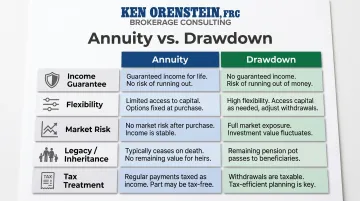
The table below breaks down how annuities and drawdown strategies compare across the five factors that matter most in retirement income planning.
| Factor | Annuity | Drawdown |
|---|---|---|
| Income Guarantee | Guaranteed for life, regardless of markets | No guarantee — depends on portfolio performance |
| Flexibility | Fixed once purchased; terms cannot be changed | Full control over timing, amounts, and investments |
| Market Risk | No market exposure after purchase | Fully exposed; early losses can permanently reduce income |
| Legacy / Inheritance | Typically ends at death (or surviving spouse in joint annuities) | Remaining balance passes to heirs |
| Tax Treatment | Payments taxed as ordinary income | Varies by account type; more flexibility for tax planning |
What Is an Annuity?
An annuity is an insurance contract: you hand over a lump sum to an insurance company, and in return they send you regular income payments — either for a fixed term or for life. In retirement planning, the focus is almost always on lifetime income annuities.
Key Annuity Types for US Retirees
Several factors determine your payout amount:
- Age at purchase and lump sum invested
- Current interest rates at the time of purchase
- Your health (impaired-health underwriting can raise payouts)
- Optional features such as cost-of-living adjustments or joint/survivor benefits
For a real-world benchmark: according to Annuity.org's April 2026 data, a $100,000 immediate annuity for a 65-year-old pays approximately $625/month for men and $590/month for women on a life-only basis. Adding a 10-year guarantee period reduces that monthly amount. Rates vary by insurer, state, and the prevailing interest rate environment, so always compare across carriers.
Annuity Advantages and Drawbacks
Advantages:
- Guaranteed income you cannot outlive — longevity risk transfers to the insurer
- No market exposure after purchase; immune to volatility
- Predictable monthly paycheck simplifies budget planning
- Impaired-health underwriting can increase payout rates for qualifying conditions
Drawbacks:
- Largely irreversible once purchased
- Fixed-level payments may not keep pace with inflation over a long retirement
- Limited or no death benefit for heirs (unless a guaranteed period is selected)
- If you die early with no guarantee period, the insurer retains remaining funds
Who Is the Ideal Annuity Candidate?
The strongest fit is a retiree with limited guaranteed income beyond Social Security — meaning essential expenses exceed what monthly Social Security checks cover. Social Security replaces roughly 40% of pre-retirement earnings on average, which leaves most retirees with a meaningful income gap to fill.
Federal employees with FERS or CSRS pensions already have a built-in guaranteed income layer. Their pension combined with Social Security may cover essential expenses entirely, reducing or eliminating the need for additional annuity coverage.
What Is a Drawdown Strategy?
Drawdown means keeping your retirement savings invested — in an IRA, 401(k), TSP, or brokerage account — and systematically withdrawing income over time. You maintain full ownership and control of the assets throughout retirement.
The 4% Rule (and Why It's More Nuanced Now)
The most widely cited drawdown framework is the 4% rule, originally developed by William Bengen in 1994. The concept: withdraw 4% of your portfolio in year one, then adjust for inflation each year after. Historically, this approach survived every 30-year retirement period in US market data.
Current institutional guidance has shifted the range:
| Source | Recommended Rate |
|---|---|
| Morningstar (2025) | 3.7% |
| Vanguard (2024) | 4.0% with spending flexibility |
| Bengen (updated) | 4.7% as a worst-case floor |
The 4% rule is a useful starting point, not a guarantee. Your actual sustainable withdrawal rate depends on your portfolio mix, flexibility, and how much guaranteed income you already have.
Sequence-of-Returns Risk: The Core Danger
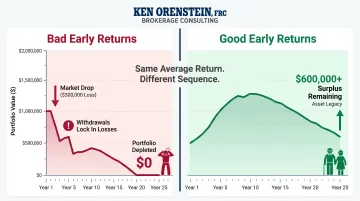
This is the biggest threat to any drawdown strategy. If markets drop significantly in your first few years of retirement, withdrawals lock in losses and permanently shrink the portfolio, even if markets fully recover later.
Two retirees with identical average returns can have completely different outcomes based solely on the order of those returns. Adjusting spending by even 5-10% during bad market years meaningfully extends portfolio longevity, but this requires the discipline (or guaranteed income cushion) to actually make those cuts when it matters.
Drawdown Advantages and Drawbacks
Advantages:
- Full liquidity and access to principal at any time
- Portfolio growth can outpace inflation over a long retirement
- Remaining balance passes to heirs
- More flexibility for tax-efficient planning: Roth conversions, RMD coordination, income bunching
Drawbacks:
- No income guarantee; you can outlive your savings
- Requires active management or professional oversight
- Behavioral risk: panic selling in a downturn can cause lasting damage
- Sequence-of-returns risk can derail even a carefully structured plan
Who Is the Ideal Drawdown Candidate?
The strongest drawdown candidates are retirees with a larger portfolio (providing more buffer against early losses), other guaranteed income sources like Social Security or a pension, and the discipline or professional guidance to manage withdrawals strategically.
Federal employees with FERS pension income are well-positioned to use their TSP in drawdown mode. Essential expenses are already covered by guaranteed sources, so the TSP can function as a growth and discretionary spending vehicle rather than a lifeline.
Annuity vs Drawdown: Which Is Better for Your Retirement?
Neither strategy is universally superior. The better choice depends on your income needs, risk tolerance, health, asset level, tax situation, and legacy goals. Here's how to think through the decision.
The Income Security Axis
Start with a simple question: do your essential monthly expenses exceed what Social Security alone covers?
If yes, you have a guaranteed income gap. Housing, healthcare, and food cannot be put on hold when markets drop. Annuities are designed specifically to close that gap, converting a lump sum into a reliable floor of income regardless of what markets do.
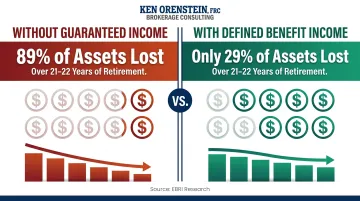
EBRI research puts the stakes in concrete terms: low-asset retirees without guaranteed income lost 89% of their assets over 21-22 years, compared to only 29% for those with defined benefit income. Guaranteed income doesn't just ease anxiety. The data shows it directly protects how much wealth you keep.
The Flexibility and Growth Axis
If you have a cushion above essential expenses, can tolerate short-term portfolio declines, and want to pass wealth to family, drawdown offers real advantages. A well-managed portfolio may generate more total income over a long retirement if markets perform well. And unlike an annuity, you can adjust your strategy as your life changes.
Tax planning is where drawdown often pulls ahead. Withdrawals from traditional retirement accounts (IRA, 401(k), TSP) are taxed as ordinary income, but the structure gives you real flexibility:
- Roth conversions during low-income years before Social Security begins
- Income bunching to stay within lower tax brackets
- RMD coordination now that SECURE 2.0 has pushed the required minimum distribution age to 73 (and to 75 starting in 2033)
Annuities offer far less tax flexibility. Ken Orenstein at Brokerage Consulting builds low-cost, tax-efficient withdrawal strategies specifically designed to improve after-tax retirement income over the long run.
Clear Situational Guidance
Choose an annuity if:
- You are risk-averse and want income certainty above all else
- Your essential expenses exceed what Social Security covers
- You have no pension and worry about outliving your savings
Choose drawdown if:
- You have ample savings and other guaranteed income in place
- You want maximum flexibility and potential legacy assets
- You have the discipline or professional support to manage withdrawals
Health matters too. Those with shorter expected lifespans may find drawdown — or short-duration guaranteed-period annuities — more financially advantageous than a lifetime annuity structure.
Can You Use Both? The Hybrid Approach
Annuity and drawdown are not mutually exclusive. Many financial advisors — including Ken Orenstein at Brokerage Consulting — recommend a layered income strategy that combines both.
The structure is simple:
- Cover essential expenses with guaranteed income — Social Security, a pension if you have one, and an annuity to close any remaining gap
- Fund discretionary spending from a drawdown portfolio — travel, home improvements, gifts, and legacy assets remain invested and flexible
A Practical Illustration
Consider a retiree whose Social Security covers roughly half of their essential monthly costs. They purchase an immediate annuity with a portion of their savings — say, enough to generate $1,200/month — which fills the gap. Their remaining retirement savings stay invested in a diversified portfolio, used for discretionary spending and potential inheritance.
The numbers don't have to be precise to make the point: the annuity handles what must be paid every month; the portfolio handles everything else.
The Psychological Benefit
Research backs up the behavioral case for this approach. TIAA found that retirees with guaranteed lifetime income spend twice as much on travel and discretionary items as peers with similar wealth but no guaranteed income stream. Having a reliable income floor removes the anxiety of watching markets fall — making it easier to stay invested and enjoy retirement.
Ken Orenstein structures this through a four-layer income architecture:
- Layer 1 — Social Security
- Layer 2 — Pension income
- Layer 3 — Guaranteed lifetime annuity income for essential expenses
- Layer 4 — Discretionary portfolio for growth and legacy
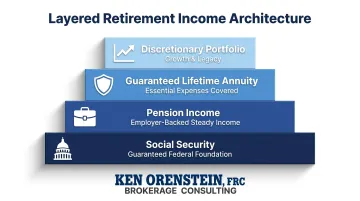
The framework adapts to each client's situation rather than applying a single fixed template.
Conclusion
Annuities offer certainty and protection from outliving your savings — at the cost of flexibility. Drawdown offers flexibility and growth potential — at the cost of income certainty. For most retirees, the right answer sits somewhere between the two.
The right plan matches your actual income needs, risk tolerance, tax situation, and long-term goals — and that looks different for everyone.
Ken Orenstein at Brokerage Consulting specializes in retirement income planning, working with individuals, seniors, and federal employees across New Jersey and nationwide. Reach out to start a no-obligation conversation:
- Phone: (888) 315-3608
- Website: bcfinserv.com
Frequently Asked Questions
How much will a $100,000 annuity pay per month?
Monthly income from a $100,000 annuity depends on your age, annuity type, current interest rates, and the payout options you choose. Based on April 2026 data, a 65-year-old purchasing a life-only immediate annuity might receive approximately $590–$625/month. Rates vary meaningfully by insurer, so always compare across carriers before purchasing.
Annuity vs drawdown: which is better for retirement income?
Neither is universally better. Annuities suit those who prioritize income certainty and want protection against outliving their savings; drawdown suits those with higher risk tolerance, larger portfolios, and other guaranteed income already in place. A financial advisor can help determine which fits your specific situation or how to combine both.
Do millionaires use annuities?
Yes. High-net-worth retirees typically use annuities to create a guaranteed income floor, not to annuitize their entire portfolio. Drawdown and tax-efficient withdrawal strategies usually carry more weight alongside a targeted annuity allocation.
Can you switch from drawdown to an annuity later in retirement?
Yes. Many retirees start with drawdown and purchase an annuity in their 70s or 80s, when annuity payout rates improve with age and the desire for income certainty increases. QLACs (deferred annuities purchased within an IRA) are a particularly practical tool for this strategy, with IRS limits now set at $210,000 for 2026.
What happens to my annuity when I die?
It depends on the options you selected. A single-life annuity typically ends at death. A joint/survivor annuity continues paying a spouse. Some contracts include a guaranteed payment period that pays beneficiaries if you die before the term expires , which is worth considering if leaving something behind matters to you.
Is drawdown suitable for everyone?
No. Drawdown requires a tolerance for market volatility, active management or advisor oversight, and the discipline to avoid over-withdrawing during downturns. It's less suitable for those who are risk-averse, lack other guaranteed income, or don't have a clear withdrawal strategy in place.