
This guide covers what a single premium annuity is, how SPIAs and SPDAs differ, how payouts actually work, the tax implications you need to understand, and who this product genuinely makes sense for.
TLDR: Key Takeaways
- A single premium annuity converts a one-time lump sum into a guaranteed income stream, either immediately or at a future date
- SPIAs start paying within one year of purchase; SPDAs delay payments to allow tax-deferred growth first
- Payout structures include single-life, joint-life, and period-certain options; COLA riders can be added for inflation protection
- Tax treatment hinges on funding source: pre-tax dollars are fully taxable at withdrawal; after-tax dollars allow partial tax-free return of principal
What Is a Single Premium Annuity?
As the NAIC defines it, a single premium annuity is a contract where "you pay the insurance company only once." That single lump-sum payment — funded from savings, a rollover, an inheritance, or a financial windfall — is exchanged for a guaranteed income stream that begins either immediately or at a future date.
Unlike flexible premium annuities, which accept contributions over time, single premium contracts require the full amount upfront.
The "Personal Pension" Analogy
A single premium annuity works like a personal pension you buy for yourself. Once funded, you no longer make investment decisions or worry about market swings. The insurer absorbs that risk and guarantees a fixed income amount regardless of what markets do. For retirees managing sequence-of-returns risk, that shift means a guaranteed check — regardless of whether markets are up or down the year you retire.
How Mortality Credits Work
Part of what makes annuities financially efficient is a mechanism called mortality credits. As Milliman's research explains, insurers pool risk across thousands of policyholders. When some annuitants pass away earlier than expected, the remaining funds support lifetime payments to those who live longer.
This pooling effect can produce income levels that fixed-income alternatives like CDs or bonds simply can't match on a per-dollar basis.
Common Funding Sources
- 401(k) or IRA rollovers (including TSP distributions for federal employees)
- Pension buyout proceeds
- Inheritance or financial windfall
- CD or money market proceeds
- 1035 exchange from an existing annuity or life insurance policy — transfers funds tax-free without triggering a taxable event on accumulated gains
SPIA vs. SPDA: Understanding the Two Main Types
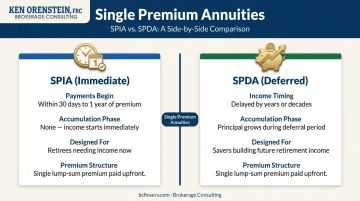
Single premium annuities come in two core forms. The choice comes down to timing — whether you need income now or want to let the money grow first.
Single Premium Immediate Annuity (SPIA)
A SPIA begins income payments no later than one year after premium payment — often within 30 days. There is no accumulation phase. You pay, and payments begin.
SPIAs are designed for people at or near retirement who need to replace a paycheck immediately. Common buyers include recent retirees, lump-sum recipients from pension buyouts, and federal retirees supplementing their FERS pension and Social Security income.
Single Premium Deferred Annuity (SPDA)
An SPDA accepts a single premium upfront but delays income payments — sometimes by years, sometimes by decades. During the deferral period, the principal grows on a fixed or indexed basis.
Example: A 50-year-old purchases an SPDA with $150,000 and defers income until age 65. The 15-year accumulation period, combined with a guaranteed roll-up rate, can produce significantly larger monthly payments than if the same person had purchased a SPIA at 65 with that same amount.
The DIA Variation
Within the deferred category, Deferred Income Annuities (DIAs) take a more targeted approach. Like SPDAs, they accept a single premium and delay income — but they're purpose-built for guaranteed lifetime income starting at a specific future date. DIAs are particularly useful for bridging late-retirement income gaps or coordinating with Social Security claiming at age 70.
LIMRA reported that 2025 SPIA sales reached $14 billion (up 3%), while DIA sales were $4.8 billion — both meaningful segments of the broader annuity market.
How Single Premium Annuity Payouts Work
Payout Frequency
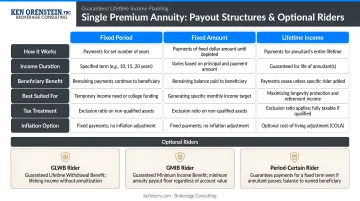
Payments are typically monthly, but insurers also offer quarterly, semiannual, and annual options. Monthly is the most common choice, as it most closely mirrors how retirees budget for living expenses. Once you've chosen a frequency, the next decision is which payout structure fits your situation.
The Three Core Payout Structures
| Structure | How It Works | Payment Level |
|---|---|---|
| Single-life | Payments for the annuitant's lifetime only; stop at death | Highest monthly amount |
| Joint-life | Payments continue for both annuitant and spouse | Reduced (typically 10–20% less) |
| Period-certain | Payments guaranteed for a set term (10, 20, or 30 years); if the annuitant dies early, a beneficiary receives the remainder | Varies by term length |
Payment Rate Options
- Fixed/level payments — the same amount every period; simple, predictable
- Fixed-percentage increase — payments grow by 1%–5% annually, securing purchasing power over time
- CPI-adjusted payments — indexed to the Consumer Price Index for true inflation tracking
The trade-off is real: inflation-adjusted and COLA options start with lower initial payments because the insurer prices in the future increases upfront. Clients who prioritize maximum early income often choose fixed payments; those worried about 20+ years of inflation tend to favor indexed options.
Current Payout Benchmark
To put these structures in concrete terms, here's what a standard SPIA currently pays for a 65-year-old investing $100,000 (single-life, no death benefit):
- Male: approximately $684/month
- Female: approximately $630/month
(Figures sourced from ImmediateAnnuities.com rate data. Actual amounts vary by insurer, age, gender, state, and current interest rates. Always obtain a live quote.)
Optional Riders
- COLA rider — annual income increases (1%–5% or CPI-linked); reduces initial payout
- Cash refund provision — if the annuitant dies before recovering the full premium, the remaining balance goes to named beneficiaries
- Installment refund — similar to cash refund, but paid out over time rather than as a lump sum
Each enhancement reduces the initial monthly payout. A client in excellent health with no dependents rarely needs a refund provision; someone with a spouse or heirs to protect almost always does. Health, life expectancy, and beneficiary goals should drive that call.
Tax Treatment of Single Premium Annuities
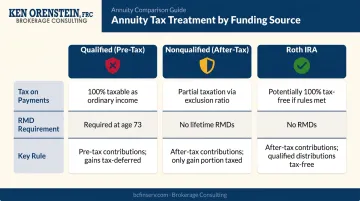
The source of your annuity premium determines whether your payments will be fully taxable, partially taxable, or entirely tax-free — and getting this right can meaningfully shape your retirement income strategy.
Qualified Annuities (Pre-Tax Funds)
When funded with pre-tax dollars — such as a traditional 401(k), IRA, or TSP rollover — every dollar of the annuity payment is taxable as ordinary income. No basis exists because contributions were never previously taxed.
Per IRS Publication 575, qualified accounts are subject to Required Minimum Distribution (RMD) rules. Distributions must generally begin by April 1 of the year after you turn 73. Failing to take sufficient RMDs can trigger a 25% additional tax on the undistributed amount.
Nonqualified Annuities (After-Tax Funds)
When funded with after-tax dollars, the IRS applies an exclusion ratio to determine what portion of each payment is a tax-free return of principal and what portion is taxable interest. Only the earnings component gets taxed — which can reduce the effective tax burden compared to a fully taxable qualified annuity.
The Roth IRA Exception
A SPIA funded through a Roth IRA may generate entirely tax-free income, provided the account has satisfied the five-year holding rule and payments begin after age 59½ (or due to disability, death, or a first-time home purchase). Roth IRA owners also face no lifetime RMD requirement, making this a tax-efficient structure for long-lived retirees.
How the three funding sources compare at a glance:
| Funding Source | Tax Treatment on Payments | Lifetime RMDs Required? |
|---|---|---|
| Qualified (pre-tax IRA, 401(k), TSP) | 100% taxable as ordinary income | Yes — begin at age 73 |
| Nonqualified (after-tax dollars) | Partial — earnings taxed, principal returned tax-free | No |
| Roth IRA | Potentially 100% tax-free (if rules met) | No |
Note on state premium taxes: Some states impose a premium tax at the time of annuity purchase. California charges 2.35%; Nevada 3.5%; Maine 2%. Rates vary significantly by state. Verify your state's treatment before purchase.
Pros and Cons of Single Premium Annuities
Single premium annuities offer a straightforward income guarantee, but the trade-offs are real. Here's what to weigh before committing a lump sum.
Pros
- Guaranteed lifetime income — payments cannot be outlived regardless of market performance
- Simplicity — no ongoing investment decisions once the contract is established
- Lower fees than variable or indexed annuities, particularly for SPIAs
- Mortality credits — pooled risk structure can produce better income than equivalent fixed-income alternatives
- Add death benefit, spousal protection, or inflation adjustments through riders at purchase
Cons
- Limited liquidity — once annuitized, the lump sum is generally irrevocable and inaccessible
- Inflation risk — fixed nominal payments lose purchasing power over time without a cost-of-living adjustment (COLA) rider
- Reduced inheritance — particularly with single-life structures that carry no guaranteed period; beneficiaries receive nothing after the annuitant's death
- Locking in a large sum means giving up potential growth from other investments — a real opportunity cost in rising-rate or strong-market environments
Is a Single Premium Annuity Right for You?
A SPIA makes the most sense when you:
- Are at or near retirement with a lump sum available ($100,000 minimum; typically $250,000+)
- Want predictable, guaranteed monthly income without managing a portfolio
- Have a clear income gap between Social Security (and any pension) and actual monthly expenses
- Prioritize stability and predictability over liquidity and growth potential
For federal employees, a SPIA can serve as a third income layer alongside FERS pension and Social Security. Ken Orenstein of Brokerage Consulting — a Federal Retirement Consultant who authored The Informed Fed: A Survival Guide to Federal Employee Benefits — uses SPIAs as paycheck replacements for federal retirees, filling income gaps the FERS pension alone doesn't cover.
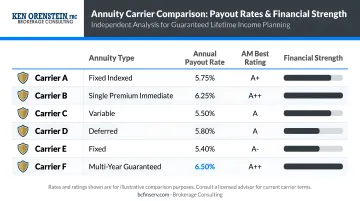
Because SPIA payout rates vary meaningfully across carriers, working with an independent broker gives you a real advantage. As an independent broker representing multiple top-rated carriers — including Aetna, Humana, and TransAmerica — Ken compares payout rates and carrier financial strength (A.M. Best, Moody's, S&P, Fitch) across the market. A captive agent can only show you one insurer's rates; an independent comparison often yields a meaningfully higher monthly payout.
Consultations are available at no cost by phone, virtually, or in person. Reach the Brokerage Consulting team at (888) 315-3608 or visit bcfinserv.com to request a quote.
Frequently Asked Questions
What is a single premium immediate annuity (SPIA) and how does it work?
A SPIA is an insurance contract where you pay a one-time lump sum and the insurer begins making regular income payments — within 30 days to one year of purchase. Payments continue for life, for a set period, or for both you and a spouse, depending on the payout structure you choose.
How much would a $100,000 single premium immediate annuity pay per month?
For a 65-year-old purchasing a single-life SPIA with no death benefit, current estimates run approximately $684/month for men and $630/month for women. Actual amounts depend on age, gender, state, insurer, and current interest rates — always get a live quote from multiple carriers before deciding.
Are single premium annuities a good investment?
SPIAs aren't investments in the traditional sense — they're insurance products. They're well-suited for retirees who want guaranteed, predictable income and are willing to give up liquidity in exchange for that certainty. They're generally not appropriate for anyone who needs flexible access to their principal.
How are single premium annuities taxed?
Qualified annuities (funded with pre-tax dollars) produce fully taxable payments. Nonqualified annuities use an exclusion ratio — only the earnings portion is taxed. Roth IRA-funded SPIAs may generate tax-free income once the five-year rule and age 59½ requirement are satisfied.
Does annuity income affect SSDI benefits?
According to the SSA, annuity payments are not counted as earnings and do not affect SSDI eligibility. SSI follows separate unearned income rules, so verify your specific situation with the SSA or a financial advisor before assuming either way.
Can you cash out a single premium immediate annuity?
Generally, no. Once annuitized, the premium cannot be withdrawn as a lump sum. Some contracts include a one-time cash advance option or a cash refund feature that pays remaining premium to beneficiaries upon the annuitant's death.