
Introduction
Your annuity statement lists several figures — and most people focus on the wrong one. The accumulated value (sometimes called account value) is the number that actually tells you how your annuity is performing, yet many holders confuse it with what they'd receive if they cashed out today, or mistake it for the inflated "benefit base" figure tied to an income rider.
U.S. retail annuity sales topped $460 billion in 2025, a record-setting fourth consecutive year — yet surveys consistently show that annuity holders struggle to interpret the key figures on their own statements. Knowing exactly what accumulated value represents — and how it moves — is what keeps you in control of your retirement timeline.
Below, you'll find a clear breakdown of how accumulated value is calculated for different annuity structures, what pushes it higher or lower, and how to apply it when making actual retirement income decisions.
Key Takeaways
- Accumulated value = premiums paid + credited interest/investment growth − withdrawals and fees, before surrender charges
- It differs from surrender value, benefit base (an income-calculation figure), and present value (a discounted future estimate)
- The formula changes depending on whether payments fall at the end or beginning of each period
- Three factors drive it most: credited rate, accumulation period, and contribution size
- Your accumulated value tells you when to convert to income, what you can withdraw penalty-free, and whether you're on track
What Is Accumulated Value in an Annuity?
Accumulated value is the total internal balance of a deferred annuity at any given point during the accumulation phase. It adds up all premium payments and credited interest or investment returns, then subtracts any withdrawals and fees — but before surrender charges come out.
Think of it as a real-time growth tracker. It tells you exactly how much your annuity has grown to date and serves as the base figure for three key calculations:
- Death benefit amounts passed to beneficiaries
- Penalty-free withdrawal limits (typically 10% of accumulated value annually)
- Annuitization — the starting point for calculating future income payments
How It Differs from Related Terms
Three terms on your statement are commonly confused with accumulated value:
| Term | What It Represents |
|---|---|
| Accumulated value | Gross contract balance before surrender charges |
| Surrender value | What you'd actually receive if you terminated the contract today (accumulated value minus surrender charges) |
| Benefit base | A separate, often higher figure used only to calculate income rider payments — not withdrawable cash |
| Present value | A discounted calculation estimating what future payment streams are worth in today's dollars |
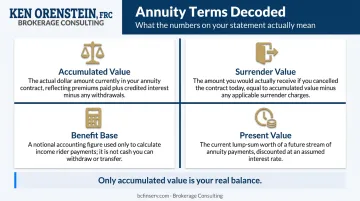
Accumulated value is the real balance. The benefit base is a calculation tool. The surrender value is what you can walk away with. Knowing which number applies to your situation — especially at distribution or during a 1035 exchange — directly affects how you plan.
How Annuity Accumulated Value Is Calculated
The core logic: take a starting principal, apply a growth rate over a number of periods, and account for the timing of contributions. That last part — the timing — is where most people get tripped up, because it changes the formula and the final number.
Ordinary Annuity (Payments at End of Period)
Most deferred annuity premiums and pension-style products follow this structure. Payments are made at the end of each period.
Formula:
FV = C × [(1 + i)ⁿ − 1] / i
Where:
- C = payment per period
- i = interest rate per period
- n = number of payment periods
Example: $1,000 contributed annually at 5% for 10 years
- FV = $1,000 × [(1.05)¹⁰ − 1] / 0.05
- FV = $1,000 × [1.6289 − 1] / 0.05
- FV = $1,000 × 12.578
- FV = $12,578
Annuity Due (Payments at Start of Period)
An annuity due has payments made at the beginning of each period. Each contribution gets one additional period to compound, which produces a higher accumulated value.
Formula:
FV(due) = C × [(1 + i)ⁿ − 1] / i × (1 + i)
Using the same numbers — $1,000 annually at 5% for 10 years:
- FV(due) = $12,578 × (1.05)
- FV(due) = $13,207
That extra $629 comes entirely from the timing difference. Each payment earns one more year of compounding.
How the Formula Applies Across Annuity Types
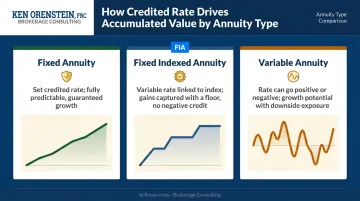
Those examples assume a fixed interest rate. The rate variable i behaves differently across annuity types, which affects how predictably accumulated value grows:
- Fixed annuity: The rate i is set by contract and stays predictable throughout the accumulation period
- Fixed indexed annuity (FIA): The credited rate varies each period based on a market index, with contractual floors ensuring accumulated value can plateau but never shrink from interest crediting alone
- Variable annuity: Subaccount returns directly drive accumulated value and can decline; the formula still applies, but i can turn negative in down markets
Key Factors That Affect Your Annuity's Accumulated Value
Credited Interest Rate
Small rate differences compound into large outcome differences over long periods. The table below illustrates how a $100,000 lump sum grows at different credited rates:
| Credited Rate | Value at 10 Years | Value at 20 Years |
|---|---|---|
| 3% | $134,392 | $180,611 |
| 5% | $162,889 | $265,330 |
| 7% | $196,715 | $386,968 |
A 2-percentage-point difference in credited rate — something that looks modest on paper — produces a $120,000+ gap over 20 years on the same $100,000 starting balance. This is why FINRA warns investors to scrutinize the fine print on indexed annuity crediting methods before purchasing.
Length of the Accumulation Period
The longer money stays untouched and compounding, the more the growth effect magnifies. Deferred annuities offer genuine flexibility here — you can extend your accumulation period if retirement gets delayed, or access funds earlier if circumstances change (subject to surrender schedules and IRS rules). That flexibility is a real advantage deferred annuities hold over pension-style income vehicles.
Contribution Amount and Structure
Two approaches produce different accumulated value trajectories:
- Single premium (lump sum): The entire balance compounds from day one, maximizing time in the market
- Flexible or periodic contributions: Each payment compounds from its own start date — later contributions have less time to grow, but consistent additions build a larger base
Larger and more frequent contributions directly increase the base on which interest compounds. Most deferred annuity contracts don't cap contributions, though individual product rules vary.
Fees and Charges
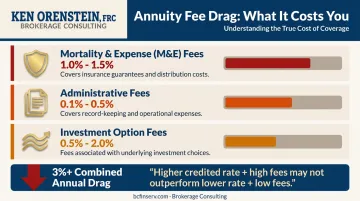
Every fee reduces effective growth. The main ones to watch:
- Mortality and expense (M&E) charges — primarily in variable annuities, often 1.0–1.5% annually
- Administrative fees — flat or percentage-based charges subtracted each period
- Income rider fees — typically 1.0–1.5% annually on the income base or account value
In a variable annuity with multiple fees stacked, total annual costs can exceed 3%. That's a significant drag on accumulated value over a 15–20 year accumulation period. Understanding total fee drag is essential when comparing products — a higher credited rate that's mostly consumed by fees isn't actually better. Tax deferral, covered next, is one growth lever that doesn't come with a fee attached.
Tax-Deferred Compounding
Because accumulated value grows without annual taxation, the full balance — including what would otherwise be paid in taxes — continues earning interest each year. This accelerates growth compared to a taxable account earning the same gross rate.
The trade-off is real: withdrawals are taxed as ordinary income, and the IRS imposes a 10% early-withdrawal penalty on distributions taken before age 59½ (with limited exceptions). Tax deferral is a powerful growth accelerant, but it comes with access constraints that require planning around.
Accumulated Value vs. Other Values on Your Annuity Statement
Accumulated Value vs. Surrender Value
These two figures diverge during the surrender period, which typically lasts 5–10 years from contract issue. Surrender value equals accumulated value minus surrender charges — and during the early years of a contract, that gap can be substantial.
The gap narrows annually as the surrender schedule steps down, and closes to zero once the surrender period ends. At that point, accumulated value and surrender value are effectively the same number. (Note: "cash value" and "accumulated value" are the same concept — different carriers may use different labels.)
Accumulated Value vs. Benefit Base
This is the most widely misunderstood distinction in annuity statements. A benefit base (also called a protected income value or income base) is a separate figure maintained by the carrier to calculate payments under a Guaranteed Lifetime Withdrawal Benefit (GLWB) rider.
It's a phantom calculation number — it exists only on paper to determine your monthly income amount. The benefit base cannot be:
- Withdrawn as a lump sum
- Received as a death benefit
- Treated as your actual account balance
The benefit base often grows at a guaranteed "roll-up rate" (commonly 5–7% annually) during the accumulation period, which is why it can look significantly higher than accumulated value. That higher number generates a higher income payment — but it doesn't represent money you actually have.
Accumulated Value vs. Present Value
Present value runs the calculation in reverse: it discounts a future payment stream back to today's dollars at a given interest rate. If someone asks "what is this annuity worth in today's money," they're asking for present value — not accumulated value.
Both figures matter, but for different questions. Accumulated value answers "how much has my annuity grown?" Present value answers "what are my future payments worth right now?" Use the right tool for the right question.
What Your Annuity's Accumulated Value Means for Retirement Planning
Tracking accumulated value over time tells you whether you're on pace to generate the retirement income you need. The accumulated value at the moment you begin income payments (annuitization) becomes the base from which monthly income, lump-sum options, or systematic withdrawal amounts are calculated.
The Annuitization Decision
When you shift from growth mode to income mode, accumulated value at that exact moment determines your payout options. Delaying annuitization typically increases accumulated value — and therefore increases future payments. Accessing funds early triggers surrender charges during the surrender period, plus potential IRS penalties before age 59½.
This timing decision isn't purely mathematical. It intersects with:
- Your Social Security claiming strategy
- Pension or TSP income timing (for federal employees)
- Required Minimum Distribution (RMD) rules after age 73
- Surrender schedule expiration dates on your specific contract
For federal employees, a deferred annuity's accumulated value often complements FERS pension and TSP distributions by filling the guaranteed income gap — layering guaranteed income sources to cover expenses Social Security and the pension alone may not fully address.
Accumulated value interacts with taxes, surrender schedules, rider features, and payout options simultaneously — and the right sequence matters. Ken Orenstein at Brokerage Consulting (Flemington, NJ) offers no-cost consultations — phone, virtual, or in-person — to review whether your annuity's accumulated value is aligned with your retirement income goals. Reach his office at (888) 315-3608 or at bcfinserv.com.
Frequently Asked Questions
What does accumulated value mean in an annuity?
Accumulated value is the total current internal balance of a deferred annuity — premiums paid plus credited interest or investment growth, minus any withdrawals and fees. It represents how much the annuity has grown to date, before any surrender charges are applied.
What is the formula for annuity accumulated value?
The core formula for an ordinary annuity (end-of-period payments) is:
FV = C × [(1 + i)ⁿ − 1] / i
Here, C is the periodic payment, i is the interest rate per period, and n is the number of periods. For an annuity due (beginning-of-period payments), multiply the result by (1 + i).
Is the accumulated value the same as the surrender value?
No. Accumulated value is the gross balance before penalties. Surrender value is what you'd actually receive after surrender charges are deducted during the surrender period. They equal each other only once the surrender period has ended.
How long does it take to access money from a deferred annuity penalty-free?
Access without surrender penalties typically requires waiting until the surrender period ends — usually 5–10 years. Withdrawals before age 59½ also trigger a 10% IRS early-withdrawal penalty in most cases.
How much does a $100,000 annuity pay per month?
The monthly payout depends on several factors: accumulated value at annuitization, payout structure (life-only, joint, or period-certain), the holder's age, and current interest rates. A $100,000 premium in a fixed immediate annuity will produce a different monthly figure than a $100,000 accumulated balance in a deferred annuity that has grown over 15 years. Consult a licensed advisor for a personalized illustration.