
Introduction
Most pre-retirees face the same dilemma: they need their savings to grow, but they've seen enough market volatility — including the simultaneous stock and bond losses of 2022 — to feel wary of full market exposure. A fixed annuity feels too conservative; a variable annuity feels too risky. That leaves a meaningful gap in the middle.
Registered Index-Linked Annuities (RILAs) were designed to fill it. RILA sales reached $79.5 billion in 2025 — the 11th consecutive year of growth — which reflects how many pre-retirees are actively searching for this kind of middle ground.
This article covers how RILAs work, what their protection and growth mechanisms actually do in practice, how they compare to other annuity types, and who they're best suited for — so you can evaluate whether one belongs in your retirement plan.
Key Takeaways
- A RILA links growth to a market index while limiting — but not eliminating — downside losses through buffers or floors
- Upside is capped or subject to a participation rate; less protection generally means higher growth potential
- RILAs sit between fixed-index annuities (lower caps, more protection) and variable annuities (full market exposure, no floor protection)
- Tax-deferred growth comes with trade-offs: surrender charges, renewal rate variability, and meaningful product complexity
What Is a Registered Index-Linked Annuity (RILA) and How Does It Work?
A RILA is a deferred annuity contract — issued by an insurance company and regulated by the SEC as a security — in which your contract value grows (or declines) based on the performance of a market index, subject to defined limits on both gains and losses.
You may also see them marketed as structured annuities, buffered annuities, or index-linked variable annuities. Same core product, different brand names.
Your Money Isn't Actually in the Market
When you put money into a RILA, the insurance company does not invest your premium directly into the S&P 500 or any other index. The insurer tracks index performance to calculate what gets credited to your contract. That means:
- No direct stock market exposure
- No share ownership
- No dividend payments
What you have is a contractual promise: at the end of a defined period, the insurer credits your account based on how the index performed — subject to the agreed-upon limits.
How Strategy Terms Work
RILA contracts are structured around strategy terms — typically 1, 3, or 6 years. The term defines the measurement window.
What matters is where the index lands at the end of the term, not what happens in between. Significant volatility mid-term is irrelevant; only the end-of-term point-to-point comparison determines your credit.
This point-to-point structure has real implications:
- A 6-year term gives the index more time to recover from early declines
- Intra-period volatility doesn't hurt you unless the index is still down at the end
- You can't capture intra-period gains if you exit early — you'd receive an interim calculated value instead
RILA as an Accumulation Vehicle
A RILA is a deferred accumulation vehicle — you build contract value during the term, then convert to income or take a lump sum later. That makes it most relevant for pre-retirees with a 5–15 year runway before they need the money.
How RILA Protection and Growth Mechanisms Work
Downside Protection: Buffers vs. Floors
These two terms get used interchangeably, but they're structurally different. Choosing the wrong one can leave you far more exposed than you expected — so the distinction shapes everything about how a RILA performs in a down market.
Buffer: The insurer absorbs the first portion of losses up to a defined threshold. You bear anything beyond it.
- Example: With a -10% buffer, if the index falls 15%, the insurer covers the first 10% and you lose 5%
- If the index falls 8%, you lose nothing — the buffer absorbs the entire decline
- If the index falls 30%, you lose 20%
Floor: The investor absorbs losses up to the floor, and the insurer absorbs anything beyond it.
- Example: With a -10% floor, if the index falls 40%, you lose only 10% — no matter how bad it gets
- The floor defines your worst-case outcome in absolute terms
| Feature | Buffer | Floor |
|---|---|---|
| Who absorbs first losses? | Insurer (up to buffer %) | Investor (up to floor %) |
| Who absorbs severe losses? | Investor (anything beyond buffer) | Insurer (anything beyond floor) |
| Worst case defined? | No — still exposed to deep declines | Yes — maximum loss is fixed |
| Typical trade-off | Higher caps available | Lower caps in exchange for certainty |
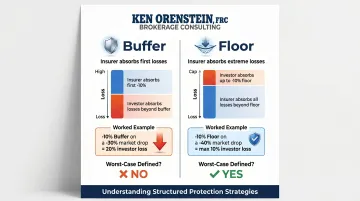
Buffers work well when you're willing to accept some tail risk in exchange for higher growth potential. Floors are better suited when a defined worst-case scenario matters more than maximizing upside — and that trade-off connects directly to how much growth a contract will offer.
Upside Growth: Cap Rates and Participation Rates
Cap rate: The ceiling on gains credited per term.
- Example: With a 10% cap on a 6-year term, if the S&P 500 gains 35%, you're credited 10%
- Choosing less downside protection (smaller buffer) typically unlocks a higher cap
Participation rate: The percentage of index gains credited to your account.
- Example: 80% participation on a 20% index gain = 16% credited return
- Some RILA products now offer participation rates above 100%, meaning your credited return can exceed actual index performance on certain index strategies
A Concrete Scenario
Here's what the math looks like in practice. Assume a $200,000 contract with a 3-year term, 10% buffer, and 12% cap on the S&P 500:
Scenario A — Market drops 18%:
- Buffer absorbs first 10%
- Investor loses 8% → contract value: $184,000
Scenario B — Market gains 30%:
- Cap limits credit to 12%
- Investor gains 12% → contract value: $224,000
The buffer didn't eliminate the loss in Scenario A, but it meaningfully reduced it. And the cap in Scenario B meant leaving some gains on the table: that's the direct price of the downside protection built into the contract.
How RILAs Compare to Other Annuity Types
RILAs occupy a specific band on the risk-reward spectrum. Here's where they sit relative to the four main annuity types:
| Feature | Fixed Annuity | Fixed Indexed Annuity (FIA) | RILA | Variable Annuity |
|---|---|---|---|---|
| Downside protection | Full principal guarantee | 0% floor — no market loss | Buffer or floor (partial) | None (optional riders add cost) |
| Growth potential | Fixed declared rate | Capped; generally lower than RILA | Higher caps than FIA | Full market participation |
| Principal guarantee | Yes | Yes (from index loss) | No | No |
| SEC-registered security | No | No | Yes | Yes |
| Complexity | Low | Moderate | High | Moderate–High |
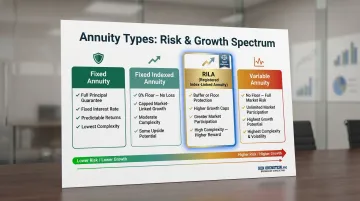
The RILA sits in the middle: more growth potential than a FIA, but more downside protection than a variable annuity with no floor.
Choosing between them comes down to risk tolerance, retirement timeline, and income structure. Many clients pair a RILA with a FIA or immediate annuity rather than using it as a standalone solution: a FIA handles guaranteed income, while the RILA targets additional growth on funds not earmarked for near-term use.
Risks, Limitations, and Common Misconceptions
The Buffer Doesn't Mean Safe
The most common mistake: treating a buffer as full protection. It isn't.
Historical S&P 500 data since 1928 shows the index has experienced annual declines exceeding 10% in roughly 26% of all years, and exceeding 20% in roughly 10% of all years. In 2008, the S&P 500 fell 37%. In 2022, it fell 18%.
A 10% buffer in 2008 would have still left an investor absorbing a 27% loss. That's a significant hit — exactly the kind of outcome that catches people off guard when they assumed the buffer would keep them whole.
Selecting a buffer level means deciding how much loss you can absorb if the market drops 30%, 40%, or more. Use historical worst-case drawdowns as your anchor — not just the cap rate the buffer unlocks.
Practical Constraints to Know
- Surrender charges: RILA contracts typically carry surrender periods of six to seven years, with penalties for early withdrawal that can significantly reduce contract value
- Interim value risk: Withdrawing before a strategy term ends means receiving an interim calculated value — not the full-term credit, which could be lower
- Renewal rate variability: Cap rates and participation rates are reset at each term renewal by the insurer based on market conditions. Your initial rates are not guaranteed for the life of the contract
- No FDIC insurance: RILA guarantees — including buffer protection — are backed solely by the financial strength and claims-paying ability of the issuing insurance company, not any government guarantee
Because no FDIC backing exists, carrier financial strength ratings from A.M. Best, Moody's, S&P, and Fitch are directly relevant to product selection. The insurer's solvency backs every contractual promise.
Most states provide secondary protection through guaranty associations — typically covering at least $250,000 in annuity benefits — but that's a backstop, not a substitute for evaluating carrier strength before you commit.
Who Should Consider a RILA?
The Ideal Profile
The average RILA buyer is approximately 60–62 years old with an initial premium around $150,000, according to SEC investor testing data. That profile makes sense — this is a pre-retirement accumulation product, not an immediate income vehicle.
A RILA tends to fit well when someone:
- Is 5–15 years from retirement with a meaningful accumulation window
- Wants more growth potential than a CD, MYGA, or FIA provides
- Can tolerate some downside risk, but wants a defined limit rather than open-ended market exposure
- Has baseline guaranteed income already lined up (pension, Social Security) and is optimizing additional assets
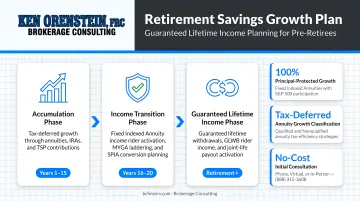
That fourth point is where federal employees under FERS often land. FERS pension benefits combined with Social Security typically replace only 55–60% of pre-retirement income. TSP balances fill part of that gap — but federal employees who need supplemental growth on additional savings, without the full volatility of a variable annuity, are exactly the kind of candidate a RILA was designed for.
Who Should Look Elsewhere
A RILA is generally the wrong tool if someone:
- Needs access to their funds within the next few years
- Cannot tolerate any loss of principal under any scenario
- Is already in retirement and needs guaranteed income now rather than accumulation later
Getting the Strategy Right
Choosing the right buffer level, cap rate, strategy term, and index requires aligning the RILA to a complete retirement picture: Social Security timing, TSP or 401(k) balances, pension income, and real liquidity needs.
Getting those variables wrong pulls in one of two directions — over-protecting (leaving too much growth on the table) or under-protecting (choosing a high cap that comes with exposure you can't actually absorb).
Ken Orenstein at Brokerage Consulting works with federal employees and individuals to build low-cost, tax-efficient retirement plans — covering carrier financial-strength review, annuity type comparisons, and RILA coordination with FERS, TSP, and Social Security strategy. No-cost consultations are available by phone, virtually, or in person at (888) 315-3608 or bcfinserv.com.
Frequently Asked Questions
How much does a $1,000,000 annuity pay per month?
A RILA is an accumulation vehicle, not an immediate income product, so there's no set monthly payout while the contract is growing. Income would depend on what the contract grows to before annuitization, then on the payout terms selected (lifetime, joint, period-certain), your age, and prevailing interest rates at that time.
What is the difference between a buffer and a floor in a RILA?
A buffer means the insurer absorbs the first portion of losses (say, the first 10%), with the investor bearing anything beyond that. A floor sets the investor's maximum loss (say, no more than 10% regardless of how far the index falls). Buffers leave you exposed in severe downturns; floors give you a defined worst-case outcome.
Are RILAs a good investment for retirement?
RILAs are a strong fit for pre-retirees who want more growth potential than a fixed annuity offers but aren't willing to absorb full market losses. That said, suitability hinges on your time horizon, risk tolerance, liquidity needs, and how the RILA fits within your broader retirement income plan.
How does a RILA differ from a fixed index annuity (FIA)?
A FIA protects 100% of principal from index losses (0% floor) but typically offers lower caps and participation rates. A RILA accepts some downside risk (via a buffer or partial floor) in exchange for higher caps and greater growth potential. RILAs are more aggressive than FIAs but more protective than variable annuities.
What happens to my RILA if the market drops more than my buffer?
Losses beyond the buffer are absorbed by the investor. With a 10% buffer and a 25% index decline, you'd lose 15% of contract value. Choose a buffer level that reflects your real risk tolerance, not just the one that unlocks the highest cap rate.
Can I access my money early from a RILA?
RILAs typically carry surrender charge periods of six to seven years, with early withdrawal penalties. Withdrawing before a strategy term ends triggers an interim calculated value rather than the full-term credit. These products work best for funds you won't need for at least six to seven years.
Guarantees are backed by the financial strength and claims-paying ability of the issuing insurance company. RILAs are not FDIC-insured. This content is for educational purposes only and does not constitute investment advice or a solicitation. Annuities involve risk, including the possible loss of principal.