
Inheriting a non-qualified annuity is genuinely different. Unlike a stock portfolio, there's no step-up in basis to wipe out embedded gains. Unlike a Roth IRA, the earnings aren't tax-free. And unlike inheriting a home, the distribution choices you make in the first year can lock you into a tax outcome that's difficult to undo.
The rules here sit at an intersection of IRC Section 72, IRS Publication 575, and the distribution options buried in the specific annuity contract — all of which interact with your own income tax bracket in ways that matter enormously. Beneficiaries who understand these rules before they act can often reduce their tax exposure substantially. Those who don't tend to trigger a larger-than-necessary tax bill in year one.
This article covers how inherited non-qualified annuities are taxed, why the no-step-up rule creates a unique burden, what your distribution options are, and how strategic timing can make a real difference.
Key Takeaways
- Only the earnings portion of a non-qualified annuity is taxable to the beneficiary — the original after-tax principal is returned tax-free
- No step-up in cost basis applies at death; all deferred gains are taxed as ordinary income when distributed
- Three main distribution options apply: lump sum, five-year rule, and annuitization, each with distinct tax timing
- Surviving spouses can continue the contract in their own name and defer taxes indefinitely; non-spouse beneficiaries cannot
- Timing distributions strategically can keep taxable income in lower brackets and prevent Medicare surcharge triggers
What Makes a Non-Qualified Annuity Different From Other Inherited Assets
A non-qualified annuity is purchased with money that has already been taxed — it sits outside of any IRA or employer retirement plan. Because of that, the owner's original premiums establish a cost basis (called "investment in the contract" under IRC Section 72(c)(1)), and that principal comes back to beneficiaries tax-free. Only the growth above that basis is taxable.
This differs sharply from a qualified annuity, where every dollar going in was pre-tax. With a qualified annuity, beneficiaries owe income tax on 100% of distributions — there's no cost basis to recover.
The Critical Contrast With Inherited Stocks
Non-qualified annuities create a uniquely painful tax situation for heirs — and the reason comes down to one rule that doesn't apply to anything else.
When you inherit a taxable brokerage account — stocks, mutual funds, bonds — IRC Section 1014(a) generally resets the cost basis to fair market value on the date of death. If a parent bought $100,000 in stock that grew to $250,000, the heir inherits a $250,000 cost basis. Selling immediately triggers no capital gains tax.
Non-qualified annuities are explicitly carved out of this rule. Two separate code sections close the door: IRC Section 1014(b)(9)(A) excludes annuities described in Section 72 from the stepped-up basis rule, and IRC Section 1014(c) excludes income in respect of a decedent.
The practical result: the $150,000 in growth that accumulated tax-deferred during the owner's lifetime doesn't disappear at death. It passes to the beneficiary as ordinary income, waiting to be taxed when distributed.
Here's how that compares at a glance:
| Asset Type | Basis at Inheritance | Tax on Growth |
|---|---|---|
| Inherited stocks / brokerage account | Stepped up to date-of-death value | Typically $0 if sold immediately |
| Non-qualified annuity | Original owner's cost basis only | Ordinary income tax on all gains |
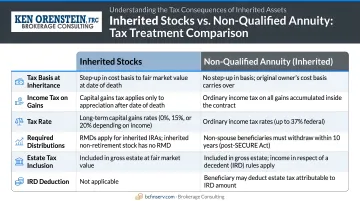
The tax-deferral that benefited the original owner doesn't reset or disappear — it converts into a tax liability the beneficiary must manage, often with limited time to plan around it.
How Inherited Non-Qualified Annuities Are Taxed
The Ordinary Income Rule
When a beneficiary takes distributions from an inherited non-qualified annuity, the earnings portion is taxed as ordinary income in the year received — not at the preferential capital gains rate. IRS Publication 575 confirms that the taxable portion of annuity distributions is treated as ordinary income, and that a lump-sum death distribution from a variable annuity is generally taxable to the extent it exceeds the unrecovered cost basis.
LIFO for Non-Periodic Withdrawals
For lump sums and partial withdrawals taken before annuitization, the IRS applies a Last In, First Out (LIFO) rule. Earnings come out first, before any principal is returned. This means early withdrawals are almost entirely taxable — the IRS doesn't allow selective blending of gains and principal on non-periodic withdrawals.
Exclusion Ratio for Annuitized Payments
If distributions are taken as regular annuity payments (annuitization), the tax treatment shifts. Each payment is split between a taxable earnings portion and a tax-free return of cost basis, calculated using the General Rule under IRC Section 72(b).
The exclusion ratio is determined by dividing the investment in the contract by the expected total return over the payout period — spreading the tax burden more evenly across payments rather than concentrating it in early withdrawals.
Per Publication 575, the Simplified Method cannot be used for non-qualified annuities — the General Rule applies.
Additional Tax Considerations
Two secondary taxes can compound the burden for higher-income beneficiaries:
- Net Investment Income Tax (NIIT): Distributions count as net investment income, subject to a 3.8% NIIT on the lesser of net investment income or MAGI above $200,000 (single) / $250,000 (MFJ) — per IRS Topic No. 559
- IRD Deduction: If the estate was large enough to owe federal estate tax and the annuity was included in the taxable estate, the beneficiary may claim an Income in Respect of a Decedent (IRD) deduction under IRC Section 691(c) — this offsets the double-tax burden of owing both income tax and estate tax on the same dollars
The Step-Up in Basis Does Not Apply — And Why This Matters
This comparison shows exactly what beneficiaries face:
| Inherited Stock Portfolio | Inherited Non-Qualified Annuity | |
|---|---|---|
| Original purchase price | $100,000 | $100,000 premiums paid |
| Value at death | $250,000 | $250,000 contract value |
| Beneficiary's cost basis | $250,000 (stepped up) | $100,000 (no step-up) |
| Taxable gain to beneficiary | $0 | $150,000 |
| Tax rate on gain | Capital gains (0–20%) | Ordinary income (up to 37%) |
The stock portfolio heir can sell immediately with zero tax liability. The annuity beneficiary inherits $150,000 in deferred ordinary income — taxed at ordinary rates, not the lower capital gains rates that apply to inherited investments.
Secondary Consequences to Watch
Beyond the direct income tax, large annuity distributions can trigger cascading effects:
- Bracket creep: Adding $150,000 of ordinary income to an existing salary can push a beneficiary from the 22% bracket into the 32% or higher bracket
- IRMAA surcharges: Medicare Part B and Part D premiums increase for individuals with MAGI above $109,000 (or $218,000 for married couples) in 2026 — annuity distributions raise MAGI
- Social Security taxation: Combined income above $34,000 (individual) or $44,000 (joint) can make up to 85% of Social Security benefits taxable — annuity income pushes this number higher
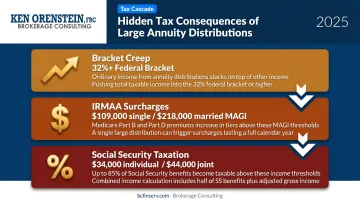
None of these consequences appear on a straightforward tax estimate. Spreading distributions across several years — rather than taking a lump sum — is often the most effective way to keep taxable income in a manageable bracket and avoid triggering IRMAA thresholds.
Your Distribution Options and the Tax Impact of Each
Under IRC Section 72(s), a non-qualified annuity must be fully distributed within five years of the owner's death if the owner dies before the annuity starting date, unless an alternative qualifying payout is elected. Beneficiaries have three paths: lump-sum distribution, the five-year rule, or annuitization over life expectancy.
Lump-Sum Distribution
Taking everything at once is straightforward but tax-expensive. The entire earnings portion hits your tax return as ordinary income in a single year. For a beneficiary already earning $80,000 in wages, adding $150,000 in annuity income creates a combined $230,000 taxable income, which lands squarely in the 32% federal bracket for a single filer.
This option makes the most sense when the annuity's earnings are modest, or when the beneficiary has large deductible expenses or losses in the same year.
Five-Year Rule
Under IRC Section 72(s)(1)(B), the beneficiary must fully distribute the annuity within five years of the owner's death but can take withdrawals in any amounts and at any timing during those five years. That flexibility lets you time withdrawals around your income: draw more in low-earning years and less when income is high. For beneficiaries who can't or don't want to annuitize, this is the most practical tool for keeping your tax bracket in check.
Annuitization Over Life Expectancy
If the contract allows it, a non-spouse beneficiary may elect to receive payments over their life expectancy, provided distributions begin within one year of the owner's death (IRC Section 72(s)(2)). This option applies the exclusion ratio to every payment, spreading both the taxable income and the tax-free principal recovery over many years. For younger beneficiaries inheriting larger contracts, this can produce the lowest annual tax hit of any option.
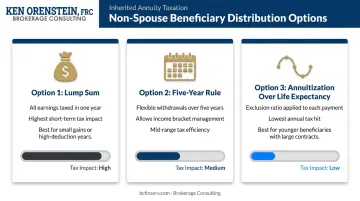
Important: The three options above assume your contract supports them — not every annuity does. Contact the insurance carrier promptly after the owner's death to confirm which distribution methods are available under the specific contract terms.
Spousal vs. Non-Spouse Beneficiary Rules
The Spousal Advantage
A surviving spouse has a unique option unavailable to anyone else: spousal continuation under IRC Section 72(s)(3). The spouse can assume the annuity contract in their own name, preserve full tax-deferred status, and defer all income tax until they choose to take distributions. No mandatory distribution timeline applies immediately. This is the most tax-efficient outcome for a spousal beneficiary.
Non-Spouse Individual Beneficiaries
Children, siblings, or other non-spouse individuals cannot continue the contract as their own. They must begin taking distributions under one of two permitted paths:
- Five-year rule: Full withdrawal of the account value by the end of the fifth year following the owner's death
- Life-expectancy payout: Periodic distributions stretched over the beneficiary's life expectancy, reducing annual tax exposure
Holding the annuity indefinitely while gains accumulate tax-deferred is not an option for non-spouse beneficiaries.
Trust and Charitable Beneficiaries
Two less common scenarios apply when the named beneficiary is an entity rather than a person:
- Trust as beneficiary: Distributions flow through the trust to its beneficiaries, but trust tax brackets compress sharply. In 2025, trusts hit the 37% bracket above just $15,650 in taxable income — a steep disadvantage compared to individual beneficiary rates.
- Charitable beneficiary: A qualified charity pays no income tax on annuity proceeds, even though those proceeds constitute income in respect of a decedent. Annuity owners with charitable intentions can eliminate the tax burden on accumulated earnings entirely by naming a charity as beneficiary.
Strategies to Reduce the Tax Burden on Inherited Annuities
For Beneficiaries: Tax Bracket Management
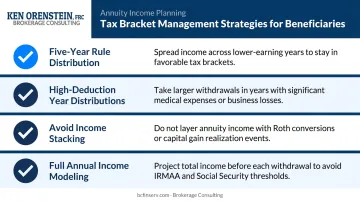
The most effective tool available to a beneficiary is controlling when income hits their return:
- Use the five-year rule to spread distributions across years with lower projected income
- Take larger distributions in years with significant deductions (medical expenses, business losses)
- Avoid stacking annuity distributions on top of other one-time income events (Roth conversions, capital gains)
- Model each year's full income picture before deciding withdrawal amounts — IRMAA and Social Security taxation thresholds make precision worthwhile
For Annuity Owners: Reduce the Deferred Gain Before Death
Owners who want to minimize the tax burden on their heirs have options during their lifetime:
- Systematic partial distributions taken during the owner's lifetime reduce the accumulated earnings that will transfer at death, drawing down the taxable gain before it passes to heirs
- 1035 exchanges between annuity contracts can improve contract terms, reduce fees, or access better income riders without triggering tax; note that accumulated gain carries over into the new contract rather than resetting
Ken Orenstein at Brokerage Consulting works with annuity owners and their beneficiaries on distribution timing, stretch vs. lump-sum payout analysis, and 1035 exchange strategy. No-cost consultations are available by phone at (888) 315-3608 or online at bcfinserv.com/request-a-quote.
Frequently Asked Questions
Does a step-up in basis apply to an inherited non-qualified annuity?
No. IRC Section 1014(b)(9)(A) explicitly excludes annuities described in Section 72 from the inherited-property basis rule. The beneficiary inherits the original owner's cost basis, and all earnings above that basis are taxed as ordinary income when distributed.
What is the five-year rule for inherited non-qualified annuities?
The five-year rule requires the entire annuity to be fully distributed within five years of the owner's death. Withdrawals can be taken in any amount at any point during that period, giving beneficiaries flexibility to manage how much taxable income hits each year.
Can a surviving spouse continue an inherited non-qualified annuity?
Yes. Under IRC Section 72(s)(3), a surviving spouse can elect spousal continuation — assuming the contract in their own name and deferring all taxes until they take distributions. Unlike non-spouse beneficiaries, a surviving spouse avoids the mandatory distribution rules entirely until their own death.
How do I find the cost basis of an inherited non-qualified annuity?
Contact the annuity carrier directly: they are required to track the owner's investment in the contract (the after-tax premiums paid). Also request premium payment records from the estate to verify the carrier's figures.
What is the difference between inheriting a qualified and non-qualified annuity?
Qualified annuities are funded with pre-tax dollars inside an IRA or employer plan, so beneficiaries owe ordinary income tax on 100% of distributions. Non-qualified annuities are funded with after-tax dollars, so only the earnings above the cost basis are taxable. Neither type receives a step-up in basis at death.
Are distributions from an inherited non-qualified annuity subject to the 10% early withdrawal penalty?
No. Under IRC Section 72(q)(2), distributions made on or after the death of the contract holder are explicitly exempt from the 10% early withdrawal penalty, regardless of the beneficiary's age. The beneficiary owes ordinary income tax on the earnings portion, but not the additional penalty.