
Introduction
Many retirees face a version of the same dilemma: they want income they can't outlive, but they're not willing to give up every chance at growth. Standard annuity products tend to force that choice — fixed annuities offer guarantees but no upside, variable annuities offer market exposure but no floor.
The hybrid annuity model attempts to split the difference. In plain terms, it's a single insurance contract that allocates premium across both a guaranteed fixed component and a market-linked variable or indexed component — providing income stability on one side and growth potential on the other.
"Hybrid annuity" is a term that gets marketed heavily but rarely explained at the structural level. This article covers how the model actually works across its three operational phases, what factors most directly affect its performance, where the common misconceptions live, and when this product genuinely fits — and when it doesn't. If you're a retiree, pre-retiree, or federal employee evaluating retirement income options, what follows is an honest breakdown before you sign anything.
Key Takeaways
- A hybrid annuity combines a fixed-rate component (guaranteed crediting) and a variable or indexed component (market-linked growth) within one contract
- The fixed side protects principal; the indexed or variable side provides limited upside tied to market performance
- Best suited for medium-to-long time horizons where both income stability and some inflation protection are priorities
- Key drawbacks: layered fees, surrender charge periods of 7–10 years, and fee structures that can obscure true costs
- Your full retirement income picture matters: FERS pension, Social Security, TSP, and liquid reserves all affect whether this product fits
What Is the Hybrid Annuity Model?
A hybrid annuity is a single insurance contract that allocates an investor's premium across two components:
- Fixed component — earns a guaranteed crediting rate regardless of market conditions
- Variable or indexed component — returns are linked either to sub-account investment performance (variable hybrid) or to a market index formula with floors and caps (fixed-indexed hybrid)
The goal is a retirement income stream that doesn't expire — eliminating longevity risk — while preserving some ability to keep pace with inflation through the growth component.
How It Differs From Pure Fixed or Variable Annuities
| Product | Guarantee | Growth Potential |
|---|---|---|
| Fixed annuity | Yes — guaranteed rate | None |
| Variable annuity | No floor | Full market exposure |
| Hybrid annuity | Partial — fixed component only | Limited — capped or participation-rate constrained |
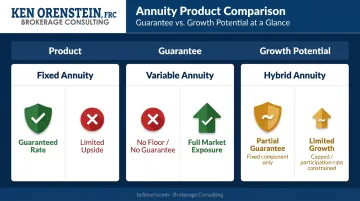
Worth knowing: "hybrid annuity" is not a formal regulatory category. FINRA uses the term descriptively for products that combine insurance and investment features. Most modern variable and indexed annuities now include optional income riders — which blurs the line between "hybrid" and standard variable or indexed products.
How the Hybrid Annuity Model Works
Phase 1: Premium Allocation and Accumulation
When the contract is funded, the premium is divided according to the allocation structure selected at signing. Some contracts fix this split permanently; others allow periodic reallocation.
Both portions grow tax-deferred — no taxes owed on gains until withdrawal. The two sides operate differently during accumulation:
- Fixed side: Credits a declared interest rate each period, regardless of what markets do
- Indexed side: Credits interest based on a formula tied to an index (often the S&P 500), subject to caps, participation rates, and spreads; interest is guaranteed not to fall below zero for fixed-indexed structures
The insurance carrier controls the indexed side's performance parameters, and those parameters can change at renewal periods.
Phase 2: Income Activation or Annuitization
Income begins through one of two distinct mechanisms:
Annuitization converts the contract's account value into a permanent stream of periodic payments. The carrier assumes all investment risk going forward. Payments don't stop regardless of market performance, but the investor surrenders ownership of the underlying account.
Income rider activation (most commonly a Guaranteed Lifetime Withdrawal Benefit, or GLWB) allows the investor to receive guaranteed withdrawals from a separate "benefit base" — a hypothetical calculation balance that may grow at a different rate than actual account value. As Morningstar explains, the benefit base differs from cash value in three key ways:
- Cannot be surrendered as a lump sum
- Grows independently of the actual account value
- Increases through roll-up, step-up, or ratchet features depending on the contract
Key distinction: Riders carry additional annual fees — typically 1.0–1.5% annually on the income base — which compound over time against net returns.
Phase 3: Ongoing Payout and Contract Maintenance
The two payout approaches differ significantly in how they handle account value, inheritance, and ongoing risk:
| Annuitization | Rider-Based Strategy | |
|---|---|---|
| Payments | Fixed; carrier bears investment risk | Guaranteed withdrawals; account value fluctuates |
| Account Value | Surrendered at annuitization | Continues; can be depleted but income persists |
| Heirs | Typically nothing passes (unless period-certain or joint-life elected) | Remaining account value may pass to beneficiaries |
| Benefit Base | N/A | Disappears at death; not inheritable |
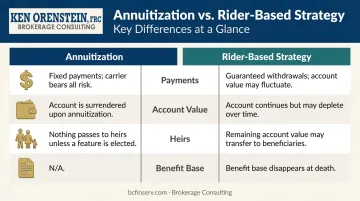
For clients with estate goals, the rider structure gives heirs access to any remaining account value — something annuitization forfeits entirely unless specific payout elections were made at signing.
Why Retirees and Pre-Retirees Consider Hybrid Annuities
The Longevity Problem
The retirement income math has shifted. According to SSA period life tables, a 65-year-old man has an average remaining life expectancy of 17.5 years; a 65-year-old woman, 20.1 years. For couples, the stakes are higher — the Society of Actuaries found that for a 65-year-old couple with average mortality, at least one spouse has a 72% chance of reaching age 85 and a 45% chance of reaching 90.
That's a long time for a portfolio to sustain withdrawals without a guaranteed income floor underneath it. Meanwhile, 32% of retirees cite outliving their savings as their greatest retirement fear.
The guaranteed income component of a hybrid annuity transfers longevity risk to the insurance carrier — payments continue regardless of how long the investor lives.
Inflation Exposure on the Fixed Side
Fixed income streams lose purchasing power steadily. At a consistent 3% annual inflation rate, $1 of income has the purchasing power of just $0.55 after 20 years. Fixed pensions and CDs provide no hedge against this erosion.
The indexed component of a hybrid annuity gives partial exposure to market growth — not equivalent to direct equity investing, but enough to preserve some purchasing power compared to a pure fixed income stream.
Why Federal Employees Still Consider This Product
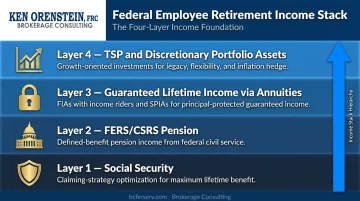
Federal employees with FERS pensions already have a defined income floor — but that floor may not fully address discretionary spending, long-term care costs, or legacy goals. Ken Orenstein, a Federal Retirement Consultant at Brokerage Consulting, positions guaranteed lifetime income annuities as Layer 3 in the federal employee income stack:
- Layer 1: Social Security (with claiming-strategy optimization)
- Layer 2: FERS/CSRS pension
- Layer 3: Guaranteed lifetime income via annuities (FIAs with income riders, SPIAs)
- Layer 4: TSP and discretionary portfolio assets
A hybrid annuity in Layer 3 supplements existing federal benefits without replacing them — particularly useful for retirees who need predictable income beyond what FERS and Social Security provide, while keeping TSP assets in growth mode.
Tax Deferral as an Additional Benefit
Gains inside the contract accumulate without annual tax drag — no taxes until withdrawal, at which point distributions are taxed as ordinary income. For investors who have already maxed qualified accounts (TSP, IRA, Roth), a nonqualified hybrid annuity provides additional tax-deferred accumulation capacity.
Withdrawals before age 59½ trigger the standard 10% IRS early distribution penalty on the taxable portion, with limited exceptions.
Key Factors That Affect a Hybrid Annuity's Performance
Five factors determine whether a hybrid annuity actually delivers on its promise:
Participation rates, cap rates, and spreads directly cap your upside on the indexed component. A 75% participation rate credits only 75% of index gains; a 7% cap means a 12% index gain still pays just 7%. Carriers can reset these terms at each renewal period.
Fee drag compounds quietly over time. Variable hybrids typically carry M&E charges of ~1.25% per year, plus administrative, sub-account, and optional rider fees. Total all-in costs with a living benefit rider can exceed 3% annually — meaningful erosion across a 10–15 year accumulation period.
Surrender periods typically run 7–10 years with a declining charge schedule (for example, 9-8-7-6-5-4-3-2-1-0%). Early withdrawals trigger those charges on top of any IRS tax and penalty implications. Most contracts carve out a free withdrawal of approximately 10% per year.
Prevailing interest rates shape both the fixed crediting rate and how income riders are priced. Contracts purchased in low-rate environments tend to lock in less favorable terms — a timing consideration worth discussing before committing.
Every guarantee is only as strong as the carrier behind it. Brokerage Consulting evaluates ratings from A.M. Best, Moody's, S&P, and Fitch before placing any contract. State guaranty associations cover annuity benefits up to $250,000 in present value for most states — a useful backstop, but not a substitute for upfront due diligence.
Common Misconceptions About Hybrid Annuities
"It's the best of both worlds"
This framing is accurate in structure but misleading in degree. The indexed component delivers a portion of market returns, constrained by participation rates, caps, and spreads — not market-equivalent growth. What investors are actually buying is downside protection and guaranteed income. That's a real trade-off, and understanding it precisely is what separates a good fit from a regrettable purchase.
"The benefit base is my account value"
This is the most consequential misunderstanding in hybrid annuity sales. When a contract includes an income rider, the "benefit base" (sometimes marketed with growth rates of 6–7% per year) is a hypothetical calculation figure used only to determine the income withdrawal amount. It is not the cash value of the contract.
It cannot be surrendered as a lump sum. In most structures, it disappears at death. Investors who conflate the two often feel misled, and the confusion is sometimes structural, not accidental.
"All fees are disclosed upfront"
Fee layers in hybrid annuities are rarely presented as a single, clear total cost figure. Common charges are disclosed separately, including:
- M&E (mortality & expense) charges — deducted from account value annually
- Administrative fees — vary by carrier and contract
- Sub-account expenses — apply to variable components
- Income rider fees — often 0.5–1.5% of benefit base per year
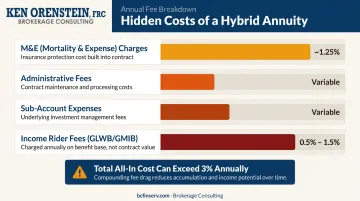
The cumulative annual cost as a percentage of account value may require active calculation. Before purchasing, request full itemized fee disclosure and add up the total yourself.
"Two products in one is always more efficient than two separate products"
Morningstar's annuity research notes that income annuities are often more efficient for generating retirement income than Guaranteed Lifetime Withdrawal Benefits in many scenarios — providing more guaranteed income at lower effective cost. Combining a low-cost SPIA with a separate index fund allocation can outperform a hybrid annuity on both cost and income efficiency. The single-contract convenience of a hybrid comes at a price; run the numbers on the alternatives before deciding convenience justifies the cost.
When a Hybrid Annuity May Not Be the Right Choice
Not every retirement income situation calls for this product. Here are situations where a hybrid annuity is likely the wrong fit:
Younger Investors Still in Accumulation
Investors under 50 with long time horizons and adequate risk capacity don't need the guaranteed income feature that justifies the fee load. Direct equity investing over a 20–30 year horizon typically outperforms fee-heavy annuity structures without the liquidity restrictions.
Anyone Who May Need Capital Within 7–10 Years
Surrender charges make hybrid annuities illiquid vehicles. Healthcare expenses, housing transitions, or family financial needs don't wait for surrender schedules to expire. Annuity premium should be capital that genuinely won't be needed within the surrender period — not a client's entire liquid savings.
When the Recommendation Isn't Driven by Your Needs
Hybrid annuities carry higher advisor compensation than simpler alternatives like low-cost index funds, term life policies, or standalone MYGAs. Ask directly whether this product fills a real gap in your retirement income plan — or whether it was recommended because it was a better deal for the advisor.
An independent advisor who reviews suitability transparently, discloses compensation structure, and evaluates alternatives before recommending any contract is where the process should start. Ken Orenstein's no-cost consultation process explicitly separates commission-based insurance placement from fee-based advisory work through Brookstone Capital Management, a distinction that matters when evaluating any annuity recommendation.
Frequently Asked Questions
What is the hybrid annuity model?
A hybrid annuity is a retirement income contract that combines a fixed-rate component (earning a guaranteed crediting rate) with a variable or indexed component (linked to market performance) within a single insurance contract. It's designed to provide both income stability and inflation-hedging potential, though growth is constrained by caps, spreads, and participation rates.
How is a hybrid annuity different from a fixed or variable annuity?
A fixed annuity offers only guaranteed, unchanging crediting with no market exposure. A variable annuity offers only market-linked sub-accounts with no guaranteed floor. A hybrid combines both, at the cost of added complexity and fee layers that neither standalone product carries on its own.
What fees should I expect with a hybrid annuity?
Variable hybrid annuities typically carry M&E charges near 1.25% annually, administrative fees, sub-account expenses, and optional rider charges of 1.0–1.5% on the income base. All-in costs can exceed 3% per year, so request full itemized fee disclosure before committing.
Can I withdraw money from a hybrid annuity early?
Most hybrid annuities impose surrender charges for 7–10 years, and withdrawals before age 59½ trigger a 10% IRS early distribution penalty on the taxable portion. Most contracts do allow a free annual withdrawal (often 10% of contract value) without triggering the surrender charge.
Is a hybrid annuity a good fit for federal employees?
It depends on the full income picture. Federal employees with FERS pensions already have a defined income floor. A hybrid annuity may make sense as a supplemental Layer 3 income source to address discretionary spending, longevity risk, or legacy goals — but only after mapping out FERS, Social Security, and TSP distributions first.
What happens to my hybrid annuity when I die?
The outcome varies by contract type. Annuitized contracts typically stop payments at death unless a period-certain or joint-life option was elected; rider-based contracts may pass remaining account value to named beneficiaries. Note that the benefit base used to calculate income withdrawals generally does not transfer to heirs.