Income annuities and fixed annuities both come from insurance companies, both protect your principal, and both involve guaranteed payouts. So why does choosing the wrong one matter? Because they solve completely different problems. One converts your savings into income. The other grows your savings until you're ready to use them. Picking based on product features alone — without understanding which phase of retirement you're in — can leave you either cash-poor when you need income or locked into payments before you're ready.
According to Allianz Life's 2025 survey, 64% of Americans worry more about outliving their money than death itself. Both annuity types address that fear — but in different ways, at different times.
Key Takeaways
- Income annuities convert a lump sum into guaranteed periodic payments — often for life — and are built for the distribution phase.
- Fixed annuities (particularly MYGAs) grow your money at a locked-in interest rate during an accumulation phase, with flexibility to access funds later.
- The dividing line is timing: income annuities are for people who need income now or soon; fixed annuities are for people still building savings.
- Both offer tax-deferred growth and principal protection, but differ in liquidity, flexibility, and income structure.
- The right choice comes down to timing and income gaps — not which product is objectively superior.
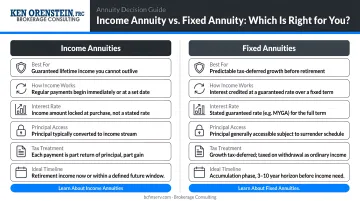
Income Annuity vs. Fixed Annuity: Quick Comparison
| Feature | Income Annuity | Fixed Annuity (MYGA) |
|---|---|---|
| Primary Purpose | Convert savings into guaranteed income | Grow savings at a guaranteed rate |
| How Income Works | Payments start immediately or on a set future date | Owner chooses when to convert or withdraw |
| Liquidity | Very limited once annuitized | Up to 10% annual free withdrawals |
| Growth Mechanism | No separate accumulation phase | Fixed interest rate for a defined term |
| Tax Treatment | Tax-deferred; taxed as income upon distribution | Tax-deferred; taxed as income upon distribution |
| Best For | Retirees needing reliable income now | Pre-retirees accumulating safe savings |
Tax treatment is similar for both annuity types — earnings grow tax-deferred, and distributions are taxed as ordinary income. The real distinction comes down to timing and control: fixed annuities keep your options open during the accumulation phase, while income annuities trade that flexibility for a predictable income stream you can't outlive.
What Is an Income Annuity?
An income annuity is an insurance contract where you exchange a lump sum for a guaranteed stream of payments. The two primary types are:
- SPIA (Single Premium Immediate Annuity): Payments begin within one year of purchase — often within 30 days. Best for retirees who need income to start right away.
- DIA (Deferred Income Annuity): Payments begin one year or more after purchase, sometimes at a much later age like 80 or 85. Often used to insure against outliving money in advanced old age.
Both types permanently convert principal into income — once purchased, the funds are committed to that payment structure.
Payout Options
The payment structure you select at purchase determines both your monthly amount and what happens to benefits after your death:
- Lifetime only — highest monthly payment, stops at death
- Lifetime with period-certain (e.g., 10 or 20 years) — payments continue to beneficiaries if you die during the guaranteed period
- Joint-and-survivor — continues paying while either spouse is alive; survivor options typically range from 50% to 100% of the original payment
- Cash refund or installment refund — returns the unpaid premium balance to beneficiaries if you die before recovering your full premium
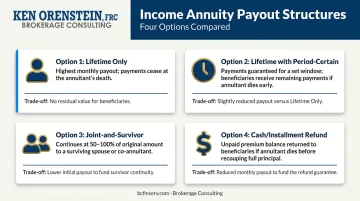
Adding a period-certain guarantee or survivor benefit reduces the monthly amount but protects the people you leave behind.
When Income Annuities Make Sense
Income annuities work best for retirees who need to replace a paycheck — especially those without a pension. The Social Security Administration's actuarial data shows remaining life expectancy at age 65 is 17.48 years for men and 20.12 years for women. That's a long time to fund, and a guaranteed lifetime income stream removes the risk of outliving that portion of your savings.
A practical example: a retiree rolls over a portion of their TSP or 401(k) — typically $250,000 or more — into a SPIA, locking in a guaranteed monthly payment for life. That payment begins almost immediately and continues regardless of how long they live or what markets do.
For federal employees, this matters most when FERS pension income alone doesn't close the gap between monthly expenses and guaranteed income — which is precisely where income annuities differ from the fixed annuity approach covered next.
What Is a Fixed Annuity?
A fixed annuity is an insurance contract that guarantees a specific interest rate on your contribution for a defined term. The most common form is the Multi-Year Guaranteed Annuity (MYGA) — which functions like a CD but with tax-deferred growth.
How MYGAs Work
Fixed annuities have two distinct phases:
- Accumulation phase — money grows at the locked-in rate, tax-deferred, for the full contract term (typically 3, 5, 7, or 10 years)
- Distribution phase — when the term ends, you can take withdrawals, roll funds into another annuity, or convert to an income stream
Unlike income annuities, fixed annuities don't lock you into a payment structure at purchase. That flexibility is the point.
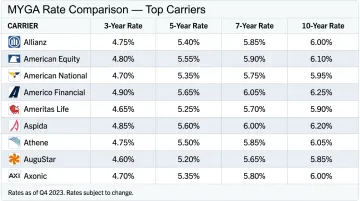
To illustrate current rates: as of May 2026, top MYGA rates ranged from approximately 5.55% for 3-year terms to 6.30–6.50% for 5- and 7-year terms, according to ImmediateAnnuities.com and Blueprint Income. These rates vary by carrier, term, and minimum premium, so comparing quotes across carriers is worth the effort.
Fixed Annuities vs. Fixed Indexed Annuities
This distinction trips up many buyers. Fixed annuities (MYGAs) have a contractually guaranteed rate — no index, no caps, no participation rates, no moving parts. The number in your contract is the number you get.
Fixed indexed annuities (FIAs) link growth to a market index like the S&P 500. They can earn more in strong markets but involve crediting formulas — caps, participation rates, spreads — that affect actual returns. They're a different product solving a different problem.
Liquidity and Surrender Charges
Most fixed annuities allow 10% of contract value per year in penalty-free withdrawals. Beyond that, withdrawals during the surrender period trigger charges — a typical 10-year schedule might run 9-8-7-6-5-4-3-2-1-0%, declining each year. Shorter terms come with shorter surrender schedules.
Early withdrawal before age 59½ may also trigger a 10% IRS penalty on the taxable portion, per IRS Topic 410.
When Fixed Annuities Make Sense
MYGAs are a strong fit for pre-retirees who want to grow money safely while deferring taxes. A federal employee five to seven years from retirement, for instance, might roll a portion of savings into a 5- or 7-year MYGA to lock in a competitive guaranteed rate.
When the contract matures near retirement, those funds can convert to an income annuity or be taken as systematic withdrawals — depending on income needs at that time. Used this way, the MYGA functions as a principal-protected growth layer alongside TSP holdings, filling a gap the TSP's fund lineup doesn't address.
Which One Is Right for You?
Start with one question: Are you still building savings, or do you need income now?
That single question eliminates most of the confusion.
Choose an income annuity if you:
- Are retired or within one to two years of retirement
- Have a specific income gap to fill between Social Security, pension, and monthly expenses
- Want guaranteed income you cannot outlive
- Are concerned about longevity risk and want to remove that uncertainty from part of your portfolio
Choose a fixed annuity if you:
- Are still working or 3–10 years from retirement
- Want to grow funds safely without market risk
- Need flexibility to access money before committing to an income stream
- Are looking for a CD alternative with tax deferral and better rates
Can You Use Both?
Yes, and many retirees do. A fixed annuity accumulates funds during the pre-retirement years, and at retirement, some or all of those funds convert into an income annuity. This sequencing captures both guaranteed growth during accumulation and guaranteed income during distribution.
This approach is called annuity laddering — stacking accumulation and income vehicles with staggered activation dates to balance liquidity with long-term income certainty. Ken Orenstein at Brokerage Consulting builds these strategies regularly for clients in the pre-retirement and early retirement window.
For federal employees, the interaction between FERS pension, TSP distributions, and Social Security timing makes this decision especially nuanced. The right sequencing depends on when you claim Social Security, how much your FERS pension covers, and what income gap remains.
A personalized retirement income plan that maps all four income layers — Social Security, pension, annuities, and portfolio — gives you the clearest picture of which product fits where. A no-cost consultation is a practical starting point.
Conclusion
Income annuities and fixed annuities are not interchangeable. They solve different problems at different stages of retirement. Income annuities are distribution tools — they turn savings into a paycheck. Fixed annuities are accumulation tools — they grow savings safely until you're ready to use them.
Neither is the right choice for everyone. The right fit depends on your timeline, flexibility needs, and the gaps in your retirement income plan. Before committing to either product, evaluate your full picture:
- Social Security income and projected start date
- Pension or FERS benefit amount
- TSP balance and distribution strategy
- Other savings and income sources
Working with an advisor who understands both the product mechanics and your retirement timeline helps you match the right tool to the right goal. A no-cost consultation with Ken Orenstein at Brokerage Consulting can clarify which option fits your plan — and when.
Frequently Asked Questions
What is the main difference between an income annuity and a fixed annuity?
Income annuities convert a lump sum into guaranteed periodic payments, starting immediately or at a future date; they're designed as distribution tools. Fixed annuities grow money at a guaranteed interest rate during an accumulation phase, and income only begins when the owner decides to convert or withdraw funds.
Can I have both an income annuity and a fixed annuity?
Yes. Many retirees use both in sequence, accumulating funds in a fixed annuity during pre-retirement years and then converting those funds to an income annuity at retirement. This captures guaranteed growth before retirement and guaranteed lifetime income after.
Are income annuities and fixed annuities both protected from market losses?
Both types protect principal from market downturns since neither invests directly in equities. The key difference is how returns are generated: fixed annuities credit a contractually guaranteed interest rate, while income annuities convert principal into payment streams backed by the insurer's claims-paying ability.
What happens to my money if I die before collecting all my payments?
For income annuities, it depends on the payout option: period-certain or joint-and-survivor structures can continue payments to beneficiaries. For fixed annuities, the remaining account value typically passes to named beneficiaries per the contract terms.
Do fixed annuities and income annuities have the same tax treatment?
Both grow tax-deferred, and distributions are taxed as ordinary income upon withdrawal. Early withdrawals before age 59½ may also trigger an additional 10% IRS penalty on the taxable portion, unless an exception applies.
Which annuity type is better for federal employees nearing retirement?
Federal employees often benefit from both: a fixed annuity (MYGA) can complement TSP growth before retirement, while an income annuity can fill the gap between a FERS pension, Social Security, and monthly expenses. The right fit depends on individual income needs, timing, and how those income sources interact.