
The numbers behind this market are substantial. Americans held $2.9 trillion in individual annuity reserves at year-end 2023, according to the American Council of Life Insurers. And in 2024, U.S. retail annuity sales hit a record $434.1 billion — up 13% year over year, per LIMRA.
Yet ownership remains surprisingly low: just 1 in 5 pre-retirees currently holds an annuity. Part of the gap is knowledge. Most annuity holders understand that growth is "tax-deferred" but have only a surface-level grasp of what that actually means inside their contract — how interest gets credited, what accelerates it, and what quietly erodes it.
That gap leads to poor product selection, missed planning opportunities, and sometimes costly mistakes at withdrawal. This guide explains the mechanics in plain terms.
Key Takeaways
- Interest inside a deferred annuity grows tax-deferred with no annual tax drag until withdrawal.
- The "triple compounding" effect means you earn interest on your principal, on prior interest, and on money that would have gone to the IRS each year.
- Interest crediting method depends on annuity type: fixed annuities use a declared rate; variable annuities use sub-account unit values; fixed index annuities use an index-linked formula with a 0% floor.
- Early withdrawals can trigger surrender charges, IRS penalties, and immediate taxation of earnings — disrupting years of compound growth.
- At withdrawal, all accumulated earnings are taxed as ordinary income, not at the lower capital gains rate.
What Is a Deferred Annuity?
A deferred annuity is an insurance contract. You pay one or more premiums to an insurance company, those funds grow during an accumulation period, and the contract eventually converts into income payments at a future date — usually at retirement.
The Two-Phase Structure
Accumulation phase: Funds grow tax-deferred inside the contract. You owe no taxes on earnings as they accumulate.
Payout phase: You begin receiving distributions, either as periodic income or lump-sum withdrawals. This is when taxation occurs.
This structure contrasts directly with an immediate annuity (or SPIA), which skips accumulation entirely and begins paying income within 30 days of purchase. Deferred annuities are built for pre-retirees who want to build a guaranteed income base before they actually need the income.
Three Types, Three Crediting Methods
A deferred annuity is not a savings account, a CD, or a life insurance policy — a point of confusion worth addressing directly. It is an insurance contract governed by state insurance law.
The three main types differ primarily in how interest accumulates:
| Type | How Interest Is Credited | Principal Protection |
|---|---|---|
| Fixed Annuity | Declared rate, credited annually | Yes |
| Variable Annuity | Sub-account unit value fluctuation | No |
| Fixed Index Annuity (FIA) | Index-linked formula, 0% floor | Yes (from market loss) |
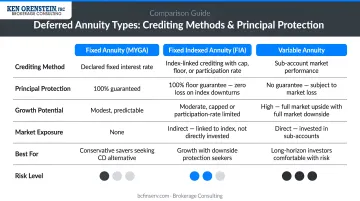
Each crediting method carries different tradeoffs in growth potential, risk exposure, and income predictability — which the next section covers in detail.
The Tax-Deferred "Triple Compounding" Advantage
What Tax Deferral Actually Does
In a taxable savings account or CD, interest earned each year is reported to the IRS and taxed at your ordinary income rate. That reduces the balance available to compound in year two, and every year after.
Inside a deferred annuity, none of that happens. All earnings stay in the contract, compounding on the full balance — year after year.
The Three Layers of Compounding
This is what financial advisors call "triple compounding":
- Interest on your original principal — the baseline growth every account earns
- Interest on previously accumulated interest — standard compounding
- Interest on the money that would have gone to the IRS — the layer that's unique to tax-deferred accounts
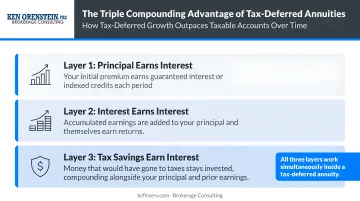
That third layer is the one most people overlook. Consider a hypothetical: $100,000 earning 5% annually over 20 years. In a taxable account (assuming a 24% tax rate applied each year), the annual tax drag reduces net compounding every single year.
Inside a deferred annuity at the same rate, the full balance compounds without interruption. Over two decades, the difference in accumulated value can be substantial — and it widens the longer the deferral period extends.
Note: This is a hypothetical illustration only. Actual results depend on interest rates, tax rates, and contract terms. Consult a qualified advisor before making product decisions.
Why Time Is the Critical Variable
The advantage grows with time — not linearly, but exponentially. At year five, the benefit is modest. At year 20, it's substantial. Deferred annuities are particularly effective for individuals in their 40s and 50s who have a decade or more before retirement — the math rewards patience.
That's the pattern Ken Orenstein sees in practice at Brokerage Consulting: pre-retirees aged 55–68 using the deferral window to build and lock in a guaranteed income rider that activates at retirement — letting that rider's income base compound through the remaining accumulation years.
What Tax Deferral Does Not Mean
Tax deferral is not tax elimination. When withdrawals begin, accumulated earnings are taxed as ordinary income — per IRS Rev. Proc. 2023-34, rates range from 10% to 37% depending on your bracket. That's a real contrast to what you'd owe in a taxable brokerage account:
- Ordinary income (annuity withdrawals): 10%–37%
- Long-term capital gains (taxable account, 1+ year hold): 0%, 15%, or 20%
Whether that trade-off makes sense depends on your current versus expected future tax bracket — a calculation worth working through before committing to the product.
How Interest Accumulates by Annuity Type
Fixed Annuities: The Declared Rate Method
A fixed annuity works much like a CD. The insurance company declares a guaranteed interest rate for a set contract term — commonly 1 to 7 years for Multi-Year Guaranteed Annuities (MYGAs). Interest is credited annually, and in most modern contracts, it compounds: earned interest joins the principal and begins earning interest itself in subsequent years.
When the guarantee period ends, the carrier sets a new renewal rate based on current market conditions. Per the NAIC Buyer's Guide for Fixed Deferred Annuities, every contract specifies a minimum guaranteed interest rate that the renewal rate cannot fall below — providing a contractual floor on future accumulation.
For conservative savers, fixed annuities offer a straightforward value:
- Predictable, stable growth with no exposure to market volatility
- A contractual minimum rate floor — regardless of what the market does
- Simple compounding mechanics that are easy to project over time
- Term flexibility: MYGAs are available in 3-, 5-, 7-, and 10-year terms, with rate differentials between term lengths shifting based on yield curve conditions
Total 2024 MYGA sales reached $156.3 billion, per Wink — driven largely by retirees and pre-retirees who prioritize certainty over growth potential.
Variable Annuities: Accumulation Units and Sub-Accounts
Variable annuities don't credit "interest" in the traditional sense. Premiums buy accumulation units in sub-accounts that function like mutual funds — stock funds, bond funds, money market options, and more. Unit values fluctuate daily based on underlying market performance.
Account value grows in two ways:
- Contributing additional premiums (buying more units)
- Existing units increasing in value when markets rise
One important caveat: Mortality and Expense (M&E) charges are deducted daily from unit values. The SEC's investor guide uses 1.25% as a standard example, and all-in costs (M&E plus sub-account expenses plus any living benefit rider fees) can exceed 3% annually in many contracts.
Unlike fixed or indexed annuities, variable annuities provide no principal guarantee. A sustained market downturn during accumulation can reduce account value below what was originally contributed. Ken Orenstein typically recommends variable annuities for clients with higher risk tolerance who already have a guaranteed income base in place from other sources.
Fixed Index Annuities: Benchmark-Linked Crediting
A Fixed Index Annuity (FIA) does not invest directly in the market. Instead, it credits interest based on the performance of an external index — commonly the S&P 500 — using a formula. The defining protection feature: in years where the index is negative, the interest credit is 0%, not negative. Principal doesn't shrink due to market performance.
Three "crediting levers" determine how much of the index gain actually flows into your account:
| Lever | How It Works | Example (10% Index Gain) |
|---|---|---|
| Cap Rate | Maximum credit regardless of index performance | 6% cap → you receive 6% |
| Participation Rate | Percentage of the index gain you keep | 65% participation → you receive 6.5% |
| Spread | Percentage deducted before crediting | 2% spread → you receive 8% |
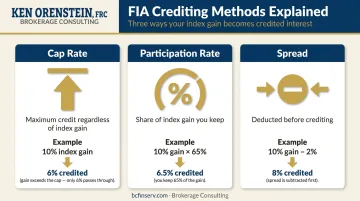
The trade-off is straightforward: FIAs offer more growth potential than fixed annuities and downside protection compared to variable annuities, but caps, participation limits, and spreads mean you never capture the full upside of a strong market year. FIA sales hit $126.9 billion in 2024 — up 32% and a third consecutive record year — making it the fastest-growing annuity category among retirement savers seeking that balance.
What Disrupts the Accumulation Process
The LIFO Tax Rule
The IRS applies a Last-In, First-Out rule to non-qualified deferred annuity withdrawals before the annuity starting date. Practically, this means the IRS treats withdrawals as coming from earnings first, not principal. Any partial withdrawal during accumulation triggers an immediate taxable event on those earnings, reducing the compounding base and slowing wealth accumulation from that point forward.
Surrender Charges
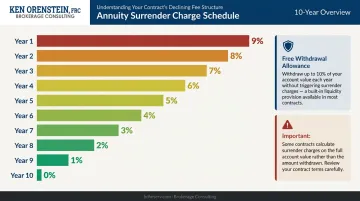
Most deferred annuity contracts impose a declining penalty schedule for withdrawals beyond the free withdrawal allowance. Per the NAIC Buyer's Guide, surrender periods typically run 5 to 10 years, with charge percentages declining each year until reaching zero.
A typical declining schedule might look like: 9-8-7-6-5-4-3-2-1-0% over 10 years. Many contracts allow a free withdrawal of up to 10% of account value per year without triggering the charge.
One detail many contract holders miss: surrender charges in some contracts are calculated on the full account value, not just the amount withdrawn. That means a large, unplanned withdrawal near the start of the surrender period can cost significantly more than the percentage implies.
The IRS 10% Early Withdrawal Penalty
Withdrawals taken before age 59½ carry an additional 10% federal tax penalty on the taxable portion — on top of ordinary income taxes already owed. Per IRS Publication 575, exceptions include:
- Disability or terminal illness
- Substantially equal periodic payments (72(t) distributions)
- Certain distributions to beneficiaries
For most pre-retirees, though, early access to annuity funds is expensive on multiple fronts: income taxes, the 10% penalty, and lost compounding all hit simultaneously.
Tax Treatment of Accumulated Earnings at Withdrawal
Ordinary Income, Not Capital Gains
All interest accumulated inside a non-qualified deferred annuity is taxed as ordinary income when distributed — not at long-term capital gains rates. For a retiree in the 22% or 24% bracket, this distinction matters: qualified dividends and long-term gains from a brokerage account might be taxed at 15%, while the same dollar of annuity income could cost 7–9 percentage points more.
This doesn't make annuities the wrong choice — the compounding advantage during accumulation can more than offset that difference. But it's a real trade-off worth running the numbers on before you commit.
The Exclusion Ratio for Annuitized Payments
When a non-qualified annuity is annuitized (converted to a stream of regular payments), each payment is a blend of taxable gain and tax-free return of principal. The IRS exclusion ratio formula — investment in the contract divided by expected return — determines what percentage of each payment is tax-free.
For lump-sum withdrawals, the LIFO (last-in, first-out) rule applies instead. That means earnings come out before principal, so you pay taxes on gains first and recover your cost basis last.
Qualified vs. Non-Qualified: A Common Source of Confusion
This distinction trips up many annuity holders:
- Qualified annuity (funded with pre-tax dollars inside an IRA, 403(b), or TSP rollover): All distributions are fully taxable, because no taxes were paid on contributions.
- Non-qualified annuity (funded with after-tax dollars): Only the earnings portion is taxable. Your original principal comes back tax-free.
This matters especially for federal employees who roll TSP assets into an IRA-based annuity — every dollar distributed will be taxable, matching how pre-tax TSP contributions are eventually treated. Knowing which bucket your annuity falls into upfront shapes both your withdrawal strategy and your broader retirement tax plan.
Frequently Asked Questions
How do interest earnings accumulate in a deferred annuity for tax purposes?
During the accumulation phase, all earnings grow without annual taxation — no IRS reporting or tax payments required on growth. When withdrawals begin, accumulated earnings are taxed as ordinary income, and the LIFO rule ensures earnings are distributed and taxed before principal is touched.
How does interest accrue in a deferred annuity?
The accrual method depends on the annuity type. Fixed annuities credit a declared rate annually; variable annuities accrue value through daily sub-account unit fluctuations. Fixed index annuities accrue interest based on external index performance, subject to cap, participation rate, and spread limits.
What is "triple compounding" in a deferred annuity?
Triple compounding means earning interest on your original principal, previously accumulated interest, and the money that would otherwise go to the IRS each year in a taxable account. All three components stay invested and compound throughout the accumulation phase.
Can you lose money in a deferred annuity?
Fixed and fixed index annuities protect principal from market losses (FIAs carry a 0% floor on index-linked credits). Variable annuity sub-accounts are subject to market risk and can decline in value. All types carry the risk of reduced value from surrender charges and early withdrawal penalties.
What happens to accumulated interest if you make an early withdrawal?
Withdrawals beyond the free withdrawal allowance can trigger surrender charges from the insurer and a 10% IRS penalty for those under 59½. Under LIFO rules, earnings are distributed first — meaning your accumulated growth is the first money subject to ordinary income tax.
How does a fixed deferred annuity differ from a CD in terms of interest accumulation?
Both offer a fixed rate for a set term, but CD interest is taxed annually as earned, reducing compounding each year, while fixed annuity interest accumulates tax-deferred until withdrawal. Fixed annuities may also offer higher rates, though they typically carry longer surrender periods than CDs.
Conclusion
A deferred annuity's accumulation power comes from two forces working together: tax deferral and compounding. Understanding which crediting mechanism applies to your contract (declared rate, sub-account units, or index-linked formula) is essential for accurately projecting what that contract will actually deliver at retirement.
Knowing how your annuity earns interest — and what can disrupt it — shapes every decision that follows: product selection, withdrawal timing, and how the contract fits alongside your other retirement income sources.
For federal employees and individuals who want personalized guidance, Ken Orenstein at Brokerage Consulting works with clients to structure deferred annuities around their full retirement picture. That can include:
- Coordinating annuity income with FERS pension timing
- Evaluating TSP rollover strategy before and after separation
- Aligning Social Security claiming decisions with guaranteed income start dates
A no-cost initial consultation is available by phone, virtual, or in-person at (888) 315-3608.