
Introduction
44% of retirees spend less than they could because they fear running out of money, according to the 2025 EBRI Retirement Confidence Survey. Another 31% name "outliving my savings" as their greatest retirement fear. Those numbers reflect something real: most Americans no longer have a traditional pension to fall back on, and Social Security alone rarely covers the gap.
Deferred annuities directly address this problem. Think of them as a privately arranged pension — a contract with an insurance company where your money grows tax-deferred during an accumulation phase, then converts into a guaranteed income stream at a future date you choose.
That "future date" is what separates a deferred annuity from an immediate annuity, which starts paying within weeks of purchase. With a deferred annuity, you're trading some flexibility today for contractually guaranteed income later.
This guide covers how deferred annuities work, the main types available, how they're taxed, and what to watch for before signing a contract — so you can decide whether one belongs in your retirement income plan.
TLDR: Key Takeaways
- A deferred annuity has two phases: accumulation (tax-deferred growth) and payout (income begins at retirement)
- Fixed, variable, and fixed indexed annuities each carry different risk and return profiles
- Withdrawals before age 59½ trigger a 10% IRS penalty plus ordinary income tax on gains
- Expect surrender charges for several years if you exit the contract early
- Best suited for long-term retirement planning, not short-term savings or near-term liquidity needs
What Is a Deferred Annuity and How Does It Work?
A deferred annuity operates in two distinct phases, and understanding both is essential before committing to one.
The Accumulation Phase
During accumulation, you make premium payments — either a single lump sum or ongoing flexible payments — and your money grows tax-deferred inside the contract. You don't owe income tax on any gains until you actually withdraw funds. This allows compound growth to work on a larger pre-tax balance over time, which compounds noticeably over a 10–20 year horizon.
Two common funding structures exist:
- Single premium — a one-time lump sum, often used after selling a business, property, or receiving an inheritance
- Flexible premium — ongoing periodic contributions, similar to funding a retirement account over time
The Payout Phase
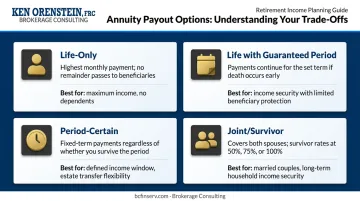
When you're ready to receive income, the contract transitions to the payout phase. At that point, you choose how payments are structured:
- Life-only — highest monthly payout, but payments stop at death with nothing left for beneficiaries
- Life with guaranteed period — payments continue for a set number of years even if you die early
- Period-certain — income for a fixed term regardless of whether you're alive
- Joint/survivor — income continues for both you and a spouse, with survivor percentages typically set at 50%, 75%, or 100% of the original payment
Each structure involves a trade-off between income level and what passes to heirs. Life-only produces the largest monthly payment; joint/survivor options cost more but protect a surviving spouse.
Optional Riders and the Deferred vs. Immediate Distinction
Many deferred annuities offer income riders — such as a Guaranteed Minimum Income Benefit (GMIB) or Guaranteed Lifetime Withdrawal Benefit (GLWB) — that lock in a future income amount regardless of account performance. These can be valuable, but they come at an added annual cost, often 0.5%–1.5% of the income base, which must be weighed against the guarantee's value.
Riders aside, it's also worth distinguishing the deferred annuity from its counterpart: a deferred annuity delays income and includes an accumulation period, while an immediate annuity (SPIA) requires a single lump sum and begins payouts within roughly a month of purchase. If you need income now rather than later, a SPIA may be the better fit.
Types of Deferred Annuities
Fixed Deferred Annuity
A fixed deferred annuity guarantees a specific minimum interest rate on your contributions. Your principal is protected, and the income payments you'll eventually receive are predictable regardless of what markets do. According to NAIC, fixed annuities guarantee earnings at least at the minimum rate stated in the contract.
This is the most straightforward option — no market exposure, no complexity around crediting methods. Fixed-rate deferred annuity sales hit $164.9 billion in 2023, more than triple their 2021 level, driven largely by clients seeking predictability and safety in an uncertain rate environment.
Variable Deferred Annuity
Variable annuities tie returns to a portfolio of investment sub-accounts — mutual fund-like options spanning stocks, bonds, and money market instruments. If those sub-accounts perform well, your account value grows faster. If they decline, your balance drops. All gains remain tax-deferred, but the risk of loss is real and disclosed prominently by FINRA.
Fees are the other key consideration. Variable annuities carry the highest costs among deferred annuity types — the SEC reports the mortality and expense (M&E) risk charge alone is often around 1.25% per year, and total all-in expenses can exceed 3% annually once administrative fees and rider costs are added. These products suit clients who already have a guaranteed income base and want to use an annuity as a supplemental growth vehicle.
Fixed Indexed Annuity
A fixed indexed annuity (FIA) sits between fixed and variable in terms of risk. Growth potential is linked to a market index — commonly the S&P 500 — but your principal is protected from direct market losses. The insurer also credits a minimum guaranteed interest rate, giving you a floor even in down years.
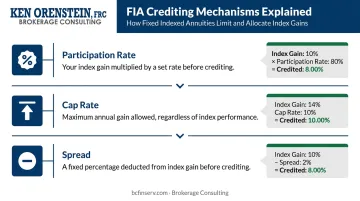
The upside is real but capped. Three crediting mechanisms control how much of the index gain you actually receive:
- Participation rates: you capture a set percentage of the index gain (e.g., 80%)
- Cap rates: gains are capped at a maximum annual ceiling (e.g., 10%)
- Spreads: a fixed percentage is subtracted from the index gain before crediting
LIMRA reported $126.9 billion in FIA sales in 2024, up 32% and a record for the third consecutive year — reflecting strong demand from clients wanting growth potential without direct market exposure.
Deferred Income Annuity (DIA)
Unlike the other three types, a DIA has no tracked account value or investment sub-account. You pay a premium today and lock in a guaranteed income stream starting at a specific future date — often a decade or more away. The insurer simply promises a set monthly payment beginning on your elected date.
This structure makes DIAs particularly effective as longevity insurance. A 60-year-old who wants guaranteed income starting at 80 can fund that at a fraction of the cost of other vehicles. A specialized version — the Qualified Longevity Annuity Contract (QLAC) — can be purchased inside an IRA or 401(k). QLAC premiums up to the IRS-set limit of $200,000 (indexed for inflation) are excluded from Required Minimum Distribution calculations, making them a practical tool for clients with RMD exposure.
How Deferred Annuity Taxation Works
The core tax advantage is straightforward: earnings inside a deferred annuity grow without being taxed each year. You don't pay income tax on gains until withdrawals or payouts begin. This allows the full pre-tax balance to compound over time — a meaningful advantage over taxable accounts during long accumulation periods.
Qualified vs. Non-Qualified Annuities
How withdrawals are taxed depends on how the annuity was funded:
| Annuity Type | Funded With | What's Taxed at Withdrawal |
|---|---|---|
| Qualified | Pre-tax dollars (IRA, 401k) | 100% of withdrawals (principal + earnings) |
| Non-qualified | After-tax dollars | Earnings only; principal comes out tax-free |
Per IRS Publication 575, taxable annuity amounts are generally taxed as ordinary income — not at capital gains rates. That distinction matters: if you're in a higher tax bracket, ordinary income rates can noticeably affect how much of each payout you keep.
Early Withdrawal Penalty
If you withdraw funds before age 59½, the IRS imposes a 10% additional tax on the taxable portion of the distribution, on top of ordinary income tax owed. This mirrors the same penalty applied to IRAs and 401(k)s — a strong signal that deferred annuities are designed for long-term retirement planning, not short-term savings.
Surrender Charges
Separate from IRS penalties, insurance companies impose their own surrender charges if you withdraw a large sum or cancel the contract within the surrender period. These charges decline gradually over time and eventually reach zero — but the timeline varies by product. For variable annuities, the SEC notes surrender periods of 6–10 years are common.
Money placed in a deferred annuity should be funds you won't need access to for years.
Advantages and Disadvantages of Deferred Annuities
Deferred annuities offer meaningful retirement planning benefits, but they come with real trade-offs. Understanding both sides helps you decide whether one belongs in your income strategy.
Key Advantages
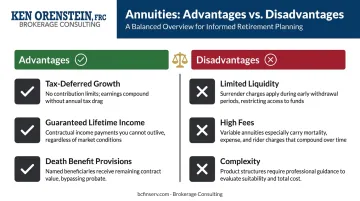
- Tax-deferred growth with no contribution limits — unlike IRAs or 401(k)s, deferred annuities don't cap annual contributions, making them useful for high earners who've already maxed out other tax-advantaged accounts
- Guaranteed lifetime income — the payout phase eliminates longevity risk; the insurer makes payments for as long as you live
- Death benefit provisions — many contracts pass remaining account value to named beneficiaries, adding an estate planning element
Key Disadvantages
The trade-offs are real and worth weighing carefully before committing to a contract.
- Limited liquidity — surrender charges and withdrawal restrictions make funds hard to access in emergencies; most contracts allow only a 10% penalty-free withdrawal per year
- Fees — variable annuities carry administrative, M&E, and rider costs that can cut into net returns over time
- Complexity — variable and fixed indexed contracts are layered documents; understanding cap rates, participation rates, and rider mechanics typically requires professional guidance
Is a Deferred Annuity Right for You?
The ideal candidate is someone with a long time horizon before retirement who wants guaranteed income beyond what Social Security and a 401(k) will provide. This is especially true for federal employees — FERS pension holders who already have Layer 1 (Social Security) and Layer 2 (FERS Basic Benefit) in place but want to add a third layer of contractually guaranteed income.
Ken Orenstein at Brokerage Consulting works specifically with federal employees and pre-retirees to build this kind of layered income architecture. For clients aged 55–68 still working, a deferred annuity with a guaranteed income rider can lock in future income today — with roll-up rates (5%, 6%, or 7% annually) accumulating the income base during the deferral period. The longer the deferral, the larger the eventual guaranteed paycheck.
Deferred annuities may not be the right fit if:
- You may need liquidity in the near term
- You haven't yet maxed out your IRA or 401(k) contributions
- You're already retired and need income now — a SPIA or DIA may be more appropriate
- You're placing funds in a qualified account (IRA/401k) where tax deferral already exists, making the annuity's added costs harder to justify unless the guaranteed income features are specifically needed
If you're uncertain where you fall, a conversation with an independent broker can clarify the decision quickly. As an independent broker representing carriers including Aetna, Humana, and TransAmerica, Ken Orenstein compares roll-up rates, payout multipliers, surrender schedules, and carrier financial strength ratings across the full market rather than a single company's lineup. No-cost consultations are available by phone, virtually, or in person at (888) 315-3608 or via bcfinserv.com.
Frequently Asked Questions
How does a deferred annuity work?
A deferred annuity has two phases: during accumulation, you make premium payments and your money grows tax-deferred inside the contract. At a future date you choose, the payout phase begins and the insurer makes regular income payments — structured as lifetime, joint-life, or period-certain depending on your election.
How much will a $100,000 deferred annuity pay per month?
Monthly payments depend on your age at payout, deferral period, current interest rates, annuity type, and payout option. A 65-year-old selecting life-only payments will receive more per month than someone electing joint-life coverage. An annuity illustration from a financial advisor will give you a precise figure based on your contract terms.
How do tax-deferred annuities work?
Earnings inside the annuity compound without being taxed each year. Taxes are owed only when money is withdrawn or payouts begin, at which point gains are taxed as ordinary income. For non-qualified annuities, only the earnings are taxable; the after-tax principal comes out tax-free.
What is a deferred annuity IRA?
A deferred annuity held inside an IRA is a qualified annuity: contributions use pre-tax dollars, and all withdrawals (principal plus earnings) are taxed as ordinary income. Because the IRA already provides tax deferral, the annuity's other features (guaranteed lifetime income, income riders) must justify any added costs.
What are the advantages and disadvantages of deferred annuities?
The main advantages are tax-deferred growth with no contribution limits, guaranteed lifetime income, and death benefit provisions. The key drawbacks are limited liquidity during the surrender period, fees (especially in variable annuities), and complexity that typically requires professional guidance to navigate effectively.
What is the difference between a DIA and a SPIA?
A DIA (Deferred Income Annuity) locks in a guaranteed income stream starting at a future date you choose at purchase, making it well-suited for those guarding against longevity risk. A SPIA (Single Premium Immediate Annuity) begins payouts within about a month of a lump-sum purchase, designed for retirees who need income immediately.