One strategy that addresses all three issues simultaneously: a Roth IRA conversion paired with a fixed index annuity (FIA). This article explains how the combination works, when it makes sense, how to execute it without costly mistakes, and what risks to evaluate before committing.
Key Takeaways
- A Roth conversion moves pre-tax IRA dollars into a tax-free Roth account — pairing it with an FIA adds principal protection and guaranteed lifetime income
- Roth IRAs have no lifetime RMD requirement for the original owner — eliminating future mandatory taxable distributions
- Multi-year, bracket-targeted partial conversions are usually more tax-efficient than converting everything at once
- The IRS values annuity contracts at fair market value — not cash surrender value — when converted, which can affect your tax bill
- Surrender charges, liquidity needs, and the 5-year rule must be evaluated before acting
What Is a Fixed Index Annuity Roth Conversion?
The Two Components
A Roth IRA conversion is the act of moving money from a traditional (pre-tax) IRA to a Roth IRA and paying ordinary income tax on the converted amount in the year it occurs. Once inside the Roth and after qualified distribution rules are met, growth and withdrawals are federal income tax-free.
A fixed index annuity is an insurance contract that credits interest tied to the performance of a market index — typically the S&P 500 — without directly exposing your principal to market losses. Credited interest is subject to caps, participation rates, or spreads set by the insurer.
How the Combination Works
Once you complete a conversion, those Roth dollars can be placed inside an FIA contract held within the Roth IRA. Interest credited during the accumulation phase grows inside the Roth structure. If qualified distribution requirements are met — the account owner is 59½ and the Roth has been open at least five years — all growth and withdrawals are tax-free.
One important clarification: the FIA is not required to do a Roth conversion. It's simply one vehicle for holding converted funds. The conversion is a tax decision made independently of the product chosen afterward.
The IRS Fair Market Value Rule
When an annuity contract itself — not just the cash value — is converted from a traditional IRA to a Roth IRA, the IRS requires the taxable amount to be based on the contract's fair market value, not its cash surrender value.
Per the final IRS regulations published July 29, 2008 (T.D. 9418), fair market value may be determined using actuarial methods that account for income riders, death benefits, and other contract features — all of which can exceed the surrender value substantially.
The regulations were specifically designed to prevent two abuses:
- Converting immediately after purchase to claim only a surrender-reduced cash value
- Stripping account value to inflate death benefit amounts before converting
In both cases, the IRS taxes the higher fair market value — not the depressed surrender amount. Always request written fair market value documentation from your carrier before executing any in-contract conversion.
Why Pair an FIA with a Roth Conversion?
Three Planning Goals, One Strategy
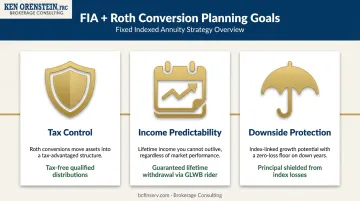
The FIA + Roth conversion combination addresses three retirement planning objectives at once:
- Tax control — future distributions become federal income tax-free once qualified distribution rules are satisfied
- Income predictability — an optional income rider (GLWB or GMIB) creates a guaranteed lifetime withdrawal benefit that arrives tax-free as a qualified Roth distribution
- Downside protection — the FIA shields principal from index losses, which matters for clients who want market-linked growth without taking market-level risk
Eliminating Lifetime RMDs
Roth IRAs have no lifetime RMD requirement for the original account owner. Converting pre-tax dollars to Roth reduces your future RMD burden proportionally. When those converted dollars are held in an FIA, the accumulation phase creates no RMD obligation. If income is eventually needed, it arrives as a tax-free qualified Roth distribution rather than a taxable mandatory withdrawal.
For federal employees or anyone carrying a large TSP or traditional IRA balance into their 70s, eliminating that mandatory withdrawal obligation is one of the most durable long-term benefits this strategy offers — and it connects directly to how the income piece works.
The "Tax-Free Pension" Concept
According to BlackRock's 2025 Read on Retirement survey, 86% of savers want guaranteed income, and 28% of retirees worry about maintaining steady monthly income — up from just 16% in 2020. An FIA with an income rider addresses this directly.
A GLWB rider inside a Roth IRA can function as a private pension: a guaranteed lifetime income stream that, once qualified, is federal income tax-free regardless of how much you ultimately receive over a lifetime.
The mechanics work through an income base separate from account value. Roll-up rates — commonly 5% to 7%, simple or compound depending on the contract — accumulate during the deferral period. Payout multipliers then determine the eventual income amount (for example, 5% of the income base at age 65, rising to 6% at age 70).
The IRMAA Complication
Converting too much in a single year can push your modified adjusted gross income (MAGI) above IRMAA thresholds, triggering Medicare premium surcharges two years later. For 2025, Part B IRMAA begins above $106,000 single / $212,000 married filing jointly, adding $74 to $443.90 per month to your premium depending on income tier.
The two-year lookback is the critical detail: a large 2025 conversion affects 2027 Medicare premiums. This is why sizing each year's conversion to stay within a specific bracket — and below the IRMAA threshold — is central to effective planning.
How to Execute the Conversion: Sequencing and Strategy
Identify Your Optimal Conversion Window
The most tax-efficient window for most households is the gap between full retirement and the point when Social Security is claimed and RMDs begin. During this period, taxable income may be lower than during working years and lower than it will be once mandatory distributions start.
Federal employees are a particularly relevant example. Many retire in their late 50s or early 60s under FERS with a pension, but face rising taxable income once TSP RMDs begin at 73 or 75. The years between retirement and RMD onset are often ideal for Roth conversion, particularly when Social Security claiming is also deferred.
EBRI's 2025 Retirement Confidence Survey found that retirees' median actual retirement age was 62, even though workers expected to retire at 65. That gap means many people have a longer conversion window than they originally planned for.
Choose the Right Conversion Sequencing Approach
Three approaches exist, each with different tax implications:
| Method | What Happens | Key Tradeoff |
|---|---|---|
| Convert first, then buy the FIA | Convert IRA cash to Roth, then purchase the FIA inside the Roth account | Cleanest bracket control; tax is based on IRA value before any annuity bonus applies |
| Buy the FIA first, then convert | Purchase FIA inside the traditional IRA, then convert the contract to Roth | The FIA's fair market value — including any bonus appreciation — becomes the taxable conversion amount |
| Multi-year partial conversions | Convert a targeted dollar amount each year across several years | Best for large pre-tax balances; spreads tax liability and fills bracket space intentionally |
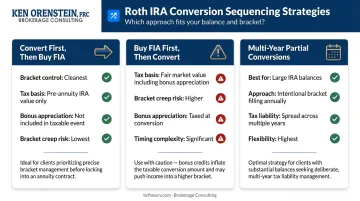
The "buy first, then convert" approach is where the most costly mistakes occur. A premium bonus that adds 10% to the contract value also adds 10% to the taxable conversion amount, potentially pushing income into a higher bracket.
The Liquidity Prerequisite
Pay conversion taxes from non-qualified savings held outside the IRA. This keeps the full converted amount inside the Roth, compounding tax-free. Using IRA dollars to cover the tax reduces the benefit of converting.
Before funding an FIA, confirm you have adequate liquidity outside the annuity. Key prerequisites include:
- Non-qualified cash reserves sufficient to cover conversion taxes at the time of conversion
- Liquid emergency funds that cover living expenses for the full surrender period — typically 5–10 years depending on the contract
- No anticipated need to access the annuity principal before the surrender period ends, to avoid surrender charges
Ken Orenstein and Brokerage Consulting provide personalized Roth conversion planning for federal employees and individuals, including multi-year conversion ladders that coordinate tax brackets, RMD projections, Social Security timing, and annuity funding. Contact Brokerage Consulting at (888) 315-3608 for a no-cost tailored assessment.
Tax Rules and Regulatory Considerations
The 5-Year Rule
Each Roth conversion starts its own 5-year clock beginning January 1st of the conversion year — not the actual conversion date. For converted amounts, the owner must wait five years before accessing those dollars penalty-free if under age 59½.
Once the account owner is 59½ and the 5-year rule is satisfied, all Roth distributions are qualified and completely tax-free — including distributions from an FIA held inside the Roth.
Reporting and the 10% Penalty Exception
Conversion income is reported in the year of conversion and included in gross income as ordinary income. The additional 10% early withdrawal penalty does not apply to Roth conversion amounts, even if the account owner is under 59½ — though the 5-year rule still applies to penalty-free access of converted amounts.
Two IRS forms are required:
- Form 1099-R — issued in the conversion year to report the converted amount
- Form 8606 — filed with your return to report the conversion and track your basis
State Tax Treatment
Most states follow the federal Roth exclusion for qualified distributions, but not all. New Jersey excludes qualified Roth distributions, while California generally conforms to federal treatment. State treatment of the conversion income itself also varies.
Always consult a qualified tax advisor before executing a conversion. Brokerage Consulting works alongside clients' tax advisors to ensure conversion plans are coordinated with their broader tax filing.
Risks, Tradeoffs, and Who This Strategy Fits
Key Risks and Tradeoffs
Surrender charges can be substantial. If an FIA in a surrender period needs to be liquidated, surrender charges — and potentially a market value adjustment — reduce the net value available. Bonus annuities frequently carry longer surrender periods and vesting schedules that recapture the bonus if the contract is surrendered early. As the NAIC Buyer's Guide to Fixed Deferred Annuities notes, surrendering too soon can trigger both charges and taxes simultaneously.
Bonuses are not free. Insurers offset premium bonuses by adjusting crediting terms — lower caps, reduced participation rates, or higher rider fees. A 10% bonus that comes with a 10-year surrender period and reduced caps may produce worse net income outcomes than a no-bonus contract with better crediting terms and a shorter surrender period. Model the full outcome across the entire surrender period — not just the headline bonus figure.
Rider fees reduce credited interest. GLWB and GMIB rider fees typically run 1.0–1.5% annually on the income base. In low-cap environments, this fee can consume a significant portion of credited interest during accumulation years.
Who Benefits Most
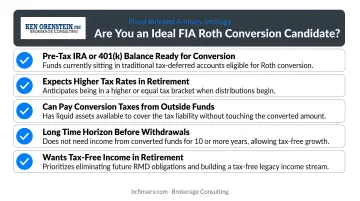
This strategy tends to produce strong results for households that meet several of these criteria:
- Meaningful pre-tax IRA, TSP, or 401(k) balance creating current or projected RMD exposure
- A retirement gap — years between full retirement and RMD onset — creating bracket-favorable conversion opportunity
- Desire for predictable, market-insulated income rather than a pure growth or total-return strategy
- Sufficient liquid assets outside the annuity to pay conversion taxes and cover living expenses through the surrender period
- A long enough time horizon before income is needed to benefit from income rider deferral mechanics
Federal employees who retire in their late 50s or early 60s — particularly those with substantial TSP balances who face RMDs starting at 73 or 75 — frequently meet several of these criteria simultaneously.
For this group, a TSP-to-IRA rollover analysis is typically the first step before evaluating a Roth conversion into an FIA. The rollover opens access to a broader range of annuity products and conversion strategies not available inside the TSP.
Frequently Asked Questions
Can I do a Roth conversion on an annuity?
Yes. An existing IRA annuity can be converted to a Roth IRA, but the taxable amount is based on the contract's fair market value — not just the cash surrender value — per IRS final regulations (T.D. 9418). A Roth conversion can also be funded into a new FIA after conversion. Confirm the specific mechanics with your carrier in writing before proceeding.
Do you pay taxes when converting a fixed index annuity to a Roth IRA?
Yes. The converted amount is treated as ordinary income in the year of conversion and reported on Form 1099-R. The 10% early withdrawal penalty does not apply to conversions, but income tax on the converted amount is due regardless of age.
What is the 5-year rule for Roth IRA conversions with an annuity?
Each Roth conversion starts its own 5-year clock beginning January 1st of the conversion year. For account owners already 59½ with a Roth open for at least five years, all distributions — including from an FIA inside the Roth — are fully tax-free qualified distributions.
Does a Roth IRA with a fixed index annuity have required minimum distributions?
No. Roth IRAs are not subject to lifetime RMDs for the original owner, including when the Roth holds an FIA. Beneficiaries who inherit a Roth generally must distribute within 10 years under SECURE Act rules, but those distributions are typically tax-free.
What happens to surrender charges during a Roth conversion of a fixed index annuity?
Surrender charges or market value adjustments may apply when an FIA is surrendered or transferred, and any bonus credited to the contract may increase the taxable fair market value. In-contract conversion — where the carrier supports it — can preserve riders and avoid surrender charges, but this is carrier- and product-specific. Confirm the details with your carrier before proceeding.
Is putting a fixed index annuity inside a Roth IRA a good strategy?
It can be a strong fit for households seeking principal protection and guaranteed tax-free income in retirement. It is not universally appropriate — surrender periods, liquidity constraints, and income rider mechanics must align with your specific timeline and financial situation.