
Introduction
Retirement income planning comes down to one uncomfortable question: will your money outlast you, or will you outlast your money?
According to Allianz's 2025 Annual Retirement Study, 64% of Americans worry more about running out of money than death — and that fear drives most of the annuities-vs.-dividend-stocks debate.
Both options solve the retirement income problem, just in opposite directions. Annuities offer guaranteed income in exchange for giving up control over your money. Dividend stocks keep your capital flexible and growing, but with no guarantee attached. Choosing the wrong one — or ignoring how they interact — can leave you overpaying in fees, losing ground to inflation, or locked out of cash when you need it most.
This article breaks down how both options work, where each one wins, and how to decide which fits your retirement picture — including specific guidance for federal employees already holding FERS pension and Social Security income.
Key Takeaways
- Annuities convert a lump-sum payment into guaranteed lifetime income, prioritizing certainty over growth.
- Dividend stocks offer regular cash income, growth potential, tax efficiency, and full liquidity — with no income guarantees.
- Annuities win on longevity protection; dividend stocks win on flexibility, lower costs, and inflation-beating potential.
- Federal employees with FERS pensions and Social Security already have a strong guaranteed income floor — which changes the annuity calculus significantly.
- Many retirees benefit from both: annuities covering essential expenses, dividend stocks funding discretionary income and growth.
Annuities vs. Dividend Stocks: A Quick Comparison
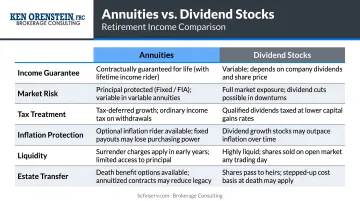
Here's how annuities and dividend stocks compare across the factors that matter most in retirement:
| Dimension | Annuities | Dividend Stocks |
|---|---|---|
| Income Reliability | Guaranteed for life (or set period), backed by insurer | Dependent on company profitability — can be cut |
| Fees | Variable annuities: layered charges often exceeding 2.5%+ | Dividend ETFs: as low as 0.04% (VIG, VYM) |
| Liquidity | Largely illiquid — surrender charges + 10% IRS penalty before age 59½ | Highly liquid — sell anytime, no penalty |
| Tax Treatment | Distributions taxed as ordinary income | Qualified dividends taxed at 0%, 15%, or 20% capital gains rates |
| Inflation Protection | Fixed payouts lose purchasing power unless inflation riders added | Many blue-chip companies grow dividends annually |
| Growth Potential | Limited (especially fixed annuities) | Both dividend income and share price can appreciate |
What Are Annuities?
An annuity is a contract with a life insurance company: you make a lump-sum payment (or series of payments), and the insurer guarantees you an income stream — either immediately or at a future date. The defining appeal is straightforward: you cannot outlive the payments.
Types of Annuities
Three main structures cover most of the market:
- Fixed annuities — pay a predetermined interest rate. Most predictable, lowest risk. Good for conservative retirees who want CD-like stability with tax-deferred growth.
- Variable annuities — returns tied to investment sub-accounts. Higher potential reward, but also higher risk, and the most expensive fee structure.
- Fixed indexed annuities (FIAs) — returns linked to a market index (like the S&P 500) with downside protection. You participate in gains up to a cap, and your principal is protected when markets fall — making FIAs a middle-ground between fixed and variable.
At Brokerage Consulting, Ken Orenstein most commonly recommends FIAs for retirees needing guaranteed income. The principal protection feature directly addresses one of the most common objections: the fear of locking into a losing position during a market downturn.
Pros of Annuities
- Longevity protection — transfers longevity risk to the insurer, so you get paid regardless of how long you live.
- Tax-deferred growth — money compounds without annual tax drag until withdrawal, accelerating growth during the years before distributions begin.
- Customizable riders — death benefit guarantees, nursing home provisions, and inflation adjustments can be added (at extra cost).
Cons of Annuities
- High, layered fees — the SEC's published example of a variable annuity fee stack: 1.25% M&E charge + 0.15% administrative fee + 0.25% death benefit rider + 0.95% sub-account expenses = 2.60% before any additional riders. FINRA notes that variable annuity expenses are "likely much higher than a typical mutual fund."
- Surrender charges and illiquidity — most contracts impose 5–10 year surrender periods. The SEC's example shows surrender charges starting at 7% in year one, declining 1% annually to zero by year seven. Early withdrawals before age 59½ also trigger a 10% IRS additional tax.
- Ordinary income taxation — annuity distributions are taxed as regular income, not at the lower capital gains rates applied to qualified dividends — a real disadvantage for retirees in higher brackets.
What Are Dividend Stocks?
Dividend stocks are shares in companies that distribute a portion of profits to shareholders — typically quarterly. Retirees can live off these payouts without selling shares, while the underlying stock can also appreciate over time.
How Dividend Stocks Generate Retirement Income
Returns come from two sources: the dividend payment (cash income) and capital appreciation (stock price growth). Many established companies offer both.
The S&P 500 Dividend Aristocrats — companies that have raised dividends for at least 25 consecutive years — are a useful benchmark. According to ProShares, Dividend Aristocrats grew their dividends at 8% annually since 2006.
Compare that to recent inflation readings: U.S. CPI hit 8.0% in 2022, 4.1% in 2023, and 2.9% in 2024. Over most periods, that 8% dividend growth rate has outpaced inflation — something fixed annuity payments cannot claim.
Dividend ETFs offer a simpler, diversified alternative to picking individual stocks. Popular options, their expense ratios, and focus areas:
| ETF | Expense Ratio | Focus |
|---|---|---|
| Vanguard VIG | 0.04% | Dividend growth |
| Vanguard VYM | 0.04% | High dividend yield |
| iShares DVY | 0.38% | High dividend yield |
| ProShares NOBL | 0.35% | Dividend Aristocrats |
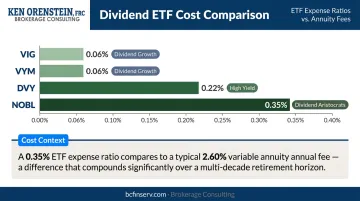
Even ProShares NOBL at 0.35% costs a fraction of a typical variable annuity's annual fee load.
Pros of Dividend Stocks
- Rising dividends naturally compensate for purchasing power erosion — unlike fixed annuity payouts, which don't adjust for inflation.
- Tax efficiency — qualified dividends are taxed at 0%, 15%, or 20%, far below ordinary income rates that apply to most annuity withdrawals. In 2025, married couples filing jointly owe 0% on qualified dividends up to $96,700 in taxable income.
- Liquidity and flexibility — you can sell shares anytime, access capital without penalty, and rebalance as your needs change.
Cons of Dividend Stocks
- Cuts can happen without warning — Walgreens slashed its quarterly dividend by 48% in January 2024, and its stock dropped more than 10% the same day. In Q2 2020, 50 S&P 500 companies reduced or suspended dividends entirely.
- No income guarantee — there is no contractual obligation. Market downturns, recessions, or company-specific problems can reduce your income without notice.
- A quality dividend portfolio doesn't run itself — it requires ongoing research, monitoring, and periodic rebalancing.
Which Is Better for Retirement? Key Factors to Consider
There is no universal answer. The right choice depends on four factors: risk tolerance, liquidity needs, tax situation, and how much guaranteed income you already have.
Risk Tolerance and Income Certainty
Choose annuities if:
- You have low risk tolerance and no pension
- You need to know exactly how much hits your account each month
- Market volatility causes you to make emotional decisions with your portfolio
Choose dividend stocks if:
- You can tolerate short-term price swings without panic-selling
- You have other guaranteed income (Social Security, pension, FERS)
- You want your income stream to grow over a 20–30 year retirement
The Cost Gap Over Time
The fee difference between a variable annuity and a low-cost dividend ETF is dramatic over a long retirement. Consider this hypothetical:
- $300,000 portfolio, 6% gross return, 0% fees over 20 years → grows to $962,141
- $300,000 portfolio, 6% gross return, 2% annual fee drag over 20 years → grows to $657,337
- Difference: $304,804 — lost entirely to fees
Variable annuities can be useful, but the fee burden requires clear justification against the income guarantees they provide.
Tax Strategy: Where You Hold Each
- Annuities inside a traditional IRA — growth is already tax-deferred, so there's no added tax benefit, but the income guarantee still applies.
- Dividend stocks in a Roth IRA — qualified Roth distributions are completely tax-free, making this the most efficient location for dividend-paying investments (IRS Publication 590-B).
For retirees in mid-to-upper tax brackets, the ordinary income tax treatment of annuity withdrawals can erode the value of that guaranteed income. Dividend stocks in tax-advantaged accounts often win on long-term after-tax income. That context matters when weighing the two side by side — which is exactly where a combined approach often makes sense.
The Case for Combining Both
Many financial planners — and Ken Orenstein's practice specifically — recommend a "floor and upside" approach:
The multi-layered income architecture:
- Social Security — optimize your claiming strategy to maximize lifetime benefits
- Pension income — FERS/CSRS for federal employees
- Annuity income — Fixed, FIA, or SPIA to cover essential expenses with a guaranteed floor
- Dividend stocks and investment portfolio — discretionary income, growth, and liquidity

This structure eliminates longevity risk for essential expenses while preserving growth potential and liquidity for everything else.
A Note for Federal Employees
Federal employees in FERS already receive guaranteed income from two sources: their FERS pension (typically 1% × high-3 average salary × years of service, or 1.1% if retiring at 62+ with 20+ years) plus Social Security. The average Social Security retired-worker benefit as of April 2026 is $2,081 per month.
That existing income floor largely eliminates the need for an additional annuity for many federal employees. A well-managed TSP rollover paired with dividend stocks may be the more appropriate complement to FERS and Social Security — delivering growth, flexibility, and tax efficiency without paying for coverage they already have.
Ken Orenstein, a Federal Retirement Consultant (FRC) and author of The Informed Fed: A Survival Guide to Federal Employee Benefits, helps federal employees map their full income picture — FERS, Social Security, TSP, and any annuity considerations — before making any product commitment. No-cost consultations are available by phone, virtual, or in-person at Brokerage Consulting.
Conclusion
Annuities and dividend stocks solve different retirement problems. Annuities address longevity risk and income certainty — the fear of outliving your money. Dividend stocks tackle inflation risk and growth potential, which matters more as retirements stretch toward 25 or 30 years.
The right choice depends on what's missing from your income plan: your health, tax bracket, existing guaranteed income, and how much liquidity you need.
For personalized guidance — especially if you're a federal employee navigating FERS, TSP, and federal retirement benefits — Brokerage Consulting offers tailored, low-cost retirement income planning with no-cost initial consultations. Reach Ken Orenstein's team at (888) 315-3608 or visit bcfinserv.com to request a consultation.
Frequently Asked Questions
Are annuities better than dividend stocks?
Neither is objectively better. Annuities offer contractual income guarantees and longevity protection; dividend stocks offer growth, liquidity, and tax efficiency. The right choice depends on your risk tolerance, existing guaranteed income sources, and how long your retirement may last.
What does Warren Buffett say about annuities?
Buffett's shareholder letters consistently advocate for low-cost index investing over high-fee financial products. His 2013 Berkshire letter recommended "a low-cost S&P 500 index fund" for non-professional investors, a philosophy that aligns more with dividend ETFs than variable annuities.
Can I combine annuities and dividend stocks in retirement?
Yes, and many advisors recommend exactly this. The "floor and upside" approach uses annuities to cover essential living expenses (housing, food, healthcare) and dividend stocks to fund discretionary spending and long-term growth.
What are the tax differences between annuities and dividend stocks?
Annuity withdrawals are taxed as ordinary income — the same rate as wages. Qualified dividends are taxed at lower capital gains rates: 0%, 15%, or 20% depending on your taxable income. For most retirees in mid-to-higher brackets, dividend stocks offer a clear tax advantage.
How do I know how much to put in an annuity vs. dividend stocks?
Start by calculating your essential monthly expenses. If Social Security and pension income already cover those, you may not need an annuity at all. If there's a gap, consider a fixed annuity or SPIA sized to close it, then direct remaining assets toward dividend stocks for growth.