
One meaning is contractual: certain annuity contracts include built-in provisions that periodically lock in gains for the death benefit or income base. The other is a tax concept: the step-up in cost basis that resets an inherited asset's tax basis at death. Annuities are explicitly excluded from this tax benefit under IRC Section 1014 — and that exclusion can mean a substantially larger tax bill for heirs.
This article clarifies both meanings, explains how built-in step-up provisions work in practice, and unpacks why annuities don't qualify for the tax step-up at death — a distinction that directly affects federal employees, retirees, and anyone with a non-qualified annuity in their estate.
Key Takeaways
- Some annuity contracts include step-up provisions (death benefit resets, income base ratchets) that lock in gains at set intervals — this is a contract feature, not a tax benefit
- Annuities do not receive a step-up in cost basis at death under U.S. tax law — unlike stocks, real estate, and most other inherited assets
- Gains inside a non-qualified annuity pass to heirs as ordinary income, taxed at rates up to 37% — not at the lower capital gains rates (0%, 15%, 20%)
- Non-spouse beneficiaries generally must withdraw the entire annuity within five years, compressing the tax hit into a short window
- Structured distribution planning started during the owner's lifetime can significantly reduce the tax impact for both owners and heirs
What "Step-Up" Really Means in Annuity Planning
Two Definitions, One Word
The contractual step-up is a provision built into certain annuity contracts that periodically resets the death benefit, income base, or account value to the current contract value if it has grown. This locks in gains for a specific purpose — protecting the death benefit amount or securing a higher withdrawal base.
The tax step-up in basis is a U.S. tax rule under IRC Section 1014 that resets an inherited asset's cost basis to its fair market value on the date of the owner's death. For most assets, this eliminates capital gains taxes on all appreciation built up during the owner's lifetime.
Stocks, real estate, and mutual funds qualify for the tax step-up. Annuities do not.
Why Annuities Are Excluded
IRC Section 1014(b)(9)(A) explicitly excludes "annuities described in Section 72" from the inherited-property basis rule. The reason ties directly to how the IRS classifies annuity gains — when money grows inside an annuity, those gains are deferred ordinary income, not capital appreciation.
IRS Revenue Ruling 2005-30 confirms this: deferred annuity death benefits above the owner's investment in the contract are classified as Income in Respect of a Decedent (IRD) under IRC Section 691 and do not receive a basis adjustment at death. The same tax deferral that makes annuities attractive during accumulation creates a tax liability that doesn't reset when the owner dies.
Qualified vs. Non-Qualified Annuities
| Annuity Type | Cost Basis | Tax at Inheritance |
|---|---|---|
| Qualified (IRA/401(k)) | Zero — contributions were pre-tax | Ordinary income tax on all distributions |
| Non-qualified | After-tax premiums paid | Ordinary income tax on gains above original premium |
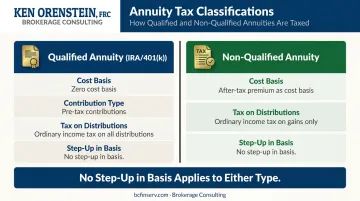
In both cases, no step-up in basis applies at death. The qualified vs. non-qualified distinction affects how much of each distribution is taxable — not whether a step-up is available. It never is.
How Built-In Step-Up Provisions Work in Annuity Contracts
Death Benefit Step-Up
Many variable and fixed indexed annuities include a guaranteed death benefit that resets to the current account value at specified intervals — typically annually. If the contract value grows, the death benefit "steps up" to the new high-water mark.
The practical effect: if a contract worth $200,000 grows to $250,000 and the death benefit resets, then later drops back to $210,000, the beneficiary still receives $250,000. The step-up locked in the peak value.
Per the SEC's guide to variable annuities, this feature is designed specifically to "lock in investment performance" and protect heirs from market declines that occur after the reset date.
Income Base Step-Up (The Ratchet)
Annuities with Guaranteed Lifetime Withdrawal Benefit (GLWB) riders often include an annual reset mechanism — sometimes called a "ratchet" — where the income base steps up to the current account value if markets have performed well.
The income base is the value used to calculate guaranteed lifetime withdrawal amounts, not the actual account value available for surrender. A higher income base means larger guaranteed withdrawals for life. According to the NAIC Buyer's Guide for Fixed Deferred Annuities, these GLWB features guarantee income payments that cannot be outlived, even if the account value eventually reaches zero.
When comparing GLWB riders across carriers, Brokerage Consulting evaluates roll-up rates (commonly 5%, 6%, or 7%, simple or compound), ratchet mechanics, and payout multipliers — since small differences in these terms can produce meaningfully different lifetime income outcomes.
What These Features Cost
Step-up riders are not free. The SEC confirms that stepped-up death benefits and guaranteed minimum income benefits carry additional charges that reduce account value. For variable annuities, these layers add up quickly:
- Base contract charges: Mortality and expense risk (~1.25%/year) plus administrative fees (~0.15%/year)
- Living benefit rider fees: Typically 1.0–1.5% annually on the income base, depending on the carrier and rider terms
Brokerage Consulting's rider analysis weighs these costs against the actual guarantee value for each client — because a rider that looks expensive in isolation may still deliver strong value depending on payout age, health, and income needs.
Which Annuity Types Offer Step-Up Provisions
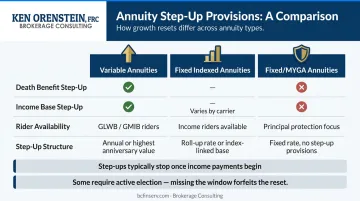
- Variable annuities — most commonly include both death benefit and income step-up riders
- Fixed indexed annuities (FIAs) — may offer income base step-ups; availability varies by carrier
- Fixed/MYGA annuities — generally do not include step-up provisions; designed for principal protection and guaranteed rates, not rider-based guarantees
A few practical caveats apply regardless of annuity type:
- Most step-up provisions stop once income payments begin
- Some require the owner to actively elect the reset — missing an election window can forfeit that step-up permanently
Why Annuities Don't Receive a Step-Up in Cost Basis at Death
How the Rule Works for Other Assets
Under IRC Section 1014(a), when a person dies holding an appreciated asset, the cost basis resets to fair market value at the date of death. A concrete example:
Stock example: You purchase stock for $50,000. At your death, it's worth $200,000. Your heirs inherit with a basis of $200,000. If they sell immediately, they owe zero capital gains tax on the $150,000 of appreciation.
This rule applies to stocks, real estate, mutual funds, and most other investment assets. The estate may owe estate taxes at large enough values, but the income tax on lifetime appreciation is wiped out.
What Happens to a Non-Qualified Annuity at Death
The basis does not reset. Heirs inherit the original owner's cost basis and owe ordinary income tax on all gains above that basis.
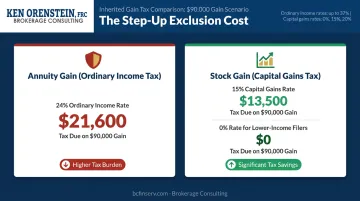
Annuity example: You invest $110,000 in a non-qualified annuity. At your death, it's worth $200,000. Your heirs inherit with a basis of $110,000 — not $200,000. They owe ordinary income tax on $90,000 of gain.
The Double Disadvantage
The tax hit for annuity heirs is worse than it looks, for two reasons:
- Lifetime appreciation remains fully taxable — there's no basis reset as there is with stocks
- Gains are taxed at ordinary income rates — not the lower long-term capital gains rates
For 2026, IRS Rev. Proc. 2025-32 sets ordinary income rates at 10%, 12%, 22%, 24%, 32%, 35%, and 37%. Long-term capital gains rates are 0%, 15%, or 20% depending on income.
A beneficiary in the 24% ordinary income bracket inheriting that $90,000 gain faces a tax bill of roughly $21,600. By contrast, the same gain taxed at the 15% capital gains rate would cost $13,500 — or potentially $0 if their total income fell below the 0% capital gains threshold ($49,450 for single filers in 2026).
The LIFO Rule Makes It Worse
Under IRC Section 72(e)(2), non-annuity distributions from non-qualified annuities are taxed on an income-first basis — gains come out before any return of basis.
Heirs can't recover the original premium tax-free until all accumulated gains have been distributed. Combined with the five-year distribution requirement for most non-spouse beneficiaries (under IRC Section 72(s)), the entire tax liability can be compressed into a short window.
The Impact on Beneficiaries and Estate Planning
Spousal vs. Non-Spouse Beneficiaries
The IRS treats these two categories very differently:
- Surviving spouses can be treated as the contract holder under IRC Section 72(s)(3), continuing the annuity in their own name and deferring taxes further — a continuation right that only spouses receive.
- Non-spouse beneficiaries have no continuation option. Under IRC Section 72(s)(1), the full annuity must be distributed within five years of the owner's death. One exception applies under Section 72(s)(2): if distributions begin within one year of death and are paid over the beneficiary's life expectancy — but the contract must specifically name the beneficiary with that election in place.
The IRMAA and Social Security Ripple Effect
How a beneficiary takes distributions matters beyond just the tax on the gain. Large payouts can push income past key thresholds, triggering two additional costs:
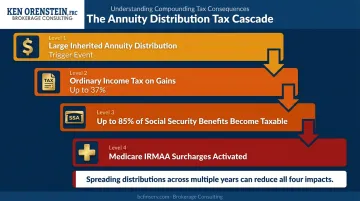
- Social Security taxation: The IRS notes that up to 85% of Social Security benefits may be taxable for single filers with income above $34,000 and joint filers above $44,000 (per IRS guidance and SSA data)
- Medicare IRMAA surcharges: Higher income triggers increased Medicare Part B and Part D premiums; CMS 2026 data confirms these surcharges apply based on income-related monthly adjustment amounts
In a single tax year, one large inherited distribution can increase taxes on the gain, expose Social Security benefits to taxation, and add hundreds of dollars per month in Medicare surcharges. Spreading distributions across years — where the contract and IRS rules allow — can limit this compounding effect.
Strategies to Reduce the Tax Burden on Annuity Gains
Annuitization and the Exclusion Ratio
Converting a non-qualified annuity into a stream of periodic payments (annuitization) spreads the taxable gain across multiple years. Each payment is split between a taxable gain portion and a tax-free return of basis, calculated using the exclusion ratio described in IRS Publication 939.
This approach avoids front-loading a large taxable amount, reduces the risk of bracket creep, and lowers the likelihood of triggering IRMAA surcharges or additional Social Security taxation in any single year.
Systematic Partial Withdrawal Planning
Leaving accumulated gains to compound until death forces heirs to recognize all of it as taxable income, often within five years. Taking planned withdrawals annually while alive — staying within manageable tax brackets — can significantly reduce that inherited tax hit.
This strategy works especially well when the owner is in a lower bracket than heirs are likely to be. Ken Orenstein at Brokerage Consulting incorporates tax-efficient withdrawal sequencing into retirement income planning, coordinating annuity distributions alongside Social Security, FERS pension income, and TSP distributions to minimize lifetime tax exposure for federal retirees with layered income sources.
Charitable Giving Strategies
For owners with significant deferred gains and philanthropic intent, several options can reduce or eliminate the income tax on accumulated gains:
- Naming a charity as beneficiary — Charities, as tax-exempt entities, owe no income tax on IRD assets they receive
- Charitable remainder trusts (CRTs) — The IRS describes CRTs as irrevocable trusts that allow donors to contribute assets to charity while drawing income for life or a term of years
- Charitable gift annuity — Converts an asset into a guaranteed income stream with a charitable component
These strategies require careful legal and tax coordination and are most appropriate for owners with substantial deferred gains and clear charitable intent.
Common Misunderstandings About Annuity Step-Ups
Misunderstanding 1: "Step-Up" Means a Tax Benefit
Many annuity buyers hear "step-up" in a sales context and assume it means heirs will receive the annuity at a reset tax basis — tax-free. That's not what it means.
Annuity step-up provisions are purely contractual. They adjust the death benefit amount or income base calculation — nothing more. The tax step-up in basis that applies to inherited stocks and real estate does not apply to annuities under current U.S. tax law.
Misunderstanding 2: Tax Deferral Equals Tax-Free Inheritance
Some investors assume that because an annuity grows tax-deferred, it must behave like a Roth IRA at death. It doesn't work that way. Tax deferral delays the obligation; it doesn't erase it. Under Rev. Rul. 2005-30, accumulated annuity gains are always taxable to heirs as ordinary income, regardless of how long the money remained inside the contract.
The comparison to Roth IRAs is worth addressing directly:
- Roth IRAs (per IRS Publication 590-B): qualified distributions are excluded from gross income
- Deferred annuities: gains are always taxable as ordinary income at distribution — no equivalent exclusion exists
That distinction matters most at estate planning time, when heirs may face a significant income tax bill on inherited annuity gains they didn't anticipate.
Frequently Asked Questions
Do any annuities have a step-up in basis?
No annuity — qualified or non-qualified — receives a step-up in cost basis at the owner's death under current U.S. tax law. IRC Section 1014(b)(9)(A) explicitly excludes Section 72 annuities, and IRS Rev. Rul. 2005-30 confirms that accumulated gains are IRD taxable as ordinary income to beneficiaries.
Is a step-up in basis good or bad?
For inherited assets like stocks and real estate, a step-up in basis is a significant tax benefit that eliminates capital gains tax on appreciation built during the owner's lifetime. Annuities don't qualify, which typically results in a heavier tax burden for heirs than inheriting other assets of equivalent value.
What is a death benefit step-up in an annuity contract?
A death benefit step-up is a contractual provision in some variable or indexed annuities where the guaranteed death benefit periodically resets to the current account value if it has grown, locking in market gains for the beneficiary. This is a contract feature: it protects the benefit amount but does not change how that benefit is taxed when paid to heirs.
How does the lack of step-up in basis affect annuity beneficiaries?
Beneficiaries who inherit a non-qualified annuity owe ordinary income tax on all gains above the original owner's cost basis. Non-spouse beneficiaries typically must withdraw the full value within five years, concentrating the tax hit into a short timeframe that can push them into higher brackets and trigger IRMAA or Social Security taxation.
Are there strategies to minimize the tax impact when inheriting an annuity?
Yes. Spreading distributions over the allowable period (rather than taking a lump sum) reduces annual taxable income. Some beneficiaries can use the exclusion ratio to recover a portion of the original basis tax-free over time. A tax-aware financial advisor can help you choose the right distribution strategy before you take any withdrawals.
What is the difference between a step-up provision and a step-up in basis for annuities?
A step-up provision within an annuity contract periodically resets the death benefit or income base to a higher value; it's a product feature. A step-up in basis is a tax rule that resets an inherited asset's cost basis at death. Annuities qualify for the first but are explicitly excluded from the second under U.S. tax law.