Picking the wrong tool has real consequences. Rely on a sinking fund logic when you need income distribution, and you may arrive at retirement without the paycheck structure you planned for. Structure a retirement portfolio around income payments when you actually need to accumulate a lump sum, and you'll come up short at the deadline.
This article breaks down both instruments clearly — how each works, when to use one versus the other, and how they fit into a real retirement strategy.
Key Takeaways
- Ordinary annuity: Equal payments made or received at the end of each period — used for loan repayment, pensions, mortgages, and SPIAs
- Sinking fund: Regular deposits into a dedicated account to accumulate a specific lump sum by a target date — for debt retirement or planned large expenses
- The core difference is direction: annuities distribute money over time, while sinking funds build it up
- Both rely on compound interest and fixed payments; the purpose is what separates them
- Most retirement plans eventually use both at different life stages
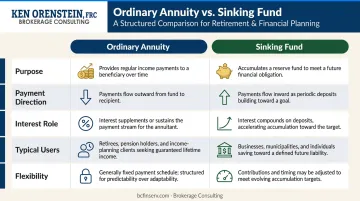
Ordinary Annuity vs. Sinking Fund: A Quick Comparison
The table below highlights the key structural differences at a glance.
| Dimension | Ordinary Annuity | Sinking Fund |
|---|---|---|
| Purpose | Distribute income or repay debt over time | Accumulate a target lump sum by a future date |
| Payment direction | Payments flow to recipient (or from borrower) | Deposits flow into a dedicated savings account |
| Interest role | Determines payment size relative to principal | Grows contributions toward the target balance |
| Typical users | Retirees, homeowners, loan borrowers | Corporations retiring bonds, individuals saving for large expenses |
| Flexibility | Often fixed, tied to a loan or insurance contract | Can be structured independently with variable schedules |
What Is an Ordinary Annuity?
An ordinary annuity is a financial arrangement involving equal payments made or received at the end of each regular period — monthly, quarterly, or annually — over a defined term. That end-of-period timing distinguishes it from an annuity due, where payments occur at the beginning of each period.
Ordinary annuities work in two directions:
- As a payout instrument — A pension, fixed annuity contract, or lottery settlement pays the holder a fixed amount at regular intervals
- As a payment instrument — A mortgage or car loan where the borrower makes equal end-of-period payments covering both interest and principal
How the Math Works
Each payment in an ordinary annuity earns compound interest for the remaining term, so earlier payments accumulate more growth. Consider a straightforward example: depositing $500 per month at 6% annual interest for five years. By the end of year five, the future value of those contributions — with compounding — exceeds a simple $30,000 sum of payments.
That predictable compounding is what makes ordinary annuities practical retirement income tools: the payment schedule is fixed, and the income stream requires no ongoing investment decisions.
Use Cases of an Ordinary Annuity
Retirement income: Federal employees under FERS and CSRS receive monthly pension benefits structured exactly like ordinary annuities — fixed, recurring, paid at the end of each period for life. As of September 30, 2024, OPM reported nearly 2.78 million federal annuitants across CSRS and FERS combined. Beyond federal pensions, 2024 U.S. retail annuity sales reached a record $432.4 billion, reflecting broad demand for guaranteed income products in the private market.
Loan repayment: Mortgages, auto loans, and personal loans are ordinary annuities by design — equal end-of-period payments covering both interest and principal until the balance is retired.
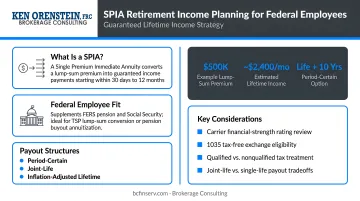
Private annuity products: Single Premium Immediate Annuities (SPIAs) are a textbook ordinary annuity structure. A retiree deposits a lump sum, and the insurance carrier begins making fixed monthly payments — often for life, sometimes with period-certain or joint-life options — within 30 days of purchase. This is particularly useful for retirees who've received a pension buyout, 401(k) rollover, or inheritance and need predictable income immediately.
What Is a Sinking Fund?
A sinking fund is a dedicated account into which an individual or organization makes regular deposits over time, with the goal of accumulating a specific lump sum by a predetermined date. The deposits, combined with the interest they earn, build toward a future target amount.
Two primary uses drive sinking fund adoption:
- Capital savings — Saving toward a large asset purchase: home down payment, equipment, vehicle replacement, or a major tax obligation
- Debt retirement — Accumulating funds to repay bond or loan principal at maturity, a standard practice among corporations and municipalities issuing long-term bonds
Key Structural Points
- Sinking fund deposits are typically made at the end of each period, mirroring the timing structure of an ordinary annuity — with accumulation as the goal rather than income distribution
- Payments are generally rounded up to the nearest cent to ensure the fund reaches at least the required target amount, not one penny short
- Spreading contributions over time, while earning interest, reduces the total out-of-pocket burden compared to saving a lump sum at the deadline
For example: saving $20,000 over three years requires smaller regular deposits than setting aside the full amount at the end. Interest earned along the way does part of the work.
Use Cases of a Sinking Fund
Corporate debt retirement is one of the most common institutional applications. When companies issue bonds, they often establish sinking fund provisions requiring systematic deposits toward the bond's face value before maturity. FINRA notes that these provisions require issuers to retire a portion of bonds periodically — reassuring investors and reducing last-minute refinancing pressure.
Personal financial goals: Individuals commonly use sinking funds for:
- Home down payments with a specific purchase timeline
- Vehicle replacement on a defined schedule
- Large annual expenses like insurance premiums or tax bills
- Business equipment purchases planned 2-5 years out
Understanding how a sinking fund accumulates value over time makes the contrast with an ordinary annuity's distribution structure clearer — both rely on periodic payments, but they serve opposite financial directions.
Which One Fits Your Goals?
The right choice comes down to three questions:
- Are you trying to receive or distribute money over time, or accumulate a specific amount?
- What is your time horizon — and does it end with a lump sum need or an income need?
- Are you managing debt repayment (ordinary annuity) or building toward a future obligation (sinking fund)?
Choose an Ordinary Annuity When:
- You need predictable income in retirement and want payments that arrive on a fixed schedule
- You're repaying a loan — mortgage, auto, personal — on a structured amortization schedule
- You want to convert a lump sum (such as a pension buyout, 401(k) rollover, or inheritance) into regular monthly income
- You are a federal employee transitioning from FERS or CSRS and want supplemental guaranteed income layered on top of your existing pension
Choose a Sinking Fund When:
- You have a known future financial obligation — bond maturity, large purchase, balloon payment — and want to spread contributions over time
- You're a business owner managing long-term debt retirement and need to systematically build principal reserves
- You have disciplined savings goals tied to a specific target amount and deadline, not an ongoing income need
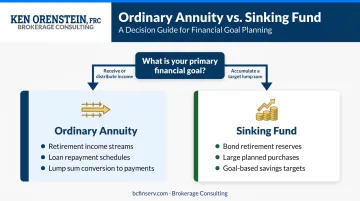
Where They Overlap — and How to Tell Them Apart
Both tools involve fixed periodic payments and compound interest. That overlap trips people up. The clean differentiator: follow the money.
- In an ordinary annuity, money flows out to a recipient (or into a loan payoff) over time
- In a sinking fund, money flows in to a reserve account toward a future target
A comprehensive retirement plan often uses both, at different stages. During working years, a federal employee might run a sinking fund approach to accumulate savings toward a specific goal: supplemental retirement capital, a large purchase, or a lump sum target.
At retirement, that same person may rely on a FERS or CSRS pension, which operates exactly like an ordinary annuity, for monthly income — potentially supplemented by a SPIA or fixed indexed annuity for additional guaranteed cash flow.
Matching the right instrument to the right phase is where planning gets precise. Ken Orenstein at Brokerage Consulting works with federal employees and pre-retirees to map this kind of multi-stage income architecture, identifying which tools belong in accumulation and which belong in distribution, based on each client's timeline, obligations, and income gaps.
Conclusion
Neither ordinary annuities nor sinking funds is universally superior. Ordinary annuities are the right tool when the goal is to receive or disburse a steady income stream over time — think pensions, mortgages, and SPIAs. Sinking funds are the right tool when the goal is disciplined accumulation toward a known future lump sum — think bond retirement provisions and structured personal savings plans.
The most effective retirement strategies incorporate both: a sinking fund mindset during accumulation years and an annuity-based income structure at distribution.
Whether you're a federal employee navigating FERS and CSRS pension decisions, a business managing debt obligations, or an individual saving for a major goal, the instrument has to fit the objective. Using the wrong tool at the wrong life stage is one of the most common — and most correctable — retirement planning mistakes.
To build a retirement income plan that uses the right instruments at the right life stages, schedule a no-cost consultation with Ken Orenstein at Brokerage Consulting — available by phone at (888) 315-3608, virtually, or in person through bcfinserv.com/request-a-quote.
Frequently Asked Questions
What is the difference between an ordinary annuity and a sinking fund?
An ordinary annuity involves equal payments received or made at the end of each period — used to distribute income or repay a loan over time. A sinking fund involves regular deposits made to accumulate a specific lump sum by a future date. The core difference is purpose: distribution or repayment versus targeted accumulation.
Can a sinking fund be used as a retirement savings tool?
Yes, individuals can apply sinking fund logic to save toward a specific retirement target, such as a nest egg amount or a planned large expense. It works best for discrete, goal-driven savings — formal retirement income products like annuities and pensions are structured differently and better suited for ongoing income needs.
What is the difference between an ordinary annuity and an annuity due?
Both involve equal periodic payments, but timing differs. In an ordinary annuity, payments occur at the end of each period. In an annuity due, payments occur at the beginning. That one-period head start produces a slightly higher accumulated value because deposits compound for one additional period.
Is a sinking fund better than an ordinary annuity for paying off debt?
It depends on the debt structure. Sinking funds accumulate a principal lump sum for repayment at maturity, which is common with corporate bonds. Ordinary annuities amortize debt through regular principal-and-interest payments over the loan term — the structure of the obligation dictates which method applies.
What are common examples of ordinary annuities in personal finance?
Typical examples include fixed pension payments, mortgage payments, car loan payments, and fixed annuity contracts from insurance carriers. All share the same structure: equal payments at regular end-of-period intervals over a defined term.
How do interest rates affect ordinary annuities vs. sinking funds?
Higher rates increase the future value of sinking fund deposits, so you can reach the same target with smaller contributions. For ordinary annuities, higher rates mean larger loan payments but higher income payouts on a retirement annuity product. LIMRA reported that lower rates in late 2024 suppressed demand for fixed-rate deferred and income annuity products — a clear example of how rate sensitivity cuts both ways.