
This article covers exactly what a fixed annuity is, how it works across its two core phases, which types are available (including MYGAs), the real trade-offs involved, how fixed annuities stack up against CDs and other retirement options, and who is genuinely well-suited for one.
Key Takeaways
- A fixed annuity guarantees a set interest rate during accumulation and converts into a predictable income stream at retirement
- Growth is tax-deferred — you owe nothing until you withdraw
- Three main types — immediate, deferred, and MYGA — each fit a different retirement timeline
- Trade-offs include surrender charges, limited liquidity, and inflation risk without a rider
- Insurer financial strength backs these guarantees, not FDIC coverage
What Is a Fixed Annuity and How Does It Work?
A fixed annuity is a contract between you and an insurance company. The insurer promises to credit your contributions at a guaranteed interest rate during the accumulation phase, then, when you elect, makes regular payments to you during the payout (distribution) phase.
The Two Core Phases
Accumulation phase: Your premium grows at a locked rate, compounding tax-deferred. You pay no taxes on earnings until you take distributions.
Payout phase: The insurer begins making income payments based on the payout option you selected when the contract was issued. The amount, duration, and structure are defined by the contract.
How Fixed Annuities Are Funded
- Single premium: One lump-sum payment — common for 401(k) or IRA rollovers, pension buyouts, or inherited funds
- Flexible premium: A series of contributions over time, building value gradually before retirement
The Guarantee Behind the Guarantee
The "guaranteed" return in a fixed annuity doesn't come from the federal government. It comes from the insurance company's claims-paying ability. The insurer takes on all investment risk, so your principal and stated interest rate are not exposed to market swings. Before purchasing, check the insurer's financial strength ratings from agencies like AM Best or S&P.
Tax Treatment
That financial stability pairs with a meaningful tax advantage. Earnings inside a fixed annuity accumulate without annual taxation. Withdrawals are taxed as ordinary income to the extent they are taxable. Per IRS Publication 575, early distributions before age 59½ may trigger an additional 10% tax penalty on the taxable portion, on top of regular income tax.
A less obvious benefit: a 1035 tax-free exchange lets you transfer an existing annuity into a new contract without triggering taxes on accumulated gains. This is particularly useful when moving from an older policy with a below-market rate into a current MYGA.
Types of Fixed Annuities: Key Differences to Know
Immediate vs. Deferred Fixed Annuities
Immediate fixed annuities are purchased with a single lump sum and begin income payments within one year of purchase, per NAIC guidelines. Maryland's consumer guide notes a typical window of 1 to 13 months. These work well for retirees who need income now — including federal retirees converting a lump-sum pension distribution into monthly payments.
Deferred fixed annuities involve a waiting period before income begins. Contributions can be a single premium or multiple payments, and the delay allows more time for interest to compound tax-deferred. This makes them better suited for those still several years from retirement.
Multi-Year Guaranteed Annuities (MYGAs)
MYGAs are a specific type of deferred fixed annuity that lock in a guaranteed rate for the entire chosen term — meaning your return is fixed from day one, with no mid-term adjustments regardless of where interest rates move.
Common terms and indicative rates (as of May 2026, per Blueprint Income — rates change frequently and should be verified before purchase):
| Term | Indicative Rate |
|---|---|
| 3-year | 5.85% |
| 5-year | 6.30% |
| 7-year | 6.50% |
MYGAs function like a CD — but with tax-deferred growth and no FDIC coverage. Choosing the right term requires weighing rate differentials against carrier stability. Ken Orenstein at Brokerage Consulting evaluates 3-, 5-, 7-, and 10-year MYGA options across multiple carriers, factoring in financial strength ratings from AM Best, S&P, Moody's, and Fitch alongside the rate before making any recommendation.
Payout Structure Options
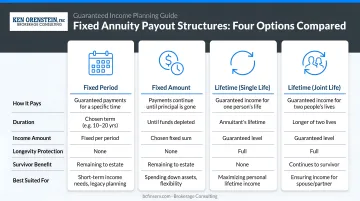
Once a fixed annuity is annuitized, the decision is generally irrevocable. Key options:
- Lifetime (single-life): Payments last as long as you live — addresses longevity risk directly
- Joint-and-survivor: Continues to a surviving spouse, typically at 50%, 75%, or 100% of the original payment
- Fixed-period: Payments end on a set date, regardless of whether you're living
- Guaranteed period with lifetime: Protects beneficiaries if you die early in the payout phase
Fixed Annuity Pros and Cons
Pros of a Fixed Annuity
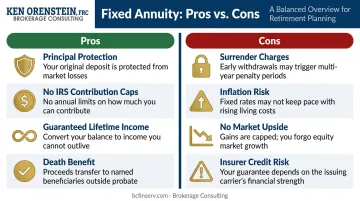
- Principal protection: Market downturns cannot reduce your contract value — the insurer absorbs all investment risk
- No IRS contribution caps: Nonqualified fixed annuities carry no annual contribution limits — unlike IRAs ($7,000 in 2024) or 401(k)/TSP plans ($23,000 plus catch-up), making them useful once you've maxed out other tax-advantaged accounts
- Guaranteed lifetime income: Selecting a lifetime payout option creates income that cannot be outlived, addressing the core longevity concern most pre-retirees carry
- Death benefit: If you die before payouts begin, most contracts pay the accumulated value to named beneficiaries — bypassing probate in many cases
Cons of a Fixed Annuity
- Surrender charges and limited liquidity: Most contracts impose surrender periods of 3–10 years, with early withdrawal charges typically ranging from 5% to 15%. Many contracts allow a 10% annual free withdrawal after year one — but access beyond that threshold is costly
- Inflation risk: Fixed payments don't automatically adjust for rising costs. A payment that covers expenses comfortably today may fall short a decade into retirement. COLA riders are available but reduce the initial payment amount
- No market upside: In a sustained bull market, a fixed annuity won't participate — the tradeoff for guaranteed, predictable returns
- Insurer credit risk: Guarantees rest on the financial health of the issuing company. State guaranty associations provide some backstop — typically $250,000 or more per policyholder per the National Organization of Life & Health Insurance Guaranty Associations (NOLHGA) — but this is not equivalent to FDIC insurance
How Fixed Annuities Compare to Other Retirement Options
Fixed annuities don't exist in a vacuum. Understanding how they stack up against variable annuities, fixed indexed annuities, and CDs helps clarify when a fixed annuity is the right fit — and when another product might serve you better.
Fixed vs. Variable Annuities
The core difference comes down to risk exposure:
- Variable annuities invest premiums in market-linked subaccounts, offering higher growth potential but also the possibility of losing principal
- Fixed annuities carry no market exposure — returns are guaranteed regardless of how markets perform
- Variable annuities are classified as securities, regulated by the SEC and FINRA; fixed annuities are state-regulated insurance products
Fixed vs. Fixed Indexed Annuities (FIAs)
FIAs tie interest credits to an index like the S&P 500, with a floor that prevents loss when markets fall. They offer more growth potential than standard fixed annuities but introduce real complexity: participation rates, caps, spreads, and crediting method choices all affect the actual return.
For clients who want maximum predictability, a fixed annuity is simpler. For those who want a middle ground between guaranteed rates and market participation, an FIA may be worth evaluating.
Fixed Annuities vs. CDs
Both offer guaranteed returns over a set term. But the differences matter:
| Feature | Fixed Annuity / MYGA | Bank CD | |---------|---------------------|---------|| | Guaranteed rate | Yes | Yes | | FDIC-insured | No | Yes (up to $250,000) | | Tax treatment | Tax-deferred until withdrawal | Interest taxed annually | | Lifetime income option | Yes | No | | Liquidity | Surrender charges apply | Early withdrawal penalties vary | | Indicative 5-year rate (May 2026) | ~6.15–6.30% | ~1.34% (FDIC national average) |
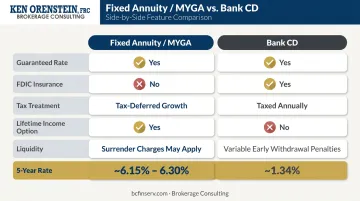
The rate gap currently favors MYGAs considerably, but CDs carry federal deposit insurance that annuities do not. For investors in higher tax brackets, deferring taxes on interest until withdrawal can widen that advantage further — a meaningful consideration when comparing net returns side by side.
Who Should Consider a Fixed Annuity?
Fixed annuities aren't the right fit for everyone. The profile that makes the most sense:
- Risk-averse — prefers certainty over growth potential
- Within 5–15 years of retirement or already retired — enough time for tax deferral to matter, but close enough that capital preservation outweighs growth
- Has maxed out TSP or 401(k) contributions and wants to shelter additional savings from current taxation
- Can leave funds untouched during the surrender period — typically 3–10 years
- Worries about outliving savings — and values the lifetime income option
A Quick Self-Assessment
Before scheduling a consultation, ask yourself:
- Have I maxed out my TSP or 401(k) contributions?
- Do I want guaranteed-return assets alongside market-exposed investments?
- Can I comfortably set aside this portion of savings for the surrender period?
- Am I concerned about outliving my income?
If most answers land on yes, fixed annuities deserve a closer look — especially for federal employees with specific income-layering needs.
A Note for Federal Employees
Federal employees with FERS or CSRS pensions have a solid income foundation, but pension income alone often doesn't fully close the gap between retirement expenses and guaranteed income sources.
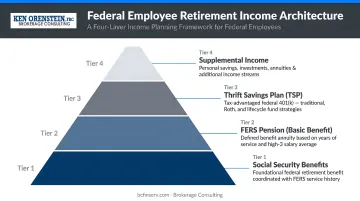
Ken Orenstein at Brokerage Consulting works specifically with federal employees to build what he calls a layered retirement income architecture:
- Social Security
- FERS/CSRS pension
- Guaranteed annuity income
- Discretionary portfolio assets
Fixed annuities and MYGAs slot into Layer 3, providing principal-protected, tax-deferred growth that complements TSP assets without adding market risk.
For federal employees with a TSP lump sum — or those weighing a rollover — TSP-to-annuity rollover analysis is a standard part of the consultation. That includes evaluating whether the broader private IRA universe offers better outcomes than staying within the TSP's limited fund set.
A no-cost consultation is available by phone, virtual meeting, or in-person at (888) 315-3608.
Frequently Asked Questions
What does a fixed annuity provide?
A fixed annuity provides a guaranteed interest rate during the accumulation phase and, when you elect to begin payouts, a predictable income stream that can last for a set period or your entire lifetime. It protects against market volatility and addresses the risk of outliving your savings.
How is a fixed annuity different from a CD?
Both offer fixed, guaranteed returns over a set term, but fixed annuities grow tax-deferred and can provide lifetime income — two features CDs don't offer. CDs carry FDIC insurance up to $250,000; fixed annuities do not. Fixed annuities also typically involve longer commitment periods and surrender charges.
Can you lose money in a fixed annuity?
Principal and guaranteed interest are protected from market loss. However, surrendering the contract early can trigger charges that reduce your net value. In the rare event an insurer becomes insolvent, state guaranty associations provide some coverage — typically $250,000 or more, varying by state.
What happens to a fixed annuity when you die?
If you die before payouts begin, most contracts pay the accumulated contract value to named beneficiaries. Once payouts begin, continuation depends on the option chosen — a guaranteed period option keeps payments flowing to beneficiaries through the end of that term.
Is a fixed annuity a good investment for retirement?
It can be a strong retirement tool for those who prioritize income predictability and principal protection over growth potential. It's not ideal for everyone — liquidity needs, risk tolerance, time horizon, and your overall income picture all matter. A suitability review with a financial advisor helps determine whether it fits your specific retirement plan.
What are typical surrender charges for a fixed annuity?
Surrender periods typically run 3 to 10 years, with charges stepping down each year — a 10-year contract might start at 9% and reach 0% by year 10. Most contracts allow a 10% annual free withdrawal after year one. Schedules vary by carrier and contract.